

|
offered by the United Nations Environment Programme
and the Cologne University of Applied Science
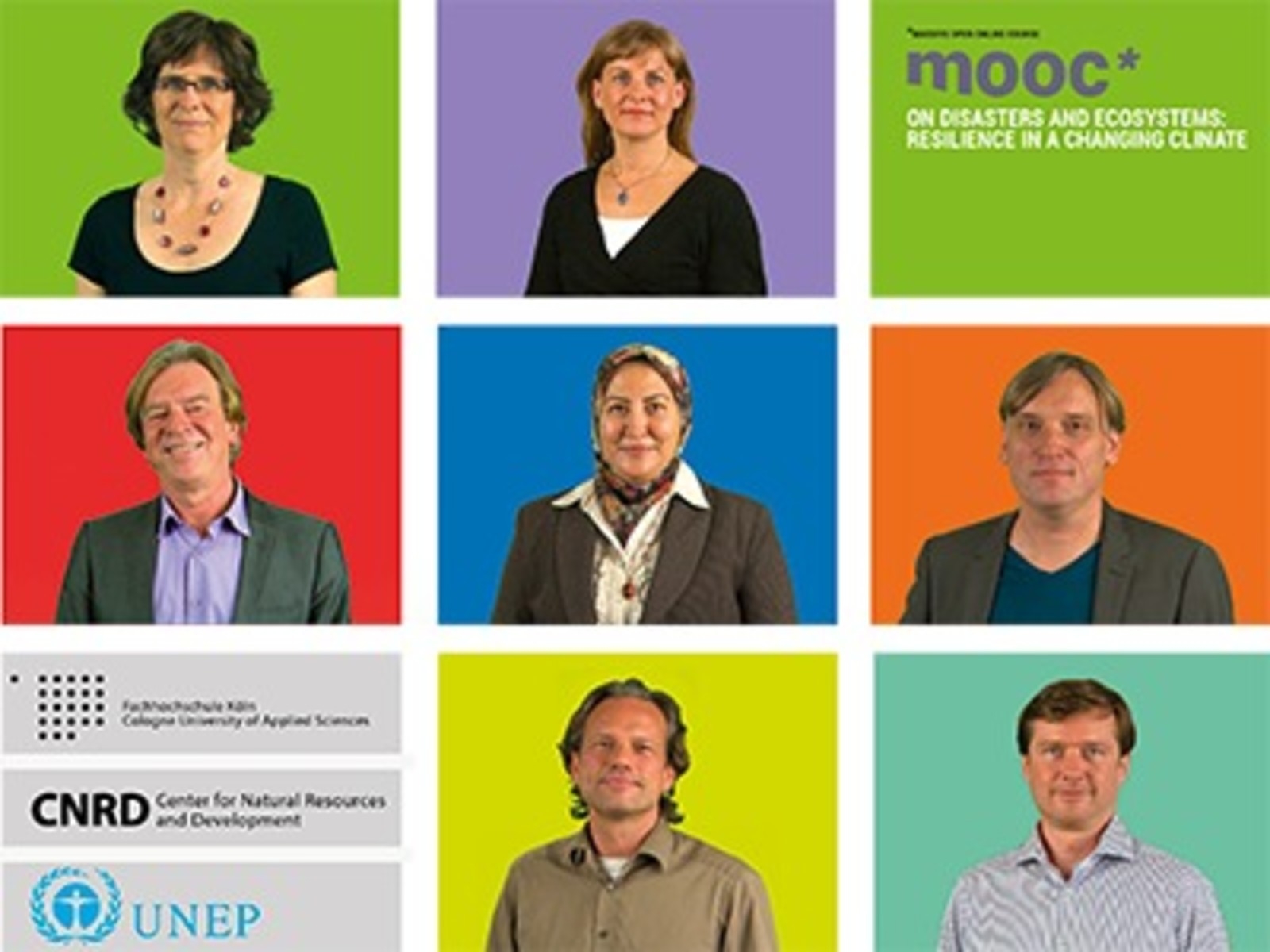
Course SummaryThis MOOC enhances knowledge and skills for tackling complex issues such as resilience and transformation, sustainable development, ecosystem management, disaster risk reduction, climate change adaptation and how they can be operationalized. It will benefit disaster managers and practitioners, climate change adaptation professionals, development planners, project implementers and policy makers. The course will be delivered through a series of lectures and case studies, quizzes, peer-reviewed exercises, along with additional study materials provided to the students. Lectures will be available through videos as well as online documents and will be geared for students who may not have access to high speed internet so they can follow the course. Students will be provided the opportunity to enhance their critical thinking through real life and fictitious problem solving exercises. Each week will feature an international expert who will be available to respond to questions and interact with students. What will I learn?After completion of the course, the participant will be able to:
What do I need to know?There are no prerequisites, just some willingness to learn about this innovative topic! It is however true that it will help if you have heard about disasters and climate change before starting. Course StructureThe course is structured in two parts: The leadership track, which is tailored for busy professionals or students curious about the topic. The leadership track will run three weeks. The expert track is for professionals and students who seek more in-depth learning and skill development in applying ecosystem-based tools for disaster risk reduction and adaptation. The expert track will run 12 weeks with 3 weeks for the final assignment, peer review process and course wrap-up. Each unit has several quizzes, a concise background document for further reading, a discussion forum, supplementary videos with interviews with international experts and short documentary videos from around the world. In addition, world leaders were interviewed for our MOOC. Course Outline and ScheduleChapter 1. Leadership track – introduction (Week 1. Jan 12-18) Chapter 2. Leadership track – linking disasters, climate change and ecosystems, Part 1 (Week 2. Jan 19-25) Chapter 3. Leadership track – disaster management, resilience and ecosystems (Week 3. Jan 26- Feb 1) Chapter 4. Expert track – linking disasters, climate change and ecosystems, Part 2 (Weeks 4&5. Feb 2-15) Chapter 5. Putting theory into practice (Weeks 5 & 6. Feb 16-22) Chapter 6. Ecosystem-based tools for disaster risk reduction – introduction (Week 7. Feb 23-Mar 1) Chapter 7. Most common Eco-DRR tools (Week 8. Mar 2-8) Chapter 8. Most common Eco-DRR tools (Week 9. Mar 9-15) Chapter 9. Economics, valuation and policy issues (Week 10. Mar 16-22) Chapter 10. Resilience and transformation & final assignment (Weeks 11 -13. Mar 23-April 12) Who is teaching this course?Instructors include international faculty members from Germany, Egypt, Austria and Switzerland, supported by a line-up of expert guest lecturers and exclusive interviews with world leaders in the field of climate change, disaster risk reduction and environment: • Dr. Achim Steiner (Executive Director of UNEP) Some FAQsHow much time do I need to put in taking the MOOC?In total, we estimate that a total of 40-50 hours is needed to complete the MOOC (taking both the Leadership and Expert Tracks), which will also depend on your background and English fluency. The MOOC is roughly equivalent to a 1 –week in-class training course. This estimate is based on completing the video lectures, guest video lectures, reading materials and exercises. Will there be exams involved?The Leadership track has quizzes so you can self-check your knowledge level as you go. This is, however, not a precondition for progressing to the next module. And you may, however, choose to revisit a module if you feel you did do not perform satisfactorily in a module. The Expert track has two short peer-reviewed assignments and one final peer-reviewed exercise where you will be designing your own project! The peer reviewed exercises will provide an environment for interaction between course participants. You are welcome to use any other communication tool to facilitate group assignments. What are the interactive features in this MOOC?Iversity has a community discussion forum that will be followed by course instructors and a roster of international “Experts of the week”. The Iversity platform offers all participants the chance to give feedback on the MOOC itself but also to start discussions on any topic related to the MOOC. During the enrolment stage of the MOOC, you will be asked to fill out some basic information about yourself and be invited to actively participate in the community discussion forum. You can also post notices on the MOOC “meeting point” or to join discussions that others have started. There will thus be ample opportunity to connect with other participants for information exchanges In cooperation with the Global Universities Partnership on Environment and Sustainability
and the Center for Natural Resources and Development
Contributions by eye on earth
Supported by the Federal Ministry for Economic Cooperation and Development
exceed - Excellence Centers for Exchange and Development
and the DAAD - German Academic Exchange Service
Categories:
Starts :
2015-01-12 |

|
AlternativesIf you know any alternatives, please let us know. PrerequisitesIf you can suggest any prerequisite, please let us know. | ||





Add to calendar

Let us know when you did the course Disasters and Ecosystems: Resilience in a Changing Climate.

Add the course Disasters and Ecosystems: Resilience in a Changing Climate to My Personal Education Path.
Select what exam to connect to the course. The course will be displayed on the exam page in the list of courses supported for certification with the exam.