

Online courses directory (10358)

There is a constant demand for carpenters in the construction trade. Today, expertise in working with various types of building materials is an indispensable requirement of a carpenter's job. Formwork and joinery are two such areas where skilled carpenters would find themselves working with diverse materials. Formwork involves constructing the forms into which concrete is poured, whereas joinery comprises of working with the wooden parts of a building, such as window frames and doors. Both jobs require further knowledge of working with wood, concrete, and other building materials such as steel reinforcement bars. This free online course will introduce the learner to the basic practices involved in formwork and joinery. The course explains the general types of concrete, concrete mixing information, and the test carried out to measure the workability of fresh concrete. The course also outlines the key components and terms associated with windows, exterior doors, and stairways used in residential construction. This course will be of great interest to all construction professionals who would like to learn more about the carpentry skills involved in finishing and closing off a structure. It will also be of interest to all learners who want to further develop their career in carpentry and the construction trade.<br />

Carrier systems involve the design, operation and management of transportation networks, assets, personnel, freight and passengers. In this course, we will present models and tools for analyzing, optimizing, planning, managing and controlling carrier systems.

This course serves as an introduction to urban form and design, focusing on the physical, historical, and social form of cities. Selected cities are analyzed, drawn, and compared, to develop a working understanding of urban and architectural form. The development of map making and urban representation is discussed, and use of the computer is required. A special focus is placed on the historical development of the selected cities, especially mid-nineteenth and mid-twentieth century periods of expansion. Readings focus on urban design theory in the twentieth century and will be discussed during a weekly seminar on them. This is a methods class for S.M.Arch.S. students in Architecture and Urbanism.

With principles of improvement science as a foundation, new knowledge about the continuous improvement of educational innovations is rapidly emerging among communities of educational professionals and researchers, as they work together in new ways to solve practical problems, improve student performance, and reduce achievement gaps.
Developed in collaboration with the Carnegie Foundation for the Advancement of Teaching, this course will use case studies to take learners deep into the design, organization, and management of three innovative approaches to large-scale, practice-focused continuous improvement that have currency in the US and abroad:
- Design-Based Implementation Research
- Implementation Science
- Networked Improvement Communities
For each case, learners will use logics of innovation to analyze the central strategy of each approach, and they will use principles of improvement science to analyze how each uses disciplined methods to address practical problems faced by teachers and leaders.
This course is part of the Leading Educational Innovation and Improvement MicroMasters Program offered by MichiganX.

TV programs such as "Law and Order" show how forensic experts are called upon to give testimony that often determines the outcome of court cases. Engineers are one class of expert who can help display evidence in a new light to solve cases. In this seminar you will be part of the problem-solving process, working through both previously solved and unsolved cases. Each week we will investigate cases, from the facts that make up each side to the potential evidence we can use as engineers to expose culprits. The cases range from disintegrating airplane engines to gas main explosions to Mafia murders. This seminar will be full of discussions about the cases and creative approaches to reaching the solutions. The approach is hands-on so you will have a chance to participate in the process, not simply study it. Some background reading and oral presentation are required.

We will explain how to start with raw data, and perform the standard processing and normalization steps to get to the point where one can investigate relevant biological questions. Throughout the case studies, we will make use of exploratory plots to get a general overview of the shape of the data and the result of the experiment. We start with RNA-seq data analysis covering basic concepts of RNA-seq and a first look at FASTQ files. We will also go over quality control of FASTQ files; aligning RNA-seq reads; visualizing alignments and move on to analyzing RNA-seq at the gene-level: counting reads in genes; Exploratory Data Analysis and variance stabilization for counts; count-based differential expression; normalization and batch effects. Finally, we cover RNA-seq at the transcript-level: inferring expression of transcripts (i.e. alternative isoforms); differential exon usage. We will learn the basic steps in analyzing DNA methylation data, including reading the raw data, normalization, and finding regions of differential methylation across multiple samples. The course will end with a brief description of the basic steps for analyzing ChIP-seq datasets, from read alignment, to peak calling, and assessing differential binding patterns across multiple samples.
Given the diversity in educational background of our students we have divided the series into seven parts. You can take the entire series or individual courses that interest you. If you are a statistician you should consider skipping the first two or three courses, similarly, if you are biologists you should consider skipping some of the introductory biology lectures. Note that the statistics and programming aspects of the class ramp up in difficulty relatively quickly across the first three courses. By the third course will be teaching advanced statistical concepts such as hierarchical models and by the fourth advanced software engineering skills, such as parallel computing and reproducible research concepts.
These courses make up 2 XSeries and are self-paced:
PH525.1x: Statistics and R for the Life Sciences
PH525.2x: Introduction to Linear Models and Matrix Algebra
PH525.3x: Statistical Inference and Modeling for High-throughput Experiments
PH525.4x: High-Dimensional Data Analysis
PH525.5x: Introduction to Bioconductor: annotation and analysis of genomes and genomic assays
PH525.6x: High-performance computing for reproducible genomics
PH525.7x: Case studies in functional genomics
This class was supported in part by NIH grant R25GM114818.
HarvardX requires individuals who enroll in its courses on edX to abide by the terms of the edX honor code. HarvardX will take appropriate corrective action in response to violations of the edX honor code, which may include dismissal from the HarvardX course; revocation of any certificates received for the HarvardX course; or other remedies as circumstances warrant. No refunds will be issued in the case of corrective action for such violations. Enrollees who are taking HarvardX courses as part of another program will also be governed by the academic policies of those programs.
HarvardX pursues the science of learning. By registering as an online learner in an HX course, you will also participate in research about learning. Read our research statement to learn more.
Harvard University and HarvardX are committed to maintaining a safe and healthy educational and work environment in which no member of the community is excluded from participation in, denied the benefits of, or subjected to discrimination or harassment in our program. All members of the HarvardX community are expected to abide by Harvard policies on nondiscrimination, including sexual harassment, and the edX Terms of Service. If you have any questions or concerns, please contact harvardx@harvard.edu and/or report your experience through the edX contact form.

Learn how advances in biomedicine hold the potential to revolutionize drug development, drug treatments, and disease prevention: where are we now, and what does the future hold? This course is intended for healthcare providers 5+ years out of training--a lot has changed!! Other providers, medical/health sciences students, and members of the public may also be interested.
In the PH525 case studies, we will explore the data analysis of an experimental protocol in depth, using various open source software, including R and Bioconductor. We will explain how to start with raw data, and perform the standard processing and normalization steps to get to the point where one can investigate relevant biological questions. Throughout the case studies, we will make use of exploratory plots to get a general overview of the shape of the data and the result of the experiment.
We will learn the basic steps in analyzing DNA methylation data, including reading the raw data, normalization, and finding regions of differential methylation across multiple samples.
This class was supported in part by NIH grant R25GM114818.
This course is part of a larger set of 8 total courses running Self-Paced through September 15th, 2015:
PH525.1x: Statistics and R for the Life Sciences
PH525.2x: Introduction to Linear Models and Matrix Algebra
PH525.3x: Advanced Statistics for the Life Sciences
PH525.4x: Introduction to Bioconductor
PH525.5x: Case study: RNA-seq data analysis
PH525.6x: Case study: Variant Discovery and Genotyping
PH525.7x: Case study: ChIP-seq data analysis
PH525.8x: Case study: DNA methylation data analysis
HarvardX requires individuals who enroll in its courses on edX to abide by the terms of the edX honor code. HarvardX will take appropriate corrective action in response to violations of the edX honor code, which may include dismissal from the HarvardX course; revocation of any certificates received for the HarvardX course; or other remedies as circumstances warrant. No refunds will be issued in the case of corrective action for such violations. Enrollees who are taking HarvardX courses as part of another program will also be governed by the academic policies of those programs.
HarvardX pursues the science of learning. By registering as an online learner in an HX course, you will also participate in research about learning. Read our research statement to learn more.
Harvard University and HarvardX are committed to maintaining a safe and healthy educational and work environment in which no member of the community is excluded from participation in, denied the benefits of, or subjected to discrimination or harassment in our program. All members of the HarvardX community are expected to abide by Harvard policies on nondiscrimination, including sexual harassment, and the edX Terms of Service. If you have any questions or concerns, please contact harvardx@harvard.edu and/or report your experience through the edX contact form.

Steve Perricone, Co-founder of BioFuelBox, explains how his alternative fuel company solves multiple problems in waste r

Learn to frame and address health-related questions using modern biostatistics ideas and methods.

You wanna learn how to talk in Japanese but don't have material or not know where to start ? start here!

The goal of this class is to prove that category theory is a powerful language for understanding and formalizing common scientific models. The power of the language will be tested by its ability to penetrate into taken-for-granted ideas, either by exposing existing weaknesses or flaws in our understanding, or by highlighting hidden commonalities across scientific fields.

Create Formed Sheetmetal Components Usign CATIA V5 Generative Shape Design

This course provides an introduction to causal and statistical reasoning. After taking this course, students will be better prepared to make rational decisions about their own lives and about matters of social policy. They will be able to assess criticallyeven if informallyclaims that they encounter during discussions or when considering a news article or report. A variety of materials are presented, including Case Studies where students are given the opportunity to examine a causal claim, and the Causality Lab, a virtual environment to simulate the science of causal discovery. Students have frequent opportunities to check their understanding and practice their skills. This course is meant to serve students in several situations. One, it is meant for students who will only take one such research methods course, and are interested in gaining basic skills that will help them to think critically about claims they come across in their daily lives, such as through a news article. Two, it is meant for students who will take a few statistics courses in service of a related field of study. Three, it is meant for students interested in the foundations of quantitative causal models: called Bayes Networks.

The causes and prevention of interstate war are the central topics of this course. The course goal is to discover and assess the means to prevent or control war. Hence we focus on manipulable or controllable war-causes. The topics covered include the dilemmas, misperceptions, crimes and blunders that caused wars of the past; the origins of these and other war-causes; the possible causes of wars of the future; and possible means to prevent such wars, including short-term policy steps and more utopian schemes.
The historical cases covered include the Peloponnesian and Seven Years wars, World War I, World War II, Korea, the Arab-Israel conflict, and the U.S.-Iraq and U.S. al-Queda wars.
This is an undergraduate course, but it is open to graduate students.

What causes armed conflict in the world today? This course examines current thinking on this critical question in world affairs.

This course explores the causes of modern war with a focus on preventable causes. Course readings cover theoretical, historical, and methodological topics. Major theories of war are explored and assessed in the first few weeks of the class, asking at each stage "are these good theories?" and "how could they be tested?" Basic social scientific inference -- what are theories? What are good theories? How should theories be framed and tested? -- and case study methodology are also discussed. The second half of the course explores the history of the outbreak of some major wars. We use these cases as raw material for case studies, asking "if these episodes were the subject of case studies, how should those studies be performed, and what could be learned from them?"

Build your earth science vocabulary and learn about cycles of matter and types of sedimentary rocks through the Education Portal course Earth Science 101: Earth Science. Our series of video lessons and accompanying self-assessment quizzes can help you boost your scientific knowledge ahead of the Excelsior Earth Science exam . This course was designed by experienced educators and examines both science basics, like experimental design and systems of measurement, and more advanced topics, such as analysis of rock deformation and theories of continental drift.

How can we think of culture as a tool for understanding foreign societies?
Why do emerging countries consider cultural values as instrumental in their quest for modernisation?
How can art contribute to a country’s public image?
These are central questions in an increasingly globalised world. Through a case study on global culture, this online course on the first ever award for contemporary art in China aims to address these questions and to find some possible answers.
While working through six chapters, you will receive exclusive reading material, supplementary videos and background information about the developments in the Chinese art scene over the past 40 years, the Chinese Contemporary Art Award established by Mr Uli Sigg as well as the Sigg Collection as part of the newly created M+ museum in Hong Kong.
Moreover, you will gain insights into Chinese contemporary art, first-hand information about the art scene in China, and a wide range of contacts with relevant local and international institutions and actors.
The course is produced by the Centre of Further Education at the Zurich University of the Arts (ZHdK), based on research by IFCAR and presented by Michael Schindhelm on the e-learning platform iversity.org.
–
–
Zurich University of the Arts
Centre of Further Education
Prof. Elisabeth Danuser
–
Target Group
The CCAA online course is tailored to the needs and interests of curators, collectors, art managers, artists, journalists, cultural producers, gallery owners and researchers but equally attractive for curious individuals.
Prerequisites
If you opt for the Certification of Accomplishment track, you must have experience in a cultural or artistic field in order to help shape your personal perspective. Such prior knowledge will help you while completing the assignment and applying models and methods.
With its audit track, the CCAA online course also welcomes curious individuals.
Learning Objectives
In this online course you will learn:

By working through the entire online course, you will acquire the skills and knowledge needed to analyse and navigate the Chinese contemporary art scene.
Course Structure
This online course will be accessible for one year, beginning on April 13, 2016. For the first six weeks, it will be released as a time-based MOOC with a new chapter launched every Wednesday. Later on, it will be available as a self-paced course.
The course includes six chapters:
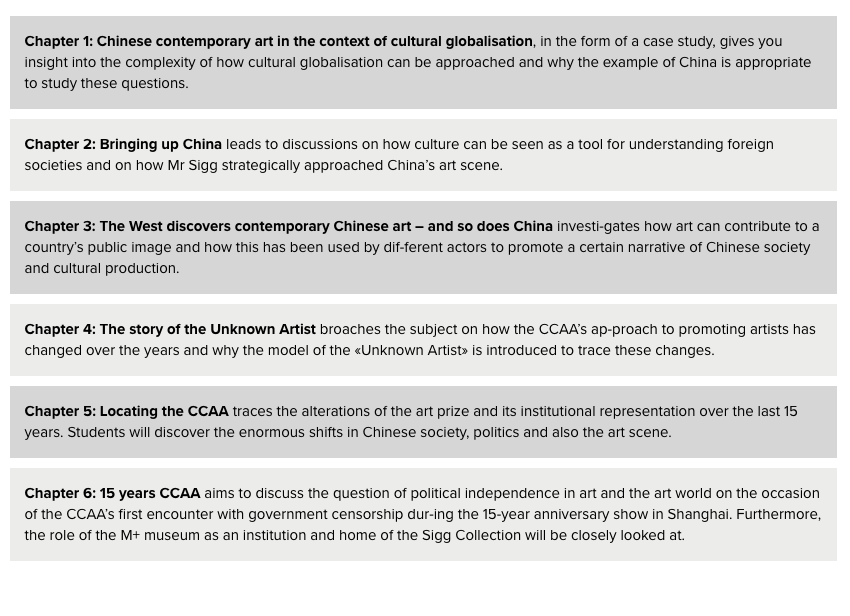
Suggested reading list
- Belting, Hans 2011: Global Studies. Mapping Contemporary Art and Culture. Ostfildern: Hatje Cantz.
- Chiu, Melissa 2008: Chinese Contemporary Art. 7 Things You Should Know. New York: AW Asia.
- Fibicher, Bernhard (ed.) 2005: Mahjong. Contemporary Chinese Art from the Sigg Collection, Ostfildern-Ruit: Hatje Cantz. (exhibition catalogue)
- Goodrow, Gérard A. 2014: Crossing China. Land of the Rising Art Scene. Köln: Daab.
- Schindhelm, Michael et al. 2014: Why Hong Kong. Connecting Spaces Documents # 1, Zurich.
http://issuu.com/connecting_spaces_hk_zh/docs/why_hong_kong_k
- Wu, Hung 2014: Contemporary Chinese Art. A History: 1970s-2000s. London: Thames&Hudson.

How can we think of culture as a tool to understand foreign societies?
Why emerging countries consider cultural values as instrumental in their quest for modernization?
How can art contribute to a country’s public image?
These are central questions in an increasingly globalized world. Through a case study on global culture, this online course on the first ever award for contemporary art in China named CCAA aims to address these questions and identify some possible answers.
While working through six chapters, you will receive exclusive reading material, supplementary videos and background information about the developments in the Chinese art scene of the last 40 years, the Chinese Contemporary Art Award established by Mr Uli Sigg as well as the Sigg Collection as part of the newly created museum M+ in Hong Kong.
Moreover, you get insights into contemporary Chinese art, first-hand information about the art scene in China, and a wide range of contacts with relevant local and international institutions and actors.
What will I learn?
In this online course you will learn about...
- ... the crucial stakeholders, institutions and networks that influence/d Chinese contemporary art.
- ...divergent terminological interpretations in a global context.
- ... how questions can be discussed and approached with the CCAA case study, by applying it to other topics in the field of global culture.
- ... the strategy of running an art award, as used by Uli Sigg to explore and describe the - to him unknown - field of Chinese contemporary art.
- ...the ambivalences of Chinese art historiography and how to build a sensorium for different interest groups and their agendas
- ... a method on how to study cultural milieus with the help of a specific model.
- and finally, you will develop criteria necessary for critically engaging with contemporary Chinese art.
By working through the entire online course, you will acquire the skills and knowledge needed to analyze and navigate the Chinese contemporary art scene.
What do I need to know?
If you opt for the Certification of Accomplishment track, you might have experience in a cultural or artistic field to bring in individual perspectives and your personal expertise. Such prior knowledge will help you while writing the assignment and applying models and methods.
With its audit track, the CCAA online course also welcomes curious individuals.
Course Structure
This online course will be accessible for one year, beginning on April 13, 2016. For the first six weeks, it will be released as a time-based MOOC with a new chapter launched every Wednesday. Later on, it will be available as a self-paced course.
The course includes six chapters:
1 - Chinese contemporary art in the context of cultural globalization
Chapter 1 gives you an insight into the complexity of how cultural globalization can be approached in form of a case study and why the example of China is appropriate to study these questions.
2 - Bringing up China – Uli Sigg, his collection and its internationalization
Chapter 2 «Bringing up China» leads to discussions on how culture can be understood as a tool in order to understand foreign societies and how Mr Sigg strategically approached China’s art scene.
3 - The west discovers contemporary Chinese Art — and so does China
Chapter 3 investigates how art can contribute to a country’s public image and how this has been used by different actors to promote a certain impression of Chinese society and cultural production.
4 - The Story of the Unknown Artist. From mapping the art scene to promoting excellency.
Chapter 4 broaches the subject on how the CCAA’s approach on promoting artists has changed over the years and why the model of the «unknown artist» is introduced to trace these changes.
5 - Locating the CCAA – From letter-box company to multi-purpose centre
Chapter 5 traces back the adaptations of the art prize and its institutional representation over the last 15 years. The learners find out about the enormous shifts in Chinese society, politics and also the art scene.
6 - 15 Years CCAA – Whom does Chinese contemporary art belong to?
Chapter 6 aims to discuss the question of independence in art on the occasion of the CCAA’s first encounter with government censorship during the 15-year anniversary show in Shanghai. Finally, the massive museum project M+ is presented.
The course features two different tracks. The Audit Track is for free and allows learners to get familiar with the subject. The Certificate Track costs €119. To obtain a Certificate of Accomplishment , participants must submit an assignment. The ZHdK Centre of Further Education evaluates assignments four times a year.
Add to calendar

Trusted paper writing service WriteMyPaper.Today will write the papers of any difficulty.