

Online courses directory (10358)

Learn core distributed computing concepts that underlie today’s and tomorrow’s cloud computing systems.

Learn core distributed computing concepts that underlie today’s and tomorrow’s cloud computing systems.

Organizations are increasingly moving their critical information and assets to the cloud. Understand the technology, best practices, and economics of cloud computing, and the rewards and risks of this rush to the cloud.
In this course, part of the Cloud Computing MicroMasters program, you will learn the essentials of cloud computing, including Infrastructure As A Service (IaaS), Platform As A Service (PaaS), Software As A Service (SaaS), and other "X as a service" platforms.
You will explore how the cloud can support businesses by increasing productivity and effectiveness.

As Cloud Computing shapes businesses of all sizes, it is vital to understand the technologies behind cloud infrastructure, both public and private.
In this course, part of the Cloud Computing MicroMasters program, you will learn to evaluate and compare cloud systems, technologies and providers. In doing so, you will build an understanding of the concepts of elasticity and availability through cloud orchestration.
Some industry leading cloud platforms will be covered in this class, including: Amazon Web Services, VMware vSphere, Microsoft Azure, Google Cloud, and OpenStack. You will use the built-in tools and management consoles within those platforms to configure and manage the infrastructure.

The exciting field of Cloud Computing is rapidly changing how businesses operate today. Cloud computing provides rapid access to shared pools of resources, such as: compute, storage, networks, applications, services, or libraries using an on-demand, utility-based model. The characteristics of a cloud computing model include: self-service, network access, resource pools, rapid elasticity, and metered resource usage. As with any large-scale shift, new skills and processes must be learned and implemented to overcome management challenges. Existing business processes, workflows, and policies must be adapted to account for this new technology.
This course, part of the Cloud Computing MicroMasters program, focuses on commonly encountered management issues with the adoption and implementation of cloud computing. Examples include: Cloud migration, Cloud Requests for Proposals, Cloud Service Level Agreements, and other business process compliance issues.
You will examine these issues in depth, then review industry best practices and other case studies to develop the techniques that address and mitigate them. Business processes such as procurement, vendor management, and end-user management are also covered.

How do you protect the critical data that is increasingly being stored in the cloud? Learn how to build a security strategy that keeps data safe and mitigates risk.
In this course, part of the Cloud Computing MicroMasters program, you will be introduced to industry best practices for cloud security and learn how to architect and configure security-related features in a cloud platform. Case studies and government standard documents will be reviewed to help ensure appropriate levels of security are implemented.
You’ll develop the necessary skills to identify possible security issues in the cloud environment. You will also gain experience with tools and techniques that monitor the environment and help prevent security breaches such as monitoring logs and implementing appropriate security policies.

The network is what makes the cloud. The cloud’s key capabilities—the ability to share infrastructure, the ability to move and scale applications across servers, massive parallelism, virtualization, and worldwide connectivity—are all rooted in the network. Learn how it all works!

Learn how to take scattered data and organize it into groups for use in many applications, such as market analysis and biomedical data analysis, or as a pre-processing step for many data mining tasks.

Learn the basics of machining with G-Code.

Around the world, major challenges of our time such as population growth and climate change are being addressed in cities. Here, citizens play an important role amidst governments, companies, NGOs and researchers in creating social, technological and political innovations for achieving sustainability.
Citizens can be co-creators of sustainable cities when they engage in city politics or in the design of the urban environment and its technologies and infrastructure. In addition, citizens influence and are influenced by the technologies and systems that they use every day. Sustainability is thus a result of the interplay between technology, policy and people’s daily lives. Understanding this interplay is essential for creating sustainable cities. In this MOOC, we zoom in on Amsterdam, Beijing, Ho Chi Minh City, Nairobi, Kampala and Suzhou as living labs for exploring the dynamics of co-creation for sustainable cities worldwide. We will address topics such as participative democracy and legitimacy, ICTs and big data, infrastructure and technology, and SMART technologies in daily life.
This global scope will be used to illustrate why specific forms of co-creation are preferred in specific urban contexts. Moreover, we will investigate and compare these cities on three themes that have a vast effect on city life:
- Water and waste
- Energy, air, food and mobility
- Green spaces and food
This MOOC will teach you about the dynamics of co-creation and the key principles of citizens interacting with service providing companies, technology and infrastructure developers, policy makers and researchers. You will gain an understanding of major types of co-creation and their interdependency with their socio-technical and political contexts. You will become equipped to indicate how you can use co-creation to develop innovative technologies, policy arrangements or social practices for a sustainable city in your own community. You will demonstrate this by developing an action plan, research proposal or project idea.
Basic knowledge of sustainability in urban settings, urban environmental technology and urban management is assumed.
This course forms a part of two educational programme of the Amsterdam Institute for Advanced Metropolitan Solutions (AMS) - AMS Vital and Circular city research themes. It is developed by Wageningen UR and TU Delft, two of the founding universities of AMS Institute, and in cooperation with Tsinghua University.
License:
Unless otherwise specified the Course Materials of AMS.URB.2x are Copyright Amsterdam Institute for Advanced Metropolitan Solutions (AMS Institute) and are licensed under a Creative Commons Attribution-NonCommercial-ShareAlike (CC-BY-NC-SA) 4.0 International License.

See how Khan Academy is used in real-life. Covers various models in public, charter, and independent schools as well as community programs with elementary, middle, and high school students. We're excited about the way these schools are using our resources and are eager to learn from more teachers and students. Khan Academy at Eastside College Prep. About Eastside Prep. Khan Academy in Los Altos School District. About LASD. 3rd graders build robots at Santa Rita Elementary School. NPR Story on KA Los Altos Pilots (June 2011). The Gates Notes: Teachers in Los Altos. The Gates Notes: Students in Los Altos. The Gates Notes: Administrators in Los Altos. 6th graders learn to build a Spider robot. Khan Academy at Oakland Unity High School. About Oakland Unity. Khan Academy chats with teachers - Oct 11, 2012. Khan Academy at KIPP. About KIPP. Khan Academy at Summit Prep. About Summit Public Schools. Khan Academy at Eastside College Prep. About Eastside Prep. Khan Academy in Los Altos School District. About LASD. 3rd graders build robots at Santa Rita Elementary School. NPR Story on KA Los Altos Pilots (June 2011). The Gates Notes: Teachers in Los Altos. The Gates Notes: Students in Los Altos. The Gates Notes: Administrators in Los Altos. 6th graders learn to build a Spider robot. Khan Academy at Oakland Unity High School. About Oakland Unity. Khan Academy chats with teachers - Oct 11, 2012. Khan Academy at KIPP. About KIPP. Khan Academy at Summit Prep. About Summit Public Schools.
Learn how Khan Academy is used outside of schools. Community programs ranging from summer and afterschool programs to jails have found benefit in Khan Academy. Take a tour of the Khan Academy site. Afterschool, community, and summer programs. Prisons, jails and correctional facilities. International usage. Offline programs. Take a tour of the Khan Academy site. Afterschool, community, and summer programs. Prisons, jails and correctional facilities. International usage. Offline programs.

Learn how to use Khan Academy in your classroom. Start with the "Quick Start Guide" for 6 steps to get going!. An intro to Khan Academy. Quick start guide. What makes a Khan Academy classroom?. The role of the teacher. The role of the student. Data-driven instruction. Deciding on an implementation model. Using Khan Academy with limited resources. Using Khan Academy in higher education. Creating your account. Getting your class online. How to add a coach on Khan Academy. How to delete a student or class list. Technology set-up and maintenance. Device considerations. FAQs about accounts. Before the first day. First day agenda and materials. Systems and procedures. Engaging parents. Beyond the first day. Finding a place to start. Integrating Khan Academy into curriculum: creating and using playlists. Mapping to standards (including Common Core). Real-life examples of curriculum. Approaches to interactive learning. Classroom culture. Different types of learners. 1-on-1 coaching. Peer-to-peer tutoring. Small group instruction. Projects in a KA classroom. Project resources. Common challenges & possible solutions. Making your classroom more data-driven. Evolving your implementation. Sharing best practices. Share your story with us!. An intro to Khan Academy. Quick start guide. What makes a Khan Academy classroom?. The role of the teacher. The role of the student. Data-driven instruction. Deciding on an implementation model. Using Khan Academy with limited resources. Using Khan Academy in higher education. Creating your account. Getting your class online. How to add a coach on Khan Academy. How to delete a student or class list. Technology set-up and maintenance. Device considerations. FAQs about accounts. Before the first day. First day agenda and materials. Systems and procedures. Engaging parents. Beyond the first day. Finding a place to start. Integrating Khan Academy into curriculum: creating and using playlists. Mapping to standards (including Common Core). Real-life examples of curriculum. Approaches to interactive learning. Classroom culture. Different types of learners. 1-on-1 coaching. Peer-to-peer tutoring. Small group instruction. Projects in a KA classroom. Project resources. Common challenges & possible solutions. Making your classroom more data-driven. Evolving your implementation. Sharing best practices. Share your story with us!.

Overview of how to set up accounts for students under 13 and 13+, how to add a coach on Khan Academy, and how to separate students into class lists. For more information on getting started and technology needs, check out http://www.khanacademy.org/toolkit/getting-started. Creating Khan Academy accounts for users ages 13+. Creating Khan Academy accounts for users under age 13. Adding a coach and creating class lists on Khan Academy. How to delete a student or class list. How to add a coach on Khan Academy.
Overview of how to set up accounts for students under 13 and 13+, how to add a coach on Khan Academy, and how to separate students into class lists. For more information on getting started and technology needs, check out http://www.khanacademy.org/toolkit/getting-started. Creating Khan Academy accounts for users ages 13+. Creating Khan Academy accounts for users under age 13. Adding a coach and creating class lists on Khan Academy. How to delete a student or class list. How to add a coach on Khan Academy. Creating Khan Academy accounts for users ages 13+. Creating Khan Academy accounts for users under age 13. Adding a coach and creating class lists on Khan Academy. How to delete a student or class list. How to add a coach on Khan Academy.
Learn about Khan Academy's vision of a classroom of the future and get an overview of KA resources, including our interactive exercises and coach reports. An intro to Khan Academy. Why use Khan Academy?. Khan Academy Vision. The biggest misconceptions about Khan Academy. Take a tour of the Khan Academy site. Take a tour of our data reports. Take a tour of KA exercises. Take a tour of KA's Computer Science in the classroom. Try it out!. An intro to Khan Academy. Why use Khan Academy?. Khan Academy Vision. The biggest misconceptions about Khan Academy. Take a tour of the Khan Academy site. Take a tour of our data reports. Take a tour of KA exercises. Take a tour of KA's Computer Science in the classroom. Try it out!.
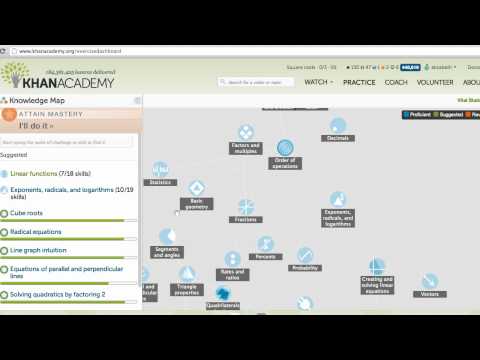
Overview of the videos, exercises, reports, and Computer Science resources available on Khan Academy, with emphasis on how resources can be used in classrooms. For more information, check out http://www.khanacademy.org/toolkit/ka-resources. For a mapping of Khan Academy content to Common Core standards, check out khanacademy.org/commoncore. Khan Academy overview. Khan Academy reports overview. Khan Academy Exercise Overview. Khan Academy Computer Science in the classroom. Khan Academy overview. Khan Academy reports overview. Khan Academy Exercise Overview. Khan Academy Computer Science in the classroom.
Overview of the videos, exercises, reports, and Computer Science resources available on Khan Academy, with emphasis on how resources can be used in classrooms. For more information, check out http://www.khanacademy.org/toolkit/ka-resources. For a mapping of Khan Academy content to Common Core standards, check out khanacademy.org/commoncore. Khan Academy overview. Khan Academy reports overview. Khan Academy Exercise Overview. Khan Academy Computer Science in the classroom.
Answers to teachers' questions about Khan Academy and how it can be used in the classroom. Answers may come from Khan Academy team members and/or teachers who use Khan Academy with their students. Khan Academy chats with teachers - Oct 11, 2012. Khan Academy chats with teachers - Oct 11, 2012.

Overview of some of the ways to use Khan Academy. For more information, including worksheets to help plan the first day and month with Khan Academy, check out http://www.khanacademy.org/toolkit/classroom-uses. . Easiest Way. Station Rotation. Learning Lab. Interactive Classroom. Using class time.
Add to calendar

Trusted paper writing service WriteMyPaper.Today will write the papers of any difficulty.