

Online courses directory (10358)

Since the discovery of the structure of the DNA double helix in 1953 by Watson and Crick, the information on detailed molecular structures of DNA and RNA, namely, the foundation of genetic material, has expanded rapidly. This discovery is the beginning of the "Big Bang" of molecular biology and biotechnology. In this seminar, students discuss, from a historical perspective and current developments, the importance of pursuing the detailed structural basis of genetic materials.

Are you interested in investigating how nature engineers itself? How engineers copy the shapes found in nature ("biomimetics")? This Freshman Seminar investigates why similar shapes occur in so many natural things and how physics changes the shape of nature. Why are things in nature shaped the way they are? How do birds fly? Why do bird nests look the way they do? How do woodpeckers peck? Why can't trees grow taller than they are? Why is grass skinny and hollow? What is the wood science behind musical instruments? Questions such as these are the subject of biomimetic research and they have been the focus of investigation in this course for the past three years.

How to use acrylic paints to make your step into oil painting easier and more rewarding.

Explore this five-unit course and discover a unified framework for understanding the essential physics that govern materials at atomic scales. You’ll then be able to relate these processes to the macroscopic world.
The course starts with an introduction to quantum mechanics and its application to understand the electronic structure of atoms and the nature of the chemical bond. After a brief description of the electronic and atomic structures of molecules and crystals, the course discusses atomic motion in terms of normal modes and phonons, as well as using molecular dynamics simulations.
Finally, principles of statistical mechanics are introduced and used to relate the atomic world to macroscopic properties.
Throughout the course, students will use online simulations in nanoHUB to apply the concepts learned to interesting materials and properties; these simulations will involve density functional theory and molecular dynamics.

In this physics course, you will learn about the structure and function of our universe, from the micro-world of quantum fields and atoms up to the mega-world of stars and galaxies.
You will learn about the objective laws governing the physical world and about methods, provided mainly by physics, which allow us to obtain such knowledge.
This course is taught by the National Research Nuclear University MEPhI, one of the world leaders in nuclear science and education. Our hope is that this course will help boost your curiosity and positively influence or even help to determine your future professional career.
This course is for anyone is who is curious about how our world is constructed and wants to learn more about our universe and the nature surrounding us.
Knowledge of physics and mathematics is NOT required. Basic school level will be quite enough.

A very brief configuration lab introducing Dense, Sparse and SSM modes and configuring Anycast-RP using MSDP.

CCNA, CCNP and CCIE level scenarios and practices

Each part of the world faces specific vulnerabilities to climate change and has different opportunities to mitigate the effects and build resilience in the 21st century. With the Paris Agreement at COP 21, the global community has signaled its intent to act. Indeed, without climate action, decades of development progress are threatened, meaning that we are at a ‘make it or break it’ point in time. This course presents the most recent scientific evidence, regional impacts and climate action strategies, and some opportunities for you to take action on climate change.

Learn about one of the greatest engineering efforts in human history: NASA’s Project Apollo and the space race to put a man on the moon.
Apollo 11 landed on the moon in 1969, just eleven years after the first successful satellite launch (Sputnik in 1957) and forty-three years after Robert Goddard’s launch of the world’s first liquid fueled rocket. But the history of rocket development actually can be traced back more than 2,000 years to the experiments of Archytas, an ancient Greek Philosopher.
This aerospace history course will take you back in time and trace the many developments in technology that transformed rockets from celebratory accouterments to weapons and finally to launchpads for human space travel. It is a story of technology, but ultimately the emphasis on this course is about people. Some are very well-known, but others not so.
You will learn how the Chinese introduced rockets as weapons, how early experimenters succeeded through trial and error, how scientific advancement provided the foundation for rocket development and space travel, and how rocket use spread throughout the world prior to the modern era. Finally, you will be introduced to the contributions of rocket pioneers such as Tsiolkovsky, Oberth and Goddard who dreamed of and paved the way for space travel. The course culminates with an introduction of German rocket development in the early 1930s and the emergence the genius rocket engineer Wehner von Braun.
Verified students are eligible to earn Continuing Education Units (CEUs) and Professional Development Hours (PDHs), valid toward continuing education requirements for many professional certifications.

In this course, we’ll trace the evolution of the rocket, from rudimentary battlefield weapon to essential vehicle in the exploration of space.
Beginning with Germany’s effort to avoid the restrictions of the Treaty of Versailles by developing rockets, you will learn how Wernher von Braun led the German effort during WWII. The course will then follow several parallel paths, including simultaneous rocket development in the US and in the Soviet Union, home of another rocket engineering genius, Sergei Korolev.
The end of WWII saw both the US and Soviet Union in a rush to acquire as much rocket technology as possible. You’ll learn how the Cold War between the US and the Soviet Union drove this development and the roles both von Braun and Korolev played in the creation of these advanced rockets.
The course then traces how von Braun and Korolev led the transformation from rockets of war to rockets for space exploration. Von Braun’s and Korolev’s contributions created the space age.
You will learn how Korolev’s R-7, the world’s first intercontinental ballistic missile became the launch vehicle for the world’s first artificial satellite, Sputnik. And you will learn how in the US, now working with Von Braun, used the Redstone ballistic missile to launch their first satellite, called Explorer.
The course culminates with the formation of NASA and America’s official entry it what would soon be called the “Space Race” between the US and the Soviet Union.

This course introduces concepts, algorithms, programming, theory and design of spatial computing technologies such as global positioning systems (GPS), Google Maps, location-based services and geographic information systems. Learn how to collect, analyze, and visualize your own spatial datasets while avoiding common pitfalls and building better location-aware technologies.

Course Summary
The course examines the major theories of International Relations, the key sub-fields of international politics, and the current practices of global politics.
In the first part, the theories of realism, liberalism, marxism, and constructivism are studied.
In the second part, the key concepts in foreign policy analysis, internetional political economy, and security studies are presented.
In the final part, the course disentagles the context of globalization, the institutional framework of global governance, and the current reality of global politics with its risks and opportunities.
The classes will be integrated with internet hang-outs centered on current events, as well as different kinds of exercises and tests.
What will I learn?
By the end of the course, the student will be able to understand critically international affairs, to analyse major international events, to interpret the position of key international players, and in the ultimate analsysis to play actively the global political game.
What do I need to know?
Basic knowledge of international history and current affairs.
Course Structure
Chapter 1 How to study International Relations (on key methodologies to study international affairs)
- Structure of the course: To dos
- How to explain international phenomena?
- The Westphalian World
- The origin of the discipline: idealism
Chapter 2 Realism (on the principal paradigm of IR theory)
- Anthropology and history
- Four assumptions
- State and Power
- Strategies
- Order
- Institutions and negotiations
- Geopolitics
- Justice
- Conclusions
Chapter 3 Liberalism (on the second major paradigm of IR)
- Introduction to liberalism
- Assumptions
- Democratic Peace Theory
- Interdependence and neo-liberal institutionalism
- International organizations and International regimes
- Global governance
- Integration
- Conclusions
Chapter 4 Marxism and Constructivism (on two important alternative theories)
- Marxism: Class Struggle
- Four Assumptions
- Teoria de la dependencia
- World System theory
- Neo-Gramscian Approaches
- Constructivism: The power of imagination
- Ideas, identities, interests
Chapter 5: Foreign Policy Analysis (on the first sub-field of IR)
- Instruments and determinants of foreign policy
- Models of foreign policy decision-making
Chapter 6: International Political Economy (on the second sub-field of IR)
- Inequality
- The three schools of IPE
- From the embedded liberalism to globalization
Chapter 7: Security studies (on the third sub-field of IR)
- The notion of security
- Security and strategy
- The development of war
- Models of peacebuilding
Chapter 8: Globalization and the context of global politics (on the context of today's politics)
- What is globalization?
- The future of globalization
- Conceptual maps of international affairs
- Future scenarios
Chapter 9 Global Politics (on today's politics)
- The rule of global governance
- Global politics
- Transnational civil society: nature and functions
- Public institutions-civil society interaction
- The Boomerang Effect rivisited
Workload
Approximately 4 hours per week for watching video lectures, taking quizzes and completing homework assignments.
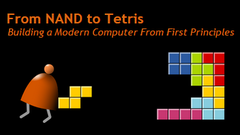
Build a modern computer system, starting from first principles. The course consists of six weekly hands-on projects that take you from constructing elementary logic gates all the way to building a fully functioning general purpose computer. In the process, you will learn -- in the most direct and intimate way -- how computers work, and how they are designed.

The objective of this course is to introduce large-scale atomistic modeling techniques and highlight its importance for solving problems in modern engineering sciences. We demonstrate how atomistic modeling can be used to understand how materials fail under extreme loading, involving unfolding of proteins and propagation of cracks.
This course was featured in an MIT Tech Talk article.

When developing designs, it is important to pick a point of view and consider multiple design options using prototypes. This course will teach you to rapidly instantiate your point of view using multiple prototyping tools, from paper prototypes to the Wizard of Oz method, to test and iterate your ideas quickly. The design strategies you learn in this course will be applicable in a variety of contexts, from services, to interfaces, to products.

How can poor societies become prosperous and overcome obstacles to do so? Professor Sir Paul Collier is one of the world’s leading scholars on this question, and in this economics course you will have the opportunity to learn from him directly.
This course will discuss and examine the following topics:
- The role of government and the key political, social and economic processes that affect development;
- Why societies need polities that are both centralised and inclusive, and the process by which these polities develop;
- The social factors that are necessary for development, including the importance of identities, norms, and narratives;
- The impact of economic processes on development, including discussion about how government policies can either promote or inhibit the exploitation of scale and specialisation;
- The external conditions for development, including trade flows, capital flows, labour flows and international rules for governance.
Enrol in this course to understand the factors that influence economic development and the different development paths that countries across the world have taken.

There has been much discussion in recent years, on this campus and elsewhere, about the death of the book. Digitization and various forms of electronic media, some critics say, are rendering the printed text as obsolete as the writing quill. In this subject, we will examine the claims for and against the demise of the book, but we will also supplement these arguments with an historical perspective they lack: we will examine texts, printing technologies, and reading communities from roughly 1450 to the present. We will begin with the theoretical and historical overviews of Walter Ong and Elizabeth Eisenstein, after which we will study specific cases such as English chapbooks, Inkan knotted and dyed strings, late nineteenth-century recording devices, and newspapers online today. We will also visit a rare book library and make a poster on a hand-set printing press.

Connecting the Washington science standards to the Next Generation Science Standards

This course will cover various topics on the discoveries about how the Universe evolved in 13.7 billion years since the Big Bang.
This course will explore government policies dealing with African-Americans and Native Americans; the rise of big business and urbanization; the second industrial revolution and immigration; U.S. overseas expansion and participation in the First World War; as well as progressivism and the modernist cultures of the 1920s. Full series: U.S. History 1: First Peoples to the Early Republic: Born in Colonialism U.S. History 2: The Civil War Era: Dividing a Nation U.S. History 3: The Gilded Age to the Roaring Twenties: The Emergence of Modern America U.S. History 4: The Great Depression to the War on Terror: Enter the World Stage
Add to calendar

Trusted paper writing service WriteMyPaper.Today will write the papers of any difficulty.