

Online courses directory (10358)

This practicum subject integrates theory and practice through the design, implementation, and evaluation of a comprehensive community information infrastructure that promotes democratic involvement and informs community development projects. Students work with Lawrence Community Works, Inc. to involve constituents and generate solutions to an important planning problem in the City of Lawrence, Massachusetts. Final project presentations take place in a public forum, and serve to inform future development of the information infrastructure. Subject begins with an overview of the digital divide, e-government, public participation GIS, and neighborhood information systems. Subject includes a reflection component and a deliberate investigation of race, class, and gender dynamics.
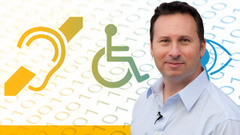
Learn to address Information and Communication Technology (ICT) accessibility in this course covering challenges and strategies for organizations and individuals. Whether corporate, governmental, or nonprofit, this course will enable you to identify ICT accessibility issues, analyze needs, and evaluate solutions for both employees and customers with disabilities.

In this introductory course, learn how to measure an organization’s ICT accessibility and assess the importance of maintaining an inclusive workplace for both employees and customers with disabilities. This six-week course consists of modules detailing some of the primary ICT accessibility obstacles facing organizations today. Each module is taught by a subject matter expert – through content-rich videos, activities, and discussion forums.
Whether you work in the corporate, government or non-profit sector, this course will enable you to identify ICT accessibility issues, analyze specific needs, and evaluate possible solutions. As the world becomes more technology driven, organizations of all sizes and sectors touch ICT accessibility, whether through website design, document creation, or multimedia utilization. Start outlining a plan to establish and maintain an accessible enterprise operation today.
Join our instructors as we explore why, what, and how to integrate accessibility design elements into your ICT organizational roadmap to support equal access for all.
This ICT accessibility course will consist of six modules over a six week term. Each module will consist of multiple video lessons. The lesson videos will include instructional content, resources, demonstrations, guest subject matter experts and personal interviews. There will be at least one weekly activity assignment, two discussion forum question postings and one graded ten question multiple-choice quiz at the end of each module.

This is a discussion-based, interactive seminar on the development of information and communication technology in Sub-Saharan Africa. The students will seek to understand the issues surrounding designing and instituting policy, and explore the possible ways in which they can make an impact on information and communication technology in Africa.
This is a discussion-based, interactive seminar on the development of information and communication technology in Sub-Saharan Africa. The students will seek to understand the issues surrounding designing and instituting policy, and explore the possible ways in which they can make an impact on information and communication technology in Africa.

This is a discussion-based, interactive seminar on the development of information and communication technology in Sub-Saharan Africa. The students will seek to understand the issues surrounding designing and instituting policy, and explore the possible ways in which they can make an impact on information and communication technology in Africa.

This course explores the ultimate limits to communication and computation, with an emphasis on the physical nature of information and information processing. Topics include: information and computation, digital signals, codes and compression, applications such as biological representations of information, logic circuits, computer architectures, and algorithmic information, noise, probability, error correction, reversible and irreversible operations, physics of computation, and quantum computation. The concept of entropy applied to channel capacity and to the second law of thermodynamics.

This freshman course explores the scientific publication cycle, primary vs. secondary sources, and online and in-print bibliographic databases; how to search, find, evaluate, and cite information; indexing and abstracting; using special resources (e.g. patents) and "grey literature" (e.g. technical reports and conference proceedings); conducting Web searches; and constructing literature reviews.
The beginning of the 21st century has been called the Information Age because of rapid increases in information and information resources. Information literacy is now a core competency mandated by higher education accreditation associations for almost all U.S. colleges and universities. It goes far beyond simple web searches and equips students with the research skills necessary to find, evaluate, and appropriately use the types of information required for college level research. This course is geared toward college students, especially those majoring in art and design, but will be useful to anyone who wants to become a more effective searcher. Students will explore the “deep web” (information not found through search engines) and experiment with various search strategies and filtering techniques. Students will also be encouraged to explore resources found in local libraries.

Learn to defend and protect vital company information using the latest technology and defense strategies. Analyze internal and external threats to proactively prevent information attacks. Gain experience by solving real-world problems and leave the class equipped to establish and oversee information security.

Learn to defend and protect vital company information using the latest technology and defense strategies. Explore the latest techniques for securing information and its systems, from policies and procedures to technologies and audit. Learn from leading experts who share proven practices in areas such as mobile workforce safety, security metrics, electronic evidence oversight and coping with e-crime and e-discovery. Study the protection of Cloud computing information. Discover how to foster the development of future information security leaders.

This is the first part of an introductory business information systems series, designed to help you pass the CLEP Information Systems and Computer Applications exam and introduce you to the amazing world of Information Technology.
In this course, you will learn the basic concepts of information systems and their application.

This is the second part of an introductory business information systems series, designed to help you pass the CLEP Information Systems and Computer Applications exam and introduce you to the amazing world of Information Technology
In this course, you will learn the basic concepts of information systems and their application.

This is the third part of an introductory business information systems series, designed to help you pass the CLEP Information Systems and Computer Applications exam and introduce you to the amazing world of Information Technology.
In this course, you will learn the basic concepts of information systems and their application.

This is the fourth part of an introductory business information systems course, designed to help you pass the CLEP Information Systems and Computer Applications exam and introduce you to the amazing world of Information Technology.
In this course, you will learn the basic concepts of information systems and their application.

This is the fifth part of an introductory business information systems series, designed to help you pass the CLEP Information Systems and Computer Applications exam and introduce you to the amazing world of Information Technology.
In this course, you will learn the basic concepts of information systems and their application.

This course explores how information technology is reshaping different dimensions of the U.S. labor market: the way work is organized, the mix of occupations, the skills required to perform in an occupation, economy-wide labor productivity, and the distribution of wages.
This course explores how information technology is reshaping different dimensions of the U.S. labor market: the way work is organized, the mix of occupations, the skills required to perform in an occupation, economy-wide labor productivity, and the distribution of wages.
This course explores how information technology is reshaping different dimensions of the U.S. labor market: the way work is organized, the mix of occupations, the skills required to perform in an occupation, economy-wide labor productivity, and the distribution of wages.

In virtually every industry and every firm, information technology is driving change, creating opportunities and challenges. Leaders who don't understand at least the fundamentals of information systems will be at a strategic disadvantage. This course provides broad coverage of technology concepts and trends underlying current and future developments in information technology, and fundamental principles for the effective use of computer-based information systems. There will be a special emphasis on manufacturing. Information Systems topics that will be covered include networks and distributed computing, including the World Wide Web, hardware and operating systems, software development tools and processes, relational databases, security and cryptography, enterprise applications, B2B, the semantic web and electronic commerce. Sloan LFM students with an interest in Information Systems are encouraged to register for this course.
Add to calendar

Trusted paper writing service WriteMyPaper.Today will write the papers of any difficulty.