

Online courses directory (10358)

This course focuses on the social, political, economic and institutional environment of countries. This environmental context molds the country’s objectives, defines the country’s strategy, programs and policies for achieving objectives, and significantly impacts companies.
The context is affected by historical events, and by the country’s leadership. Many stakeholders shape the environment and the institutions, or “rules of the game”, that affect business. Labor, students, farmers, non-governmental organizations (NGOs) and the military play a crucial role, making the analysis of country environments complex and fascinating.
We will study Japan in some depth, and catch brief glimpses of South Korea, Singapore, Chile, Turkey, India, South Africa and the former Soviet Union, to appreciate the forces that influence diverse country environments, and companies’ strategies.
The course will review aspects of global institutions, such as the World Trade Organization (WTO), which set global rules that profoundly affect business strategy and human welfare. It will also explore opportunities and challenges at the bottom of the pyramid, the last frontier for value creation by companies and NGOs.

Una materia bilingüe (videos y materiales en español e ingles), introduciendo alumnos a los factores sociales, económicos, históricos, y políticos que influyen al entorno global de negocios. A bilingual course (materials and videos in Spanish & English) introducing students to social, economic, political, historical factors that influence the global business environment.

Una materia bilingüe (videos y materiales en español e ingles), introduciendo alumnos a la manera de administrar una organización o empresa en el entorno global de negocios. A bilingual course (materials and videos in Spanish & English) introducing students to how to manage and operate a business or organization in the global business environment.

This course covers, with a focus on both theory and empirics, advanced topics in international trade (as well as inter-regional trade and economic geography.) It includes the study of positive issues, such as: Why do countries trade? What goods do countries trade? What are the implications of openness for the location of production, industries, occupations, and innovative activity? And, what impedes trade and why do some countries deliberately erect policy impediments to trade? The course also concerns normative issues, such as: Is trade openness beneficial to a representative agent? And, are there winners and losers from trade and if so, can we identify them? Throughout, these issues are approached in neoclassical settings as well as those with market failures, at the industry-level as well as the firm-level, and in the presence of both mobile and immobile factors (e.g., FDI, offshoring of tasks, multinational firms and immigration).

This seminar will explore the difficulties of getting agreement on global definitions of sustainability; in particularly building international support for efforts to combat climate change created by greenhouse gas emissions as well as other international resource management efforts. We will focus on possible changes in the way global environmental agreements are formulated and implemented, especially on ways of shifting from the current "pollution control" approach to combating climate change to a more comprehensive strategy for taking advantage of sustainable development opportunities.
This course will explore the different dimensions of sustainability in healthcare and ways to incorporate those ideas into the managerial and quality improvement processes of healthcare organizations. Then it will compare how those issues have been addressed in different healthcare systems around the world. The course will analyze and discuss the key elements of the five pillars of sustainability of healthcare organizations, which are: environmental, socio-cultural, institutional capacity development, financial, and political. We will review critical issues such as recycling medical waste; sustainable energy solutions for hospitals and healthcare organizations in countries with different levels of development; how to improve community health through sustainable healthcare; and many other issues equally relevant to large and small healthcare organizations in developed or developing countries. As the participants review and exchange lessons learned in different corners of the world, they will discover and exchange ideas and tools to assess the sustainability efforts of their organizations and to implement feasible strategies to advance their initiatives.

Human rights are developed through the constant dialogue between international human rights bodies and domestic courts, in a search that crosses geographical, cultural and legal boundaries. The result is a unique human rights grammar, which this course shall discuss and question, examining the sources of human rights, the rights of individuals, the duties of States, and the mechanisms of protection.
We shall rely extensively on comparative material from different jurisdictions, to study a wide range of topics including, religious freedom in multicultural societies, human rights in employment relationships, economic and social rights in development, or human rights in the context of the fight against terrorism.

This course introduces the international and domestic laws, institutions, and legal and political theories that protect basic liberties of all human beings. The course provides an overview of the internal law of human rights and the principal mechanisms and strategies for holding governments accountable for violating those rights.

Armed conflicts have always existed all over the world. Unfortunately, recent events have shown that this phenomenon is becoming increasingly complex, especially with respect to certain legal issues, for instance relating to:
- the definition of armed conflicts when foreign forces are fighting armed groups located in the territory of another State.
- the definition of combatants when terrorists are involved in the hostilities.
- the targeting of certain objects which are used for both military and civilian purposes.
- the detention by rebels of State armed forces.
- the involvement and status of UN peacekeepers involved in combat operations.
- the application of the law of occupation to international organizations.
This law course will help you to understand these complex legal issues by teaching you basic norms governing armed conflicts, also known as ‘International Humanitarian Law’ (‘IHL’). This course provides essential theoretical and practical knowledge for students, researchers and academics who wish to specialize in this field. It is also dedicated to professionals, including members of NGOs, involved in armed conflict situations, or members of armed forces.
Starting with the sources and subjects of IHL, as well as its scope of application, the course will address the main substantive norms of IHL governing: the conduct of hostilities; the protection afforded to persons in the hands of the enemy; occupation; and implementation of IHL.
We will discuss questions such as:
- who and what can be targeted by the enemy.
- which weapons can be used.
- which method of warfare is authorized.
- who enjoys protection and what type of protection.
- which norms apply in non international armed conflicts.
We will also deal with the different ways through which IHL can be implemented and how belligerents may be held accountable for violations of its rules when committing war crimes or crimes against humanity.
These critical issues will be addressed in light of recent practice, including the fight against ISIS and Al-Qaeda in different regions of the world, as well as other recent conflicts such as those occurring in Armenia, Afghanistan, Libya, Mali, RDC, Syria, The Soudan, Ukraine or Yemen. Older ongoing conflicts, such as the Israeli-Palestinian one, will also be addressed.

Are you aware of controversial situations opposing States and foreign investors in relation to the protection of public health and the environment? Do you remember the recent case examples, Philip Morris v Uruguay and Vattenfall v Germany?
In the aftermath of these high profile cases, policy-makers, civil society organizations and domestic constituencies came to realize the societal importance of international investment law. From this realization, came passionate and sometimes ill-informed discussions about the features of international investment law, which grants rights to foreign investors to foster States’ development and reform it. Central to these discussions were the issues of:
- The promotion of sustainable development in international investment law.
- The balance between the protection of foreign investors and the right of host States to regulate to protect public welfare objectives.
- The legitimacy of arbitration tribunals to rule over disputes between host States and foreign investors.
Learning and understanding the features and dynamics of international investment law is not only key for international lawyers, but it is important for being a well-informed citizen.
In this law course, you will:
- Discover the history of international investment law and understand the dynamics shaping its evolution.
- Learn the objectives of international investment law and the specific rights it grants to foreign investors.
- Be able to to evaluate how those rights are interpreted by arbitration tribunals.
- Master the features and functioning of investment arbitration.
- Understand why international investment law and investment arbitration are criticized and be able to assess the soundness of these criticisms.
- Gain insight into the content of treaties newly concluded, for instance the CETA between the European Union and Canada, and be able to assess how they address the issues of the right of States to regulate and of the legitimacy of arbitration tribunals.

Workers’ Rights are Human Rights. International Labour Standards are designed to provide minimum levels of protection every worker should enjoy. They serve as safeguards against exploitative and dangerous working conditions. Reaffirmed by the UN Sustainable Development Goals, fundamental rights and dignity at the workplace are a precondition for building inclusive and sustainable societies. However, making respect for workers’ rights a reality remains a daily struggle for far too many.
This short online course offers a mix of video lectures, readings, discussion questions and self-learning options to provide you with knowledge and practical skills for using International Labour Standards to promote and defend worker’s rights worldwide.
What will I learn
At the end of the course you will understand the concept behind International Labour Standards, as well as their standard setting process at the International Labour Organisation (ILO).
You will have a sound overview on the functioning of the ILO supervisory mechanisms and how you can use them to promote and defend workers’ rights in your country or at the international level. You will also have a good understanding of the fundamentals on Freedom of Association and Collective Bargaining, as well as the right to strike as a key element for realising workers’ rights.
What do I need to know?
No prior knowledge is required.
Course Structure
Chapter 1: Introduction to International Labour Standards (ILS)
What is the concept behind International Labour Standards? Which types of International Labour Standards exist and how are they set? Which actors are involved and how are they interlinked? This chapter provides an overview on International Labour Standards and lays the foundation for understanding the standard setting mechanisms at the ILO. In particular, we have a close look at the role of trade unions in setting International Labour Standards.
Chapter 2: Supervision of International Labour Standards (ILS)
This chapter aims at enabling you to understand and use the ILO supervisory mechanisms for the protection of workers’ rights. The elaborate process is illustrated in a concise and hands-on way, and we take you through it step by step. Again, we pay particular attention to what trade unions can do to make effective use of the ILO supervisory mechanisms.
Chapter 3: Freedom of Association, Collective Bargaining and the right to strike
Freedom of Association and Collective Bargaining are ‘enabling rights’ at the heart of decent work. But what is the legal concept of Freedom of Association under Convention 87 and what makes it fundamental to the implementation of International Labour Standards? This chapter also provides you with an overview on the current debate on the right to strike as a key element of Freedom of Association.
Line-up of contributors
Beatriz Vacotto
- Legal specialist and Coordinator of the Wages, Working Time, Maritime and Specific Workers Team, International Labour Standards Department, ILO
- Main areas of interest: Support to trade unions on issues related to International Labour Standards and the ILO supervisory mechanisms.
Jeffrey Vogt
- Legal Director, International Trade Union Confederation (ITUC)
- Main areas of interest: trade and labour standards, freedom of association, precarious work, comparative labour law
Prof. Dr. Stefanie Lorenzen
- Professor of Employment and Labour Law at the Berlin School of Economics and Law, Department of Business and Economics, Germany
- Author of the video lectures on Freedom of Association and Collective Bargaining of this course
- Main areas of interest: employment law, co-determination, right to collective bargaining, international and European labour law
Prof. Paul Whitehead
- Professor of Practice in Labor Studies and Employment Relations at Penn State University, USA
- Main areas of interest: Trade unions, collective bargaining, labor and employment law, international labor law, international human resources, trade law, and programs for pensions, health care, and social security
Maité Llanos
- International project coordinator, Global Labour University
- Global Labour University Online tutor
Tandiwe Gross
- Associate Expert at the Bureau for Workers’ Activities, ILO
- International coordinator of the Global Labour University’s Online Education Programs

International law can be considered as the law of the international community, the law that governs relations between States. But it also relates to what international organizations do and, increasingly, it concerns individuals, corporations, NGO’s and other non-state actors.
As the world becomes more interdependent and more complex, and as new institutions are put in place to make international law more effective, international law has become an exciting, expanding field. Never before has it been so relied upon, used and developed. Despite their differences in size, power, culture, religion and ideologies, states rely on international law to cooperate and to coexist; they speak the language of international law and international law serves them as an important common language.
This law course will extensively rely on judgments and advisory opinions of the International Court of Justice (ICJ), which is the principal judicial organ of the United Nations (UN).
Having acquired a basic knowledge of international law, you’ll find it easier to comprehend this subject in future international law sub-fields, like international human rights, international humanitarian law or international investment law.
This course will teach you what international law is, the role it plays in the world today, how it can be used. You will also gain knowledge to help you better discern legal arguments within the flow of international news and reports.
This course is part of the International Law MicroMasters Program that is designed to give learners a critical understanding of how international relations between States and individuals are dealt with, regarding the law.
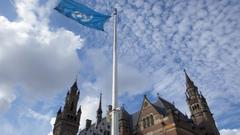
This course is a guide to the international courts and tribunals in The Hague. The Hague is the international judicial capital of the world. It is home to more than half a dozen international courts and tribunals that contribute to international justice. This course maps the unique roles played by these institutions and explains how they promote peace and global justice.

Develop intercultural competences for successfully leading in international environments, and working with diverse international teams.

This is a week long open learning event to engage the teaching community from across the globe to join in designing, sharing, and discussing how to create great learning designs for transforming education...

This course provides an overview of the management challenges international organizations & NGOs are faced with. You will learn key theoretical frameworks and practical tools to excel in this environment.

This graduate class is designed as a Ph.D.-level overview of international political economy (IPE), with an emphasis on the advanced industrial countries. It also serves as preparation for the IPE portion of the International Relations general exam. An important goal of the course is to use economic theories to identify the welfare effects, distributional consequences, and security implication of foreign economic policy decisions, and to use the tools of political science to analyze how interest groups, voters, political parties, electoral institutions, ideas, and power politics interact to share policy outcomes.

This course examines the interconnections of international politics and climate change. Beginning with an analysis of the strategic and environmental legacies of the 20th Century, it explores the politicization of the natural environment, the role of science in this process, and the gradual shifts in political concerns to incorporate "nature". Two general thrusts of climate-politics connections are pursued, namely those related to (a) conflict – focusing on threats to security due to environmental dislocations and (b) cooperation – focusing on the politics of international treaties that have contributed to emergent processes for global accord in response to evidence of climate change. The course concludes by addressing the question of: "What Next?"
This course examines the interconnections of international politics and climate change. Beginning with an analysis of the strategic and environmental legacies of the 20th Century, it explores the politicization of the natural environment, the role of science in this process, and the gradual shifts in political concerns to incorporate "nature". Two general thrusts of climate-politics connections are pursued, namely those related to (a) conflict – focusing on threats to security due to environmental dislocations and (b) cooperation – focusing on the politics of international treaties that have contributed to emergent processes for global accord in response to evidence of climate change. The course concludes by addressing the question of: "What Next?"

This course is divided into three parts. First, you’ll learn how the Chinese World Order emerged in the ancient world, focusing on the concept of the "heavenly mandate" (天命) as the ultimate source of political power (1 module). You’ll also learn how the Chinese World Order expanded into the relationship between China and surrounding political entities (1 module) and several challenges when the Qing (淸) Empire replaced the Ming (明) Empire.
Second, this course will review how China tried to project its world order into the relationship with Korea and Korea came to be integrated into the Chinese World Order from the 14th century to the 18th century (4 modules). More specifically, it will show how China intervened in the interstate trade and Korean music.
Finally, it will compare the two trajectories of political thoughts between Korea and Japan since 17th century. Korea fantasized itself as the genuine heir and center of the Chinese World Order, closing its door to foreigners. Meanwhile, Japan overcame the Chinese World Order and eventually converted itself as a modern state (1 module).
The working language is Korean with English subtitles.
Add to calendar

Trusted paper writing service WriteMyPaper.Today will write the papers of any difficulty.