

Online courses directory (10358)
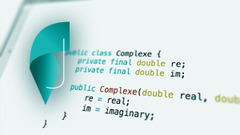
Ce cours introduit la programmation orientée objet en l'illustrant en langage Java. Il présuppose connues les bases de la programmation (variables, types, boucles, fonctions, ...). Il est conçu comme la suite du cours «Initiation à la programmation (en Java)».

Le cours expose la théorie de Galois, du classique critère de non-résolubilité des équations polynomiales aux méthodes plus avancées de calcul de groupes de Galois par réduction modulo un nombre premier.

Ce module se base essentiellement sur les principes décrit dans le Guide du Corpus des Connaissances en Management de Projet (Guide PMBOK*) du PMI (Projet Management Institute).<br />Le « Project Management Body of Knowledge » est un ouvrage de référence en gestion de projet, édité par le Project Management Institute (PMI). Sa 4ème édition est un standard reconnu internationalement qui fournit les fondamentaux du management de projet s'appliquant à une large portée de projets.<br />

Ce cours propose une introduction à la protection internationale des droits de l’homme. Il en présente les sources, les catégories, le contenu et les limites qui leur sont opposables, ainsi que les obligations qu’ils génèrent à la charge des Etats. Il expose aussi les principaux mécanismes de mise en œuvre prévus au niveau universel et régional pour assurer leur respect.

3D modeling and animation have transformed numerous fields, including filmmaking, computer games, architecture and product design. Yet the underlying basis of high-quality 3D production originates in traditional design and animation methodologies. This course provides an introduction to the exciting world of 3D content creation, while emphasizing its connection to the creative thought process. Students will learn an overview of the artist workflow as it relates to modeling, texturing, animation, lighting and rendering. This course offers a new dimension to the process of filmmaking and design.

Learn Ableton Live’s most powerful tools and how to use them to take your musical ideas from conception to final recording.

Everyone does accounting of some kind, such as browsing bank statements, preparing a budget for building a house, or counting the cost of a birthday party. Individuals who want to be accountants, managers or entrepreneurs should be able work with financial reports.
This accounting course will give you an overview of business organizations and describes the role accounting plays in managing them. You’ll learn about the effect of common business transactions on financial statements, how to apply the double-entry system for processing transactions and the principles of measuring performance and the related mechanics. At the end of this course, you will know how to prepare financial statements.

Learn about acoustics and sound fields by using the concept of impedance. We will start with the fundamental concept of one-dimensional cases, understand the essentials, and also cover extended topics.

Learn about acoustics by using the concept of impedance. Following part 1, radiation, scattering, and diffraction are studied. Wave propagation in closed space is also covered. Leads to understand essentials as well to cover graduate level topics.

Actuary is rated the best job of 2015 by CareerCast.com because it pays well and offers abundant opportunities for advancement.
You may have heard of actuarial science, or you might even know an actuary, but do you know what an actuary does? During the course you’ll hear from a wide variety of actuaries about their careers.
And don’t be scared that the course will be “just a whole lot of mathematics”. Together, we will go beyond the math to learn how actuaries approach problems relating to risk, using examples from:
- Finance
- Investments
- Banking
- Insurance
You will learn how actuarial science applies mathematical and statistical methods to assess risk in these industries and other professions.
You’ll experience “hands-on” learning using Excel (or an equivalent spreadsheet tool) to project and investigate the financial condition of a company choosing appropriate strategies for the company through the use of simulations.
The course has been carefully designed for students from a wide variety of backgrounds, with secondary/high school level being the only assumption of mathematical background. Even if you don’t have any background in, for example, calculus, the course has been designed so you can skip over these sections without affecting your understanding of the rest of the course. You also do not need to have any Excel or other spreadsheet background to take the course.
For those with stronger mathematical backgrounds, extension questions are provided to test you further. You’ll learn a huge amount about actuarial science no matter what your background is!
Join us today. To connect with the course community before and during the course, join our Facebook group, and tweet us with #actuarialedX.
"Great introduction to this specialized field; every day there are new challenges where as a student you are put in a situation to learn and apply the lessons with practical exercises. Great structure of the course, with main concepts to review at the end of a lesson. I would recommend to anyone who would like to learn more about actuarial science." - Previous student

This aerodynamics course focuses on the study of the flow of air about a body, and the “body” will be an airplane, but many of the concepts explored are relevant to a wide variety of applications from sailboats to automobiles to birds. Learners completing this aerodynamics course will gain a fundamental understanding of concepts and models used to aerodynamically analyze and design subsonic, transonic, and supersonic aircraft.
While the course is an introduction to aerodynamics, it is an advanced subject typically taken as a third or fourth year undergraduate subject in aerospace engineering.

This course provides an overview of and introduction to the fundamentals of aeronautics, using the history of aviation as a story line. The course uses examples from the very beginning of aviation (the Montgolfier brothers’ balloon flight in 1783 and the Wright brothers’ heavier-than-air flight in 1903) and continues all the way through to the current Airbus A380 and future aircraft. During this trajectory three major topics are discussed: aeronautics, aerodynamics and flight mechanics.
Lectures are frequently accompanied by related exercises and demonstrations. The course also incorporates (design) challenges/competitions, based on the knowledge obtained through the lectures.
LICENSE
The course materials of this course are Copyright Delft University of Technology and are licensed under a Creative Commons Attribution-NonCommercial-ShareAlike (CC-BY-NC-SA) 4.0 International License.

Great course for those who are interested in learning about the Fundamentals of Aerospace Engineering

The fundamental concepts, and approaches of aerospace engineering, are highlighted through lectures on aeronautics, astronautics, and design. Active learning aerospace modules make use of information technology. Student teams are immersed in a hands-on, lighter-than-air (LTA) vehicle design project, where they design, build, and fly radio-controlled LTA vehicles. The connections between theory and practice are realized in the design exercises. Required design reviews precede the LTA race competition. The performance, weight, and principal characteristics of the LTA vehicles are estimated and illustrated using physics, mathematics, and chemistry known to freshmen, the emphasis being on the application of this knowledge to aerospace engineering and design rather than on exposure to new science and mathematics.

Spaceflight is exciting, and you don’t have to be a “Rocket Scientist” to share in the excitement! 16.00x makes the basics of spaceflight accessible to everyone. Join MIT Professor Jeffrey Hoffman, a former NASA astronaut who made five spaceflights and was the first astronaut to log 1000 hours on the Space Shuttle, as he teaches you the core principles behind space travel and exploration. The course will cover how rockets work, how spacecraft move in orbit, how we create artificial environments inside spacecraft to keep astronauts alive and healthy, what it’s like living in a world without gravity, how the human body adapts to space, and how spacewalks happen, plus more. Many lessons will be illustrated with Professor Hoffman’s own experiences in space.
Advanced Notice of a Future Spaceflight Course
Students who are interested in taking more online space-related courses should be aware that Professor Hoffman will be presenting a new online course in the fall of 2018 about “Systems Engineering and the Space Shuttle”. 16.00x is good preparation for this new course.

We live in a world of numbers. You see them every day: on clocks, in the stock market, in sports, and all over the news. Algebra is all about figuring out the numbers you don't see. You might know how fast you can throw a ball, but can you use this number to determine how far you can throw it? You might keep track of stock prices, but how can you figure out how much money you've made (or lost) in the market? And you may already know how to tell time, but can you calculate at what times a clock's hour and minute hands are exactly aligned? With algebra, you can answer all of these questions, using the numbers you already know to solve for the unknown. Algebra is an essential tool for all of high school and college-level math, science, and engineering. So if you're starting out in one of these fields and you haven't yet mastered algebra, then this is the course for you!
In this course, you'll be able to choose your own path within each lesson, and you can jump between lessons to quickly review earlier material. AlgebraX covers a standard curriculum in high school Algebra I, and CCSS (common core) alignment is indicated where applicable.
Learn more about our High School and AP* Exam Preparation Courses

This course provides an introduction to mathematical modeling of computational problems. It covers the common algorithms, algorithmic paradigms, and data structures used to solve these problems. The course emphasizes the relationship between algorithms and programming, and introduces basic performance measures and analysis techniques for these problems.

The free online course Introduction to Alternative Dispute Resolution describes the benefits of using ADR as a conflict resolution method, how to prepare for an ADR process, and how confidentiality is maintained during the ADR process. The course also outlines both the common and uncommon methods of ADR and the situations in which each method can be used.<br /><br />The course begins by introducing you to what alternative dispute resolution is. You will learn about when ADR is used and why it is important to understand the ADR process. You will learn about the reasons why ADR should be chosen as a resolution method and the seven principles for resolving disputes. You will learn how to prepare for ADR and about what is expected in an ADR process, with suggestions for getting the most out of the ADR process. This section concludes by explaining the role of ADR practitioners, including what to expect from your ADR practitioner, questions you may want to ask your ADR practitioner, and how to give feedback about your ADR practitioner.<br /><br />The course then introduces you to the most common methods of ADR – Negotiation, Mediation, and Arbitration. This section explains each of these methods in detail by including various features of each such as the cost, the benefits and drawbacks associated with each method, and when each method may be used. This section also describes other less common methods of ADR that some people adopt and how they are used. This section concludes by explaining public policy, legislation, and ADR and how the introduction of new laws could ensure equality in an ADR process.<br /><br />This free course will be of great interest to all professionals who are working in both the public and private sectors, and who are involved in conflict analysis, and management and resolution processes. It will also be of interest to learners who want to study mediation and other non-adversarial dispute and conflict resolution processes. <br />

This course provides a substantive overview of U.S. politics and an introduction to the discipline of political science. It surveys the institutional foundations of U.S. politics as well as the activities of political elites, organizations, and ordinary citizens. It also explores the application of general political science concepts and analytic frameworks to specific episodes and phenomena in U.S. politics.

Analysis I (18.100) in its various versions covers fundamentals of mathematical analysis: continuity, differentiability, some form of the Riemann integral, sequences and series of numbers and functions, uniform convergence with applications to interchange of limit operations, some point-set topology, including some work in Euclidean n-space.
MIT students may choose to take one of three versions of 18.100: Option A (18.100A) chooses less abstract definitions and proofs, and gives applications where possible. Option B (18.100B) is more demanding and for students with more mathematical maturity; it places more emphasis from the beginning on point-set topology and n-space, whereas Option A is concerned primarily with analysis on the real line, saving for the last weeks work in 2-space (the plane) and its point-set topology. Option C (18.100C) is a 15-unit variant of Option B, with further instruction and practice in written and oral communication.
Add to calendar

Trusted paper writing service WriteMyPaper.Today will write the papers of any difficulty.