

Online courses directory (10358)

Traditionally, progress in electronics has been driven by miniaturization. But as electronic devices approach the molecular scale, classical models for device behavior must be abandoned. To prepare for the next generation of electronic devices, this class teaches the theory of current, voltage and resistance from atoms up. To describe electrons at the nanoscale, we will begin with an introduction to the principles of quantum mechanics, including quantization, the wave-particle duality, wavefunctions and Schrödinger's equation. Then we will consider the electronic properties of molecules, carbon nanotubes and crystals, including energy band formation and the origin of metals, insulators and semiconductors. Electron conduction will be taught beginning with ballistic transport and concluding with a derivation of Ohm's law. We will then compare ballistic to bulk MOSFETs. The class will conclude with a discussion of possible fundamental limits to computation.
Traditionally, progress in electronics has been driven by miniaturization. But as electronic devices approach the molecular scale, classical models for device behavior must be abandoned. To prepare for the next generation of electronic devices, this class teaches the theory of current, voltage and resistance from atoms up. To describe electrons at the nanoscale, we will begin with an introduction to the principles of quantum mechanics, including quantization, the wave-particle duality, wavefunctions and Schrödinger's equation. Then we will consider the electronic properties of molecules, carbon nanotubes and crystals, including energy band formation and the origin of metals, insulators and semiconductors. Electron conduction will be taught beginning with ballistic transport and concluding with a derivation of Ohm's law. We will then compare ballistic to bulk MOSFETs. The class will conclude with a discussion of possible fundamental limits to computation.
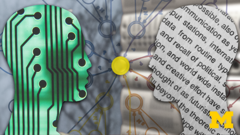
This course provides an introduction to the field of Natural Language Processing, including topics like Language Models, Parsing, Semantics, Question Answering, and Sentiment Analysis.

This course explores the organization of synaptic connectivity as the basis of neural computation and learning. Perceptrons and dynamical theories of recurrent networks including amplifiers, attractors, and hybrid computation are covered. Additional topics include backpropagation and Hebbian learning, as well as models of perception, motor control, memory, and neural development.

This subject will be an intensive introduction to neuroanatomy, involving lectures, demonstrations, and hands-on laboratories, including a brain dissection. The course will not assume any prior knowledge of neuroanatomy, though some general knowledge of brain structures will be helpful.

Economics, psychology, and neuroscience are converging today into a unified discipline of Neuroeconomics with the ultimate aim of providing a single, general theory of human decision making. Neuroeconomics provides economists, psychologists and social scientists with a deeper understanding of how they make their own decisions, and how others decide.

This course is an introduction to the mammalian nervous system, with emphasis on the structure and function of the human brain. Topics include the function of nerve cells, sensory systems, control of movement, learning and memory, and diseases of the brain.

The course will span modern neuroscience from molecular neurobiology to perception and cognition, including the following major topics: anatomy and development of the brain; cell biology of neurons and glia; ion channels and electrical signaling; synaptic transmission, integration, and chemical systems of the brain; sensory systems, from transduction to perception; motor systems; and higher brain functions dealing with memory, language, and affective disorders.

HTML 5 is the latest version of the HyperText Mark-Up Language. HTML is the language of choice for structuring and presenting content for the World Wide Web. In this free online course you will learn about the latest features of HTML 5 including Geolocation, video, Web worker, canvas/SVG, app cache and database. This course will be of great interest to professionals in the areas of Web design and development and to learners who want to gain a greater knowledge and understanding of HTML 5.<br />

The phenomenology and experimental foundations of particle and nuclear physics are explored in this course. Emphasis is on the fundamental forces and particles, as well as composites.

Course on Basics of Nuclear Power Generation, Nuclear Fission, Nuclear Power Plants and Nuclear Thermodynamics Principle

This course provides an introduction to nuclear science and its engineering applications. It describes basic nuclear models, radioactivity, nuclear reactions and kinematics; covers the interaction of ionizing radiation with matter, with an emphasis on radiation detection, radiation shielding, and radiation effects on human health; and presents energy systems based on fission and fusion nuclear reactions, as well as industrial and medical applications of nuclear science.

This course analyzed the basic techniques for the efficient numerical solution of problems in science and engineering. Topics spanned root finding, interpolation, approximation of functions, integration, differential equations, direct and iterative methods in linear algebra.

This course is offered to undergraduates and introduces students to the formulation, methodology, and techniques for numerical solution of engineering problems. Topics covered include: fundamental principles of digital computing and the implications for algorithm accuracy and stability, error propagation and stability, the solution of systems of linear equations, including direct and iterative techniques, roots of equations and systems of equations, numerical interpolation, differentiation and integration, fundamentals of finite-difference solutions to ordinary differential equations, and error and convergence analysis. The subject is taught the first half of the term.
This subject was originally offered in Course 13 (Department of Ocean Engineering) as 13.002J. In 2005, ocean engineering became part of Course 2 (Department of Mechanical Engineering), and this subject was renumbered 2.993J.

This course offers an advanced introduction to numerical linear algebra. Topics include direct and iterative methods for linear systems, eigenvalue decompositions and QR/SVD factorizations, stability and accuracy of numerical algorithms, the IEEE floating point standard, sparse and structured matrices, preconditioning, linear algebra software. Problem sets require some knowledge of MATLAB®.
This course offers an advanced introduction to numerical linear algebra. Topics include direct and iterative methods for linear systems, eigenvalue decompositions and QR/SVD factorizations, stability and accuracy of numerical algorithms, the IEEE floating point standard, sparse and structured matrices, preconditioning, linear algebra software. Problem sets require some knowledge of MATLAB®.

Most mathematical models of science and engineering problems cannot be solved exactly or they take too long to solve exactly. Learn how to solve the models approximately.

Learn how to find approximate solutions to mathematical models that cannot be solved exactly or need a long time to find an exact solution.

6.336J is an introduction to computational techniques for the simulation of a large variety of engineering and physical systems. Applications are drawn from aerospace, mechanical, electrical, chemical and biological engineering, and materials science. Topics include: mathematical formulations; network problems; sparse direct and iterative matrix solution techniques; Newton methods for nonlinear problems; discretization methods for ordinary, time-periodic and partial differential equations, fast methods for partial differential and integral equations, techniques for dynamical system model reduction and approaches for molecular dynamics.
This course was also taught as part of the Singapore-MIT Alliance (SMA) programme as course number SMA 5211 (Introduction to Numerical Simulation).

Considering a career in nursing? This course will introduce you to the role of nurses in Australian healthcare.
Add to calendar

Trusted paper writing service WriteMyPaper.Today will write the papers of any difficulty.