

Online courses directory (10358)
Great leaders are made, not born. Whether you’re a student, an individual contributor, a recent manager just starting to lead others, an experienced mid-level manager, or someone passionate about making an impact on your community, you too can benefit from leadership development! LeaderMOOC builds on the latest research from the Center for Creative Leadership on the “fundamental four” leadership capabilities needed for success: self-awareness, learning agility, influence, and communication. Participants will vote on one additional area they would like to explore. The emphasis throughout is “leadership for real,” so rather than taking an academic approach, the course allows participants to discover, for each topic, something essential about their own leadership strengths and challenges, as well as how to translate these insights into real situations in the workplace and community.

This course uses the fictionalized story of Jim Barton as the CEO of a manufacturing company (first published in the book Harder Than I Thought and now dramatized in this course) to examine important issues in 21st century leadership.

Successful entrepreneurs need more than business ideas, they need to be good leaders. This free online course from ALISON reviews the essential leadership skills an entrepreneur or business person needs. These skills include the knowledge and understanding of how to organise your company, how to select your business team, how to manage your business team, and how you should behave as a business professional. All great entrepreneurs and business people gain this knowledge and understanding early in their career and by studying this course you can gain the knowledge and understanding to acquire these skills also.

Successful entrepreneurs need more than business ideas, they need to be good leaders. This free online course from ALISON reviews the essential leadership skills an entrepreneur or business person needs. These skills include the knowledge and understanding of how to organise your company, how to select your business team, how to manage your business team, and how you should behave as a business professional. All great entrepreneurs and business people gain this knowledge and understanding early in their career and by studying this course you can gain the knowledge and understanding to acquire these skills also. <br />

This course explores how we use story to articulate ethical norms. The syllabus consists of short fiction, novels, plays, feature films and some non-fiction. Major topics include leadership and authority, professionalism, the nature of ethical standards, social enterprise, and questions of gender, cultural and individual identity, and work / life balance. Materials vary from year to year, but past readings have included work by Robert Bolt, Michael Frayn, Timothy Mo, Wole Soyinka, H. D. Thoreau, and others; films have included Crouching Tiger, Hidden Dragon, Hotel Rwanda, The Descendants, Motorcycle Diaries, Three Kings, and others. Draws on various professions and national cultures, and is run as a series of moderated discussions, with students centrally engaged in the teaching process.

In this class you will be creating a leadership development tool for students like yourselves in the leadership program at Sloan. This tool might be a coaching guide for second-year pilots, a leadership workbook for MBA students to use during their summer employment, a leadership assessment for club presidents or a workshop on networking. You will be free to choose the tool that you want to develop, but by the end of the class there must be a product that can be used at Sloan. In addition, the tools must link in some way to the leadership model used at Sloan.

Combining leadership, management & entrepreneurship skills, discover the 21 Principles of 21st Century Leadership.

This course examines recent research to uncover the practical actions anyone can take to be a successful leader.

Want to explore ambitious teaching and how collaboration between students and teachers can lead to deeper learning and the development of 21st-century skills?
This course is developed in partnership with Microsoft as part of the Microsoft K-12 Education Leadership initiative, which aims to help K-12 school leaders drive the pursuit of ambitious instruction in classrooms.
Beyond the straightforward transfer of facts and skills, ambitious instruction has teachers and students making meaning of rich academic content, engaging authentic practical and intellectual puzzles, and creating new knowledge and capabilities in themselves and others. Globally, ambitious instruction sits at the very center of policy-driven educational improvement efforts, with schools and systems pressed to engage students in "deeper learning" and the development of "21st-century skills."
This course is both for individual leaders and for teams of leaders from a school, district/region, or system who aim to improve educational opportunities and outcomes for students, especially those historically underserved by public schools. For these teams, the course will function as a platform both for initiating their joint practice and for collaborating on issues that arise in their joint practice.
Students will explore:
- The meaning and practice of ambitious instruction.
- The use of technology in ambitious instruction.
- Systemic supports for ambitious instruction.
- The practice of leading transformative change.
This course is part of the Leading Educational Innovation and Improvement MicroMasters Program offered by MichiganX.

“Leading Change: Go Beyond Gamification with Gameful Learning” instructs school leaders and teachers on tools and strategies to support gameful learning in schools.
Developed in partnership with Microsoft, this education course aims to transform teaching and learning at all levels through explorations of how the features that make video games great learning environments can be used in formal learning environments to increase learner engagement on a local, regional and global scale. By creating classroom learning environments that support learners’ senses of autonomy, competence and relatedness, school leaders are able to promote actively engaged and resilient learning.
Gameful learning is a new way to conceive curriculum and assessment that provides concrete support for personalizing learning for every student. You will learn to design gameful learning environments and apply a systematic framework that leads to enhanced intrinsic motivation and engagement for students.
This course has been funded by Microsoft and is part of the Microsoft K-12 Education Leadership initiative developed to provide resources to K-12 school leaders around the world as they address the unique needs of their schools in a changing educational and technology landscape.

This capstone course will feature knowledge, disposition, and performance assessments that examine growth along dimensions critical to the effective leadership of educational innovation and improvement.
Learners will apply knowledge and principles of ambitious instruction, logics of innovation, improvement science, and exemplary cases to case studies of large-scale, practice-focused innovation. In doing so, they will identify and explain strengths in these innovations. They will also identify problems and challenges faced by these initiatives and, then, propose means of organizing and managing in response to those problems and challenges.
This course is part of the Leading Educational Innovation and Improvement MicroMasters Program offered by MichiganX.

Gain the leadership skills highly valued and needed to perform in the digital age with practical tools to use in real time, using workplace challenges you are currently experiencing.
This course, part of the Digital Leadership MicroMasters program, begins with a focus on the trends of the digital age and how they shape your industry, your organization and your career no matter what job or sector you work. We then focus on the capabilities needed to both successfully grow your own career and effectively lead individuals, teams and organizations.
Using current workplace challenges you will learn how to work within the digital age: developing unique skills to execute and innovate, build trust, lead virtual teams, collaborate, negotiate and managing conflict, adapt and learn from experience, and drive continuous change.
You will learn about and practice skills such as:
- leveraging a network of relationships;
- using conflict to drive creativity;
- working across boundaries;
- coming to a common core purpose across competing agendas and metrics;
- leading change through experimentation and implementation.
No previous courses in leadership or organization behavior are required. We will begin the journey from where you are and will use innovative cases, assessments, simulations, etc. Leadership is fun and so is the process we use to advance your capabilities.
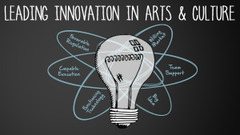
Developed by David Owens at Vanderbilt University and customized for the cultural sector with National Arts Strategies, this course will help arts and culture leaders create an environment where new ideas are constantly created, shared, evaluated and the best ones are successfully put to work.

Through lectures, discussions, and class exercises, 15.322 analyzes the human processes underlying organizational behavior and change. The class makes students aware of the challenge of organizational change and equips them to better handle it. There are many psychological and sociological phenomena that regularly occur in organizations, though many of these forces are difficult to see. The aim is to increase the students' understanding of these forces – in themselves and in others – so they become more visible and manageable. The prerequisite for this course is 15.321, Leading Organizations I.

Improve your ability to manage creativity and to lead an innovation strategy in businesses, schools, hospitals, governments, and other complex organizations and institutions, by diagnosing likely innovation failures before they occur.

What does it take to inspire others, promote a novel idea, or even have a difficult conversation? How can you position yourself as a leader through inclusive communication? How do you know that the message you are intending to send is what is being received? Join Catalyst experts to explore this topic and the important role communication plays in inclusive leadership.
All too often, we struggle to communicate effectively—particularly with others who are different from us in some way. This course will show you how the most effective communication utilizes the inclusive leadership mindset of Empowerment, Accountability, Courage, and Humility and guide you on how to use that mindset yourself. Through research and real-world examples, you will learn strategies to enhance your communication skills and approach. Topics will include understanding dialogue processes, debunking everyday communication myths, testing assumptions, listening, expressing yourself authentically, and communicating across differences. With short quizzes, compelling case studies, and engaging videos, you will develop knowledge in each section and share your experience with other learners.
Throughout the course, you will create a plan of action to help apply the strategies learned in this course to your work and other parts of your life.

Use data to build a better startup faster in partnership with Geckoboard

Jumpstart Your First Business Model With This FREE 5-part Course

Este curso contiene un subconjunto de material en español del curso 16.660J (en Inglés). Para la versión en Inglés, por favor vea 16.660J Introduction to Lean Six Sigma Methods January IAP 2012.
El programa presenta los fundamentos del pensamiento Lean a través de conceptos y herramientas prácticas y aplicables. Este curso cubre los principios fundamentales, prácticas y herramientas de una empresa Lean, incluyendo Lean Six Sigma y otros métodos de enfoques modernos para la productividad organizacional. El curso incluye ejemplos y ejercicios aplicados en la industria aeroespacial, automotriz, servicios de salud y otros sectores. La metodología es altamente interactiva con simulaciones y ejercicios orientados hacia el aprendizaje de conceptos aplicados en experiencias grupales, incluyendo una simulación Lego®, tour virtual a fábricas, charlas de expertos entre otros. Este curso fue ofrecido en la Pontificia Universidad Católica de Chile a través del Centro de Excelencia en Gestión de Producción (GEPUC) de 17 a 19 abril, 2013.
 | MIT Professional EducationConecta A Los Profesionales Con Conocimiento Y Expertise Avanzado A Traves De Entrenamiento Y Capacitacion Los cursos y programas ofrecidos por MIT Professional Education son diseñados por expertos de MIT para conectar a profesionales de la industria con los últimos avances tecnológicos y de conocimiento. La inmersión en un intenso ambiente de aprendizaje permite a profesionales alrededor del mundo la oportunidad de acceder a información crucial para nutrir sus carreras, generar un mayor desarrollo empresarial e impactar al mundo. Nuestros programas le entregan a los participantes acceso inigualable a los mayores expertos de cada área. Esta experiencia de aprendizaje altamente focalizada les permite acceder a tópicos de interés vital y compartir con expertos reconocidos a nivel mundial además de incorporarse a una red internacional de colegas talentosos. Para mayor información acerca de los programas de MIT Professional Education favor visitar: http://professionaleducation.mit.edu. |

By Sasha Dichter and Bob Dorf
Add to calendar

Trusted paper writing service WriteMyPaper.Today will write the papers of any difficulty.