

Online courses directory (10358)

If you're only working to serve someone else, stop. Only when you're following your true passions - in the cas

When putting together a team, Fern Mandelbaum, Partner at Monitor Venture Partners, focuses on the CEO. She looks for so

A series of interactive learning modules designed to help users acquire, develop, and refine effective written communication skills.

In the information age, data is all around us. Within this data are answers to compelling questions across many societal domains (politics, business, science, etc.). But if you had access to a large dataset, would you be able to find the answers you seek?
This course, part of the Data Science MicroMasters program, will introduce you to a collection of powerful, open-source, tools needed to analyze data and to conduct data science. Specifically, you’ll learn how to use:
- python
- jupyter notebooks
- pandas
- numpy
- matplotlib
- git
- and many other tools.
You will learn these tools all within the context of solving compelling data science problems.
After completing this course, you’ll be able to find answers within large datasets by using python tools to import data, explore it, analyze it, learn from it, visualize it, and ultimately generate easily sharable reports.
By learning these skills, you’ll also become a member of a world-wide community which seeks to build data science tools, explore public datasets, and discuss evidence-based findings. Last but not least, this course will provide you with the foundation you need to succeed in later courses in the Data Science MicroMasters program.
This class provides an introduction to the Python programming language and the iPython notebook. This is the third course in the Genomic Big Data Science Specialization from Johns Hopkins University.

This is a course to teach basic Python programming skills through data analysis. The book and course materials are all free and licensed as Creative Commons. There is no complex math in...
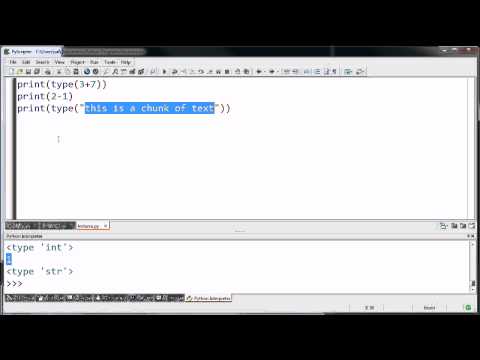
Introduction to programming and computer science. Introduction to Programs Data Types and Variables. Binary Numbers. Python Lists. For Loops in Python. While Loops in Python. Fun with Strings. Writing a Simple Factorial Program. (Python 2). Stepping Through the Factorial Program. Flowchart for the Factorial Program. Python 3 Not Backwards Compatible with Python 2. Defining a Factorial Function. Diagramming What Happens with a Function Call. Recursive Factorial Function. Comparing Iterative and Recursive Factorial Functions. Exercise - Write a Fibonacci Function. Iterative Fibonacci Function Example. Stepping Through Iterative Fibonacci Function. Recursive Fibonacci Example. Stepping Through Recursive Fibonacci Function. Exercise - Write a Sorting Function. Insertion Sort Algorithm. Insertion Sort in Python. Stepping Through Insertion Sort Function. Simpler Insertion Sort Function. Introduction to Programs Data Types and Variables. Binary Numbers. Python Lists. For Loops in Python. While Loops in Python. Fun with Strings. Writing a Simple Factorial Program. (Python 2). Stepping Through the Factorial Program. Flowchart for the Factorial Program. Python 3 Not Backwards Compatible with Python 2. Defining a Factorial Function. Diagramming What Happens with a Function Call. Recursive Factorial Function. Comparing Iterative and Recursive Factorial Functions. Exercise - Write a Fibonacci Function. Iterative Fibonacci Function Example. Stepping Through Iterative Fibonacci Function. Recursive Fibonacci Example. Stepping Through Recursive Fibonacci Function. Exercise - Write a Sorting Function. Insertion Sort Algorithm. Insertion Sort in Python. Stepping Through Insertion Sort Function. Simpler Insertion Sort Function.
In this free online course Python Programming - Working with Complex Decisions and Events you will learn about creating and using if statements, and checking multiple conditions using elif statements. You will also learn about creating and using for loops and while loops, and the mistakes that can happen when creating and using loops.<br /><br />The course begins by introducing you to if statements which are used to check conditions and make decisions with your code. You will learn about the constraints when checking your if statements, different ways to write an if statement and using the else statement for when the if statement in not true. You will learn about adding an if statement to check multiple conditions with the elif statement. You will also learn how to order elif and if statements for your code to work correctly, and how to combine conditions with the logic operators and & or.<br /><br />Next, you will learn about loops and how to create a for loop. You will learn about nesting loops in loops and using a variable as the condition in the loop. You will learn about accessing the loop values and manually assigning values for each step in the loop. <br /><br />Finally, you will learn about creating and constructing while loops. You will learn about how a while loop functions. You will learn the difference between using a for and while loop as well as mistakes that can happen when you use loops in your code.<br /><br />This free Alison course will be of great interest to those learners who wish to get started in programming and improve their ability to write programs using the Python programming language.<br /><br />Prerequisites: You should have completed the previous two courses on programming with Python: 'Programming Concepts with Python' and 'Python Programming - Working with Numbers, Dates and Time'.<br />
In this free online course Python Programming - Working with Functions and Handling Errors you will learn about functions, how to create your own functions and how to use them. You will also learn about errors that can occur in your code. You will learn about using the try/ except statement to handle potential errors.<br /><br />The course begins by introducing you to functions and you will learn how to create your own functions and how to pass parameters into your functions.<br /><br />Next, you will learn about what type of errors you can get and about different methods for handling errors. You will learn about using the try/except statement to test pieces of code that may cause an error.<br /><br />This free Alison course will be of great interest to those learners who wish to get started in programming and improve their ability to write programs using the Python programming language.<br /><br />Prerequisites: You will need to have completed the previous courses on programming with Python: 'Programming Concepts with Python', 'Python Programming - Working with Numbers, Dates and Time', 'Python Programming - Working with Complex Decisions and Events' and 'Python Programming - Working with Lists and Files'.<br />
In this free online course Python Programming - Working with Lists and Files you will learn about creating and modifying lists, creating files and saving data to those files. You will also learn about reading data form files along with what csv files are and getting data from them.<br /><br />The course begins by introducing you to lists. You will learn about creating lists, both empty lists and lists with values in them. You will learn about how to add data to your lists, updating and deleting items on your list, and searching through your lists.<br /><br />Next, you will learn how to create a file with your code, and how to write data to your file. You will learn how to close the file after your code is finished using it. You will also learn what csv files are, and the process of opening and reading data from files. You will learn about importing the csv library to help with reading data from csv files, and about taking the data from your csv file and putting it in a list.<br /><br />This free Alison course will be of great interest to those learners who wish to get started in programming and improve their ability to write programs using the Python programming language.<br /><br />Perquisites: Your will need to have completed the previous courses on programming with Python: 'Programming Concepts with Python', 'Python Programming - Working with Numbers, Dates and Time' and 'Python Programming Working with Complex Decisions and Events'.
In this free online course Python Programming - Working with Numbers, Dates and Time you will introduced to mathematical operations, converting variable types and using dates in and time in your code.<br /><br />The course begins by introducing you to storing numeric variables in your code. You learn about the difference between creating a numeric variable compared to creating a string. You will learn about preforming mathematical operations in your code, and formatting your numbers and printing them on screen. You will also learn about getting the user to input numbers and converting that input to work with your numeric variables and mathematical operations. <br /><br />Next, you will learn about working with dates and time. You will learn about importing libraries into your project so you can use their functions and methods. You will learn about obtaining and displaying today's date. You will learn how to format your dates and the different date formats to display the dates. You will learn about the functions which are included in the Datetime library and converting user input to a date format. You will learn about working with time and how it uses many of the same functions dates would but with specific parameters for time.<br /><br />This free Alison course will be of great interest to those learners who wish to get started in programming and improve their ability to write programs using the Python programming language.<br /><br />Prerequisites: You should have completed previous course in this series: Introduction to Programming with Python.

A first programming course in Python suitable for any age and/or experience level.

A free course to support python programming. Get a paid and full version for more !

An accessible but substantial introduction to quantum mechanics for anyone with a reasonable college-level understanding of physical science or engineering.

Starting from a basic knowledge of quantum mechanics, this course shows how to use and understand it in a broad range of modern applications.
Learn about the qualitative approach to the social and behavioral sciences, using qualitative methods of inquiry and analysis. Learn to evaluate qualitative research and how to collect qualitative data and perform qualitative analyses yourself.

This course is intended for graduate students planning to conduct qualitative research in a variety of different settings. Its topics include: Case studies, interviews, documentary evidence, participant observation, and survey research. The primary goal of this course is to assist students in preparing their (Masters and PhD) dissertation proposals.

Essential Tools & Techniques for Project Managers

Cities are becoming the predominant living and working environment of humanity, and for this reason, livability or quality of life in the city has become crucial.
This urban planning course will focus on four areas that directly affect livability in a city: Urban energy, urban climate, urban ecology and urban mobility. The course begins by presenting measurable criteria for the assessment of livability, and how to positively influence the design of cities towards greater livability. We will focus on this basic topic of the human habitat in a holistic way, and introduce possibilities of participatory urban design by citizens, leading towards the development of a citizen design science.
You will be able to share your experiences with the other participants in the course and also with the experts from the teaching team. In completing this course, you will better understand how to make a city more livable by going beyond the physical appearance and by focusing on different properties and impact factors of the urban system.
Livability in Future Cities is the second course in a series of MOOCs under the title “Future Cities.” This series aims to bring the latest research on planning, managing and transforming cities to places where this knowledge has the highest benefit for its citizens. “Future Cities” provided an overview, and this course will focus on livability in existing and new cities.

The ability to quantify the uncertainty in our models of nature is fundamental to many inference problems in Science and Engineering. In this course, we study advanced methods to represent, sample, update and propagate uncertainty. This is a "hands on" course: Methodology will be coupled with applications. The course will include lectures, invited talks, discussions, reviews and projects and will meet once a week to discuss a method and its applications.
Add to calendar

Trusted paper writing service WriteMyPaper.Today will write the papers of any difficulty.