

Online courses directory (10358)

A conceptual and interpretive public health approach to some of the most commonly used methods from basic statistics.
A practical and example filled tour of simple and multiple regression techniques (linear, logistic, and Cox PH) for estimation, adjustment and prediction.

This course provides an introduction to the physical chemistry of biological systems. Topics include: connection of macroscopic thermodynamic properties to microscopic molecular properties using statistical mechanics, chemical potentials, equilibrium states, binding cooperativity, behavior of macromolecules in solution and at interfaces, and solvation. Example problems include protein structure, genomic analysis, single molecule biomechanics, and biomaterials.

This course explores the theory of self-assembly in surfactant-water (micellar) and surfactant-water-oil (micro-emulsion) systems. It also introduces the theory of polymer solutions, as well as scattering techniques, light, x-ray, and neutron scattering applied to studies of the structure and dynamics of complex liquids, and modern theory of the liquid state relevant to structured (supramolecular) liquids.
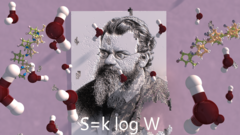
Thermodynamics explains phenomena we observe in the natural world and is the cornerstone of all of engineering. You're going to learn about thermodynamics from a molecular picture where we'll combine theory with a wide range of practical applications and examples. The principles you'll learn in this class will help you understand energy systems such as batteries, semiconductors, catalysts from a molecular perspective. But be warned: this is a fast-paced, challenging course. Everyone is welcome, but hold on to your hat!

This course is an introduction to statistical data analysis. Topics are chosen from applied probability, sampling, estimation, hypothesis testing, linear regression, analysis of variance, categorical data analysis, and nonparametric statistics.

We live in a time of unprecedented access to information. You'll learn how to use statistics to interpret that information and make decisions. San Jose State University

Introduction to statistics. Will eventually cover all of the major topics in a first-year statistics course.
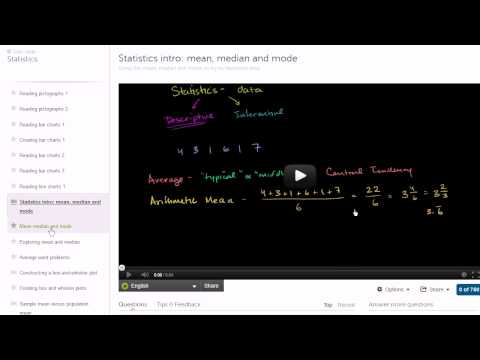
Introduction to statistics. We start with the basics of reading and interpretting data and then build into descriptive and inferential statistics that are typically covered in an introductory course on the subject. Overview of Khan Academy statistics. Statistics intro: mean, median and mode. Constructing a box-and-whisker plot. Sample mean versus population mean.. Variance of a population. Sample variance. Review and intuition why we divide by n-1 for the unbiased sample variance. Simulation showing bias in sample variance. Simulation providing evidence that (n-1) gives us unbiased estimate. Statistics: Standard Deviation. Statistics: Alternate Variance Formulas. Introduction to Random Variables. Probability Density Functions. Binomial Distribution 1. Binomial Distribution 2. Binomial Distribution 3. Binomial Distribution 4. Expected Value: E(X). Expected Value of Binomial Distribution. Poisson Process 1. Poisson Process 2. Introduction to the Normal Distribution. Normal Distribution Excel Exercise. Law of Large Numbers. ck12.org Normal Distribution Problems: Qualitative sense of normal distributions. ck12.org Normal Distribution Problems: Empirical Rule. ck12.org Normal Distribution Problems: z-score. ck12.org Exercise: Standard Normal Distribution and the Empirical Rule. ck12.org: More Empirical Rule and Z-score practice. Central Limit Theorem. Sampling Distribution of the Sample Mean. Sampling Distribution of the Sample Mean 2. Standard Error of the Mean. Sampling Distribution Example Problem. Confidence Interval 1. Confidence Interval Example. Mean and Variance of Bernoulli Distribution Example. Bernoulli Distribution Mean and Variance Formulas. Margin of Error 1. Margin of Error 2. Small Sample Size Confidence Intervals. Hypothesis Testing and P-values. One-Tailed and Two-Tailed Tests. Z-statistics vs. T-statistics. Type 1 Errors. Small Sample Hypothesis Test. T-Statistic Confidence Interval. Large Sample Proportion Hypothesis Testing. Variance of Differences of Random Variables. Difference of Sample Means Distribution. Confidence Interval of Difference of Means. Clarification of Confidence Interval of Difference of Means. Hypothesis Test for Difference of Means. Comparing Population Proportions 1. Comparing Population Proportions 2. Hypothesis Test Comparing Population Proportions. Squared Error of Regression Line. Proof (Part 1) Minimizing Squared Error to Regression Line. Proof Part 2 Minimizing Squared Error to Line. Proof (Part 3) Minimizing Squared Error to Regression Line. Proof (Part 4) Minimizing Squared Error to Regression Line. Regression Line Example. Second Regression Example. R-Squared or Coefficient of Determination. Calculating R-Squared. Covariance and the Regression Line. Correlation and Causality. Chi-Square Distribution Introduction. Pearson's Chi Square Test (Goodness of Fit). Contingency Table Chi-Square Test. ANOVA 1 - Calculating SST (Total Sum of Squares). ANOVA 2 - Calculating SSW and SSB (Total Sum of Squares Within and Between).avi. ANOVA 3 -Hypothesis Test with F-Statistic. Another simulation giving evidence that (n-1) gives us an unbiased estimate of variance. Mean Median and Mode. Range and Mid-range. Reading Pictographs. Reading Bar Graphs. Reading Line Graphs. Reading Pie Graphs (Circle Graphs). Misleading Line Graphs. Stem-and-leaf Plots. Box-and-Whisker Plots. Reading Box-and-Whisker Plots. Statistics: The Average. Statistics: Variance of a Population. Statistics: Sample Variance. Deductive Reasoning 1. Deductive Reasoning 2. Deductive Reasoning 3. Inductive Reasoning 1. Inductive Reasoning 2. Inductive Reasoning 3. Inductive Patterns.

Whether you'd like a refresher on the differences between descriptive and inferential statistics or are looking to hone your ability to analyze residuals, this course's video lessons have got you covered. Instructors discuss topics ranging from sample variance and box plots to conditional probabilities and z-scores. Areas of study addressed in this course include:
Statistics is the science that turns data into information and information into knowledge. This class covers applied statistical methodology from an analysis-of-data viewpoint. Topics covered include frequency distributions; measures of location; mean, median, mode; measures of dispersion; variance; graphic presentation; elementary probability; populations and samples; sampling distributions; one sample univariate inference problems, and two sample problems; categorical data; regression and correlation; and analysis of variance. Use of computers in data analysis is also explored. This course contains the Winter 2013 Statistics 250 Workbook and Interactive Lecture Notes. Fall 2011 Statistics 250 materials (syllabus, lectures, and workbooks) are also available for download. Course Level: Undergraduate This Work, Statistics 250 - Introduction to Statistics and Data Analysis, by Brenda Gunderson is licensed under a Creative Commons Attribution-NonCommercial-ShareAlike license.

The job of a data scientist is to glean knowledge from complex and noisy datasets.
Reasoning about uncertainty is inherent in the analysis of noisy data. Probability and Statistics provide the mathematical foundation for such reasoning.
In this course, part of the Data Science MicroMasters program, you will learn the foundations of probability and statistics. You will learn both the mathematical theory, and get a hands-on experience of applying this theory to actual data using Jupyter notebooks.
Concepts covered included: random variables, dependence, correlation, regression, PCA, entropy and MDL.

We will learn the basics of statistical inference in order to understand and compute p-values and confidence intervals, all while analyzing data with R. We provide R programming examples in a way that will help make the connection between concepts and implementation. Problem sets requiring R programming will be used to test understanding and ability to implement basic data analyses. We will use visualization techniques to explore new data sets and determine the most appropriate approach. We will describe robust statistical techniques as alternatives when data do not fit assumptions required by the standard approaches. By using R scripts to analyze data, you will learn the basics of conducting reproducible research.
Given the diversity in educational background of our students we have divided the series into seven parts. You can take the entire series or individual courses that interest you. If you are a statistician you should consider skipping the first two or three courses, similarly, if you are biologists you should consider skipping some of the introductory biology lectures. Note that the statistics and programming aspects of the class ramp up in difficulty relatively quickly across the first three courses. By the third course will be teaching advanced statistical concepts such as hierarchical models and by the fourth advanced software engineering skills, such as parallel computing and reproducible research concepts.
These courses make up 2 XSeries and are self-paced:
PH525.1x: Statistics and R for the Life Sciences
PH525.2x: Introduction to Linear Models and Matrix Algebra
PH525.3x: Statistical Inference and Modeling for High-throughput Experiments
PH525.4x: High-Dimensional Data Analysis
PH525.5x: Introduction to Bioconductor: annotation and analysis of genomes and genomic assays
PH525.6x: High-performance computing for reproducible genomics
PH525.7x: Case studies in functional genomics
This class was supported in part by NIH grant R25GM114818.
HarvardX requires individuals who enroll in its courses on edX to abide by the terms of the edX honor code. HarvardX will take appropriate corrective action in response to violations of the edX honor code, which may include dismissal from the HarvardX course; revocation of any certificates received for the HarvardX course; or other remedies as circumstances warrant. No refunds will be issued in the case of corrective action for such violations. Enrollees who are taking HarvardX courses as part of another program will also be governed by the academic policies of those programs.
HarvardX pursues the science of learning. By registering as an online learner in an HX course, you will also participate in research about learning. Read our research statement to learn more.
Harvard University and HarvardX are committed to maintaining a safe and healthy educational and work environment in which no member of the community is excluded from participation in, denied the benefits of, or subjected to discrimination or harassment in our program. All members of the HarvardX community are expected to abide by Harvard policies on nondiscrimination, including sexual harassment, and the edX Terms of Service. If you have any questions or concerns, please contact harvardx@harvard.edu and/or report your experience through the edX contact form.

This course is a broad treatment of statistics, concentrating on specific statistical techniques used in science and industry. Topics include: hypothesis testing and estimation, confidence intervals, chi-square tests, nonparametric statistics, analysis of variance, regression, correlation, decision theory, and Bayesian statistics.

This course offers an in-depth the theoretical foundations for statistical methods that are useful in many applications. The goal is to understand the role of mathematics in the research and development of efficient statistical methods.

Statistics is a versatile discipline that has revolutionized the fields of business, engineering, medicine and pure sciences. This course is Part 2 of a 4-part series on Business Statistics, and is ideal for learners who wish to enroll in business programs. The first two parts cover topics in Descriptive Statistics, whereas the next two focus on Inferential Statistics.
Spreadsheets containing real data from diverse areas such as economics, finance and HR drive much of our discussions.
In Part 2, we use the language of probability to examine the underlying distributions of random variables. We model real-life phenomena using known variables such as Binomial, Poisson and Normal. We learn how to simulate data that are distributed according to these variables.
We shall take up datasets that have over a million rows, which makes it difficult to analyze using a spreadsheet. This is a natural setting for R, an advanced statistical programming platform. We incorporate helpful tutorials to get learners acquainted with the platform.

Statistics is a versatile discipline that has revolutionized the fields of business, engineering, medicine and pure sciences. This course is Part 1 of a 4-part series on Business Statistics, and is ideal for learners who wish to enroll in business programs. The first two courses cover topics in Descriptive Statistics, whereas the next two courses focus on Inferential Statistics.
Spreadsheets containing real data from diverse areas such as economics, finance and HR drive much of our discussions.
In Part 1, we shall be exploring multiple ways to describe these datasets, numerically as well as visually. Throughout, we shall embrace a problem-based approach to understanding the material: the primary reason to pick up a tool or a technique will be to solve a problem. Our course makes judicious use of tools.
In Part 2, we shall take up a few datasets that have over a million rows, which makes it impossible to analyze using a spreadsheet. This is a natural setting for R, an advanced statistical programming platform. The courses incorporate helpful tutorials to get learners acquainted with both the mechanisms. Parts 3 and 4 are dedicated to Inferential Statistics. In Part 3, we begin by exploring the benefits of random sampling, and apply the Central Limit Theorem to arrive at confidence intervals for important population parameters. We also learn how to formulate hypotheses for business data, and resolve them with the testing framework that we establish. Along the way, we shall compare two or more populations and draw inferences with a set of statistical tests.
You will learn all these concepts with the help of various demonstrations, which show real-life application of the concepts related to business situations.

An introduction to the statistics behind the most popular genomic data science projects. This is the sixth course in the Genomic Big Data Science Specialization from Johns Hopkins University.

Provides a firm grounding in the foundations of probability and statistics, the course focuses on real examples from the medical literature and popular press
Provides a firm grounding in the foundations of probability and statistics, the course focuses on real examples from the medical literature and popular press.
Add to calendar

Trusted paper writing service WriteMyPaper.Today will write the papers of any difficulty.