

Online courses directory (19947)

Course Summary
Games have become the new normal. The gaming industry is already more powerful than any other form of entertainment like music or movies. An average young person will spend more than 10,000 hours gaming by the age of 21 - about the amount of time that it takes us to master any kind of skill and yet, there's a huge engagement crisis in many other areas.
70% of US full-time employees are not motivated by what they are doing, but World of Warcraft players can spend up to 17,000 hours online. In 2014, competitive eSports tournaments gathered more than $30 million in prizes and it keeps on increasing. Meanwhile, kids now spend way more time engaged to video games than they do with books, with an average attention span that is now less than 10 seconds and decreases every year...
It seems like only games are truly understanding how human motivation really works. But how is that possible? Why are we that glued to games? Can we design those kind of gameful experiences in non-game contexts to make them more engaging?
And the most important question: How to do it?
What will you learn?
In this course you'll learn the basics of Gamification with a highly practical approach. We'll focus on how to design gamified experiences in real life and students will be able to gain knowledge in areas such as: game design, psychology, management or education.
Our main goal will be to understand and master the principles of Gamification to design experiences that make things more fun and engaging.
Who should take this course?
Do you want your team to perform better? Are you looking for ways to fully engage happy customers? Do you want to see kids learning while playing? Or are you just looking forward to seeing a better world?
Gamification can be used in many areas and almost any task can be fun and engaging. This course could be great for many different interest groups, including: teachers, educators, managers, C-level executives, health and fitness professionals, psychologists or researchers. So...
Whether you ever asked yourself one of these questions or you just want to know how to make things more fun and engaging, this course is for you!
Do I need prior knowledge?
This course goes from a basic level to an advanced one so all you need to bring in the class is a playful attitude!
Anyway, having some prior knowledge is always great, so if you already want to start this epic adventure, here are 3 ways you can do so:
- If you are more the reading type of person: http://www.epicwinblog.net/2013/05/best-gamification-books-where-to-start.html
- If you’d rather watch some videos: http://www.epicwinblog.net/p/epic-win-videos.html
- And if you don't like those options, well, there’s always a way. Go and start playing games or try out some gamified experiences!
How will I be assessed?
This course will feature creative assignments where we’ll try to help you learn by doing. Every week, a space within the forum will be opened for you to upload the task and peer to peer reviews.
It is not mandatory to complete these assignments in order to achieve any of the course's certificates but it is truly recommendable if you want to learn how to create and design real life gamification.
Workload
This course will feature weekly videos and creative assignments, so you’ll have to spend around 3-4 hours per week to keep up. If you want to learn even more, we’ll provide you with reading references and plenty of insightful videos, blogs and resources. In a way, the workload is actually up to you.
Course Structure
Week 1 (21/04/2015) Introduction to Gamification
Week 2 (28/04/2015) Setting up the Scene
Week 3 (05/05/2015) Fun & User Experience
Week 4 (12/05/2015) Engagement & Aesthetics
Week 5 (19/05/2015) Gamification Mechanics: Basic Level
Week 6 (26/05/2015) Gamification Mechanics: Advanced Level
Week 7 (02/06/2015) Gamification Mechanics: Expert Level
Week 8 (09/06/2015) Flow, Feedback, Balance & Pacing
Week 9 (16/06/2015) Storytelling in Games & Gamification
Week 10 (23/06/2015) Gamification Projects: Team, Budgets & More!
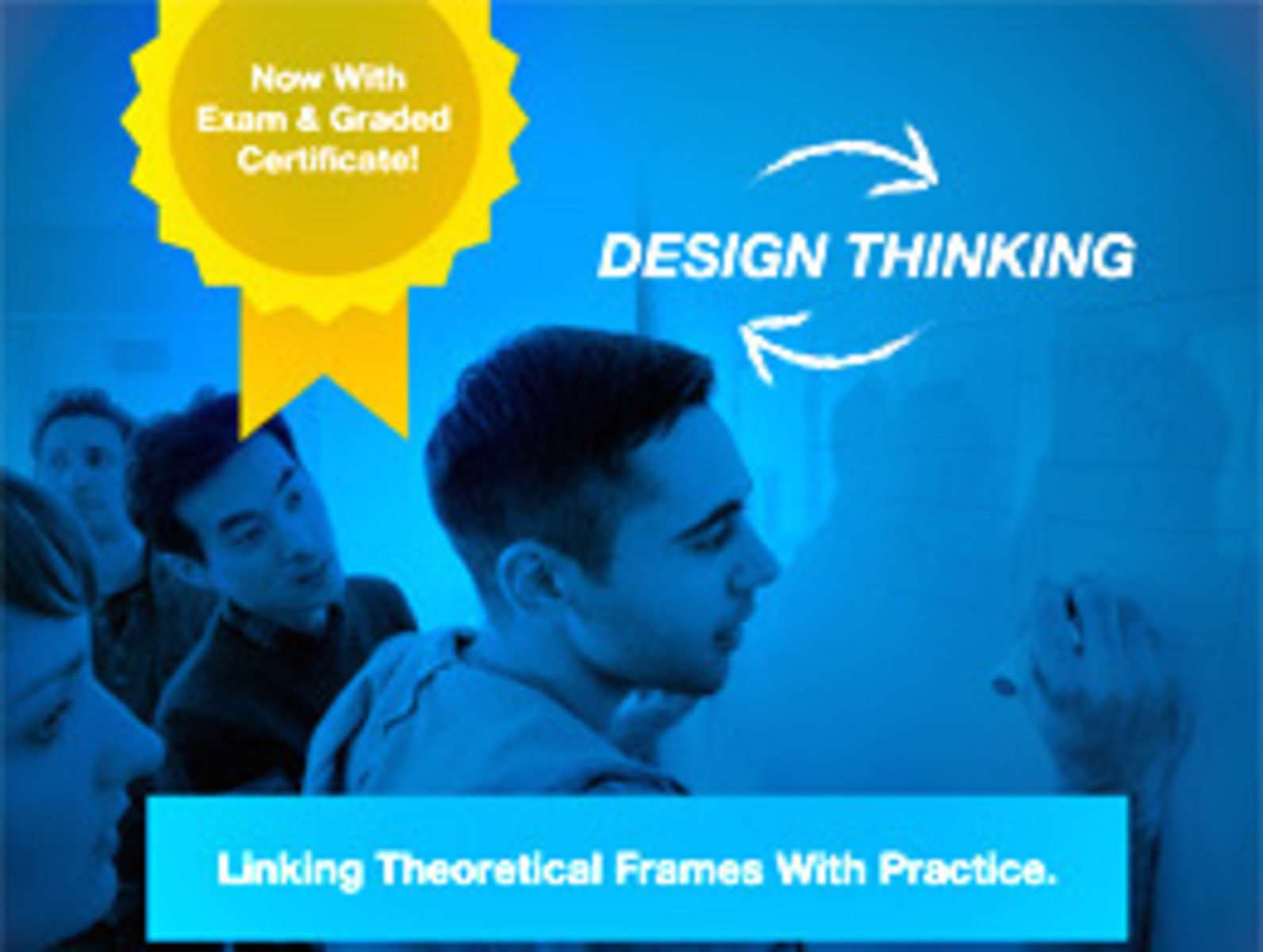
Welcome to the Macromedia University Design Thinking MOOC.
The Macromedia University MOOC Design Thinking is about understanding and implementing the methodology of Design Thinking. You will learn how Design Thinking uses creative, human centered techniques as a strategic approach to stimulate innovation. At MHMK, Macromedia University of Applied Sciences, we believe that human needs and experience should drive innovation – not technology. Being a school whose graduates will engage in designing the digital landscape surrounding us, we like to share our conviction of a good, decent and ethical way of creating tomorrows products and services.
Sign up now!
What to Expect
The Macromedia MOOC Design Thinking links theoretical frames with practice. You will look into fundamentals like historical and theoretical aspects of design, design models and design systems. You will gain deeper insights into the Design Thinking methodology and the human-centered design approach. You will learn how to apply teamwork and communications skills, and you will hear about creativity methods and visualization tools in the context of strategic design. And last but not least, the Macromedia MOOC Design Thinking will teach you how to evaluate ideas and concepts and why an innovation attitude and intercultural communication competence is crucial for a successful implementation.
Week by week we invite you to meet academics, professionals and students, who are using Design Thinking in the creative industries as well as in management in order to solve problems of great complexity. Each week is divided into three or four lectures/chapters. Each lecture is divided in several lessons/units, which are usually not longer than 5 mInutes. The lessons are made of video material, slides, additional reading material and tasks.
Expect to view approx. 80 minutes of lectures per week which sums up to altogether 5 hours per week incl. self-study time.
Course Structure
Course Structure:
WEEK ONE - 15 April - 21 April 2015:
• Design Thinking MOOC introduction (Prof. Oliver Szasz)
• Prologue Week One (Prof. Oliver Szasz)
• Design Today (Prof. Tanja Schmitt-Fumian)
• Design Models and Design Theory (Prof. Juergen Faust)
• Design as a Discipline (Silvio Barta)
• Design Systems (Prof. Juergen Faust)
WEEK TWO - 21 April - 28 April 2015:
• Prologue Week Two (Prof. Oliver Szasz)
• Human Centered Design and Research Methods (Astrid Thomaser)
• Design Thinking Process (Thomas Stegmann)
• Experience Design (Prof. Oliver Szasz)
• Problem Space Definition and Wicked Problems (Prof. Oliver T. Hellriegel)
WEEK THREE - 28 April - 05 May 2015:
• Prologue Week Three (Prof. Oliver Szasz)
• Creativity and Ideation (Johann Knott & Bret Sheridan)
• Strategic and Concept Design (Prof. Lars Grau)
• Multidisciplinary Teams and Communications Skills (Gary York)
• Storytelling (Prof. van Wyngaarden)
WEEK FOUR - 05 May - 12 May 2015:
• Prologue Week Four (Prof. Oliver Szasz)
• Prototyping and Testing (Paul Neervoort)
• Business and Innovation (Prof. Dr. Alyosh Agarwal)
• Intercultural Communication (Prof. Dr. Barbara Stelzner)
• Design Thinking MOOC Wrap-Up (Prof. Oliver Szasz)
Email Contact for Course Related Questions:
Why this MOOC is interdisciplinary
Originating in the Design Department of MHMK, Macromedia University of Applied Sciences in Munich, the Macromedia MOOC Design Thinking is emphasizing the rewarding link between management and creativity. To us, managing creativity means drawing on various findings and multidiscliplinary methods, yet guiding them through standardized and verifiable management procedures. Besides Design and Art history, the background of our MOOC team therefore ranges from business, psychology and human resource to transmedia, visualization, narration, and journalism, for instance. We will thus be able to discuss Design Thinking from various perspectives.
Learning Outcomes
Our MOOC will help you answer the following questions:
1. What is Design Thinking? Which benefits may I expect when implementing it as a management strategy?
2. How can innovation be systematically triggered ?
How can I implement Design Thinking into my own projects? 3. Talking about the potential of Design Thinking – what kind of best practices are there ?
4. What kind of team do I need to in order to initialize a Design Thinking process?
Prior Knowledge
No prior knowledge of Design Thinking is needed in order to attend the MOOC. Interest in creative techniques, innovation and management is welcome. - You don't know what human centered design, strategic design or participatory innovation culture is? - Great, you'll learn it here. - You are a business development specialist? - Great, we hope to inspire you. Please feel free to help us inspire others by sharing interesting links, events and projects on our Facebook page.

> Click here if you wish to subscribe to the news and update service of Macromedia University
We would be happy to keep you posted!

> Click here to link to the Fan Page on Facebook:
Become a friend and follow the conversation!

Kursbeschreibung
Eine Lernkultur der Potenzialentfaltung bedeutet ein individuelles Lernen in einer unterstützenden Gemeinschaft. Kinder lernen nicht nur, Wissen zu reproduzieren, sondern Verantwortung zu übernehmen, zusammen zu arbeiten, ihre Persönlichkeit kennen zu lernen und zu entwickeln und sich Wissen selbstständig anzueignen, im eigenen Rhythmus dem eigenen Lernstil entsprechend. Eine neue Lernkultur berührt daher die ganze Schule: ihre Strukturen, das Selbstverständnis der Erwachsenen, die genutzten Lernmaterialien, die Raumaufteilung... Hierbei handelt es sich nicht um eine verordnete, extern gesteuerte Reform, sondern um eine Transformation der Schulen von innen heraus. Hierbei gibt es auch kein vorgegebenes Modell, sondern Schulen haben das Privileg und die Herausforderung, ihre eigenen Überzeugungen umzusetzen. Hierzu gibt es inzwischen viele Vorbilder, Schulen, die aufgebrochen sind und den Mut haben, es anders zu versuchen.
Dieser Kurs befasst sich weniger mit der Lernkultur der Potenzialentfaltung, über die es viel von anderen Schulen zu lernen gibt. Der Fokus liegt auf der Ermächtigung zur Transformation: wie gestalte ich an meiner Schule den Aufbruch mit? Wie fange ich an? Welche Schritte müssen gegangen werden? Woran kann es liegen, wenn es nicht läuft? Wie gestalte ich Zusammenarbeit? Wie entwickle ich ein Konzept? Wie integriere ich kontinuierliche Veränderung in den Schulalltag?
Der Kurs ist in 12 Themen untergliedert, wobei jede Woche ein Thema für Sie freigeschaltet wird. Sie finden in jeder Woche einen Exkurs von Prof. Gerald Hüther zu einem Aspekt der neuen Lernkultur. Die weiteren Inhalte sind in kurze Texte und erklärende Videos aufbereitet, die ebenfalls bewusst kurz gehalten sind, um Ihnen größere Flexibilität bei der Zeiteinteilung zu ermöglichen.
Im Zentrum des Kurses stehen die Aufgaben und der Austausch untereinander. Sie werden jede Woche zu drei Aufgaben aufgefordert: eine Wissensaufgabe, ein kleiner Denkauftrag; eine Herzaufgabe, die die Selbstreflexion im Zentrum hat; und eine Handaufgabe, die eine konkrete Handlung direkt an Ihrer Schule beinhaltet. Ihre Gedanken und Erfahrungen teilen Sie dann mit den anderen Teilnehmenden.
Dieser Kurs kann mit einer kostenfreien Teilnahmebestätigung abgeschlossen werden, wenn Sie 80% des Materials gesichtet und an den Quizz-Fragen (oftmals mit Augenzwinkern) teilgenommen haben.
Kursstruktur
Woche 1: "Fertig machen zum Start". Einander, den Kurs und diese Plattform kennenlernen.
Woche 2: "Ein Prozess? Dein Prozess!". Alles über Prozesse und worauf man achten kann, wenn man sie gestalten möchte.
Woche 3: "Einer fängt an". Wie ich an meiner Schule Mitstreiter*innen finde.
Woche 4: "Stärken & Träume". Das Potenzial der Schule mit einer gemeinsamen Vision als Fundament der Transformation.
Woche 5: "Gemeinschaft". Weil Zusammenarbeit nicht ganz von alleine toll wird, man aber viel dafür tun kann.
Woche 6: "Information". Sich von anderen inspirieren lassen und die Rahmenbedingungen verstehen.
Woche 7: "Essenz". Alles noch mal auf den Punkt bringen als dauerhafte Orientierung.
Woche 8: "Design". Ein neues Konzept für unsere Schule.
Woche 9: "Umsetzung". Machen, machen, weitermachen oder habe einen Plan und alles kommt anders.
Woche 10: "Feiern". Weil es Teil der Arbeit ist und wir es so sehr verdienen.
Woche 11: "Lernende Schule". Nach der Transformation ist vor der Transformation.
Woche 12: "Persönliches Lernen & Transfer". Wie es nach diesem Kurs weiter geht.
Was lerne ich in diesem Kurs?
In diesem Kurs können Sie...
... ein Grundverständnis von Prozessen, ihrer Logik und Gestaltungsmöglichkeiten erlangen;
... eine große Vielfalt von Methoden für den Transformationsprozess kennenlernen;
... eine Orientierungshilfe der verschiedenen Schritte von Schulentwicklung mitnehmen;
... ihr eigenes Handeln und Ihre Haltung reflektieren;
... viel über Zusammenarbeit lernen;
... Mut finden, an Ihrer Schule anzufangen;
... sich mit Menschen mit ähnlichen Visionen austauschen und verbinden;
... mit Grundwerkzeugen der lernenden Schule vertraut werden.
Welche Vorkenntnisse brauche ich für diesen Kurs?
Die Teilnahme erfordert keinerlei Vorwissen. Die Anbindung an eine Schule ist jedoch sehr hilfreich, da jede Woche eine Aufgabe direkt an der Schule zu bearbeiten ist. Diese Aufgaben sind jedoch auch in jeder anderen Organisation durchführbar, teilweise sogar im privaten Umfeld. So ist die direkte Arbeit an einer Schule sehr hilfreich, nicht jedoch zwingende Voraussetzung.
Arbeitsaufwand
- 2-3 Stunden pro Woche

Kursbeschreibung
Der MOOC INNOVATIVES FILME MACHEN bietet einen praxisnahen Einblick in wichtige Produktionsphasen und zentralen Techniken, die bei der Produktion eines innovativen Independent Films durchlaufen oder eingesetzt werden. Das Übungsbeispiel ist der Science Fiction Film ART GIRLS (D 2014, 120 Minuten). Darüber hinaus bietet der MOOC theoretisches Grundlagenwissen über Film- und Kunsttheorie sowie über die im Film und durch deren Produktionsweise verhandelten Themen wie kollektive Intelligenz, das auch methodisch durch eine partizipatorische Fortführung der Filmerzählung in Social Media Kanälen verstärkt werden soll.
Was lerne ich in diesem Kurs
- Fachkenntnisse in Filmtheorie, Medienkunst, praktische Abläufe der Filmproduktion,
- Überblick über aktuelle kulturwissenschaftliche Diskurs (Natur vs. Kultur, mediatisierte Perzeption, kollektive Intelligenz)
- Medienkompetenz
- Anregung zur Entwicklung eigener Beiträge in Text-, Bild - oder Videoform zur kollektiven Fortführung der Filmerzählung und dadurch Erprobung gemeinschaftlicher Kreativitätsformen
Welches Vorwissen brauche ich?
Vorkenntnisse von Grundlagenbegriffen von Film und Medien empfohlen, aber keine Voraussetzung. Er ist für Studierende insbesondere von Studiengängen, die sich theoretisch und/oder praktisch mit Film und Medien auseinandersetzen geeignet sowie auch für beruflich oder freizeitlich Interessierte. Ausgewählte Kursinhalte sind auch für Schüler_innen der Sekundarstufe II (ab 16 Jahren) als Ergänzung zum Kunst- oder Medienkompetenzunterricht geeignet.
Kursstruktur
Kapitel 0 - Willkommen zum Kurs
Einführung und Einstimmung in den MOOC
Kapitel 1 - Storytelling: Techniken der innovativen Narration
In diesem Kapitel erkunden wir komplexe Beziehungen zwischen Autor, Erzähler und Figur. Warum sind die handelnden Personen nicht mit der Intention des Autors zu verwechseln?
Kapitel 2 - Das Drehbuch ist nicht alleinseligmachend: Textsorten bei der Filmproduktion
Überblick über verschiedene Möglichkeiten, in Schrift und auch Bild den kreativen Prozess zu fördern.
Kapitel 3 - Hybridformen 1: Dokufiktion und andere Genre-Montagen
Dieses Kapitel erkundet wie in den Medien zunehmend die Grenzen zwischen Fakt und Fiktion sich auflösen. Welche Risiken, welche Chancen birgt das für die innovative Filmerzählung?
Kapitel 4 - Kategorien und Hybridformen 2: Kunst-Fiktionen, Kollektiv-Fiktionen
Anhand des konkreten Beispiels Art Girls sehen wir, wie die innovative Verbindung von Spielfilm und Medienkunst die Filmerzählung für verschiedene Stimmen und Perspektiven öffnen kann. Unter besonderer Berücksichtigung des Einsatzes realer Kunstwerke von Joseph Beuys, Martin Kippenberger, Susanne Weirich u.a. im fiktionalen Setting.
Kapitel 5 - Potentiale der Animation und Visual Effects
Crashkurs in CGI, VFX und andere künstliche Bilderwelten
Kapitel 6 - Ton: 3D-akustischer Raum zwischen 1 und 128 Kanälen
Einführung in das Sound Design als filmisches Ausdrucksmittel
Kapitel 7 - Innovativ-kollektive Produktion und Rezeption
Film war schon immer Teamarbeit, auch als die kreative Vision nur einem allmächtigen "Autoren" zugeschrieben wurde. Wie können Vielstimmigkeit und Kollektivität im Produktionsprozess begünstigt werden, und wie können auch nach Fertigstellung des Films die Rezipienten die Geschichte fortsetzen?
Kapitel 8 - Montage: Dialog, Vielstimmigkeit, Botschaft, Wirkung, Kollektive Intelligenz
Die Montage ist die Anordnung der filmischen Elemente in der Zeit und auch im Raum. Sie stellt die filmische Wirkung her. Dieses Kapitel gibt Einblick in verschiedene Formen und Funktionen der Montage.
Arbeitsaufwand
Ca. 3 Stunden pro Woche zum Bearbeiten der Videos, Quizze und Hausaufgaben.

Course Summary
Over the past decades world hunger has been joined by a second nutrition problem: chronic over nutrition and lack of exercise in industrialized and developing countries. The ensuing overweight and obesity pose a severe health problem. Picking the most relevant examples, this short course will analyze the biochemical basis of the development of diseases associated with the so called metabolic syndrome. Among others, the steps towards the development of type 2 diabetes and atherosclerosis will be discussed.
This course is divided into 4 chapters. In each chapter one particular nutrition-related disease will be discussed on three levels.
What will I learn?
Level 1: Basic understanding of how poor lifestyle impacts on the regulation of physiological processes.
Level 2: Understanding of the major biochemical principles underlying selected examples of nutrition-related diseases.
Level 3: Sound understanding, which experimental evidence supports the current views on the development of certain nutrition-related diseases.
What do I need to know?
Level 1: Basic knowledge in biology
Level 2: Basic knowledge of biochemical principles
Level 3: Advanced knowledge in biochemistry
Course Structure
Chapter 1: Insulin Resistance.
You will learn, how overweight and obesity cause insulin resistance in the different organs.
Chapter 2: Type 2 Diabetes.
You will learn about the current ideas, how reversible insulin resistance irreversibly proceeds to type 2 diabetes and how the late complications of type 2 diabetes develop.
Chapter 3: Dyslipidemias.
You will learn, how lipids are carried in our blood and distributed throughout the body, what controls their levels and how this control is impaired in disease.
Chapter 4: Atherosclerosis.
You will learn, how different risk factors, among others type 2 diabetes, dislipidemia and hypertension, contribute to the development of atherosclerosis and its consequences like stroke and heart attack.
Workload
Approximately 2- hours per week for watching video lectures, taking quizzes and completing homework assignments.
Architecture 101
To learn more about architecture 101, we kindly invite you to read about it in the first part of the course description, here. Being this part 2 (from place to space), in order to understand the whole picture, it is better to start from part 1.
Architecture 101 (part 2: from place to space)
In part 1 of our course, we explore the state of nothingness and start moving towards the idea of “place”. In part 2, we deal with the concept of “place” and our conceptual journey goes on towards “space”.
In short:
part 1: from nothingness to place
part 2: from place to space
part 3: from space to architecture
Places to stay, to move, to eat, to cook, to love. Place to live. Place to die.
Places for our bodies, places on our bodies.
Places to clean and remember. We went all over the place... Different places for doing so many different things. Different places and different positions, all weaven to different states of mind.
Of course, in this 6-month journey called “Architecture 101”, we expect the final output to be about making architecture. And it will be (part 3).
But as we said before: we cannot make architecture without understanding what space is, and we cannot sense any kind of space before knowing about “place”, and we cannot imagine any kind of place without getting into a mental and physical state of pure nothingness.
So now, how do we go from to place to space?
As John Cage told us in the first week of part 1, "There is no such thing as an empty space or an empty time. There is always something to see, something to hear. In fact, try as we may to make a silence, we cannot."
“In a small room one does not say what one would in a large room.” (Louis Kahn)
What more could we add?
In this part of the course, we will understand what kind of matter surrounds us and how this matters to us. What matters? This is what we will need to find out.
Then, we will try to define the boundaries of this matter at hand. Adding a new dimension to the whole thing, we will put ourselves into context. A physical and a mental context. All of this, using a “hands-on” system (you will learn by doing).
Course Structure
Week 1: taking measurements
Week 2: proportions
Week 3: technical drawing
Week 4: papercut models
Week 5: the history of place / the history of space
Week 6: in a world of webzines
Week 7: what is an “exam”?
Week 8: what is a “break”?
Learning Objectives
We will see spaces like architects do.
We will explore the ways in which place becomes space.
We will learn to measure and project ideas into a 3 dimensional way.
We will also learn a significative amount of extremely interesting (and totally useless) things.
All of the above refers to the conceptual part of our course.
Then, since we love having our students making practical things, you will also learn lots of technical things using a number of interesting applications.
What will I make?
A scale model in a box (a box with a given proportion, size, appearance) in which you will represent a specific “space”. If one thousand people finish this part 3, we will have a fabulous collection of 1000 boxes. A cool exhibition is on its way. Makes sense, don’t you think?
Prior knowledge
This is the 2nd part of a tripartite course called Architecture 101.
To have followed the first part is highly recommended, however not required.
Then, in terms of other kinds of prior knowledge, nothing in particular is required.
However, in terms of technical equipment, this course will be easier to follow for those with access to a smartphone or tablet.
You don’t need a smartphone or tablet. But, as we wrote, we imagined a class with thousands of people lost in their phones, from all around the world. In commuters, we trust!
Workload
Between 3 and 7 hours a week.
From Monday to Friday, for a total of 6 weeks, you will receive an email with a 15 second-video to watch (to get you in the mood), and a pdf with some instructions for completing an assignment and a series of references (to go deeper in the subject at hand).
Then, you will get to work on your assignment. Once you complete your assignment, you will upload it to the iversity platform and share it on your preferred social media account(s). Ideally Instagram.
Then, during the weekend, we will give you some time to catch up.
Are you ready?
:-)
Kurszusammenfassung
Der Kurs führt ein in die Fragestellungen der modernen Arbeitspsychologie. Er vermittelt das Grundwissen und die wichtigsten Konzepte und Interventionsmethoden der Arbeitspsychologie. Am Anfang steht die Klärung der wichtigsten Begriffe: Was ist Psychologie bzw. Arbeitspsychologie? Was unterscheidet bedingungs- von personenbezogenen Ansätzen? Welche Menschenbilder, Bilder der Arbeit, Organisationsmetaphern und Technikverständnisse liegen der Arbeitspsychologie zu Grunde? Es folgt die Erläuterung vier grundlegender Paradigmen der Arbeitsgestaltung und des Betriebsmanagements. In den folgenden Kapiteln werden Einzelthemen wie Zielvereinbarung und Mitarbeitergespräche, Arbeit und Gesundheit - speziell Ermüdung, Stress und Bewältigung, Burnout, Arbeitszufriedenheit und Arbeitsmotivation, Arbeitsgruppen und Gruppenarbeit erklärt. Der Kurs schliesst ab mit einem Kapitel zur Methodik der Analyse, Bewertung und Gestaltung von Arbeit.
Lernziele
Die Teilnehmenden entwickeln ein Grundverständnis für Fragestellungen und Herangehensweisen der Psychologie, speziell im Bereich der Arbeits- und Berufstätigkeit in Organisationen.
Die Teilnehmenden lernen grundlegende Konzepte und Theorieansätze der Psychologie kennen und sie lernen, diese für konkrete praktische Frage- und Problemstellungen zu nutzen.
Die Teilnehmenden lernen die Forschungsmethoden und Ergebnisse wichtiger empirischer Studien sowie die psychologischen Schlussfolgerungen daraus kennen.
Die Studierenden lernen grundlegende Ansätze und Methoden/Verfahren der Arbeitsanalyse und der Arbeitsgestaltung kennen und für Anwendungen in ihrem eigenen Arbeitsbereich nutzbar zu machen.
Die Studierenden lernen die wichtigsten Wirkungszusammenhänge zwischen Arbeit und Gesundheit/ Wohlbefinden sowie damit verbundene Präventionsansätze kennen.
Die Studierenden lernen, anhand ihres erworbenen Wissens ihre eigene Arbeits- und Lebenssituation zu reflektieren und wissensbasiert zu optimieren.
Kursübersicht
Einführung in die Arbeitspsychologie
1. Einleitung, Grundlegende Konzepte der Arbeitspsychologie, Was ist Arbeitspsychologie?
2. Vier Paradigmen der Arbeitsgestaltung und des Betriebsmanagements 1: Taylorismus, Human Relations (Hawthorne)
3. Vier Paradigmen der Arbeitsgestaltung und des Betriebsmanagements 2: Job Enlargement und Job Enrichment (Herzberg), der soziotechnische Systemansatz
4. Arbeitstätigkeit und Arbeitshandeln
5. Die Wirkung von Arbeit auf den Menschen 1: Belastung, Beanspruchung und Beanspruchungsfolgen
6. Die Wirkung von Arbeit auf den Menschen 2: Stress, Burnout
7. Arbeitszufriedenheit und Arbeitsmotivation
8. Arbeitsgruppen und Gruppenarbeit
9. Management und Führung aus arbeitspsychologischer Sicht
10. Psychologische Konzepte und Verfahren der Arbeitsanalyse und Arbeitsgestaltung
Was muss ich wissen?
Voraussetzung für die Teilnahme sind ein Grundverständnis von und Interesse an psychologischen Fragestellungen. Der Kurs richtet sich an Studienanfänger aber auch Führungskräfte sowie Mitarbeitende in Personalabteilungen, die in der Praxis mit arbeitspsychologischen Fragestellungen konfrontiert sind.

Course Summary
This MOOC is an introduction in Critical Thinking, with an emphasis on using reason in our daily communication. Its main topics cover the structure and analysis of arguments, the study of inductive reasoning as basis for scientific knowledge and as key ingredient in how we understand reality. Next we will focus on fallacies (like loaded question or hasty generalization) and on guidelines for structuring a presentation, an argumentative essay or a debate. Furthermore, the course gives you an overview of cognitive biases (a fashionable topic nowadays), and on the use of emotional tools in persuasion. The teaching is accompanied by tons of documented experiments and fun examples, guided practice, quizzes, links to additional materials (like TED talks) and short homework.
What do I learn?
After taking this course you will have the tools to analyze the truth of all kinds of statements, from opinion articles to court verdicts and investment proposals. You will better understand the philosophical basis of human knowledge, also you will be more persuasive in domestic talks as well as in good structured presentations, debates or argumentative essays. Furthermore, a main goal of this course is that you will be able to recognize and refute the most common fallacies (reasoning errors), and understand irrational behavior.
What do I need to know?
No prior knowledge is needed for this course, participants should only come equipped with natural curiosity and a respect for the truth.
Course Structure
Chapter & Topic
Chapter 1:

Course Summary
The course examines the major theories of International Relations, the key sub-fields of international politics, and the current practices of global politics.
In the first part, the theories of realism, liberalism, marxism, and constructivism are studied.
In the second part, the key concepts in foreign policy analysis, internetional political economy, and security studies are presented.
In the final part, the course disentagles the context of globalization, the institutional framework of global governance, and the current reality of global politics with its risks and opportunities.
The classes will be integrated with internet hang-outs centered on current events, as well as different kinds of exercises and tests.
What will I learn?
By the end of the course, the student will be able to understand critically international affairs, to analyse major international events, to interpret the position of key international players, and in the ultimate analsysis to play actively the global political game.
What do I need to know?
Basic knowledge of international history and current affairs.
Course Structure
Chapter 1 How to study International Relations (on key methodologies to study international affairs)
- Structure of the course: To dos
- How to explain international phenomena?
- The Westphalian World
- The origin of the discipline: idealism
Chapter 2 Realism (on the principal paradigm of IR theory)
- Anthropology and history
- Four assumptions
- State and Power
- Strategies
- Order
- Institutions and negotiations
- Geopolitics
- Justice
- Conclusions
Chapter 3 Liberalism (on the second major paradigm of IR)
- Introduction to liberalism
- Assumptions
- Democratic Peace Theory
- Interdependence and neo-liberal institutionalism
- International organizations and International regimes
- Global governance
- Integration
- Conclusions
Chapter 4 Marxism and Constructivism (on two important alternative theories)
- Marxism: Class Struggle
- Four Assumptions
- Teoria de la dependencia
- World System theory
- Neo-Gramscian Approaches
- Constructivism: The power of imagination
- Ideas, identities, interests
Chapter 5: Foreign Policy Analysis (on the first sub-field of IR)
- Instruments and determinants of foreign policy
- Models of foreign policy decision-making
Chapter 6: International Political Economy (on the second sub-field of IR)
- Inequality
- The three schools of IPE
- From the embedded liberalism to globalization
Chapter 7: Security studies (on the third sub-field of IR)
- The notion of security
- Security and strategy
- The development of war
- Models of peacebuilding
Chapter 8: Globalization and the context of global politics (on the context of today's politics)
- What is globalization?
- The future of globalization
- Conceptual maps of international affairs
- Future scenarios
Chapter 9 Global Politics (on today's politics)
- The rule of global governance
- Global politics
- Transnational civil society: nature and functions
- Public institutions-civil society interaction
- The Boomerang Effect rivisited
Workload
Approximately 4 hours per week for watching video lectures, taking quizzes and completing homework assignments.

Course Summary
When was Stonehenge built? Who built it? How was it built? Why was it built? Answers cannot be promised to all of these, but we can get better at asking the questions and work towards solutions. We can look at how people have responded to Stonehenge. Most of all we can begin to think about what Stonehenge means to us.
What do I learn?
- To understand present archaeological thinking about Stonehenge.
- To evaluate responses to Stonehenge in art, literature, music, architecture and culture.
- To consider your own response to Stonehenge, expressed through two peer-evaluated mini-essays.
What do I need too know?
No entry requirements. This MOOC is open to all.
Course Structure
Chapter 1: The Stonehenge Landscape
Stonehenge as a landscape of prehistoric sites. A historical context: the Mesolithic, the Neolithic and the building of the Stonehenge.
Chapter 2: Who built Stonehenge?
Theories: when, by whom, how and why.
Chapter 3: Stonehenge Problems
Context - the Stonehenge landscape: problems with transportation and erection. Part destruction - why and how?
Chapter 4: Responses to Stonehenge
An array of responses: Geoffrey of Monmouth (1138); the antiquarian tradition, the temple and astronomic alignments traditions; various amateur theories; the archaeological traditions.
Stonehenge, Woodhenge: monuments in a landscape
Chapter 5: Cultural Contexts
Stonehenge in fiction, poetry, music, art and popular culture.
Chapter 6: Stonehenge Today
Stonehenge as a cultural icon, emblem of Britain, World Heritage site and sacred space.
Blick Mead as the cradle of Stonehenge.
Chapter 7: Reassessing Stonehenge
Written activity as an assessment
Chapter 8: Responses to Stonehenge
Examination of students' responses through their essays. Integration of blog, Wiki, Twitter and eBook as a way of continuing the discussion after the course.
Workload
Approximately two hours per week for watching video lectures, completing quizzes and homework assignments.

Course Summary
In an age of self-service stores, saturated markets, and ever more demanding customers, the creative and science-driven design of the point of sale has become a crucial success factor for both retailers and service businesses. In this MOOC, you will be introduced to shopper marketing. You will learn to understand shopping behavior and how to optimize the design of retail stores and service environments to increase customer satisfaction and sales. While the focus is on the practical applicability of the concepts discussed, the MOOC is also firmly grounded in consumer and psychological research. In the lessons, I will draw on both the recent research literature and my own experience in marketing consulting and consumer research.
The topics covered in the MOOC are:
• Store layout: Influencing how shoppers navigate the store
• Helping shopper orientation in the store
• Store design factors
• Visual merchandising techniques
• Influencing the store atmosphere
• Experiential store design: Making shopping fun
• Specific applications of store design principles
What will I learn?
By the end this MOOC, you will have developed an understanding of consumer behavior at the point of sale and be able to apply this knowledge to the (re)design of retail spaces and service environments.
Specifically, you will:
• appreciate the relevance of shopper marketing and store design
• understand the goals of store and servicescape design
• be able to apply environmental psychology principles to the design of retail and service spaces
• understand the effect of sensory clues such as music, scents and colors on shopping behavior
• understand how emotions influence shopping decisions and be able to trigger emotions in shoppers
• understand the importance of experiential marketing and store design
• be able to influence consumer behavior with specific store design and visual merchandising techniques
• be able to apply the knowledge gained in this MOOC to evaluate retail spaces and servicescapes
Also, you should have fun in this MOOC :-)
What do I need to know?
No prior marketing, business or psychology knowledge is required.
Course Structure
Week 1: Shopper movement and behavior in the store
Find out how shoppers navigate the store, how they search for products, and how you can make them find the products you want them to see and buy.
1.0 Welcome to the course
1.1 Overview of the module
1.2 Shopper shadowing: Tracking shoppers in the store
1.3 Four principles of how shoppers move in the store
1.4 Grid and free form: Creating a store layout that suits the store
1.5 Follow the yellow brick road: Influencing shopper movement through a loop
1.6 How I ended up buying potato chips: Where to place products so that shoppers buy them
1.7 Eye level is buy level: The principles of shelf placement
1.8 Horizontal, not vertical: Shoppers’ search patterns
1.9 Follow the eye: Eyetracking at the Point of Sale
From my bookshelf
Week 2: Shopper orientation and disorientation
Learn why shopper confusion kills every sale and how you can help shoppers find their way—all the way to the cash register.
2.1 Overview of the module
2.2 I’m so lost… and I hate this place: The effects of shopper disorientation
2.3 It’s all stored in the head: Improving shopper orientation through cognitive maps
2.4 Beware of the magic number 7: Improving shopper orientation through signs
2.5 Words and pictures: Applying dual coding theory
2.6 You are here: Improving orientation through store maps
2.7 The store as a forbidden place: Consumer disinformation
From my bookshelf
Week 3: Influencing shoppers through the store atmosphere
Learn how to appeal to shopper emotions through use of colors, scents, light, and music.
3.1 Overview of the module
3.2 Communicating through the senses: How the store atmosphere influences emotions
3.3 How the environment influences shoppers: The Mehrabian-Russell-Model
3.4 Arousal and pleasure: The key drivers of in-store behavior
3.5 Better slow than fast: Using background music in the store
3.6 The smell of happy memories: Using ambient scents
3.7 Let the sunshine in: Store lighting
3.8 Red or blue? Colors in the store
3.9 Everything must fit: The importance of congruence
From my bookshelf
Week 4: Visual merchandising – the art and science of product presentation
Let me show you what the most attention-grabbing and profitable ways to present your merchandise are.
4.1 Overview of the module
4.2 The art and science of seducing shoppers with the merchandise: What is visual merchandising?
4.3 Shoppers buy only what they see: The 3 key principles of visual merchandising
4.4 Less is more: Avoiding the choice overload effect
4.5 Choosing the right company for your products: The bundled presentation merchandising technique
4.6 Creating visual magnets: Directing the shoppers’ attention
4.7 A picture says more than a thousand words: Using in-store graphics to trigger cognitive schemas
From my bookshelf
Week 5: Making shopping fun through experiential store design
I'll teach you to make shopping memorable and fun by creating unique experiences.
5.1 Overview of the module
5.2 Competing with cyberspace: Reasons for experiential store design
5.3 Necessity or fun: Utilitarian and hedonic shopping
5.4 Appealing to the pleasure seekers: 4 steps for creating shopping experiences for hedonic shoppers
5.5 Exciting places and live entertainment: Designing experiences for adventure shoppers
5.6 Creating a third place: Designing experiences for social shoppers
5.7 Gifts, indulgence and curiosity: Experiences for role, gratification, and idea shoppers
5.8 Appealing to the bargain hunters: Designing experiences for deal-prone consumers
5.9 Jungles, castles and Harry Potter: Creating effective themed experiences
From my bookshelf
Week 6: Recipes for influencing shoppers
Find out how you can apply the concepts learned in this course to influence specific shopping behaviors and achieve positive effects for the store.
6.1 Overview of the module
6.2 How much longer? Shorten consumers’ wait-time perceptions
6.3 Expensive or cheap? Influence shoppers’ price perceptions
6.4 Accessibility for all: Design the store for senior citizens
6.5 Wait, wait, don’t go! Keep shoppers in the store longer
6.6 I must have that! Encourage impulse purchases
6.7 Make shopping simple and fun: The importance of processing fluency
6.8 Course conclusion

Ganz gleich in welcher Wissenschaftsdisziplin, Statistik ist das Schweizer Armeemesser für die Behandlung von vielen Zahlen – um daraus wenige Zahlen zu machen. Das klingt unspektakulär, hat aber schon so manchen Studierenden der Human-, Wirtschafts- und Naturwissenschaften an den Rand der Verzweiflung geführt. Dabei ist Statistik überall, in den alltäglichsten Situationen und den komplexesten Forschungsfragen.
In dieser Einführung kümmern wir uns um das Fundament der Statistik, die Wahrscheinlichkeitstheorie. Das klingt schlimm, ist es aber nicht. Wir erfahren etwas über die männliche Sicht weiblichen Intellekts, antike Cassettenhüllen, gezinkte Würfel, Milchreis, Hochrisiko-Sportfeste und vieles mehr, das uns den Einstieg in die Welt der Wahrscheinlichkeit so leicht macht als sei die Statistik auf eine strenge Diät gegangen.
Kursüberblick
Der Kurs beschäftigt sich mit Inhalten rund um das Gebiet der Wahrscheinlichkeitsrechnung. Ausgehend von verschiedene Definitionen für Wahrscheinlichkeit widmen wir uns schnell den praxisnäheren Fragen, die mit Wahrscheinlichkeitsrechnung beantwortet werden können. Wir erfahren den Unterschied zwischen Häufigkeit und Wahrscheinlichkeit, lernen den Satz von Bayes kennen und danach direkt Bernoullis Zufallsexperimente. Diese bringen uns zu den diskreten Wahrscheinlichkeitsverteilungen, von denen wir die Binomialverteilung, die Poissonverteilung und die Hypergeometrische Verteilung näher kennenlernen werden. Danach kümmern wir uns um stetige Wahrscheinlichkeitsverteilungen und deren wichtigsten Vertreter, die Normalverteilung. Links liegen lassen wir während des ganzen Kurses die von Vielen gefürchtete Kombinatorik, die wir nur an zwei Stellen wirklich benötigen.
Lernergebnisse
Am Ende des Kurses wirst Du die grundlegenden formalen Elemente der Wahrscheinlichkeit kennen. Du wirst verstanden haben, was sich Pierre Simon Laplace und Nikolaj Kolmogoroff unter dem Begriff Wahrscheinlichkeit vorgestellt haben. Du wirst mit bedingten Wahrscheinlichkeiten und dem Satz von Bayes umgehen können. Und schließlich wirst Du Dich in vielen Wahrscheinlichkeitsverteilungen zurechtfinden wie der Binomialverteilung, der Poissonverteilung, der hypergeometrischen Verteilung und der Normalverteilung.
Vorkenntnisse
Alles, was Du zum Genuss der Wahrscheinlichkeitstheorie brauchst, lernst Du hier. Du brauchst keine besonderen Vorkenntnisse, denn mehr als Plus, Minus, Mal und Geteilt wird hier kaum gerechnet. Versprochen! Also schau vorbei und lern mit uns die Statistik von einer ganz neuen Seite kennen.
FAQ
Für grundsätzliche Fragen findest du hier die FAQs.

Course Summary
The course addresses the design and development of Serious Games. Serious Games are games that do not have entertainment as the main purpose but rather an educational, awareness raising, training, advertisement or other “serious” purpose that benefits from the engaging context that games provide to motivate the users. Serious Games have been typically used in education, training, health, defense and other sectors.
MOOC students will go through all the steps of the development of a Serious Educational Game from selecting the idea and binding it with learning goals to the development and testing of the game prototype in an environment that does not require programming skills. The programme of study will allow students to understand the process of idealizing, designing, developing, testing and delivering a game. At the same time, students will benefit from a hands-on experience, working in intercultural and interdisciplinary teams, exploiting the expertise of an international team of participating teachers and industry experts.
What do I learn?
The course objective is to allow students understand the process of idealizing, designing, developing, testing and delivering a serious game.
In the end, students will be able to...
- Understand and comment the main concepts of game culture and digital game theory
- Analyze game taxonomies and identify the specific characteristics of each game type
- Carry out analyses and user tests to understand users’ demands and needs and convert them into serious game requisites (including learning objectives for game-based learning)
- Understand and apply serious game methodologies
- Understand the concepts related to game play, game flow, interactive narratives, storytelling and apply them in practice to develop an addictive game
- List the main tools (game editors) available to develop games and to identify the best one for a specific purpose
- Use a specific game editor to develop a serious game
- Idealize, design, develop, test and deliver a serious game
What do I need to know?
Basic computer and internet skills
Workload
Approximately 5 hours per week for watching video lectures, taking quizzes and completing homework assignments.

Design 1o1 “Redux”
“Design 1o1 Redux” is an introduction to design through 101 exercises. A six-month journey divided into 3 courses “online” here on iversity (Part 1, Part 2 and Part 3), one final exhibition / graduation party and an “offline” workshop in which we will go one step beyond.
In short:
Part 1: “Myself” (Nov 2 to Dec 27)
Part 2: “My House” (Jan 4 to Feb 28)
Part 3: “My World” (Feb 29 to Apr 24)
Exhibition / Graduation: In Croatia (Apr 23-24)
Winter camp: In Croatia (Apr 25 to May 1)
:-)
And now, Part 3: My World...
Design 1o1 Redux Part 3: My World
Johan Cruyff, a very famous footballer (and fantastic designer), once said:
“I never practice tricks. I play very simply.
That's what it's all about. Playing simple football is the hardest thing.”
If we think about it, design is everything.
It can be football, but it can also be an object, a building, a game… our lives, our worlds!
In this part of the Design 1o1 Redux, we will go out and “get busy” designing our very own worlds. Something for which we will need to master a high level of simplicity.
We will work with all kinds of cool apps for phones and tablets (do you have a smartphone or tablet?). We will also share our works with the others on Instagram, using special hashtags.
:-)
Course Structure
Our various activities will be divided into 8 weeks:
Week 1: My Neighborhood
Week 2: My Town
Week 3: My Trips
Week 4: My Nature
Week 5: My Shelter
Week 6: My Thing
Week 7: My Exam
Week 8: My Break
What will I learn?
You will learn to develop some basic design attitudes for better understanding the mechanics of today’s world.
One step at a time, you will learn that “design” is foremost a language.
A language shared, talked and discussed by designers from all over the world.
How does the world look through the special lenses of "design"?
Along the way, you will learn about a considerably high number of things. Starting from your very own self.
Prior Knowledge
In terms of prior knowledge, there is nothing required.
If you have a lot of prior knowledge, it might make the learning process more difficult, but don’t worry, no one is perfect. If we talk about contemporary “#design”, we are all absolute beginners!
However, in terms of technical equipment, this course is easier to follow via a smartphone or tablet. Of course, you can follow us via a desktop computer... but this is not how we intended the whole thing to be.
:-)
Workload
Between 4 and 7 hours a week.
Everyday, from Monday to Friday, for a total of 6 weeks, you will receive a package via email. Each package contains a 15-second video to watch (to get you in the proper mood), and a pdf-letter introducing the daily brief (or “homework”) and a series of objects, characters and happenings intertwined with the narrative of the course (to go deeper in the subject at hand).
You will work on your assignment…
Then, once completed, you will upload it to your Instagram account (for the rest of us to see).
Easy as a kiss.
Questions or Comments?
You can write to Ms. Lola (our so-called secretary, but actually the real boss of this whole venture) at: design101.info@gmail.com.
Now, please understand that Ms. Lola is very busy. You might get higher chances of getting a quick and complete answer via Instagram, Facebook, Twitter. Come and let us show you around!
:-)
The Design 1o1 Community
This course is run by the Design 1o1 Community.
You can learn more about who we are and what we do here.
All course contents are used for educational purposes.
The written content is by IdLab, and the visual content is assembled by IdLab.
The Design 1o1 Redux is a project by IdLab for Abadir Academy of Fine Arts.



Course Summary
In this third part of Vehicle Dynamics, we will illuminate the vertical dynamic aspects of vehicles. In short, we will describe the elements involved when a car drives on a bumpy or rough street.
We will start with a survey of suspensions and springs and dampers. After this, we will explain the description of rough streets and give an introduction to Fourier integrals. Next, we will take a closer look at vertical models. In the last fundamental part of the course, we will describe the conflict between driving safety and comfort. The course will be finished with two applications from automotive mechatronics.
What will I learn?
At the end of the course you will …
- know different kinds of suspensions, springs and dampers.
- know the description of rough and bumpy streets.
- understand the Fourier integral.
- understand the conflict between driving safety and comfort.
- be able to calculate simple properties of a car.
What do I have to know?
Some basic understanding of the following subjects will help you successfully participate in this course:
Algebra; Trigonometric Functions; Differential Calculus; Linear Algebra; Vectors; Coordinate Systems; Force, Torque, Equilibrium; Mass, Center of Gravity, Moment of Inertia; Method of Sections, Friction, Newton's Law, (Lagrange's Equation)
Course structure
This course has a total of 11 chapters, and the topics for each chapter are the following:
Chapter 1: Overview
Chapter 2: Damped Oscillator
Chapter 3: Fourier integral
Chapter 4: Conflict: Comfort vs. Safety I
Chapter 5: Conflict: Comfort vs. Safety II
Chapter 6: Ideal active system and skyhook damper principle
Chapter 7: Vibration absorber in powertrains
Chapter 8: Models and nonlinearities
Chapter 9: Homework solutions of chapter 1, 2 and 3
Chapter 10: Homework solutions of chapter 4, 5 and 6
Chapter 11: Homework solutions of chapter 7 and 8
Exam for the Certificate Track users: 17.07-31.07.2016 (exam period has been pushed forward)

Architecture 101:
Architecture to convert a place into a state of mind.
Apparently a simple task, actually a fairly tricky operation.
To (try to) understand, we split our journey into three parts.
This course is about part 1: from nothingness to place (part 2 is from place to space, part 3 is from space to architecture).
What is a place?
What is space?
How do we make space?
How do we prepare our mind to make space?
Without a concept, we can’t have a place.
Without a place, we can’t have space.
Without a space, we can’t have architecture...
If we want to create space, in the first instance, it has to happen in our mind. When a conceptual vision takes form in our minds, a place (with its own spatial features) is born.
Architecture 101 is an introduction to space and architecture through 101 exercises. A six-month journey divided into 3 courses “online” on iversity (part 1, part 2 and part 3), one final exhibition / graduation party. If you are still alive after all of this daunting process, there will be a one-week workshop “offline”, where we will go one step beyond.
In short:
Part 1: From Nothingness to Place (Jan 5 to Feb 28, we will work in 2d)
Part 2: From Place to Space (Mar 2 to Apr 25, we will work in 3d)
Part 3: From Space to Architecture (Apr 27 to Jun 20, we will work in scale 1 to 1)
Exhibition / Graduation at Abadir, in Sicily (Jun 19 to Jun 21, we set up our fancy exhibition)
Workshop: Architecture 101 Summer Camp at Abadir, in Sicily (Jun 22 to Jun 26, we build for real).
Architecture 101 (part 1: from nothingness to place)
To start our journey, we will deal with the absence of space and place.
Something that could be defined as “nothingness”.
As Ang Lee or Paul Valery would respectively say :
“The source of all the material comes from nothingness.”
“God made everything out of nothing, but the nothingness shows through.”
In a different way, Ludwig Wittgenstein taught us that when things have no name, they don’t exist. Hence in order to understand things, we have to start with worlds in which things have no name. Pieces of music without sound. Televisions without signal.
We will go through the process of shaping meaning. Articulate and complex meanings, defining relationships between mind and bodies, bodies and places. Little by little, we will encounter places and see the world taking shape.
All of this, using a “hands-on” system (you will by doing).
Course Structure
Week 1: taking pictures
Week 2: learning to sketch
Week 3: making collages
Week 4: observing the weather
Week 5: shaping diagrams
Week 6: drawing maps
Week 7: passing an exam
Week 8: taking a break
Learning Objectives
To see places like architects do.
To understand the principles upon which we convert a place into a state of mind.
We will explore nothingness, void and negative space.
We will learn to name things, we will learn how to invent place (as we wrote before, when things have no name, they cannot exist).
We will learn to stare, observe and see.
We will learn a significative amount of extremely interesting (and totally useless) things.
All of the above refers to the conceptual part of our course.
Then, since we love having our students making practical things, you will also learn lots of technical things using a number of interesting applications.
At the end, what do I make?
A booklet (with a given proportion, size, appearance) where you will collect all of your visual experiments. Each booklet devoted to a specific “place”. If one thousand people finish this part 1, we will have a fabulous collection of 1000 booklets.
Prior Knowledge
Important thing!
In terms of prior knowledge, nothing in particular is required.
However, in terms of technical equipment, this course will be easier to follow for those with access to a smartphone or tablet.
We shaped this course for a very specific kind of student.
Our imaginary student is a gent (or gentle lady) who accesses our content via his/her smartphone. Of course you can follow us via a desktop, make homework at home on your table. Yet, the way we intended the whole thing is for someone who takes the whole course (including doing homework) via a smartphone (or tablet).
Workload
Between 3 and 7 hours a week.
From Monday to Friday, for a total of 6 weeks, you will receive an email with a 15 second-video to watch (to get you in the mood), and a pdf with some instructions for completing an assignment and a series of references (to go deeper in the subject at hand).
Then, you will get to work on your assignment. Once you complete your assignment, you will upload it to the iversity platform and share it on your preferred social media account(s). Ideally Instagram.
Then, during the weekend, we will give you some time to catch up.
Are you ready?
:-)

This is a hands-on four chapter course to learn how to better understand and act when faced with complex situations. By the end of the course students will be able to take a story from the news, describe what makes the situation complex and identify opportunities for effective action or change. We will draw on systems theory and complexity theory for our teachings and learn to use proven data collection and modelling techniques from systems thinking and system dynamics.
Who is this course for?
The course is designed for practicing managers, social entrepreneurs, students of business and other social sciences. It is useful to anyone looking for a clear way to understand the complexities of today's world.
What do I need to know?
No prior knowledge is required.
What will I learn in this course?
By the end of the course, you will have acquired the ten skills of a systems thinker. You will know how to identify the variables in interaction in a complex situation, describe and model the systemic structure that explains complex behaviours, anticipate how a situation may change over time and find leverage points to influence outcomes.
Course structure
Chapter 1: Introducing complexity
We will define complexity and explore how complex situations require changes to the way we apprehend the world.
Chapter 2: Thinking in systems
We will describe and model how different factors, such as people, ideas or things interact over time and generate the complexity in a specific problem situation.
Chapter 3: Mapping the dynamics of complexity
We will learn the role of accumulations and nonlinearities in complex systems and observe how they contribute to both the changes over time and the unexpected and often frustrating behaviours we observe. We will learn to use free online software to simulate complex situations.
Chapter 4: Living with complexity
We will learn a number of tools and techniques that will accelerate our understanding of real world situations and help us to act with impact when faced with complexity. We will also consider the implications of complexity for management, social change and sustainability.

The course will provide clinicians with an in-depth understanding of the scope and manifestations of HIV-related diseases, their prevention, management, and care. Special emphasis will be placed on co-infections and co-morbidities as well as the latest research findings and guidelines related to HIV treatment. The course will be comprised of 6 modules, with various sub-topics under each module.
The course language is English. We will provide subtitles in English and Russian.
What will I learn?
By the end of this course, students will be able to:
- differentiate the clinical manifestations of HIV-related diseases
- propose relevant diagnosis, monitoring, and treatment strategies for HIV infection and related diseases according to EACS and WHO guidelines
- recognise benefits and adverse effects of various HIV drug therapies
- assess strategies for prevention and treatment of opioid drug use
- assess strategies for prevention of the transmission of HIV and related infections
- understand public health approaches in delivering HIV/AIDS treatment and strategic use of ARVs for treating and preventing HIV infection
What do I need to know?
Participants should have a basic background in medicine.
Course Structure
The course consists of 6 chapters:


Add to calendar

Trusted paper writing service WriteMyPaper.Today will write the papers of any difficulty.