

Online courses directory (19947)

The course provides a graduate level introduction to Industrial Organization. It is designed to provide a broad introduction to topics and industries that current researchers are studying as well as to expose students to a wide variety of techniques. It will start the process of preparing economics PhD students to conduct thesis research in the area, and may also be of interest to doctoral students working in other areas of economics and related fields. The course integrates theoretical models and empirical studies.

This course in organizational economics prepares doctoral students for further study in the field. The course introduces the classic papers and some recent research. The material is organized into the following modules: boundaries of the firm, employment in organizations, decision-making in organizations, and structures and processes in organizations. Each class session covers a few leading papers.
This course was joint-taught between faculty of the Massachusetts Institute of Technology and Harvard University. The Harvard course is Economics 2670 Organizational Economics.

The course provides a survey of the theory and application of time series methods in econometrics. Topics covered will include univariate stationary and non-stationary models, vector autoregressions, frequency domain methods, models for estimation and inference in persistent time series, and structural breaks.
We will cover different methods of estimation and inferences of modern dynamic stochastic general equilibrium models (DSGE): simulated method of moments, Maximum likelihood and Bayesian approach. The empirical applications in the course will be drawn primarily from macroeconomics.

This course presents micro-econometric models, including large sample theory for estimation and hypothesis testing, generalized method of moments (GMM), estimation of censored and truncated specifications, quantile regression, structural estimation, nonparametric and semiparametric estimation, treatment effects, panel data, bootstrapping, simulation methods, and Bayesian methods. The methods are illustrated with economic applications.
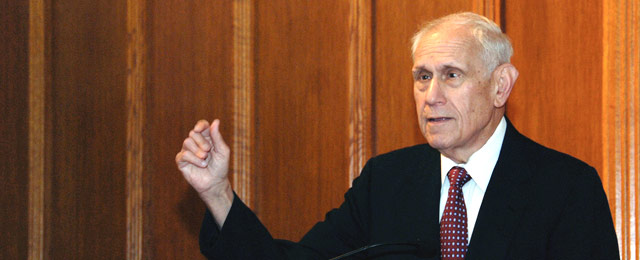
This is an introductory course in Greek history tracing the development of Greek civilization as manifested in political, intellectual, and creative achievements from the Bronze Age to the end of the classical period. Students read original sources in translation as well as the works of modern scholars.

This course presents the principles of evolution, ecology, and behavior for students beginning their study of biology and of the environment. It discusses major ideas and results in a manner accessible to all Yale College undergraduates. Recent advances have energized these fields with results that have implications well beyond their boundaries: ideas, mechanisms, and processes that should form part of the toolkit of all biologists and educated citizens.
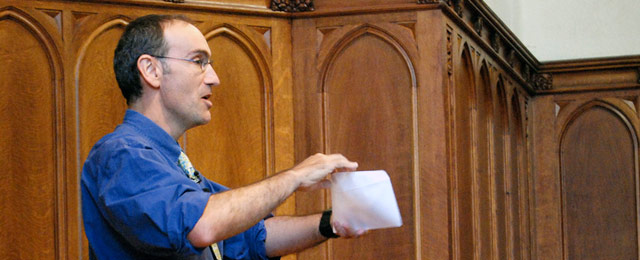
This course is an introduction to game theory and strategic thinking. Ideas such as dominance, backward induction, Nash equilibrium, evolutionary stability, commitment, credibility, asymmetric information, adverse selection, and signaling are discussed and applied to games played in class and to examples drawn from economics, politics, the movies, and elsewhere.

This course focuses on dynamic optimization methods, both in discrete and in continuous time. We approach these problems from a dynamic programming and optimal control perspective. We also study the dynamic systems that come from the solutions to these problems. The course will illustrate how these techniques are useful in various applications, drawing on many economic examples. However, the focus will remain on gaining a general command of the tools so that they can be applied later in other classes.

14.461 is an advanced course in macroeconomics that seeks to bring students to the research frontier. The course is divided into two sections. The first half is taught by Prof. Iván Werning and covers topics such as how to formulate and solve optimal problems. Students will study fiscal and monetary policy, among other issues. The second half, taught by Prof. George-Marios Angeletos, covers recent work on multiple equilibria, global games, and informational fictions.

This course explores the theory behind and evidence on regulatory, tax, and other government responses to problems of market failure. Special emphasis is given to developing and implementing tools to evaluate environmental policies. Other topics include cost-benefit analysis, measurement of the benefits of non-market goods and costs of regulations, and the evaluation of the impact of regulations in areas such as financial markets, workplace health and safety, consumer product safety, and other contexts.

This course covers, with a focus on both theory and empirics, advanced topics in international trade (as well as inter-regional trade and economic geography.) It includes the study of positive issues, such as: Why do countries trade? What goods do countries trade? What are the implications of openness for the location of production, industries, occupations, and innovative activity? And, what impedes trade and why do some countries deliberately erect policy impediments to trade? The course also concerns normative issues, such as: Is trade openness beneficial to a representative agent? And, are there winners and losers from trade and if so, can we identify them? Throughout, these issues are approached in neoclassical settings as well as those with market failures, at the industry-level as well as the firm-level, and in the presence of both mobile and immobile factors (e.g., FDI, offshoring of tasks, multinational firms and immigration).

This is a graduate course in labor economics. The course will focus on covering theory and evidence on inequality, wage structure, skill demands, employment, job loss, and early-life determinants of long-run outcomes. Particular areas of focus are: (1) wage determination, including the Roy model, equalizing wage differentials, and models of discrimination; (2) the roles played by supply, demand, institutions, technology and trade in the evolving distribution of income.
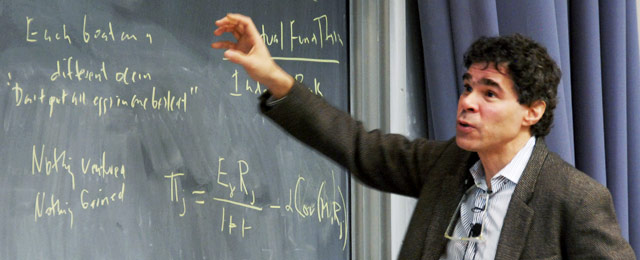
This course attempts to explain the role and the importance of the financial system in the global economy. Rather than separating off the financial world from the rest of the economy, financial equilibrium is studied as an extension of economic equilibrium. The course also gives a picture of the kind of thinking and analysis done by hedge funds.
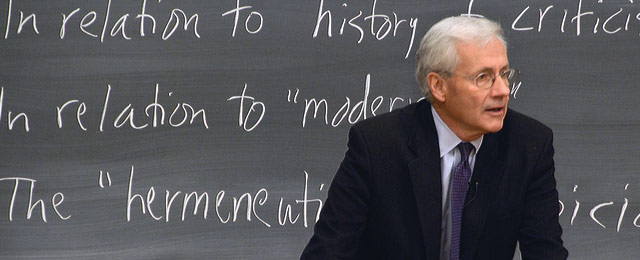
This is a survey of the main trends in twentieth-century literary theory. Lectures will provide background for the readings and explicate them where appropriate, while attempting to develop a coherent overall context that incorporates philosophical and social perspectives on the recurrent questions: what is literature, how is it produced, how can it be understood, and what is its purpose?
This course covers the body of modern poetry, its characteristic techniques, concerns, and major practitioners. The authors discussed range from Yeats, Eliot, and Pound, to Stevens, Moore, Bishop, and Frost with additional lectures on the poetry of World War One, Imagism, and the Harlem Renaissance. Diverse methods of literary criticism are employed, such as historical, biographical, and gender criticism.

Can law change human behavior to be less environmentally damaging? Law will be examined through case histories including: environmental effects of national security, pesticides, air pollution, consumer products, plastics, parks and protected area management, land use, urban growth and sprawl, public/private transit, drinking water standards, food safety, and hazardous site restoration. In each case we will review the structure of law and evaluate its strengths and weaknesses.

This course is a survey of world economic history, and it introduces economics students to the subject matter and methodology of economic history. It is designed to expand the range of empirical settings in students' research by drawing upon historical material and long-run data. Topics are chosen to show a wide variety of historical experience and illuminate the process of industrialization. The emphasis will be on questions related to labor markets and economic growth.

This course emphasizes dynamic models of growth and development. Topics covered include: migration, modernization, and technological change; static and dynamic models of political economy; the dynamics of income distribution and institutional change; firm structure in developing countries; development, transparency, and functioning of financial markets; privatization; and banks and credit market institutions in emerging markets.
At MIT, this course was team taught by Prof. Robert Townsend, who taught for the first half of the semester, and Prof. Abhijit Banerjee, who taught during the second half. On OCW we are only including materials associated with sessions one through 13, which comprise the first half of the class.

This course is designed for students particularly concerned with the practical problems of operating in large formal organizations, either from an operational or a research perspective. It will focus, as the title suggests, upon different forms of economic organizations and institutions in advanced and developing industrial societies and the theories (and theoretical perspectives) which might help us to understand them.

This subject is aimed at students with little or no programming experience. It aims to provide students with an understanding of the role computation can play in solving problems. It also aims to help students, regardless of their major, to feel justifiably confident of their ability to write small programs that allow them to accomplish useful goals. The class will use the Python™ programming language.
Add to calendar

Trusted paper writing service WriteMyPaper.Today will write the papers of any difficulty.