

Online courses directory (19947)

This class presents the fundamental probability and statistical concepts used in elementary data analysis. It will be taught at an introductory level for students with junior or senior college-level mathematical training including a working knowledge of calculus. A small amount of linear algebra and programming are useful for the class, but not required.
Learn fundamental concepts in data analysis and statistical inference, focusing on one and two independent samples.

This course provides techniques of effective presentation of mathematical material. Each section of this course is associated with a regular mathematics subject, and uses the material of that subject as a basis for written and oral presentations. The section presented here is on chaotic dynamical systems.
We present a course developed by the team of Tomsk State University of Control Systems and Radioelectronics.
This course offers basic knowledge in mathematical logic.
The goals of mathematical logic are:
- To provide a formal language for mathematical statements that is easily translatable into the natural language and that allows compact and convenient notation.
- To offer clear and unambiguous interpretation of such statements that is at the same time simple and close to the natural mathematical concepts.
We made sure to make this course informative and interesting for everyone!
What will I learn?
Upon completion of the course, students will have acquired fundamental knowledge that is valuable in itself and will serve as the foundation for other studies. For example, software engineers strongly rely on logic-mathematical theories in their work.
• Natural languages possess a number of flaws - inaccuracy, polysemy, complexity.
• Knowledge of the simple yet powerful methods of mathematical statement transformations made possible by the language of logic is just as vital as is the knowledge of elementary algebra. No need to reinvent the wheel.
• Invented almost a century ago to address the needs of mathematics, mathematical logic has found application in theoretical and practical programming.
• When dealing with applied problems, a researcher has to switch between the descriptive language, mathematical language, the language of numerical methods and algorithms, and specific programming languages. The language of mathematical logic offers a great opportunity to practice this translation between languages and is used as a powerful formalised tool for transmission of information between distant languages.
What do I need to know?
Most of the course content will be understandable for students with only a high school level of education. Some minor sections of the course will require knowledge of imperative programming and elements of mathematical analysis.
Course Structure
The course consists of 7 chapters:
Chapter 1 - Mission of mathematical logic:
Goals, objectives, methods.
Relation between mathematics and mathematical logic.
Examples of logical errors, sophisms and paradoxes.
Brief history of mathematical logic, discussing how problems mathematical logic faced and solved in its development, and how mathematical logic integrates further and further into programming.
Chapter 2 - Foundations of the set theory:
Set theory is the basis for development of languages.
Chapter 3 - Propositional logic:
Propositional logic studies the simplest yet the most important formal language.
Chapter 4 - First-order languages:
The language of propositional logic has limited tools, so we talk about more complex languages based on predicate logic. The language of predicate logic offers tools for full and exact description of any formal notions and statements.
Chapter 5 - Axiomatic method:
The axiomatic method makes it possible to solve many logical problems, errors and paradoxes. It is widely used in today's mathematics and the knowledge of it is vital for anyone using functional and logical programming languages.
Chapter 6 - Mathematical proof:
Discussion of the types of mathematical proof and how proof can be aided with a computer.
Chapter 7 - Algorithm theory:
To learn about the possibilities of the algorithmic approach and the limitations of calculations, one must know the rigorous definition of algorithms and computability. The module offers these definitions and defines algorithmically unsolvable problems. The module introduces the concept of algorithm complexity, which is an important factor when selecting algorithms to solve problems. The module also compares problems by complexity - this knowledge makes it possible to use any search algorithm to solve problem instead of search for the good algorithm.

This graduate-level course is a continuation of Mathematical Methods for Engineers I (18.085). Topics include numerical methods; initial-value problems; network flows; and optimization.

Mathematical Methods for Quantitative Finance covers topics from calculus and linear algebra that are fundamental for the study of mathematical finance. Students successfully completing this course will be mathematically well prepared to study quantitative finance at the graduate level.

Find out what solid-state physics has brought to Electromagnetism in the last 20 years. This course surveys the physics and mathematics of nanophotonics—electromagnetic waves in media structured on the scale of the wavelength.
Topics include computational methods combined with high-level algebraic techniques borrowed from solid-state quantum mechanics: linear algebra and eigensystems, group theory, Bloch's theorem and conservation laws, perturbation methods, and coupled-mode theories, to understand surprising optical phenomena from band gaps to slow light to nonlinear filters.
Note: An earlier version of this course was published on OCW as 18.325 Topics in Applied Mathematics: Mathematical Methods in Nanophotonics, Fall 2005.

How do populations grow? How do viruses spread? What is the trajectory of a glider?
Many real-life problems can be described and solved by mathematical models. In this course, you will form a team with another student and work in a project to solve a real-life problem.
You will learn to analyze your chosen problem, formulate it as a mathematical model (containing ordinary differential equations), solve the equations in the model, and validate your results. You will learn how to implement Euler’s method in a Python program.
If needed, you can refine or improve your model, based on your first results. Finally, you will learn how to report your findings in a scientific way.
This course is mainly aimed at Bachelor students from Mathematics, Engineering and Science disciplines. However it will suit anyone who would like to learn how mathematical modeling can solve real-world problems.

As modern life science research becomes ever more quantitative, the need for mathematical modeling becomes ever more important. A deeper and mechanistic understanding of complicated biological processes can only come from the understanding of complex interactions at many different scales, for instance, the molecular, the cellular, individual organisms and population levels.
In this course, through case studies, we will examine some simplified and idealized mathematical models and their underlying mathematical framework so that we learn how to construct simplified representations of complex biological processes and phenomena. We will learn how to analyze these models both qualitatively and quantitatively and interpret the results in a biological fashion by providing predictions and hypotheses that experimentalists may verify.
当现代生命科学研究变得更加量化,建立数学模型的需求变得越来越重要。对复杂生物现象的深入理解最终是建立在了解发生于多时空间尺度的复杂生物学相互作用上,例如,分子尺度,细胞尺度,个体和群体尺度上。通过研究一些案例,我们将建立一些简化的数学模型以及其背后的基本数学框架。同时,我们将学习如何建立基本生物学过程的简单表征,以及如何定量和定性和定量地的分析这些模型,并将它们的结果以生物学的方式进行解释,以期提供实验学家进行检验的假说和预测。

This graduate level mathematics course covers decision theory, estimation, confidence intervals, and hypothesis testing. The course also introduces students to large sample theory. Other topics covered include asymptotic efficiency of estimates, exponential families, and sequential analysis.

This course provides students with decision theory, estimation, confidence intervals, and hypothesis testing. It introduces large sample theory, asymptotic efficiency of estimates, exponential families, and sequential analysis.

This course covers elementary discrete mathematics for computer science and engineering. It emphasizes mathematical definitions and proofs as well as applicable methods. Topics include formal logic notation, proof methods; induction, well-ordering; sets, relations; elementary graph theory; integer congruences; asymptotic notation and growth of functions; permutations and combinations, counting principles; discrete probability. Further selected topics may also be covered, such as recursive definition and structural induction; state machines and invariants; recurrences; generating functions.

This subject offers an interactive introduction to discrete mathematics oriented toward computer science and engineering. The subject coverage divides roughly into thirds:
- Fundamental concepts of mathematics: Definitions, proofs, sets, functions, relations.
- Discrete structures: graphs, state machines, modular arithmetic, counting.
- Discrete probability theory.
On completion of 6.042J, students will be able to explain and apply the basic methods of discrete (noncontinuous) mathematics in computer science. They will be able to use these methods in subsequent courses in the design and analysis of algorithms, computability theory, software engineering, and computer systems.
Interactive site components can be found on the Unit pages in the left-hand navigational bar, starting with Unit 1: Proofs.

This course covers the mathematical techniques necessary for understanding of materials science and engineering topics such as energetics, materials structure and symmetry, materials response to applied fields, mechanics and physics of solids and soft materials. The class uses examples from the materials science and engineering core courses (3.012 and 3.014) to introduce mathematical concepts and materials-related problem solving skills. Topics include linear algebra and orthonormal basis, eigenvalues and eigenvectors, quadratic forms, tensor operations, symmetry operations, calculus of several variables, introduction to complex analysis, ordinary and partial differential equations, theory of distributions, and fourier analysis.
Users may find additional or updated materials at Professor Carter's 3.016 course Web site.

Broadly speaking, Machine Learning refers to the automated identification of patterns in data. As such it has been a fertile ground for new statistical and algorithmic developments. The purpose of this course is to provide a mathematically rigorous introduction to these developments with emphasis on methods and their analysis.
You can read more about Prof. Rigollet's work and courses on his website.
The second part of our intermediate math course continues our free online maths suite of courses. It covers binomial, normal and hypergeometric distribution, discrete random variables, and integration. This course is ideal for students preparing for an exam, or for those wanting to refresh their knowledge of mathematics.

Kursbeschreibung
Mathematik: das ist Freude am Denken! Und mathematisch denken kann jeder! Wer an diesem Kurs teilnimmt, erhält seine regelmäßige Dosis an meditativen Denkaufgaben, spannenden Knobeleien und mathematischen Einsichten. In den Inhaltsgebieten Arithmetik und Geometrie werden mathematische Denk- und Arbeitsweisen vermittelt, beispielsweise Problemlösen, Begriffe definieren und Sätze finden und beweisen.
Was lerne ich in diesem Kurs?
Im ersten Kursblock werden wir uns mit folgenden Fragen befassen: Wie definiert man mathematische Begriffe? Wie findet man eigentlich mathematische Gesetzmäßigkeiten? Und wie beweist man diese? Welche Rolle spielen Annahmen in der Mathematik? Wie baut sich das Gebäude der Mathematik aus Definitionen, Annahmen und Gesetzmäßgikeiten auf? Fragen über Fragen, denen wir uns mit zahlreichen Experimenten widmen.
Im zweiten Kursblock werden wir die Denk- und Arbeitsweisen aus dem ersten Block in verschiedenen Gebieten anwenden und dadurch festigen. In der Geometrie werden wir uns mit der Tätigkeit des Messens und dem Abstandsbegriff, mit Strecken, Halbgeraden und Geraden, mit Ebenen und Halbenenen und mit Winkeln befassen. In der Arithmetik schauen wir uns den Begriff der Teilbarkeit näher an, veranschaulichen Begriffe wie "größter gemeinsamer Teiler" und "kleinstes gemeinsames Vielfaches", untersuchen Primzahlen und Primfaktorzerlegungen und experimentieren mit Stellenwertsystemen.
Im dritten Kursblock befassen wir uns mit grundlegenden mathematischen Konzepten: Was sind Mengen, Relationen und Funktionen? Auch hier werden wir uns den Begriffen und ihren Zusammenhängen mit grundlegenden mathematischen Denk- und Arbeitsweisen nähern. Experimentieren, erforschen, untersuchen, ergründen, Vermutungen anstellen, Vermutungen verwerfen, Vermutungen beweisen.
Im vierten und letzten Kursblock machen wir uns noch einmal an zentrale Gesetzmäßigkeiten der Mathematik. Wie findet man solche Gesetzmäßgikeiten, und wie beweist man sie? In der Geometrie schauen wir uns schicke Sätze am Kreis an, in der Arithmetik nicht weniger schicke Sätze der Zahlentheorie. Mathematik pur, Mathematik anschaulich, Mathematik handgemacht.
Welche Vorkenntnisse benötige ich?
Jede/r kann mitmachen, der mathematische Vorkenntnisse aus dem Gymnasium mitbringt. Und wenn Du nicht auf dem Gymnasium warst, aber gerne mitmachen möchtest: Dann trau dich! Man sollte natürlich schon mal mit Geometrie und Algebra zu tun gehabt haben. Vieles wird dann wieder aufgefrischt, denn wir machen dann nicht auf dem Niveau der 12. oder 13. Klasse weiter, sondern bauen die Teilgebiete, in denen wir arbeiten, noch einmal grundlegend auf. Oberstufenwissen zu Analysis und Linearer Algebra ist nicht notwendig!
Wie hoch ist der Arbeitsaufwand
Du kannst dich entscheiden, wie aktiv Du dich in den Kurs einbringen möchtest - je nach Interesse und Ehrgeiz!
1) Kiebitze wollen "nur mal gucken" oder mit dem mathematischen Denken erst einmal warm werden. Kiebitze schnuppern jede Woche in den Kurs, schauen sich eins, zwei Videos an und stöbern vielleicht einmal in den weiterführenden Bereichen. Hierdurch bekommen sie einen Einblick, was mathematisches Denken bedeutet, und sie erhalten Impulse, wo man Mathematik auch im Alltag findet und gebrauchen kann. Vielleicht bekommen sie dabei sogar Lust auf mehr! Aufwand: ca. 1-2 Stunden pro Woche
2) Anpacker legen Hand an und erforschen aktiv Mathematik, haben aber keine rechte Lust auf zu viele Formeln. Für Anpacker heißt es: Ärmel hochkrempeln! Im MOOC lernen sie, wie man mathematische Situationen systematisch erforscht, wie man anschauliche Begründungen für mathematische Gesetzmäßgikeiten finden kann, und sie erhalten einen Einblick darin, wie man Abstraktes konkretisiert (und umgekehrt). Sie entwickeln ihre Vorstellungskraft zur Lösung mathematischer Probleme weiter und lernen, Vermutungen anhand konkreter Modelle zu untersuchen. Aufwand: ca. 3-4 Stunden pro Woche
3) Formalisierer geben sich mit der Anschauung nicht zufrieden - sie wollen Formeln sehen! Formalisierer sind Anpacker, die zusätzlich auch noch das Spiel mit abstrakter Symbolsprache lieben. Sie lernen, formale Definitionen zu fassen und formale Beweise zu führen. Natürlich immer basierend auf tragfähigen Vorstellungen, die sie mit den Anpackern teilen! Aufwand: ca. 7-8 Stunden pro Woche
Du möchtest ein Kiebitz in der Arithmetik sein, aber ein Anpacker in der Geometrie? Oder ein Formalisierer in der Arithmetik, aber ein Kiebitz in der Geometrie? Kein Problem - alles ist möglich! So kannst Du deinen individuellen Aufwand selbst wählen und dir diejenigen Inhalte zusammenstellen, die dich interessieren.
Erhalte ich ein Zertifikat?
Du erhältst eine Teilnahmebestätigung, wenn du aktiv mitmachst. Wie das genau geht, wird in der ersten Woche erklärt.
2003 AIME II Problem 1. 2003 AIME II Problem 3. Sum of factors of 27000. Sum of factors 2. 2003 AIME II Problem 4 (part 1). 2003 AIME II Problem 4 (part 2). 2003 AIME II Problem 5. 2003 AIME II Problem 5 Minor Correction. Area Circumradius Formula Proof. 2003 AIME II Problem 6. 2003 AIME II Problem 7. 2003 AIME II Problem 8. Sum of Polynomial Roots (Proof). Sum of Squares of Polynomial Roots. 2003 AIME II Problem 9. 2003 AIME II Problem 10. 2003 AIME II Problem 11. 2003 AIME II Problem 12. 2003 AIME II Problem 13. 2003 AIME II Problem 14. 2003 AIME II Problem 15 (part 1). 2003 AIME II Problem 15 (part 2). 2003 AIME II Problem 15 (part 3). 2003 AIME II Problem 1. 2003 AIME II Problem 3. Sum of factors of 27000. Sum of factors 2. 2003 AIME II Problem 4 (part 1). 2003 AIME II Problem 4 (part 2). 2003 AIME II Problem 5. 2003 AIME II Problem 5 Minor Correction. Area Circumradius Formula Proof. 2003 AIME II Problem 6. 2003 AIME II Problem 7. 2003 AIME II Problem 8. Sum of Polynomial Roots (Proof). Sum of Squares of Polynomial Roots. 2003 AIME II Problem 9. 2003 AIME II Problem 10. 2003 AIME II Problem 11. 2003 AIME II Problem 12. 2003 AIME II Problem 13. 2003 AIME II Problem 14. 2003 AIME II Problem 15 (part 1). 2003 AIME II Problem 15 (part 2). 2003 AIME II Problem 15 (part 3).
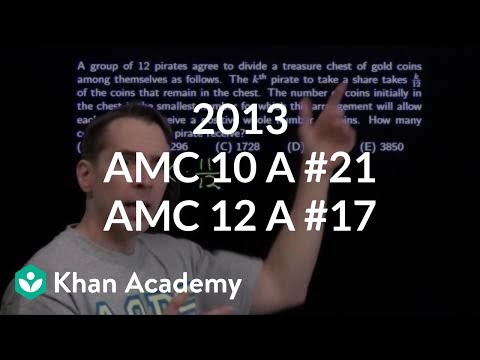
The AMC 10 is part of the series of contests administered by the MAA American Mathematics Competitions that determines the United States team in the International Math Olympiad. The AMC 10 is a 25 question, 75 minute multiple choice test for students in 10th grade or below. Two versions of the AMC 10 are offered each year. 2013 AMC 10 A #21 / AMC 12 A #17. 2013 AMC 10 A #22 / AMC 12 A #18. 2013 AMC 10 A #23 / AMC 12 A #19. 2013 AMC 10 A #24. 2013 AMC 10 A #25. 2013 AMC 10 A #21 / AMC 12 A #17. 2013 AMC 10 A #22 / AMC 12 A #18. 2013 AMC 10 A #23 / AMC 12 A #19. 2013 AMC 10 A #24. 2013 AMC 10 A #25.

Planning to study for an MBA but unsure of your basic maths skills? All MBA programs require some maths, particularly on quantitative subjects such as Accounting, Economics and Finance.
In this mathematics course, you will learn the fundamental business math skills needed to succeed in your MBA study. These math skills will also give you an edge in the workplace enabling you to apply greater analytical skill to your decision making.
You will learn how to evaluate and manipulate the types of formulae that appear in an accounting syllabus, how to perform the calculus required to solve optimization problems in economics and how to apply the concept of geometric series to solving finance-related problems such as calculating compound interest payments.
This course assumes no prior knowledge of business maths, concepts are explained clearly and regular activities give you the opportunity to practice your skills and improve your confidence.
Add to calendar

Trusted paper writing service WriteMyPaper.Today will write the papers of any difficulty.