

Online courses directory (19947)

This freshman-level course is the second semester of introductory physics. The focus is on electricity and magnetism, including electric fields, magnetic fields, electromagnetic forces, conductors and dielectrics, electromagnetic waves, and the nature of light.
Course Format
 This course has been designed for independent study. It includes all of the materials you will need to understand the concepts covered in this subject. The materials in this course include:
- A complete set of Lecture Videos by renowned MIT Physics Professor Walter Lewin
- A complete set of detailed Course Notes, replacing the need for a traditional course textbook
- A complete set of Class Slides, with overviews and illustrations of the concepts and applications of the subject
- Homework Problems and Concept Questions to gauge your understanding of and progress through the materials
- Homework Help Videos in which Prof. Lewin takes viewers step-by-step through solving homework problems
- Visualizations of electromagnetic phenomena which are normally invisible to the human eye
- An online study group at OpenStudy where you can connect with other independent learners
The content has been organized for linear progression through each of the Course Modules, starting with Electric Fields and concluding with The Nature of Light. It is a self-study course that you can work through at your own pace.
About OCW Scholar
OCW Scholar courses are designed specifically for OCW's single largest audience: independent learners. These courses are substantially more complete than typical OCW courses, and include new custom-created content as well as materials repurposed from previously published courses. Learn more about OCW Scholar.

This freshman-level course is the second semester of introductory physics. The focus is on electricity and magnetism. The subject is taught using the TEAL (Technology Enabled Active Learning) format which utilizes small group interaction and current technology. The TEAL/Studio Project at MIT is a new approach to physics education designed to help students develop much better intuition about, and conceptual models of, physical phenomena.
Staff List
Visualizations:
Prof. John Belcher
Instructors:
Dr. Peter Dourmashkin
Prof. Bruce Knuteson
Prof. Gunther Roland
Prof. Bolek Wyslouch
Dr. Brian Wecht
Prof. Eric Katsavounidis
Prof. Robert Simcoe
Prof. Joseph Formaggio
Course Co-Administrators:
Dr. Peter Dourmashkin
Prof. Robert Redwine
Technical Instructors:
Andy Neely
Matthew Strafuss
Course Material:
Dr. Peter Dourmashkin
Prof. Eric Hudson
Dr. Sen-Ben Liao
Acknowledgements
The TEAL project is supported by The Alex and Brit d'Arbeloff Fund for Excellence in MIT Education, MIT iCampus, the Davis Educational Foundation, the National Science Foundation, the Class of 1960 Endowment for Innovation in Education, the Class of 1951 Fund for Excellence in Education, the Class of 1955 Fund for Excellence in Teaching, and the Helena Foundation. Many people have contributed to the development of the course materials. (PDF)

This course runs parallel to 8.02, but assumes that students have some knowledge of vector calculus. The class introduces Maxwell's equations, in both differential and integral form, along with electrostatic and magnetic vector potential, and the properties of dielectrics and magnetic materials.
This class was taught by an undergraduate in the Experimental Study Group (ESG). Student instructors are paired with ESG faculty members, who advise and oversee the students' teaching efforts.
This course runs parallel to 8.02, but assumes that students have some knowledge of vector calculus. The class introduces Maxwell's equations, in both differential and integral form, along with electrostatic and magnetic vector potential, and the properties of dielectrics and magnetic materials.
This class was taught by an undergraduate in the Experimental Study Group (ESG). Student instructors are paired with ESG faculty members, who advise and oversee the students' teaching efforts.

Mechanical vibrations and waves, simple harmonic motion, superposition, forced vibrations and resonance, coupled oscillations and normal modes, vibrations of continuous systems, reflection and refraction, phase and group velocity. Optics, wave solutions to Maxwell's equations, polarization, Snell's law, interference, Huygens's principle, Fraunhofer diffraction, and gratings.

This is the third course in the core physics curriculum at MIT, following 8.01 Physics I: Classical Mechanics and 8.02 Physics II: Electricity and Magnetism. Topics include mechanical vibrations and waves, electromagnetic waves, and optics. Students will learn about musical instruments, red sunsets, glories, coronae, rainbows, haloes, X-ray binaries, neutron stars, black holes and Big Bang cosmology.
Course Components
- Lecture Videos by MIT Physics Professor Walter Lewin
- Viewing Notes aligned with the lecture videos
- Concept Questions to gauge your understanding
- Problem Sets and Exams with Solutions
- Problem Solving Help Videos by MIT Physics Professor Wit Busza


This course is offered to graduates and focuses on understanding the fundamental principles of the "front-end" processes used in the fabrication of devices for silicon integrated circuits. This includes advanced physical models and practical aspects of major processes, such as oxidation, diffusion, ion implantation, and epitaxy. Other topics covered include: high performance MOS and bipolar devices including ultra-thin gate oxides, implant-damage enhanced diffusion, advanced metrology, and new materials such as Silicon Germanium (SiGe).

SP.255 is a lecture, discussion, and project based seminar about the physics of rock climbing. Participants are first exposed to the unsolved problems in the climbing community that could be answered by research and then asked to solve a small part of one of these problems. The seminar provides an introduction to engineering problems, an opportunity to practice communication skills, and a brief stab at doing some research. This seminar explicitly does not include climbing instruction nor is climbing/mountaineering experience a prerequisite.
SP.255 is a lecture, discussion, and project based seminar about the physics of rock climbing. Participants are first exposed to the unsolved problems in the climbing community that could be answered by research and then asked to solve a small part of one of these problems. The seminar provides an introduction to engineering problems, an opportunity to practice communication skills, and a brief stab at doing some research. This seminar explicitly does not include climbing instruction nor is climbing/mountaineering experience a prerequisite.

SP.255 is a lecture, discussion, and project based seminar about the physics of rock climbing. Participants are first exposed to the unsolved problems in the climbing community that could be answered by research and then asked to solve a small part of one of these problems. The seminar provides an introduction to engineering problems, an opportunity to practice communication skills, and a brief stab at doing some research. This seminar explicitly does not include climbing instruction nor is climbing/mountaineering experience a prerequisite.

This course offers an introduction to the basic concepts of the quantum theory of solids.

This course introduces the basics of Digital Signal Processing and computational acoustics, motivated by the vibrational physics of real-world objects and systems. We will build from a simple mass-spring and pendulum to demonstrate oscillation, learn how to simulate those systems in the computer, and also prove that these simple oscillations behave as a sine wave. From that we move to plucked strings and struck bars, showing both solutions as combined traveling waves and combined sine wave harmonics. We continue to build and simulate more complex systems containing many vibrating objects and resonators (stringed instruments, drum, plate), and also learn how to simulate echos and room reverberation. Through this process, we will learn about digital signals, filters, oscillators, harmonics, spectral analysis, linear and non-linear systems, particle models, and all the necessary building blocks to synthesize essentially any sound. The free open-source software provided will make it possible for anyone to use physical models in their art-making, game or movie sound, or any other application.
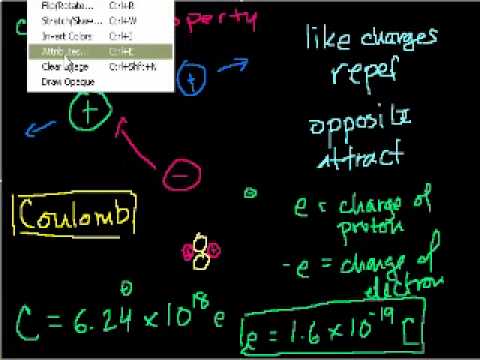
Electrostatics (part 1): Introduction to Charge and Coulomb's Law. Electrostatics (part 2). Proof (Advanced): Field from infinite plate (part 1). Proof (Advanced): Field from infinite plate (part 2). Electric Potential Energy. Electric Potential Energy (part 2-- involves calculus). Voltage. Capacitance. Circuits (part 1). Circuits (part 2). Circuits (part 3). Circuits (part 4). Cross product 1. Cross Product 2. Cross Product and Torque. Introduction to Magnetism. Magnetism 2. Magnetism 3. Magnetism 4. Magnetism 5. Magnetism 6: Magnetic field due to current. Magnetism 7. Magnetism 8. Magnetism 9: Electric Motors. Magnetism 10: Electric Motors. Magnetism 11: Electric Motors. Magnetism 12: Induced Current in a Wire. The dot product. Dot vs. Cross Product. Calculating dot and cross products with unit vector notation. Electrostatics (part 1): Introduction to Charge and Coulomb's Law. Electrostatics (part 2). Proof (Advanced): Field from infinite plate (part 1). Proof (Advanced): Field from infinite plate (part 2). Electric Potential Energy. Electric Potential Energy (part 2-- involves calculus). Voltage. Capacitance. Circuits (part 1). Circuits (part 2). Circuits (part 3). Circuits (part 4). Cross product 1. Cross Product 2. Cross Product and Torque. Introduction to Magnetism. Magnetism 2. Magnetism 3. Magnetism 4. Magnetism 5. Magnetism 6: Magnetic field due to current. Magnetism 7. Magnetism 8. Magnetism 9: Electric Motors. Magnetism 10: Electric Motors. Magnetism 11: Electric Motors. Magnetism 12: Induced Current in a Wire. The dot product. Dot vs. Cross Product. Calculating dot and cross products with unit vector notation.
Fluids (part 1). Fluids (part 2). Fluids (part 3). Fluids (part 4). Fluids (part 5). Fluids (part 6). Fluids (part 7). Fluids (part 8). Fluids (part 9). Fluids (part 10). Fluids (part 11). Fluids (part 12). Fluids (part 1). Fluids (part 2). Fluids (part 3). Fluids (part 4). Fluids (part 5). Fluids (part 6). Fluids (part 7). Fluids (part 8). Fluids (part 9). Fluids (part 10). Fluids (part 11). Fluids (part 12).
This tutorial is the meat of much of classical physics. We think about what a force is and how Newton changed the world's (and possibly your) view of how reality works. Newton's First Law of Motion. Newton's First Law of Motion Concepts. Newton's First Law of Motion. Newton's First Law. Newton's Second Law of Motion. Newton's Third Law of Motion. Newton's Third Law of Motion. All of Newton's Laws of Motion. Normal Force and Contact Force. Normal Force in an Elevator. Balanced and Unbalanced Forces. Unbalanced Forces and Motion. Slow Sock on Lubricon VI. Normal Forces on Lubricon VI. Inclined Plane Force Components. Ice Accelerating Down an Incline. Force of Friction Keeping the Block Stationary. Correction to Force of Friction Keeping the Block Stationary. Force of Friction Keeping Velocity Constant. Intuition on Static and Kinetic Friction Comparisons. Static and Kinetic Friction Example. Introduction to Tension. Introduction to Tension (Part 2). Tension in an accelerating system and pie in the face. Newton's First Law of Motion. Newton's First Law of Motion Concepts. Newton's First Law of Motion. Newton's First Law. Newton's Second Law of Motion. Newton's Third Law of Motion. Newton's Third Law of Motion. All of Newton's Laws of Motion. Normal Force and Contact Force. Normal Force in an Elevator. Balanced and Unbalanced Forces. Unbalanced Forces and Motion. Slow Sock on Lubricon VI. Normal Forces on Lubricon VI. Inclined Plane Force Components. Ice Accelerating Down an Incline. Force of Friction Keeping the Block Stationary. Correction to Force of Friction Keeping the Block Stationary. Force of Friction Keeping Velocity Constant. Intuition on Static and Kinetic Friction Comparisons. Static and Kinetic Friction Example. Introduction to Tension. Introduction to Tension (Part 2). Tension in an accelerating system and pie in the face.

Classical gravity. How masses attract each other (according to Newton). Introduction to Gravity. Mass and Weight Clarification. Gravity for Astronauts in Orbit. Would a Brick or Feather Fall Faster. Acceleration Due to Gravity at the Space Station. Space Station Speed in Orbit. Introduction to Newton's Law of Gravitation. Gravitation (part 2). Introduction to Gravity. Mass and Weight Clarification. Gravity for Astronauts in Orbit. Would a Brick or Feather Fall Faster. Acceleration Due to Gravity at the Space Station. Space Station Speed in Orbit. Introduction to Newton's Law of Gravitation. Gravitation (part 2).

Build your earth science vocabulary and learn about cycles of matter and types of sedimentary rocks through the Education Portal course Earth Science 101: Earth Science. Our series of video lessons and accompanying self-assessment quizzes can help you boost your scientific knowledge ahead of the Excelsior Earth Science exam . This course was designed by experienced educators and examines both science basics, like experimental design and systems of measurement, and more advanced topics, such as analysis of rock deformation and theories of continental drift.

Linear momentum. Conservation of momentum. Elastic collisions. Introduction to Momentum. Momentum: Ice skater throws a ball. 2-dimensional momentum problem. 2-dimensional momentum problem (part 2). Introduction to Momentum. Momentum: Ice skater throws a ball. 2-dimensional momentum problem. 2-dimensional momentum problem (part 2).
Relationship between angular velocity and speed. Why Distance is Area under Velocity-Time Line. Introduction to Vectors and Scalars. Calculating Average Velocity or Speed. Solving for Time. Displacement from Time and Velocity Example. Acceleration. Balanced and Unbalanced Forces. Unbalanced Forces and Motion. Newton's First Law of Motion. Newton's First Law of Motion Concepts. Newton's First Law of Motion. Newton's Second Law of Motion. Newton's Third Law of Motion. Airbus A380 Take-off Time. Airbus A380 Take-off Distance. Average Velocity for Constant Acceleration. Acceleration of Aircraft Carrier Takeoff. Race Cars with Constant Speed Around Curve. Introduction to Gravity. Mass and Weight Clarification. Gravity for Astronauts in Orbit. Would a Brick or Feather Fall Faster. Deriving Displacement as a Function of Time, Acceleration and Initial Velocity. Plotting Projectile Displacement, Acceleration, and Velocity. Projectile Height Given Time. Deriving Max Projectile Displacement Given Time. Impact Velocity From Given Height. Visualizing Vectors in 2 Dimensions. Projectile at an Angle. Different Way to Determine Time in Air. Launching and Landing on Different Elevations. Total Displacement for Projectile. Total Final Velocity for Projectile. Correction to Total Final Velocity for Projectile. Projectile on an Incline. Unit Vectors and Engineering Notation. Clearing the Green Monster at Fenway. Green Monster at Fenway Part 2. Optimal angle for a projectile part 1. Optimal angle for a projectile part 2 - Hangtime. Optimal angle for a projectile part 3 - Horizontal distance as a function of angle (and speed). Optimal angle for a projectile part 4 Finding the optimal angle and distance with a bit of calculus. Slow Sock on Lubricon VI. Normal Forces on Lubricon VI. Normal Force and Contact Force. Normal Force in an Elevator. Inclined Plane Force Components. Ice Accelerating Down an Incline. Force of Friction Keeping the Block Stationary. Correction to Force of Friction Keeping the Block Stationary. Force of Friction Keeping Velocity Constant. Intuition on Static and Kinetic Friction Comparisons. Static and Kinetic Friction Example. Introduction to Tension. Introduction to Tension (Part 2). Tension in an accelerating system and pie in the face. Introduction to Momentum. Momentum: Ice skater throws a ball. 2-dimensional momentum problem. 2-dimensional momentum problem (part 2). Introduction to work and energy. Work and Energy (part 2). Conservation of Energy. Work/Energy problem with Friction. Introduction to mechanical advantage. Mechanical Advantage (part 2). Mechanical Advantage (part 3). Center of Mass. Introduction to Torque. Moments. Moments (part 2). Unit Vector Notation. Unit Vector Notation (part 2). Projectile Motion with Ordered Set Notation. Projectile motion (part 1). Projectile motion (part 2). Projectile motion (part 3). Projectile motion (part 4). Projectile motion (part 5). Centripetal Force and Acceleration Intuition. Visual Understanding of Centripetal Acceleration Formula. Calculus proof of centripetal acceleration formula. Loop De Loop Question. Loop De Loop Answer part 1. Loop De Loop Answer part 2. Acceleration Due to Gravity at the Space Station. Space Station Speed in Orbit. Conservation of angular momentum. Introduction to Newton's Law of Gravitation. Gravitation (part 2). Viewing g as the value of Earth's Gravitational Field Near the Surface. Intro to springs and Hooke's Law. Potential energy stored in a spring. Spring potential energy example (mistake in math). Introduction to Harmonic Motion. Harmonic Motion Part 2 (calculus). Harmonic Motion Part 3 (no calculus).
Thinking about making things rotate. Center of mass, torque, moments and angular velocity. Center of Mass. Introduction to Torque. Moments. Moments (part 2). Relationship between angular velocity and speed. Conservation of angular momentum. Center of Mass. Introduction to Torque. Moments. Moments (part 2). Relationship between angular velocity and speed. Conservation of angular momentum.
