

Online courses directory (19947)
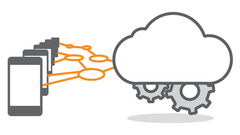
In this course we will learn how to connect Android mobile devices to cloud computing and data storage resources, essentially turning a device into an extension of powerful cloud-based services on popular cloud computing platforms, such as Google App Engine and Amazon EC2.

Get even better with training
In the free online course Programming Concepts with Python you will learn about programming concepts using the Python programming language. You will learn how to display text on screen and about reading user input into your program. You will also learn about creating variables and manipulating them using functions. You will learn that everyone makes mistakes when programming and you are shown solutions to help you find and fix those mistakes.<br /><br />The course begins by introducing you to what programming is and the possibilities of what you can create with programming. You will learn about the advantages of using Python to start learning how to program and you will be introduced to creating a Python project in Visual Studio. <br /><br />Next, the course teaches you about displaying text on screen using the print function. You will learn about the different variation of quotes that Python uses to contain your text, and how to get the user to input data. The course then introduces you to variables, what they are and how to create them. You will learn about manipulating variables using built-in functions. Finally, you will learn about Visual Studio's built-in feature called IntelliSense and its features and functions that will help you with your programming.<br /><br />This free Alison course will be of great interest to all learners who would like to learn about programming concepts and how to write their own programs using the Python programming language.<br />

Start Here and Build a Strong Foundation for Learning Web, Mobile and Game Development.

Learning to code C#? We have provided HD video lectures, live coding sessions, and nearly 100 exercises to learn on!

There is a rising demand for people with the skills to work with Big Data sets and this course can start you on your journey through our Big Data MicroMasters program towards a recognised credential in this highly competitive area.
Using practical activities and our innovative ProcessingJS Workspace application you will learn how digital technologies work and will develop your coding skills through engaging and collaborative assignments.
You will learn algorithm design as well as fundamental programming concepts such as data selection, iteration and functional decomposition, data abstraction and organisation. In addition to this you will learn how to perform simple data visualisations using ProcessingJS and embed your learning using problem-based assignments.
This course will test your knowledge and skills in solving small-scale data science problems working with real-world datasets and develop your understanding of big data in the world around you.

Are you an entrepreneur with zero coding experience? - Learn the basics of web development with this beginners course!

Learn JavaScript from scratch and get started with that website/app/game project!

Websites and HTML5 apps have to be dynamic and interactive

This course aims to teach everyone to learn the basics of programming computers using Python. The course has no pre-requisites and avoids all but the simplest mathematics. Anyone with moderate computer experience should be able to master the materials in this course.

Every day, computers and algorithms touch your life in both mundane and profound ways. They are in the plants and distribution systems that bring you electricity and clean water, sensors that moderate the flow of traffic, in the tractors and combines that sow and harvest your food, and in the satellites that measure and predict the weather.
If you are curious about what computers can do, and how we instruct them to do those things - this course is for you. No prior programming experience is needed. More than just exposure to programming, you’ll gain a powerful set of thinking and problem-solving skills that you can use in your daily life.
Start taking advantage of the computer power around us to make our world a better place.
This is a three-credit course at Arizona State University (CSE 110 Principles of Programming) and satisfies the Computer/Statistics/Quantitative (CS) general studies requirement.

Explore free tools, techniques and ideas to inspire fun and creativity in your children's approach to programming.

Learn how to speak with developers. Designed for entrepreneurs, businesses, and junior developers.

JavaScript is the programming language of the World Wide Web.
As a professional web software developer, you will not only need to know how to program in this simple yet powerful language, but you will need to understand the fundamentals of how data is exchanged on the World Wide Web (WWW) and what tools and frameworks are available to you for creating robust, interactive web applications.
This course, part of the CS Essentials for Software Development Professional Certificate program, provides an introduction to modern web development using JavaScript. In addition to exploring the basics of web page creation using HTML and CSS, you will learn advanced web page layout and responsive design tools such as Bootstrap. You will also learn how browsers represent a web page data using the Document Object Model (DOM) and how to develop dynamic, interactive web pages using JavaScript in the browser. Beyond fundamental JavaScript syntax and advanced language features such as callbacks, events, and asynchronous programming, you will work with jQuery, which provides functionality for simplified DOM manipulation and event handling.
This course will teach you how to represent and exchange data using JavaScript Object Notation (JSON), and will discuss key principles of object-oriented programming and see how they are used in JavaScript.
We will also introduce you to modern web frameworks and component-based libraries such as React for efficiently developing modular web page components, which improve scalability and maintainability. We will also cover modern software methodologies such as model-driven development, and architectures such as model-view-controller (MVC) and model-view-presenter (MVP). We will explore how they are used by teams of professional software developers to create high quality applications.
Server-side JavaScript is becoming more prevalent in the industry, with web frameworks such as Node.js making it simple to create and deploy complex, data-driven web applications. This course will prepare you to use such frameworks by covering important technologies such as HTTP and RESTful APIs.

In this introductory programming class, you’ll learn Object-Oriented Programming, a must-have technique for software engineers that will allow you to reuse and share code easily. You’ll learn by doing, and will build byte-sized (ha!) mini projects in each lesson to learn and practice programming concepts. We’ve heard that programming can be intimidating for newcomers, and we’ve created this course to make sure that you have a great learning experience! You’ll learn ***actively*** with our mini projects (see the awesome list below), which you’ll be able to share proudly with your friends. You’ll also learn important programming concepts one by one, with no surprises or leaps of logic along the way. You’ll pick up some great tools for your programming toolkit in this course! You will: - Start coding in the programming language Python; - Reuse and share code with Object-Oriented Programming; - Create and share amazing, life-hacking projects! This introductory course is for you if you want to be a software engineer, or if you want to collaborate with programmers. Mastering Object-Oriented Programming will propel your career in tech forward, and it’s also a great way to learn how software engineers think about solving problems. This course is also a part of our Full Stack Web Developer Nanodegree.

Learn the basics of F# syntax in this programming course from the experts at Microsoft, and begin your journey into the world of functional and modular programming.
Why learn F#? F# is about getting things done. The language has been attractive to groups working in finance and math-intensive disciplines but it broadens the ability of any developer to correctly express more powerful programming ideas in a safer way. So regardless of your programming background, learning F# can help make you a more effective programmer.
The first part of this course provides the groundwork and fundamentals necessary to build functional applications. It will provide a framework of functional programming concepts by giving the student clear examples and the opportunity to practice writing code using those concepts. The course will also provide you with the basics of F# syntax and the core features of the language.
The second part of this course will dive deeper into the more advanced concepts of F# such as concurrency, integration with other languages, type providers, and agents. By the end of this two-part course you will have a solid foundation in functional programming with F#.
To be successful in this course, you should have an understanding of fundamental programming concepts. Knowing the basics of program flow, conditionals, and loops will provide a good foundation for the concepts taught in this course. There are a number of excellent resources available on edX and Microsoft Virtual Academy to help you pick up those skills before jumping in.
We look forward to spending the next few weeks with you helping you explore and understand F#.
Wildly popular due to its interactive multimedia capabilities, Java programming leads the list of Internet development skills in current commercial demand. This course is recommended for people who wish to become familiar with the principles of Java Programming. Through the use of hands-on exercises, students will explore the Java language fundamentals as well as basic concepts of object-oriented programming. At the end of this course, students will be able to:

“Although many of the programs designed to teach kids to code are very simplistic, many of them, like Scratch, are suitable for all ages. It doesn't matter how old you are…Get started with the basics of programming!” -Lifehacker
Want to learn computer programming, but unsure where to begin? This is the course for you! Scratch is the computer programming language that makes it easy and fun to create interactive stories, games and animations and share them online.
This course is an introduction to computer science using the programming language Scratch, developed by MIT. Starting with the basics of using Scratch, the course will stretch your mind and challenge you. You will learn how to create amazing games, animated images and songs in just minutes with a simple “drag and drop” interface.
No previous programming knowledge needed. Join us as you start your computer science journey.
This material is based upon work supported by the National Science Foundation under Grant No. 1044106. Any opinions, findings and conclusions or recommendations expressed in this material are those of the author(s) and do not necessarily reflect the views of the National Science Foundation (NSF).

Learn Java Programming at your own Pace. Comes Complete with Working Files and a Verifiable Certificate of Completion.

This class will give you an introduction to the fundamentals of programming languages. Key concepts include how to specify and process valid strings, sentences and program structures.
Add to calendar

Trusted paper writing service WriteMyPaper.Today will write the papers of any difficulty.