

Online courses directory (19947)

This course examines the policy and planning for the provision of water supply and sanitation services in developing countries. It reviews available technologies, but emphasizes the planning and policy process, including economic, social, environmental, and health issues. The course incorporates considerations of financing, pricing, institutional structure, consumer demand, and community participation in the planning process. And it evaluates policies and projects in case studies from Asia, Africa, Latin America, and Central and Eastern Europe.

This course is an overview of engineering approaches to protecting water quality with an emphasis on fundamental principals. Theory and conceptual design of systems for treating municipal wastewater and drinking water are discussed, as well as reactor theory, process kinetics, and models. Physical, chemical, and biological processes are presented, including sedimentation, filtration, biological treatment, disinfection, and sludge processing. Finally, there is discussion of engineered and natural processes for wastewater treatment.

Biochemical technology in water and wastewater treatment engineering is essential in the field of water treatment. In this environmental studies course you will learn the basic principles and characteristics of biochemical technology.
This knowledge is necessary for those in the environmental field. In this course we will use real world cases and vivid explanations to help you better understand the biological treatment process.
《水处理工程》是环境工程、环境科学、市政工程等相关专业的主干专业课。本课程旨在向学生全面讲授水和废水处理中主要的生物处理技术单元的基本原理和特点、工艺的基本计算方法和应用范围、主要构筑物的构成和运行特点、典型的水与废水处理工艺以及相关技术的国内外最新研究进展。主要讲述废水的好氧和厌氧生物处理工艺、生物脱氮除磷工艺、废水的天然处理工艺以及污泥的处理与处置。

This introductory environmental science, environmental engineering and municipal engineering course will explore how physicochemical technology and techniques are applied to water and wastewater treatment. We will explore the basic calculation method, composition of structures and operation characteristics, and the latest advancements in water and wastewater treatment technology. Main physicochemical units, including coagulation and flocculation, sedimentation, flotation, filtration, disinfection, oxidation and reduction, membrane separation and ionic exchange, will be covered.
《水处理工程》是清华大学为环境工程、环境科学、市政工程等相关专业学生开设的主干专业课,包括物化处理技术和生化处理技术两大部分。《水处理工程-物化技术》旨在向学生全面讲授水和废水处理中主要的物化处理技术单元的基本原理和特点、工艺的基本计算方法和应用范围、主要构筑物的构成和运行特点、典型的水与废水处理工艺以及相关技术的国内外最新研究进展。本课程介绍的主要物化技术单元包括:混凝、沉淀与澄清、气浮、过滤、消毒、离子交换、膜分离、氧化还原和吸附。
This course combines an overview of the science behind water and climate in the Western United States with a survey of the major legal, political, and cultural issues focused on this precious resource.

In this Public Service Design Seminar (PSDS), we will design and build products with developmentally disabled students at the Protestant Guild Learning Center in Waltham, MA. The class will work closely with community clients to make sure that what is developed is helpful and functional. These products will be built using the Hobby Shop equipment, the water jet machine in particular. Over the course of the seminar, this class will teach students how to use the OMAX® Jet Machining Center commonly called the water jet and associated OMAX® software. The product development process will also be detailed in depth: determining customer needs, concept development, prototyping, design, and manufacturing.

In this Public Service Design Seminar (PSDS), we will design and build products with developmentally disabled students at the Protestant Guild Learning Center in Waltham, MA. The class will work closely with community clients to make sure that what is developed is helpful and functional. These products will be built using the Hobby Shop equipment, the water jet machine in particular. Over the course of the seminar, this class will teach students how to use the OMAX® Jet Machining Center commonly called the water jet and associated OMAX® software. The product development process will also be detailed in depth: determining customer needs, concept development, prototyping, design, and manufacturing.

The course material emphasizes mathematical models for predicting distribution and fate of effluents discharged into lakes, reservoirs, rivers, estuaries, and oceans. It also focuses on formulation and structure of models as well as analytical and simple numerical solution techniques. Also discussed are the role of element cycles, such as oxygen, nitrogen, and phosphorus, as water quality indicators; offshore outfalls and diffusion; salinity intrusion in estuaries; and thermal stratification, eutrophication, and sedimentation processes in lakes and reservoirs. This course is a core requirement for the Environmental MEng program.

This subject is concerned with quantitative methods for analyzing large-scale water resource problems. Topics covered include the design and management of facilities for river basin development, flood control, water supply, groundwater remediation, and other activities related to water resources. Simulation models and optimization methods are often used to support analyses of water resource problems. In this subject we will be constructing simulation models with the MATLAB® programming language and solving numerical optimization problems with the GAMS optimization package.

This course will examine current conditions and trends in water and sanitation services in low and middle income countries. Within it we will take a critical look at the underlying political, economic, social, and technical reasons why almost a billion people lack access to improved water supplies and almost 2 billion still do not have improved sanitation services.

Recent water issues, increasing populations worldwide, and variations in climate have impacted our water supply, creating questions and issues we’ve never been challenged with before...
Recent water issues, increasing populations worldwide, and variations in climate have impacted our water supply, creating questions and issues we’ve never been challenged with before...
Recent water issues, increasing populations worldwide, and variations in climate have impacted our water supply, creating questions and issues we’ve never been challenged with before...
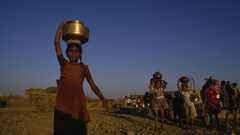
Using water as the unifying theme, explore ocean and freshwater topics and instructional strategies to integrate environmental content in your teaching practice.

A step by step guide on how to use Watercolours and make your first painting

This course is an introduction to basic ideas of geophysical wave motion in rotating, stratified, and rotating-stratified fluids. Subject begins with general wave concepts of phase and group velocity. It also covers the dynamics and kinematics of gravity waves with a focus on dispersion, energy flux, initial value problems, etc.

This course discusses the Linearized theory of wave phenomena in applied mechanics. Examples are chosen from elasticity, acoustics, geophysics, hydrodynamics and other subjects. The topics include: basic concepts, one dimensional examples, characteristics, dispersion and group velocity, scattering, transmission and reflection, two dimensional reflection and refraction across an interface, mode conversion in elastic waves, diffraction and parabolic approximation, radiation from a line source, surface Rayleigh waves and Love waves in elastic media, waves on the sea surface and internal waves in a stratified fluid, waves in moving media, ship wave pattern, atmospheric lee waves behind an obstacle, and waves through a laminated media.

Wavelets are localized basis functions, good for representing short-time events. The coefficients at each scale are filtered and subsampled to give coefficients at the next scale. This is Mallat's pyramid algorithm for multiresolution, connecting wavelets to filter banks. Wavelets and multiscale algorithms for compression and signal/image processing are developed. Subject is project-based for engineering and scientific applications.

PHYS201x follows introductory physics courses with a more detailed treatment of oscillators, waves on strings, and electromagnetic waves. In addition to deriving and solving the wave equation, mathematical methods will be introduced on making approximations, describing oscillations with complex numbers, and synthesizing functions with Fourier series. Optical reflection and refraction will be derived, as well as the lens equation and elements of geometrical optics. Optical interference, diffraction, and polarization will be covered in detail, including the role of diffraction in image formation. PHYS201x will have weekly video lectures that explain the material through detailed derivations and demonstrations. There will be weekly homework, a discussion forum, and two exams. Eight weeks of content will be presented, and one week devoted to each self-paced exam.

Course 12.307 is an undergraduate course intended to illustrate, by means of 'hands on' projects, the basic dynamical and physical principles that govern the general circulation of the atmosphere and ocean and the day to day sequence of weather events. The course parallels the content of the new undergraduate textbook Atmosphere, Ocean and Climate Dynamics by John Marshall and R. Alan Plumb.
Add to calendar

Trusted paper writing service WriteMyPaper.Today will write the papers of any difficulty.