

Online courses directory (19947)

This graduate and advanced undergraduate level lecture and literature discussion course covers the current understanding of the molecular mechanisms that regulate animal development. Evolutionary mechanisms are emphasized as well as the discussion of relevant diseases. Vertebrate (mouse, chick, frog, fish) and invertebrate (fly, worm) models are covered. Specific topics include formation of early body plan, cell type determination, organogenesis, morphogenesis, stem cells, cloning, and issues in human development.

This course uses neuroscience methods to study the cognitive development of human infants and children. Case studies draw from research on face recognition, language, executive function, representations of objects, number and theory of mind.

This class surveys developmental entrepreneurship via case examples of both successful and failed businesses and generally grapples with deploying and diffusing products and services through entrepreneurial action. By drawing on live and historical cases, especially from South Asia, Africa, Latin America as well as Eastern Europe, China, and other developing regions, we seek to cover the broad spectrum of challenges and opportunities facing developmental entrepreneurs. Finally, we explore a range of established and emerging business models as well as new business opportunities enabled by developmental technologies developed in MIT labs and beyond.

This course considers molecular control of neural specification, formation of neuronal connections, construction of neural systems, and the contributions of experience to shaping brain structure and function. Topics include: neural induction and pattern formation, cell lineage and fate determination, neuronal migration, axon guidance, synapse formation and stabilization, activity-dependent development and critical periods, development of behavior.
This course considers molecular control of neural specification, formation of neuronal connections, construction of neural systems, and the contributions of experience to shaping brain structure and function. Topics include: neural induction and pattern formation, cell lineage and fate determination, neuronal migration, axon guidance, synapse formation and stabilization, activity-dependent development and critical periods, development of behavior.
This course considers molecular control of neural specification, formation of neuronal connections, construction of neural systems, and the contributions of experience to shaping brain structure and function. Topics include: neural induction and pattern formation, cell lineage and fate determination, neuronal migration, axon guidance, synapse formation and stabilization, activity-dependent development and critical periods, development of behavior.

Ce cours est conçu pour accompagner toutes les personnes qui veulent avoir un impact positif dans la société, mais qui ne savent pas comment agir. Quel que soit votre âge ou votre formation académique, ce cours vous aidera à trouver la voie qui vous correspond pour faire bouger les lignes ! Vous apprendrez comment passer de l’envie à l’idée, et de l’idée à l’action.

In this free Alison course DevOps - Application Lifecycle Management you will explore what Application Lifecycle Management (ALM) means for project management and quality assurance in terms of value, quality, and speed. <br /><br />The course begins by introducing you to ALM and how it can cover a lot of different software development processes. You will become aware of rules associated with ALM and you are encouraged to take a broad view of your world to understand what you’re trying to accomplish. You will learn about DevOps CALMS and be able to distinguish between each aspect of CALMS. This course will show you how DevOps can help your company to thrive in many ways such as accelerating delivery, allowing experimentation and optimizing resources.<br /><br />Next, the course will introduce you to continuous delivery. You will learn about the seven principles of continuous delivery and also the benefits of implementing continuous delivery. This course will also review aspects of quality, with a focus on practices, principles, and quality gates. <br /><br />You will get a look at some of the best tools in the marketplace, backed up with the core techniques and philosophies that make high-quality code a natural outgrowth of solid software development. You will also learn about end-to-end visibility and transparency and get to know the importance of integrated data. Finally, this course will allow you to see the power of TFS as an end-to-end ALM platform.<br /><br />This course will be of great interest to professionals working in software development and who would like to learn more about application lifecycle management and its role in delivering hihg quality software products.<br /><br />

Diabetes is a growing health problem in rich and poor countries alike. With this course you will get updated on cutting-edge diabetes research including biological, genetic and clinical aspects as well as prevention and epidemiology of diabetes. All provided by high-profile scientists from one the world's leading universities in diabetes research.

This multidisciplinary course will emphasize the diagnosis and treatment of diabetes. Topics will include patient self-management, appropriate use of technologies, nutrition, behavior modification and pharmacotherapy in the management of this disease. The course will conclude by summarizing new basic science research regarding the pathophysiology and treatment of diabetes.

Learn to recognize and understand symptoms of mood problems in light of the latest diagnostic criteria.

Learn to assess the strength of a business and identify early warning signs of potential future problems.

¿Alguna vez ha vivido un conflicto intercultural?, ¿Le gustaría aportar a la transformación social de los conflictos en su territorio? ¡El diálogo intercultural es la respuesta!
Este MOOC abordará diferentes conceptos teórico-prácticos, herramientas metodológicas y experiencias sobre la diversidad cultural, multiculturalidad, interculturalidad, conflictos territoriales y gestión de conflictos.
Se dará a conocer una historia animada, se propondrán reflexiones sobre su propio territorio a través de herramientas prácticas, gracias a las cuales estará en la capacidad de aportar a la gestión de conflictos en tu territorio.
Para tomar este curso sólo necesita estar dispuesto a escuchar e interactuar, a tejer con nosotros conocimientos pertinentes para la transformación social y construcción de paz.
Este curso cuenta con el apoyo de la Oficina Regional UNESCO en Montevideo en el marco de la celebración del Decenio Internacional de acercamiento de Culturas (2013-2022), aportando al fortalecimiento de las competencias interculturales, y promoviendo el diálogo, la diversidad, el pluralismo, y el entendimiento mutuo.

This is the first semester of a two-semester sequence on Differential Analysis. Topics include fundamental solutions for elliptic; hyperbolic and parabolic differential operators; method of characteristics; review of Lebesgue integration; distributions; fourier transform; homogeneous distributions; asymptotic methods.

In this course, we study elliptic Partial Differential Equations (PDEs) with variable coefficients building up to the minimal surface equation. Then we study Fourier and harmonic analysis, emphasizing applications of Fourier analysis. We will see some applications in combinatorics / number theory, like the Gauss circle problem, but mostly focus on applications in PDE, like the Calderon-Zygmund inequality for the Laplacian, and the Strichartz inequality for the Schrodinger equation. In the last part of the course, we study solutions to the linear and the non-linear Schrodinger equation. All through the course, we work on the craft of proving estimates.

The laws of nature are expressed as differential equations. Scientists and engineers must know how to model the world in terms of differential equations, and how to solve those equations and interpret the solutions. This course focuses on the equations and techniques most useful in science and engineering.
Course Format
 This course has been designed for independent study. It provides everything you will need to understand the concepts covered in the course. The materials include:
- Lecture Videos by Professor Arthur Mattuck.
- Course Notes on every topic.
- Practice Problems with Solutions.
- Problem Solving Videos taught by experienced MIT Recitation Instructors.
- Problem Sets to do on your own with Solutions to check your answers against when you're done.
- A selection of Interactive Java® Demonstrations called Mathlets to illustrate key concepts.
- A full set of Exams with Solutions, including practice exams to help you prepare.
Content Development
Haynes Miller
Jeremy Orloff
Dr. John Lewis
Arthur Mattuck
Other Versions
Other OCW Versions
OCW has published multiple versions of this subject. 
Related Content
Course Collections
See related courses in the following collections:
Find Courses by Topic
MIT Crosslinks
Explore the topics covered in this course with MIT Crosslinks, a website that highlights connections among select MIT undergraduate STEM  courses and recommends specific study materials from OCW and others. Learn more.

Differential Equations are the language in which the laws of nature are expressed. Understanding properties of solutions of differential equations is fundamental to much of contemporary science and engineering. Ordinary differential equations (ODE's) deal with functions of one variable, which can often be thought of as time.

Topics covered in a first year course in differential equations.
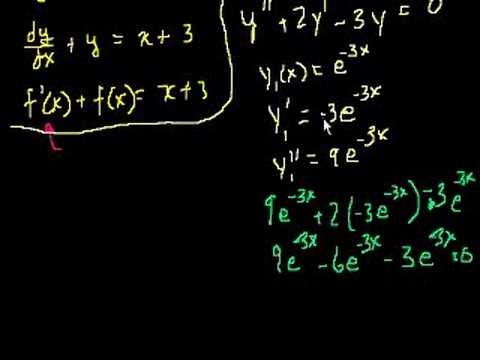
Topics covered in a first year course in differential equations. Need to understand basic differentiation and integration from Calculus playlist before starting here. What is a differential equation. Separable Differential Equations. Separable differential equations 2. Exact Equations Intuition 1 (proofy). Exact Equations Intuition 2 (proofy). Exact Equations Example 1. Exact Equations Example 2. Exact Equations Example 3. Integrating factors 1. Integrating factors 2. First order homegenous equations. First order homogeneous equations 2. 2nd Order Linear Homogeneous Differential Equations 1. 2nd Order Linear Homogeneous Differential Equations 2. 2nd Order Linear Homogeneous Differential Equations 3. 2nd Order Linear Homogeneous Differential Equations 4. Complex roots of the characteristic equations 1. Complex roots of the characteristic equations 2. Complex roots of the characteristic equations 3. Repeated roots of the characteristic equation. Repeated roots of the characteristic equations part 2. Undetermined Coefficients 1. Undetermined Coefficients 2. Undetermined Coefficients 3. Undetermined Coefficients 4. Laplace Transform 1. Laplace Transform 2. Laplace Transform 3 (L{sin(at)}). Laplace Transform 4. Laplace Transform 5. Laplace Transform 6. Laplace Transform to solve an equation. Laplace Transform solves an equation 2. More Laplace Transform tools. Using the Laplace Transform to solve a nonhomogeneous eq. Laplace Transform of : L{t}. Laplace Transform of t^n: L{t^n}. Laplace Transform of the Unit Step Function. Inverse Laplace Examples. Laplace/Step Function Differential Equation. Dirac Delta Function. Laplace Transform of the Dirac Delta Function. Introduction to the Convolution. The Convolution and the Laplace Transform. Using the Convolution Theorem to Solve an Initial Value Prob.
Add to calendar

Trusted paper writing service WriteMyPaper.Today will write the papers of any difficulty.