

Online courses directory (19947)

Videos on a first course in differential equations.

This course presents real-world mathematical models to help participants understand the notions and efficiency of differential equations and their symmetries.

In this course, you'll hone your problem-solving skills through learning to find numerical solutions to systems of differential equations. You'll write code in Python to fight forest fires, rescue the Apollo 13 astronauts, stop the spread of epidemics, and resolve other real-world dilemmas.
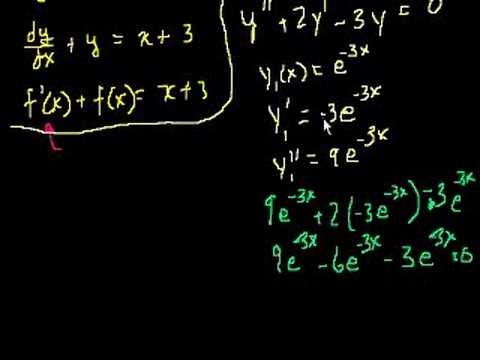
Differential equations with only first derivatives. What is a differential equation. Simple Differential Equations. Separable Differential Equations. Separable differential equations 2. Exact Equations Intuition 1 (proofy). Exact Equations Intuition 2 (proofy). Exact Equations Example 1. Exact Equations Example 2. Exact Equations Example 3. Integrating factors 1. Integrating factors 2. First order homegenous equations. First order homogeneous equations 2. What is a differential equation. Simple Differential Equations. Separable Differential Equations. Separable differential equations 2. Exact Equations Intuition 1 (proofy). Exact Equations Intuition 2 (proofy). Exact Equations Example 1. Exact Equations Example 2. Exact Equations Example 3. Integrating factors 1. Integrating factors 2. First order homegenous equations. First order homogeneous equations 2.
Transforms and the Laplace transform in particular. Convolution integrals. Laplace Transform 1. Laplace Transform 2. L{sin(at)}) - transform of sin(at). Part 2 of the transform of the sin(at). Laplace as linear operator and Laplace of derivatives. Laplace Transform of cos t and polynomials. "Shifting" transform by multiplying function by exponential. Laplace Transform of : L{t}. Laplace Transform of t^n: L{t^n}. Laplace Transform of the Unit Step Function. Inverse Laplace Examples. Dirac Delta Function. Laplace Transform of the Dirac Delta Function. Laplace Transform to solve an equation. Laplace Transform solves an equation 2. Using the Laplace Transform to solve a nonhomogeneous eq. Laplace/Step Function Differential Equation. Introduction to the Convolution. The Convolution and the Laplace Transform. Using the Convolution Theorem to Solve an Initial Value Prob. Laplace Transform 1. Laplace Transform 2. L{sin(at)}) - transform of sin(at). Part 2 of the transform of the sin(at). Laplace as linear operator and Laplace of derivatives. Laplace Transform of cos t and polynomials. "Shifting" transform by multiplying function by exponential. Laplace Transform of : L{t}. Laplace Transform of t^n: L{t^n}. Laplace Transform of the Unit Step Function. Inverse Laplace Examples. Dirac Delta Function. Laplace Transform of the Dirac Delta Function. Laplace Transform to solve an equation. Laplace Transform solves an equation 2. Using the Laplace Transform to solve a nonhomogeneous eq. Laplace/Step Function Differential Equation. Introduction to the Convolution. The Convolution and the Laplace Transform. Using the Convolution Theorem to Solve an Initial Value Prob.
Linear differential equations that contain second derivatives. 2nd Order Linear Homogeneous Differential Equations 1. 2nd Order Linear Homogeneous Differential Equations 2. 2nd Order Linear Homogeneous Differential Equations 3. 2nd Order Linear Homogeneous Differential Equations 4. Complex roots of the characteristic equations 1. Complex roots of the characteristic equations 2. Complex roots of the characteristic equations 3. Repeated roots of the characteristic equation. Repeated roots of the characteristic equations part 2. Undetermined Coefficients 1. Undetermined Coefficients 2. Undetermined Coefficients 3. Undetermined Coefficients 4. 2nd Order Linear Homogeneous Differential Equations 1. 2nd Order Linear Homogeneous Differential Equations 2. 2nd Order Linear Homogeneous Differential Equations 3. 2nd Order Linear Homogeneous Differential Equations 4. Complex roots of the characteristic equations 1. Complex roots of the characteristic equations 2. Complex roots of the characteristic equations 3. Repeated roots of the characteristic equation. Repeated roots of the characteristic equations part 2. Undetermined Coefficients 1. Undetermined Coefficients 2. Undetermined Coefficients 3. Undetermined Coefficients 4.

This course is an introduction to differential geometry. The course itself is mathematically rigorous, but still emphasizes concrete aspects of geometry, centered on the notion of curvature.

In business and sales, standing out is do or die. This course is your complete how to for differentiation success.

Improve your ability to teach diverse learners with real-world examples from elementary, middle, and high school classrooms.

Learn effective strategies for differentiating your assessments and empowering every student in your class to succeed.
This intermediate math course continues our free online maths suite of courses. It covers rules and applications of differentiation, straight line graphs, graphing circular functions, logs and indices, the Binomial theorem, inverse functions, and factors of polynomials. This course is ideal for second-level students, anyone studying for an exam, and those interested in re-igniting their knowledge of mathematics!<br />

Are you an instructor trying to shake things up a bit? Join us for this Australian BOSTES endorsed professional development course on differentiation and how it can be used to enhance classroom instruction and learning.

Digging Deeper: Making Manuscripts introduces you to the study of early text technologies, focusing especially on the medieval book and other written objects.

Digging Deeper: The Form and Function of Manuscripts introduces you to the ways medieval manuscripts are interpreted, conserved, and disseminated in the digital age.

Digging Deeper: Making Manuscripts introduces you to the study of early text technologies, focusing especially on the medieval book and other written objects.

Digging Deeper: The Form and Function of Manuscripts introduces you to the ways medieval manuscripts are interpreted, conserved, and disseminated in the digital age.

This course builds on the theory and foundations of marketing analytics and focuses on practical application by demystifying the use of data in marketing and helping you realize the power of visualizing data with artful use of numbers found in the digital space.

Learn the introductory theory and strategy behind marketing analytics that provides marketers with the foundation needed to apply data analytics to real-world challenges they confront daily in their professional lives.

Why do you need Digital Marketing?
With budgets for digital marketing constantly growing, organisations are facing a major skills shortage. The need for individuals who understand business combined with technical knowledge in Digital Marketing has never been greater. This course is based on European case studies showing current digital and social media marketing practices across Europe. Europe is one of the largest regions for digital and social marketing used but there are many local preferences and this course will help you to navigate these complexities. This course combines practical skills and theoretical knowledge with the goal of teaching you the skills to improve digital and social media marketing in organisations.
Who is this course for?
This course is aimed at two audiences:
- Organisations who want to establish and improve their digital and social media marketing footprint.
- Everyone interested in digital and social media marketing who might consider studying or working in the field.
What do I need to know?
Basic computer knowledge and skills are necessary and a business background would be advantageous but is not essential.
Learning Objectives
- Introduce current and core practices of Digital and Social Media Marketing that will allow learners to analyse, plan, execute and evaluate a digital marketing strategy.
- Introduce core tools currently used in Digital and Social Media Marketing that will allow learners to analyse, plan, execute and evaluate a digital marketing strategy.
- Develop an understanding of Search Engine Optimisation (SEO), Social Media Optimisation, Affiliate and other relevant communication channels for engagement of digital communities.
Course Structure
1. Why is Digital and Social Media Marketing important today and in the future?
1.1. Introduction to strategic planning
1.2 SWOT analysis
1.3. Developing SMART objectives for strategy and campaigns
1.4. Digital Business Maturity Model
1.5. The consumer journey to online purchase
1.6. Introduction to core concepts of digital and social media marketing
1.7. Introduction to online branding
2. Understanding the different nature of digital channels based on geographic, demographic and digital fit for a campaign
2.1 Search Engines - differences in countries - based on the case study examples
2.2 Social Media platforms differences in countries and how to they can be used
2.3 Email marketing and how it can be used
2.4 Affiliate marketing and how it can be used
2.5 Mobile marketing and how it could be used
2.6 Paid channels overview - search and social
2.7 Communities focused engagement
3. Buyer persona development
3.1 The importance of understanding who the target audience is and how search and social help to develop this understanding
3.2 Planning integration of search and social media
3.3 Keyword research for buyer persona
3.4 Social media channels for buyer persona
3.5 Develop keyword plan for a campaign
3.6 PPC keyword vs organic keyword plan
3.7 Develop social media editorial calendar
4. How campaigns fit into a wider implementation of the overall organisation strategy
4.1 Example company campaign plan
4.2 Key elements of campaign management - Gantt chart
4.3 Risk management
4.4 Digital project management tools and techniques
4.5 Project plan monitoring and review
4.6 Marketing automation
4.7 PPC campaign planning
5. Choosing the right digital profiles for the right audience
5.1 Facebook
5.2 YouTube
5.3 Twitter
5.4 LinkedIn
5.5 PPC optimisation
5.6 What makes content to go Viral?
5.7 How to create content viral?
6. The importance of ongoing monitoring and learning from your engagement
6.1 Understanding of Social Capital and its importance case study
6.2 Accessing data in Google Analytics
6.3 Accessing data from Facebook
6.4 Accessing data from Twitter
6.5 Using spreadsheets to analyse and populate reports
6.6 Learning from digital results
6.7 PPC report

Digital Anthropology is a Spring 2003 applied social science and media arts seminar, surveying the blossoming arena of digital-artifact enabled experimental sociology/anthropology. We will emphasize on both (a) Technology Testbeds – systematically deploying research lab prototypes and corporate pre-production products in a sample human organizational population and carefully observing the social consequences, and (b) Sociometrics – using digital artifacts to better observe and measure the complex social reality of interesting human systems.
Add to calendar

Trusted paper writing service WriteMyPaper.Today will write the papers of any difficulty.