

Online courses directory (108)

Il corso, a cui hanno contribuito alcuni tra i più qualificati specialisti degli studi danteschi, ha carattere propedeutico ed è indirizzato a un vasto pubblico; non rinuncia, tuttavia, a fornire le principali coordinate che permettono di situare il poema dantesco nel contesto culturale e storico del Medioevo, nonché di valutare il percorso di formazione che ha portato Dante dalle prime opere al compimento del suo capolavoro.
Concetti e argomenti principali: Dante Alighieri, Divina Commedia, Poesia, Letteratura italiana, Letteratura medievale, Cultura medievale, Storia medievale, poetica dantesca, teoria politica dantesca, teologia dantesca.
Obiettivi formativi
Alla fine del corso i partecipanti avranno acquisito conoscenza e familiarità con:
• il significato complessivo del viaggio-visione narrato nella Commedia;
• la struttura del poema, i suoi personaggi principali, le sue risorse espressive, stilistiche e metriche;
• il percorso intellettuale e letterario di Dante, dalle opere giovanili al poema;
• le principali concezioni filosofiche e religiose presupposte dalla Commedia: la teoria delle virtù e la concezione politica, il profetismo, il rapporto tra poesia e teologia.
Il corso è rivolto in particolare a:
• Studenti universitari, soprattutto nel campo della letteratura italiana e degli studi italiani;
• Studenti dei licei;
• Insegnanti e professori di lingua e/o letteratura italiana;
• Tutti coloro che sono interessati ad un primo approccio alla Commedia o ad approfondirne la conoscenza.
Conoscenze richieste
Trattandosi di un corso introduttivo alla "Commedia" di Dante, non ci sono prerequisiti per la partecipazione al corso.
Struttura del corso
Il corso è diviso in 8 capitoli. Ciascun capitolo presenta una o più lezioni video, il testo e la parafrasi dei canti presentati, e materiali di approfondimento (percorsi iconografici e musicali relativi ai canti presentati, letture aggiuntive).
Capitolo 1. Introduzione: Titolo e struttura del poema, sistema dei personaggi e fisionomia delle tre cantiche
Istruttori: Stefano Prandi, Carlo Ossola
• Benvenuti al MOOC "All'eterno dal tempo": la Commedia di Dante.
• Titolo e struttura del poema.
• Sistema dei personaggi e fisionomia delle tre cantiche.
Capitolo 2. Introduzione: Poesia, teoria politica e teologia nella Commedia
Istruttori: Stefano Prandi, Mira Mocan
• La Commedia come culmine dell'esperienza poetica dantesca.
• Profetismo e teoria politica. Poesia e teologia nella Commedia.
Capitolo 3. Inferno I-II: Il prologo infernale
Istruttore: Carlo Ossola
• Inferno I-II: l'inizio del viaggio ultraterreno di Dante.
Capitolo 4. Inferno XXXIII - XXXIV: Disperato dolore
Istruttore: Piero Boitani
• Inferno XXXIII - XXXIV: la fine della prima cantica.
Capitolo 5. Purgatorio I. La riconquista dell'innocenza
Istruttore: Corrado Bologna
• Purgatorio I: il Purgatorio come invenzione di Dante
Capitolo 6. Purgatorio XXXIII: "Puro e disposto a salire le stelle"
Istruttore: Lino Pertile
• Purgatorio XXXIII: la fine della seconda cantica e la profezia politica di Dante.
Capitolo 7. Paradiso I-II: Un nuovo inizio
Istruttore: Corrado Bologna
• Paradiso I-II: l'inizio della terza cantica e il concetto dantesco di Paradiso.
Capitolo 8. Paradiso XXXI-XXXIII: Da Beatrice all'infinito
Istruttore: Lino Pertile
• Paradiso XXXI-XXXIII: la fine della terza cantica e la fine del viaggio dantesco, il personaggio di Dante raggiunge lo stato di essere oltre la parola e oltre la memoria.

Kursbeschreibung
Der Kurs führt in das zentrale Gebiet der Informatik ein, auf dem alle anderen Teilgebiete aufbauen: Wie entwickele ich Software? Anhand der Programmiersprache Java werden Algorithmen zum Suchen und Sortieren vorgestellt und die dazu benötigten Datenstrukturen wie Keller, Schlange, Liste, Baum und Graph eingeführt.
Was lerne ich in diesem Kurs?
Die Teilnehmer des Kurses werden in die Lage versetzt, eine Problemstellung auf maschinelle Lösbarkeit hin zu analysieren, dafür einen Algorithmus zu entwerfen, die zugehörigen Datenstrukturen zu wählen, daraus ein Java-Programm zu entwickeln und dieses zur Lösung des Problems einzusetzen.
Welche Vorkenntnisse benötige ich?
Mathematikkenntnisse auf Oberstufenniveau.
Kursplan
| Kapitel | Thema |
|---|---|
| Kapitel 1 | Einführung |
| Kapitel 2 | Systemumgebung |
| Kapitel 3 | Java |
| Kapitel 4 | Datentypen |
| Kapitel 5 | Felder |
| Kapitel 6 | Methoden |
| Kapitel 7 | Rekursion |
| Kapitel 8 | Komplexität |
| Kapitel 9 | Sortieren |
| Kapitel 10 | Objektorientierung |
| Kapitel 11 | Abstrakte Datentypen |
| Kapitel 12 | Suchbäume |
| Kapitel 13 | Hashing |
| Kapitel 14 | Graphen |

Architecture 101:
Architecture to convert a place into a state of mind.
Apparently a simple task, actually a fairly tricky operation.
To (try to) understand, we split our journey into three parts.
This course is about part 1: from nothingness to place (part 2 is from place to space, part 3 is from space to architecture).
What is a place?
What is space?
How do we make space?
How do we prepare our mind to make space?
Without a concept, we can’t have a place.
Without a place, we can’t have space.
Without a space, we can’t have architecture...
If we want to create space, in the first instance, it has to happen in our mind. When a conceptual vision takes form in our minds, a place (with its own spatial features) is born.
Architecture 101 is an introduction to space and architecture through 101 exercises. A six-month journey divided into 3 courses “online” on iversity (part 1, part 2 and part 3), one final exhibition / graduation party. If you are still alive after all of this daunting process, there will be a one-week workshop “offline”, where we will go one step beyond.
In short:
Part 1: From Nothingness to Place (Jan 5 to Feb 28, we will work in 2d)
Part 2: From Place to Space (Mar 2 to Apr 25, we will work in 3d)
Part 3: From Space to Architecture (Apr 27 to Jun 20, we will work in scale 1 to 1)
Exhibition / Graduation at Abadir, in Sicily (Jun 19 to Jun 21, we set up our fancy exhibition)
Workshop: Architecture 101 Summer Camp at Abadir, in Sicily (Jun 22 to Jun 26, we build for real).
Architecture 101 (part 1: from nothingness to place)
To start our journey, we will deal with the absence of space and place.
Something that could be defined as “nothingness”.
As Ang Lee or Paul Valery would respectively say :
“The source of all the material comes from nothingness.”
“God made everything out of nothing, but the nothingness shows through.”
In a different way, Ludwig Wittgenstein taught us that when things have no name, they don’t exist. Hence in order to understand things, we have to start with worlds in which things have no name. Pieces of music without sound. Televisions without signal.
We will go through the process of shaping meaning. Articulate and complex meanings, defining relationships between mind and bodies, bodies and places. Little by little, we will encounter places and see the world taking shape.
All of this, using a “hands-on” system (you will by doing).
Course Structure
Week 1: taking pictures
Week 2: learning to sketch
Week 3: making collages
Week 4: observing the weather
Week 5: shaping diagrams
Week 6: drawing maps
Week 7: passing an exam
Week 8: taking a break
Learning Objectives
To see places like architects do.
To understand the principles upon which we convert a place into a state of mind.
We will explore nothingness, void and negative space.
We will learn to name things, we will learn how to invent place (as we wrote before, when things have no name, they cannot exist).
We will learn to stare, observe and see.
We will learn a significative amount of extremely interesting (and totally useless) things.
All of the above refers to the conceptual part of our course.
Then, since we love having our students making practical things, you will also learn lots of technical things using a number of interesting applications.
At the end, what do I make?
A booklet (with a given proportion, size, appearance) where you will collect all of your visual experiments. Each booklet devoted to a specific “place”. If one thousand people finish this part 1, we will have a fabulous collection of 1000 booklets.
Prior Knowledge
Important thing!
In terms of prior knowledge, nothing in particular is required.
However, in terms of technical equipment, this course will be easier to follow for those with access to a smartphone or tablet.
We shaped this course for a very specific kind of student.
Our imaginary student is a gent (or gentle lady) who accesses our content via his/her smartphone. Of course you can follow us via a desktop, make homework at home on your table. Yet, the way we intended the whole thing is for someone who takes the whole course (including doing homework) via a smartphone (or tablet).
Workload
Between 3 and 7 hours a week.
From Monday to Friday, for a total of 6 weeks, you will receive an email with a 15 second-video to watch (to get you in the mood), and a pdf with some instructions for completing an assignment and a series of references (to go deeper in the subject at hand).
Then, you will get to work on your assignment. Once you complete your assignment, you will upload it to the iversity platform and share it on your preferred social media account(s). Ideally Instagram.
Then, during the weekend, we will give you some time to catch up.
Are you ready?
:-)
Architecture 101
To learn more about architecture 101, we kindly invite you to read about it in the first part of the course description, here. Being this part 2 (from place to space), in order to understand the whole picture, it is better to start from part 1.
Architecture 101 (part 2: from place to space)
In part 1 of our course, we explore the state of nothingness and start moving towards the idea of “place”. In part 2, we deal with the concept of “place” and our conceptual journey goes on towards “space”.
In short:
part 1: from nothingness to place
part 2: from place to space
part 3: from space to architecture
Places to stay, to move, to eat, to cook, to love. Place to live. Place to die.
Places for our bodies, places on our bodies.
Places to clean and remember. We went all over the place... Different places for doing so many different things. Different places and different positions, all weaven to different states of mind.
Of course, in this 6-month journey called “Architecture 101”, we expect the final output to be about making architecture. And it will be (part 3).
But as we said before: we cannot make architecture without understanding what space is, and we cannot sense any kind of space before knowing about “place”, and we cannot imagine any kind of place without getting into a mental and physical state of pure nothingness.
So now, how do we go from to place to space?
As John Cage told us in the first week of part 1, "There is no such thing as an empty space or an empty time. There is always something to see, something to hear. In fact, try as we may to make a silence, we cannot."
“In a small room one does not say what one would in a large room.” (Louis Kahn)
What more could we add?
In this part of the course, we will understand what kind of matter surrounds us and how this matters to us. What matters? This is what we will need to find out.
Then, we will try to define the boundaries of this matter at hand. Adding a new dimension to the whole thing, we will put ourselves into context. A physical and a mental context. All of this, using a “hands-on” system (you will learn by doing).
Course Structure
Week 1: taking measurements
Week 2: proportions
Week 3: technical drawing
Week 4: papercut models
Week 5: the history of place / the history of space
Week 6: in a world of webzines
Week 7: what is an “exam”?
Week 8: what is a “break”?
Learning Objectives
We will see spaces like architects do.
We will explore the ways in which place becomes space.
We will learn to measure and project ideas into a 3 dimensional way.
We will also learn a significative amount of extremely interesting (and totally useless) things.
All of the above refers to the conceptual part of our course.
Then, since we love having our students making practical things, you will also learn lots of technical things using a number of interesting applications.
What will I make?
A scale model in a box (a box with a given proportion, size, appearance) in which you will represent a specific “space”. If one thousand people finish this part 3, we will have a fabulous collection of 1000 boxes. A cool exhibition is on its way. Makes sense, don’t you think?
Prior knowledge
This is the 2nd part of a tripartite course called Architecture 101.
To have followed the first part is highly recommended, however not required.
Then, in terms of other kinds of prior knowledge, nothing in particular is required.
However, in terms of technical equipment, this course will be easier to follow for those with access to a smartphone or tablet.
You don’t need a smartphone or tablet. But, as we wrote, we imagined a class with thousands of people lost in their phones, from all around the world. In commuters, we trust!
Workload
Between 3 and 7 hours a week.
From Monday to Friday, for a total of 6 weeks, you will receive an email with a 15 second-video to watch (to get you in the mood), and a pdf with some instructions for completing an assignment and a series of references (to go deeper in the subject at hand).
Then, you will get to work on your assignment. Once you complete your assignment, you will upload it to the iversity platform and share it on your preferred social media account(s). Ideally Instagram.
Then, during the weekend, we will give you some time to catch up.
Are you ready?
:-)
Architecture 101
To learn more about architecture 101, we kindly invite you to read about it in the first part of the course description, here. Eventually, also read the description of part 2 here.
Architecture 101 (part 3: from space to architecture)
In part 1 of our course, we explore the state of nothingness and start to understand the idea of “place”. In part 2 we learn to transform a place into a space. Now, we are ready for part 3: to transform a space into architecture.
What does it mean to transform a space into architecture?
“Architecture is the thoughtful making of space.” Louis Kahn
In part 2, we learn that space is composed of mind and matter. Now, in order for us to benefit from this matter, we need to put it in order. And this is exactly what architecture is all about. Architecture is about giving a very specific kind of meaning and symbolic value to a series of different things.
In this part of the course, we will plan, design and construct a system in which to organize and render coherent important matter (that matters to us). A matter of structure and proportions.
By doing so, we will give a new sense to place and space.
Are you ready?
Our 6-month online journey will be celebrated at Abadir in Sicily, where we will set up our final exhibition.
Course Structure
Week 1: materials
Week 2: colors
Week 3: sounds
Week 4: moving images
Week 5: animations
Week 6: the video
Week 7: about the exam
Week 8: break / exhibition / graduation party at Abadir, in Sicily
Week extra: Architecture 101 Summer Camp at Abadir, in Sicily (where we will build for real). If you are still alive by then, this “physical” 5-day workshop is a course in itself and it will soon be officially announced.
What will I learn?
To see architecture like architects do.
To explore the ways in which space becomes architecture.
To learn that form follows fiction.
We will also learn a significative amount of extremely interesting (and totally useless) things.
All of the above refers to the conceptual part of our course.
Then, since we love having our students making practical things, you will also learn lots of technical things using a number of interesting applications.
At the end, what do I make?
A video (with a given set of constraints) in which you will show your built 1 to 1 architecture. If one thousand people finish this part 3, we will have a fabulous collection of 1000 videos representing 1000 architectural concepts.
Prior knowledge
This is the 3rd part of a tripartite course called Architecture 101.
To have followed the first 2 parts (1 + 2) is highly recommended, however not required.
Then, in terms of other kinds of prior knowledge, nothing in particular is required.
However, in terms of technical equipment, this course will be easier to follow for those with access to a smartphone or tablet.
You don’t need a smartphone or tablet. But, as we wrote, we imagined a class with thousands of people lost in their phones, from all around the world. In commuters, we trust!
Workload
Between 3 and 7 hours a week.
From Monday to Friday, for a total of 6 weeks, you will receive an email with a 15 second-video to watch (to get you in the mood), and a pdf with some instructions for completing an assignment and a series of references (to go deeper in the subject at hand).
Then, you will get to work on your assignment. Once you complete your assignment, you will upload it to the iversity platform and share it on your preferred social media account(s). Ideally Instagram.
Then, during the weekend, we will give you some time to catch up.
Are you ready?
:-)
Digital Branding is still an underrepresented and unexplored field in research and practice. The multiplicity of cultural differences within international brand management is vast.
Following a primer on brand management and the particulars of digital media and technologies, participants experience how to present a brand using digital brand storytelling. In the latter portion of the course, you will learn advanced methods and techniques used to generate strong, ownable emotions around a brand.
The course addresses the following questions:
• How can I use the unique attributes of digital media and digital technologies for my own digital brand management work?
• How do I stage – like a theater production – my brand effectively in digital media?
• How can I tell exciting, successful stories?
• How can I place my digital brand management (concept) in the minds of my consumers and other important stakeholder groups?
Who should take this course?
The course is aimed at those who believe in the digital future and actively want to shape it, which means that we should cover some basic premises at the outset.
What counts most is passion and the will to build strong digital brands. To be a pioneer. To search out new inspiration, input and to meet new people to share your passion and network with.
What do I need to know?
Some of you already have previous knowledge of branding or of digital media, which is welcome but not required. Interest and curiosity in digital brand management as well as in the unique attributes of digital media and technologies are all you need to participate.
What will I learn?
By the end of the course:
• You will have learned how to use the unique attributes of digital media and digital technologies for your own digital brand management work.
• You will be able to stage – like a theater production – your brand effectively in digital media.
• You will be able to tell exciting, successful stories.
• You will understand how to place your digital brand management (concept) in the minds of your consumers and other important stakeholder groups in an effective manner.
Course Structure
Chapter 1:
In the first chapter, we will define the most important terms of branding. You will be formulating your own Brand Reward Promise and you'll be dealing with the Limbic Map, which will guide you toward the possibilities for positioning your brand/product in an emotionally and rewarding manner.
Chapter 2:
We will learn about the unique attributes of digital media and digital technologies.
Chapter 3:
We will experience how to present a brand using digital brand storytelling.
Chapter 4:
We will deal with Emotional Brand Codes and learn advanced methods and techniques used to generate strong, ownable emotions around a brand.
Course Summary
This MOOC aims to provide students with a critical knowledge concerning the phenomenon of youth bullying. The course focuses on both traditional bullying that usually takes place on school premises and cyberbullying, which occurs via information and communication technologies. With a social-ecological perspective, the first part of the MOOC explores the boundaries of these phenomena, and analyzes the characteristics of youth involved and the social-psychological processes that underlie the different roles youth play in bully-victim-bystander dynamics. The second part of this MOOC covers the prevention and intervention strategies available at the international level.
What will I learn?
Our MOOC will help you answer the following questions:
1. What is bullying? How can I recognize it?
2. How do new information and communication technologies modify traditional bullying behavior? Is ‘virtual’ bullying less ‘real’ than face-to-face bullying?
3. What are the risk factors for (cyber)bullying? And its consequences for youth?
4. What role do the family, school and peers play?
5. How can bullying and cyberbullying be prevented? What can schools, parents, and the society do about them? What really works?
Who is this course for?
The MOOC can be of high interest for people from all over the world and with different backgrounds (e.g. psychology, sociology, educational studies, public health, pediatrics) who wish to expand their knowledge and understanding of bullying among children and youth in a social-ecological perspective.
Given the twofold focus on both research and intervention, the course is also particularly suggested to people actively engaged in children’s and adolescents’ education and well-being (such as, teachers, school counsellors, school nurses, policy makers, etc.).
What do I need to know?
No prior knowledge of psychological concepts is needed, but can be helpful.
Interest in children’s and adolescents’ development, education and well-being is welcome and encouraged.
Course Schedule
Chapter 1: Introducing peer bullying In this chapter, you will learn what bullying is and how it differs from other types of aggression. Moreover, you will get an overview of the different forms that bullying can take in face-to-face and online interactions.
Chapter 2: A global health perspective Bullying is recognized as a serious problem worldwide. Gain an overview of what International organizations say about it. You will also learn about how it changes during children’s development and about its consequences on youth’s life.
Chapter 3: Individual risk and protective factors Complexity of bullying behavior requires a multidimensional explanation of why it occurs. Gain an overview of the cognitive, emotional, motivational, and moral factors that contribute to explain why some kids bully other kids.
Chapter 4: Bullying as a group phenomenon Bullying dynamics are not limited to the bully-victim dyad. Learn to change your perspective to recognize the role of the whole peer group. You will gain some insight into the different roles peers can play in bullying situations and how the peer group can influence individual behavior.
Chapter 5: How other contexts influence bullying Go even further and learn how bullying is influenced by other social environmental characteristics that lie in different contexts, including classrooms, schools, family, and culture.
Chapters 6 and 7: Preventing and tackling bullying In these two final chapters you will learn what can be done to prevent and tackle bullying. You will learn what an evidence-based intervention is and you will gain an overview of the intervention strategies that can be implemented at different levels, from the broad community to the single individual student. Moreover, some experts from around the world will offer you concrete examples of programs to address bullying and cyberbullying.
Our assistants
During the course you will meet our assistants: Sheila, Claudia and Valentina who will help you go through the materials and the assignments.
University of Padova
Founded in 1222, the University of Padova is one of Europe’s oldest and most prestigious seats of learning: it is a multidisciplinary university, which aims to provide its students with both professional training and a solid cultural background. A qualification from the University of Padova is a symbol of having achieved an ambitious objective, one that is recognised and coveted by both students and employers alike.
If you want to know more about the University of Padova, visit its website.
Department of Developmental Psychology and Socialisation - Within the University of Padova, the Department of Developmental Psychology and Socialisation (DPSS) was founded in 1984, replacing the Institute of Developmental Psychology founded in 1965 on the initiative of professors Fabio Metelli and Guido Petter.
Research projects conducted within the Department include basic, applied and clinical research, in the following key areas: neo-natal development, psychology of language and literacy, psychology and neuropsychology of cognitive processes, cognition and social relations, psychology of emotions, dynamic psychology and psychopathology, parenting, health and community psychology, instructional psychology and learning disabilities. For more than 15 years, the Department has been an active partner in several bullying projects funded by different agencies, including the European Union and the Italian Ministry of Research and Education.


How can we think of culture as a tool for understanding foreign societies?
Why do emerging countries consider cultural values as instrumental in their quest for modernisation?
How can art contribute to a country’s public image?
These are central questions in an increasingly globalised world. Through a case study on global culture, this online course on the first ever award for contemporary art in China aims to address these questions and to find some possible answers.
While working through six chapters, you will receive exclusive reading material, supplementary videos and background information about the developments in the Chinese art scene over the past 40 years, the Chinese Contemporary Art Award established by Mr Uli Sigg as well as the Sigg Collection as part of the newly created M+ museum in Hong Kong.
Moreover, you will gain insights into Chinese contemporary art, first-hand information about the art scene in China, and a wide range of contacts with relevant local and international institutions and actors.
The course is produced by the Centre of Further Education at the Zurich University of the Arts (ZHdK), based on research by IFCAR and presented by Michael Schindhelm on the e-learning platform iversity.org.
–
–
Zurich University of the Arts
Centre of Further Education
Prof. Elisabeth Danuser
–
Target Group
The CCAA online course is tailored to the needs and interests of curators, collectors, art managers, artists, journalists, cultural producers, gallery owners and researchers but equally attractive for curious individuals.
Prerequisites
If you opt for the Certification of Accomplishment track, you must have experience in a cultural or artistic field in order to help shape your personal perspective. Such prior knowledge will help you while completing the assignment and applying models and methods.
With its audit track, the CCAA online course also welcomes curious individuals.
Learning Objectives
In this online course you will learn:

By working through the entire online course, you will acquire the skills and knowledge needed to analyse and navigate the Chinese contemporary art scene.
Course Structure
This online course will be accessible for one year, beginning on April 13, 2016. For the first six weeks, it will be released as a time-based MOOC with a new chapter launched every Wednesday. Later on, it will be available as a self-paced course.
The course includes six chapters:
Suggested reading list
- Belting, Hans 2011: Global Studies. Mapping Contemporary Art and Culture. Ostfildern: Hatje Cantz.
- Chiu, Melissa 2008: Chinese Contemporary Art. 7 Things You Should Know. New York: AW Asia.
- Fibicher, Bernhard (ed.) 2005: Mahjong. Contemporary Chinese Art from the Sigg Collection, Ostfildern-Ruit: Hatje Cantz. (exhibition catalogue)
- Goodrow, Gérard A. 2014: Crossing China. Land of the Rising Art Scene. Köln: Daab.
- Schindhelm, Michael et al. 2014: Why Hong Kong. Connecting Spaces Documents # 1, Zurich.
http://issuu.com/connecting_spaces_hk_zh/docs/why_hong_kong_k
- Wu, Hung 2014: Contemporary Chinese Art. A History: 1970s-2000s. London: Thames&Hudson.

How can we think of culture as a tool to understand foreign societies?
Why emerging countries consider cultural values as instrumental in their quest for modernization?
How can art contribute to a country’s public image?
These are central questions in an increasingly globalized world. Through a case study on global culture, this online course on the first ever award for contemporary art in China named CCAA aims to address these questions and identify some possible answers.
While working through six chapters, you will receive exclusive reading material, supplementary videos and background information about the developments in the Chinese art scene of the last 40 years, the Chinese Contemporary Art Award established by Mr Uli Sigg as well as the Sigg Collection as part of the newly created museum M+ in Hong Kong.
Moreover, you get insights into contemporary Chinese art, first-hand information about the art scene in China, and a wide range of contacts with relevant local and international institutions and actors.
What will I learn?
In this online course you will learn about...
- ... the crucial stakeholders, institutions and networks that influence/d Chinese contemporary art.
- ...divergent terminological interpretations in a global context.
- ... how questions can be discussed and approached with the CCAA case study, by applying it to other topics in the field of global culture.
- ... the strategy of running an art award, as used by Uli Sigg to explore and describe the - to him unknown - field of Chinese contemporary art.
- ...the ambivalences of Chinese art historiography and how to build a sensorium for different interest groups and their agendas
- ... a method on how to study cultural milieus with the help of a specific model.
- and finally, you will develop criteria necessary for critically engaging with contemporary Chinese art.
By working through the entire online course, you will acquire the skills and knowledge needed to analyze and navigate the Chinese contemporary art scene.
What do I need to know?
If you opt for the Certification of Accomplishment track, you might have experience in a cultural or artistic field to bring in individual perspectives and your personal expertise. Such prior knowledge will help you while writing the assignment and applying models and methods.
With its audit track, the CCAA online course also welcomes curious individuals.
Course Structure
This online course will be accessible for one year, beginning on April 13, 2016. For the first six weeks, it will be released as a time-based MOOC with a new chapter launched every Wednesday. Later on, it will be available as a self-paced course.
The course includes six chapters:
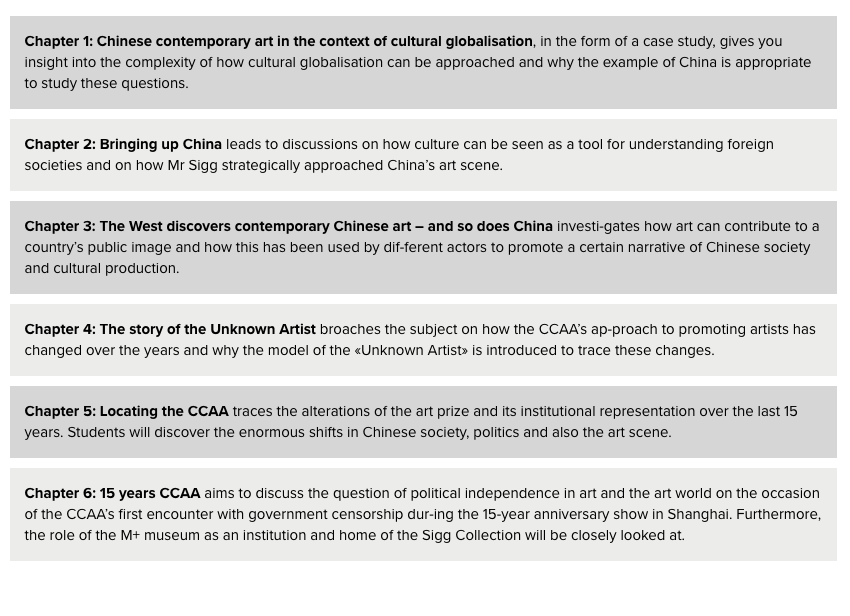
1 - Chinese contemporary art in the context of cultural globalization
Chapter 1 gives you an insight into the complexity of how cultural globalization can be approached in form of a case study and why the example of China is appropriate to study these questions.
2 - Bringing up China – Uli Sigg, his collection and its internationalization
Chapter 2 «Bringing up China» leads to discussions on how culture can be understood as a tool in order to understand foreign societies and how Mr Sigg strategically approached China’s art scene.
3 - The west discovers contemporary Chinese Art — and so does China
Chapter 3 investigates how art can contribute to a country’s public image and how this has been used by different actors to promote a certain impression of Chinese society and cultural production.
4 - The Story of the Unknown Artist. From mapping the art scene to promoting excellency.
Chapter 4 broaches the subject on how the CCAA’s approach on promoting artists has changed over the years and why the model of the «unknown artist» is introduced to trace these changes.
5 - Locating the CCAA – From letter-box company to multi-purpose centre
Chapter 5 traces back the adaptations of the art prize and its institutional representation over the last 15 years. The learners find out about the enormous shifts in Chinese society, politics and also the art scene.
6 - 15 Years CCAA – Whom does Chinese contemporary art belong to?
Chapter 6 aims to discuss the question of independence in art on the occasion of the CCAA’s first encounter with government censorship during the 15-year anniversary show in Shanghai. Finally, the massive museum project M+ is presented.
The course features two different tracks. The Audit Track is for free and allows learners to get familiar with the subject. The Certificate Track costs €119. To obtain a Certificate of Accomplishment , participants must submit an assignment. The ZHdK Centre of Further Education evaluates assignments four times a year.

Kursbeschreibung
Be the change you want to see!
Im Changemaker MOOC lernst du, wie du aus einer Idee ein Projekt zur Lösung eines gesellschaftlichen Problems entwickelst. Wir zeigen dir, wie du unternehmerische Ansätze nutzen kannst, um gesellschaftliche Herausforderungen zu lösen, egal ob du ein Projekt in den Bereichen Gesellschaft, Umwelt, Bildung oder Kultur realisieren willst.
Schritt für Schritt zum eigenen Projekt
Der Kurs führt dich Schritt für Schritt zur Erstellung eines eigenen Projektkonzepts. Du lernst, aus der Schnittmenge deiner Stärken und eines konkreten gesellschaftlichen Bedarfs eine umsetzbare Projektidee zu entwickeln. Wir machen dich mit Konzepten, Strategien und Akteuren in den Bereichen Social Entrepreneurship und Social Business vertraut. Wir zeigen dir, wie du den genauen Bedarf deiner Zielgruppe ermittelst, wie du die Maßnahmen deines Projektes planst, die Kosten kalkulierst und eine realistische Zeitplanung erstellst. Du entwickelst Strategien, um dein Projekt zu finanzieren und wirkungsvoll zu kommunizieren.
Praxis statt Theorie
Zentrale Lerninhalte werden in Form kurzer Videos vermittelt. Sie erklären alles, was du brauchst, um aus deiner Idee ein umsetzbares Projektkonzept zu machen. Du lernst erfahrene Changemaker ebenso wie junge Changeprojekte kennen. Dabei verbindet jede Lektion die Vermittlung konzeptioneller Inhalte mit der Erstellung von Bausteinen deines Projektkonzepts. Am Ende des Kurses hast du ein klar strukturiertes Konzept für dein eigenes Changeprojekt.
Was lerne ich in diesem Kurs?
Am Ende des Kurses sind die TeilnehmerInnen in der Lage, ein eigenes Changeprojekt zu planen. Sie haben die Grundkonzepte von Social Entrepreneurship kennen gelernt. Sie wissen, wo sie im Internet weitere Lernressourcen für ihr Vorhaben finden.
Welche Vorkenntnisse benötige ich?
Für die Teilnahme an diesem Kurs ist kein Vorwissen erforderlich. Er richtet sich an alle Menschen, die lernen wollen, ein eigenes Changeprojekt zur Lösung einer gesellschaftlichen Herausforderung zu entwickeln. Jede/r kann teilnehmen!
Kursstruktur
| Kapitel | Thema |
|---|---|
| Kapitel 1 | Die Welt verändern |
| Kapitel 2 | Vom Interesse zur Projektidee |
| Kapitel 3 | Was ist Social Entrepreneurship? |
| Kapitel 4 | Die Projektziele festlegen |
| Kapitel 5 | Die Strategie optimieren |
| Kapitel 6 | Die Projektstruktur planen |
| Kapitel 7 | Die Umsetzung des Projekts planen |
| Kapitel 8 | Das Projekt finanzieren |
| Kapitel 9 | Das Projekt bekannt machen |
| Kapitel 10 | Das Projekt präsentieren |
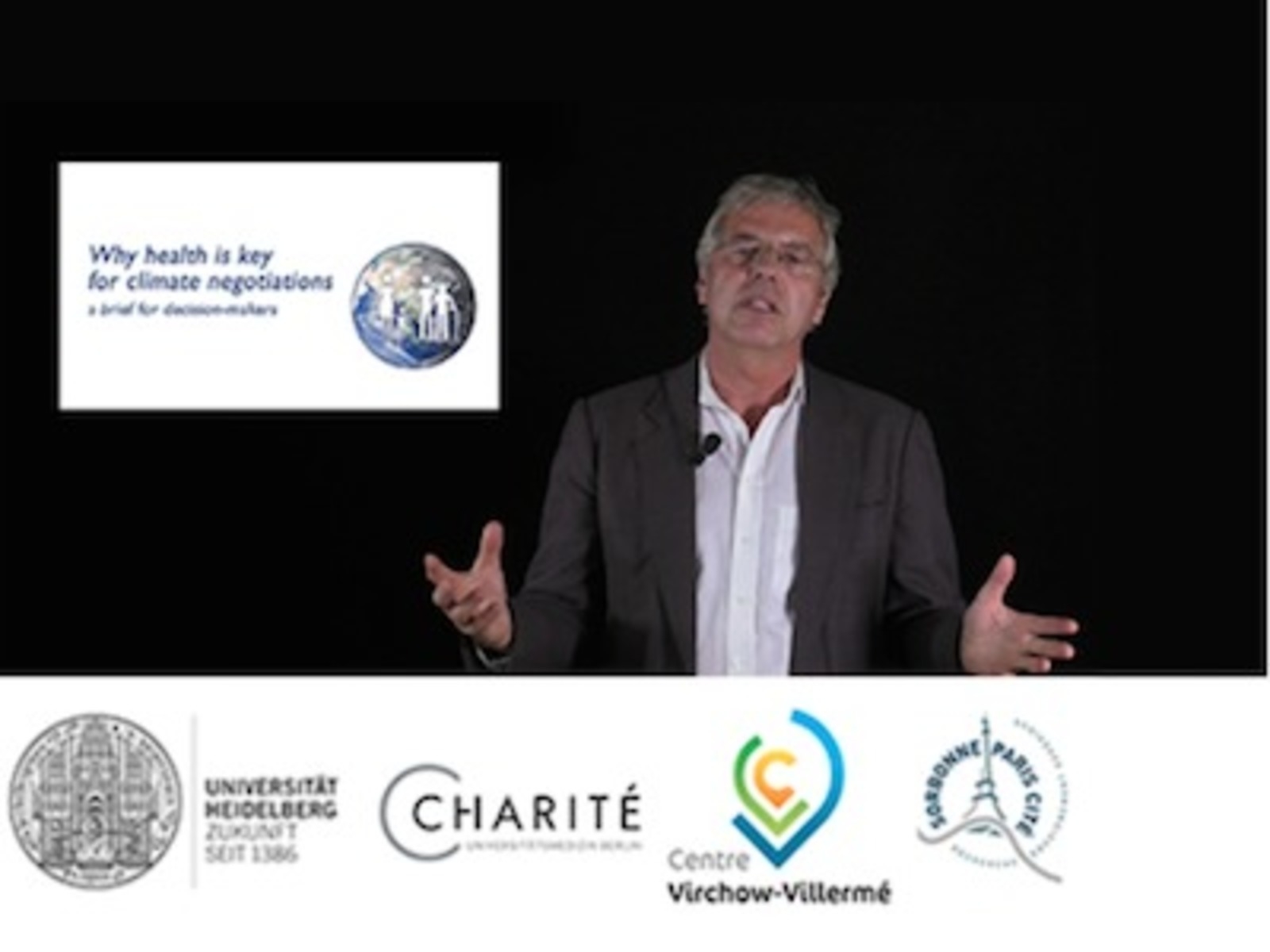
This MOOC was developed by four eminent scientists who together authored the health chapter in the recent 5th Assessment report of the IPCC. They offer you a short crash-course into the topic of climate change, tailored to senior policy-makers and negotiators of climate agreements, particularly as an input into the climate conference COP21 in Paris in December this year.
This 1 week MOOC requires 3 hours of investment time and provides hard evidence for four key arguments as to why health is and should be central in climate policy.
Two positive arguments:
1. Health is a positive motivator, a driving force for citizens and policy-makers to care about and act on climate change.
2. The huge health co-benefits must enter the risk-benefit calculations.
However, two arguments pertain to the restrictions that our health and physiology impose on humans under climate change, particularly in a world that is +4°C warmer:
1. There are health limits to adaptation.
2. Decreased work productivity in hot countries.
Finally, we should consider health as an indicator, not only for sustainable development, but also for climate policy.
Who should take this MOOC?
Senior, experienced members of climate negotiation teams from all 195 member states of the UNFCC. The course is launched to allow policy-makers involved in the Climate Conference COP21 in Paris 2015 to take it as part of their brief.
In addition, any policy maker at local, national, regional and global levels would benefit from the course, but in keeping with the philosophy of MOOCs, the course is open to any citizen interested in the topic.
What do I need to know?
Participants should be familiar with the essentials of the climate systems and the current debate on mitigation and adaptation policies, as well as proposals for fair financing of the shared but differentiated responsibilities of rich and poor countries, which are the agenda of the COP21 conference.
What will I learn?
(i) The participant will understand why health is not another sector but a key argument in developing climate policy and fair share of the burden and benefits of climate policies.
(ii) The participant will learn the scientific evidence behind the four key climate policy arguments based on human health:
1. Health is a positive motivator, a driving force for citizens.
2. The huge health co-benefits must enter the risk-benefit calculations.
3. There are health limits to adaptation.
4. Decreased work productivity in hot countries.
Course Structure
The course is organised in 4 lectures, each developing the evidence for the 4 health arguments, which we propose are inherent in all negotiations on climate policy:
1. Health is a positive motivator, a driving force for citizens.
2. The huge health co-benefits must enter the risk-benefit calculations.
3. There are health limits to adaptation.
4. Decreased work productivity in hot countries.
The four short lectures (8 minutes) are complementary and follow a common storyline. So it is desirable that the participants watch all of them. This would be an essential useful minimum of investment.
We offer 7 optional quiz questions for each lecture in case the participant wishes to check on his or her comprehension of the factual information provided.
Our discussion forums are key to our MOOC concept. This enables participants to engage in an exchange of views and information on any topic they wish related to the course topic. The course instructor and his assistant will actively participate in the forums.
Weekly YouTube feedback video: The course instructor will personally answer questions that are of great common interest or are frequently asked during a weekly youtube video, put on line each Friday at 2pm CET.
Personal email feedback: The instructor and our team will be available to respond to individual questions and comments directed at us through internal mail during the 3 months of the course will be online.

Climate change is currently at the center of the world’s attention, with delegations from more than 190 countries meeting in Paris for the COP21 to negotiate an agreement how to reduce greenhouse gas emissions to keep global warming under 2°C.
There are not many world citizens who do not have their children’s and their own health as a top priority. So why is health not more prominent topic in the debate on climate change and its impacts? We hear a lot about polar bears and smokestacks in the media, but very little on the many and the large health impacts of climate change. With this MOOC, we want to provide state-of-the art evidence of the link between climate change and the health of populations.
Who is this course for?
We address the general public from all parts of the world.
Health professionals may have a special interest and are very welcome, so are teachers and journalists, who may use this MOOC to disseminate the evidence provided. People working in meteorology and climate sciences, too, may be interested in health impacts and are welcome.
In this interface between health and climate, there are few experts. So every interested global citizen, whether expert or not, is welcome to chime in.
What do I need to know?
The course does not require any knowledge about the climate system and climate change. You do not have to be a health person to follow as we cover ground on the link between climate change and health that will be new even for medical doctors. Of course you should be reasonably comfortable with English, not the least to be able to participate in the many interactive platforms and exercises offered during this MOOC.
What will I learn?
Knowledge:
You will become familiar with the nature of health impacts worldwide, and for your country in particular. Further you will get to know best practices from around the world in adaptation strategies and the promotion of health co-benefits. There will be discussion forums for disease- and target-group specific interest groups, e.g. a forum on child malnutrition from climate change or health effects on the elderly.
Skills:
You will analyse your country as a case study throughout the course and share this work with other course participants on our country-specific platforms. You will understand the limits and strengths of your own country’s climate adaptation plan.
Action:
Hence you will be able to engage national and local policy makers to improve health protection from climate change in your country. Interviews with national policy-makers will be part of the course.
Prize:
For the three best participants, I will wave the course fees (travel costs will be at your own expense) to participate in my 3 ECTS credit, in-depth presence course at Heidelberg University “Climate change and health: impacts and adaptations”, running from July 18-29, 2016.
Course structure
Chapter 1: What is climate change and how can it affect health?
Chapter 2: What health effects do we expect?
Chapter 3: Reducing emissions - in health terms: prevention
Chapter 4: The good news: doing something to reduce emissions is good for your health
Chapter 5: Adapting to the effects of already occurring climate change - "therapy"
Outlook: A climate friendly world is healthier, more equitable, sustainable and fun
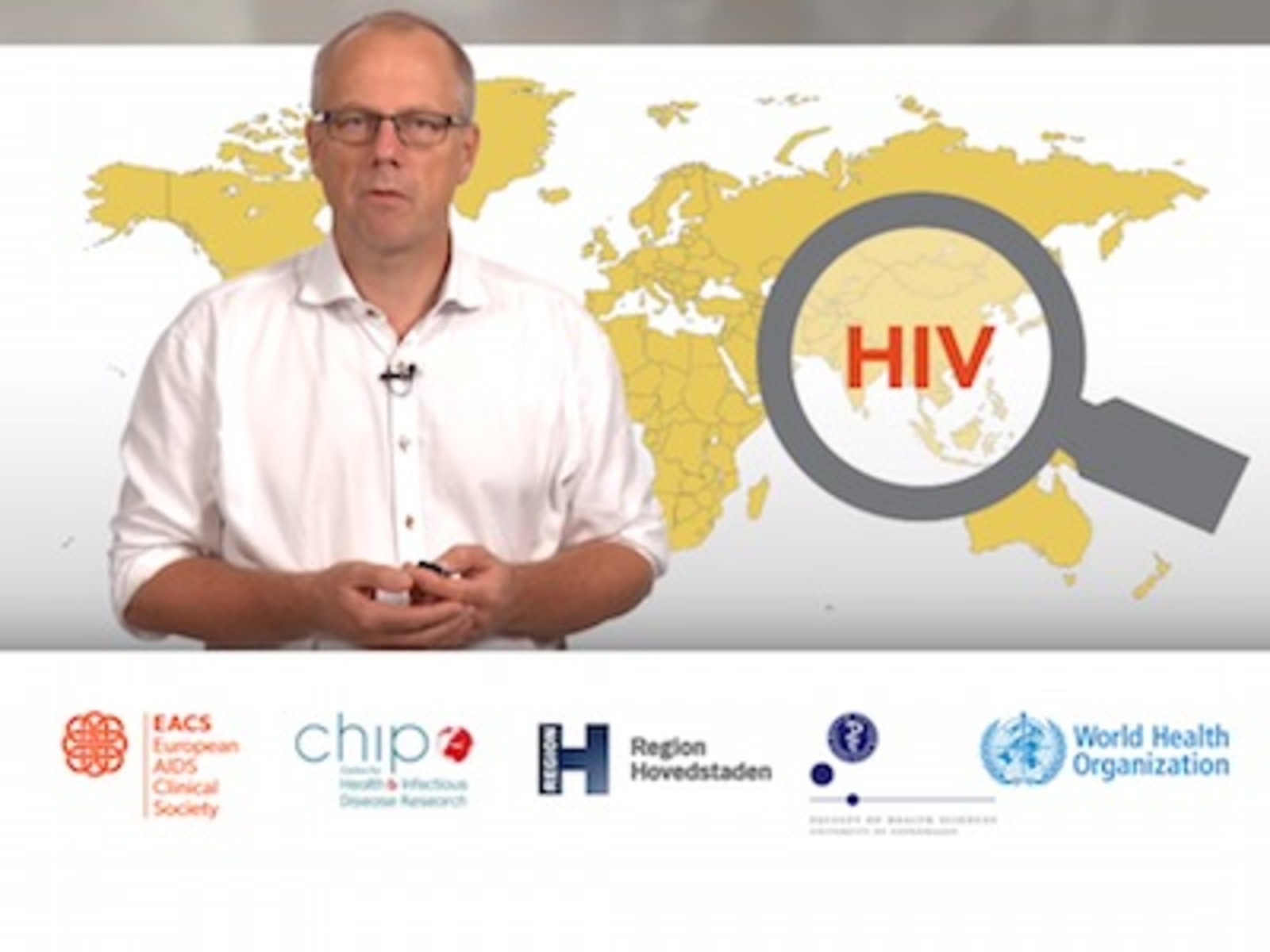
The course will provide clinicians with an in-depth understanding of the scope and manifestations of HIV-related diseases, their prevention, management, and care. Special emphasis will be placed on co-infections and co-morbidities as well as the latest research findings and guidelines related to HIV treatment. The course will be comprised of 6 modules, with various sub-topics under each module.
The course language is English. We will provide subtitles in English and Russian.
What will I learn?
By the end of this course, students will be able to:
- differentiate the clinical manifestations of HIV-related diseases
- propose relevant diagnosis, monitoring, and treatment strategies for HIV infection and related diseases according to EACS and WHO guidelines
- recognise benefits and adverse effects of various HIV drug therapies
- assess strategies for prevention and treatment of opioid drug use
- assess strategies for prevention of the transmission of HIV and related infections
- understand public health approaches in delivering HIV/AIDS treatment and strategic use of ARVs for treating and preventing HIV infection
What do I need to know?
Participants should have a basic background in medicine.
Course Structure
The course consists of 6 chapters:


The course analyzed major contemporary architectural ideas and projects in the context of globalization. We traced the development of architecture since the 1990s by discussing some of the most important topics and influential architects of our time.
Course Summary
Due to a fast-changing environment in our increasingly globalised world, higher insecurity and higher competition increases the pressure placed on companies. Furthermore, the quality of the information necessary for managers and executives to perform is increasingly both important and complex.
Based on this backdrop, this course outlines and structures the basic challenges and assumptions for companies in the field of Controlling. We will also outline and analyse the current status of Controlling. After laying this foundation, together we will deduce the "Objectification-orientated Controlling approach".
What will I learn?
The students will learn the basic building blocks and the elements of a Controlling system as well as dive deep into the "Objectification-orientated Controlling approach" .
With this knowledge, the participants will understand the need for objectified information, as well as the appropriate quality and quantity, in order to inform proper decision making as a baseline for successful company management.
Prior Knowledge
No prior knowledge necessary.
Course Syllabus
Chapter 1: Basic Assumptions
Chapter 2: Value Orientation
Chapter 3: Objectification
Chapter 4: Controlling Status Analysis
Chapter 5: Controlling Approach: Part 1
Chapter 6: Controlling Approach: Part 2

Fostering employee growth and maintaining efficient on-boarding and on-the-job training is essential for all companies and organisations. Digital learning offers the technologies, administration and tools that will optimise your return on education. This course will provide you with the Corporate Digital Learning (CDL) methods you or your company need to improve engagement, knowledge transfer and job performance.
A central aspect of this is approach is social online learning. This course in itself wants to create a CDL professional community: co-creating knowledge and exchanging ideas and best practices through dialogue and exchange amongst other learning professionals.
This free and open course is offered by KPMG AG Wirtschaftsprüfungsgesellschaft and facilitated by Dr. Jeanny Wildi-Yune. KPMG is a leading international network of professional firms providing audit, tax, consultancy and advisory services. In 155 countries across the globe, the KPMG network has more than 150,000 people working in member firms. Dr. Jeanny Wildi-Yune is an experienced senior consultant at the German KPMG member firm, with over 20 years experience in the field of education and extensive experience in corporate education in particular.
What will I learn?

Who should take this course?
Anyone interested in exploring online learning methods, especially in the business setting, has something to gain from this course. More specific groups include:
Business professionals: HR and L&D managers, general managers
- Find more cost-effective, scalable and engaging e-learning formats
- Take advantage of new trends, products, services for a higher return on education
Learning professionals: Coaches, trainers, teachers
- Engage and exchange ideas with a global community of learning professionals in the field
- Stay on top of marketing trends, thought leadership and best practices

Course Summary
This MOOC is an introduction in Critical Thinking, with an emphasis on using reason in our daily communication. Its main topics cover the structure and analysis of arguments, the study of inductive reasoning as basis for scientific knowledge and as key ingredient in how we understand reality. Next we will focus on fallacies (like loaded question or hasty generalization) and on guidelines for structuring a presentation, an argumentative essay or a debate. Furthermore, the course gives you an overview of cognitive biases (a fashionable topic nowadays), and on the use of emotional tools in persuasion. The teaching is accompanied by tons of documented experiments and fun examples, guided practice, quizzes, links to additional materials (like TED talks) and short homework.
What do I learn?
After taking this course you will have the tools to analyze the truth of all kinds of statements, from opinion articles to court verdicts and investment proposals. You will better understand the philosophical basis of human knowledge, also you will be more persuasive in domestic talks as well as in good structured presentations, debates or argumentative essays. Furthermore, a main goal of this course is that you will be able to recognize and refute the most common fallacies (reasoning errors), and understand irrational behavior.
What do I need to know?
No prior knowledge is needed for this course, participants should only come equipped with natural curiosity and a respect for the truth.
Course Structure
Chapter & Topic
Chapter 1:
Course Summary
This MOOC is an introduction in Critical Thinking, with an emphasis on using reason in our daily communication. Its main topics cover the structure and analysis of arguments, the study of inductive reasoning as basis for scientific knowledge and as key ingredient in how we understand reality. Next we will focus on fallacies (like loaded question or hasty generalization) and on guidelines for structuring a presentation, an argumentative essay or a debate. Furthermore, the course gives you an overview of cognitive biases (a fashionable topic nowadays), and on the use of emotional tools in persuasion. The teaching is accompanied by tons of documented experiments and fun examples, guided practice, quizzes, links to additional materials (like TED talks) and short homework.
What do I learn?
After taking this course you will have the tools to analyze the truth of all kinds of statements, from opinion articles to court verdicts and investment proposals. You will better understand the philosophical basis of human knowledge, also you will be more persuasive in domestic talks as well as in good structured presentations, debates or argumentative essays. Furthermore, a main goal of this course is that you will be able to recognize and refute the most common fallacies (reasoning errors), and understand irrational behavior.
What do I need to know?
No prior knowledge is needed for this course, participants should only come equipped with natural curiosity and a respect for the truth.
Course Structure
Chapter & Topic
Chapter 1:

This MOOC questions what European identity is and what we understand and promote as European culture. It explains fundamental European policies on culture, creativity and the media, with a specific focus on urban settings. The course critically explores the formation of diverse identities and cultures in Europe, by shedding light on the importance of memories and shared heritages in this process. Finally, it illustrates the policy dimension behind European cultural and media industries and questions dominant economistic approaches to cultural creativity.
Who is this course for?
This course is meant as a general introduction to the issue of "European identity and culture" for students and practitioners in the field of arts, culture and heritage. The core of the course will resemble a BA level course, yet extra materials will be provided to students who want more in-depth information on theories and case studies.
What will I learn?
Students who take the course will acquire knowledge on:
• Current debates on what is the 'European identity' and what is 'European culture' and what it means to talk of them in the singular or in the plural (cultures, identities).
• Relevant terms and understand the relationship between notions of identity, memory, heritage, and culture.
• Main approaches to cultural heritage and the public use of history.
• European policies in the media and cultural sector.
• Critical approaches to cultural industries: what are they? And why urban settings are so important for their development?
What do I need to know?
Knowledge of English is essential. Previous knowledge of basic sociological or economic debates on art, diversity and culture can be an advantage, although it is not a compulsory prerequisite.
Course structure
CHAPTER 1 - WELCOME
Unit 1.1 – Welcome and instructions
Unit 1.2 – Where are you from?
CHAPTER 2 – WHAT IS EUROPE?
Unit 2.1 – Is there a European identity? (Interview with Anna Triandafyllidou)
Unit 2.2 – What is European culture?
Unit 2.3 - Europe seen from the outside
Unit 2.4 – Art challenging what Europe is about (Interview with Ulrike H. Meinhof)
CHAPTER 3 – DIVERSITY IN EUROPE
Unit 3.1 – European identity and national identities
Unit 3.2 – Diversity policies in EU institutions: intercultural cities (Interview with Irena Guidikova)
Unit 3.3 – “Unity in diversity”: really?
Unit 3.4 – Cosmopolitanism in Europe and the Venice Biennale (Interview with Monica Sassatelli)
CHAPTER 4 – THE ROLE OF MEMORY AND HERITAGE
Unit 4.1 – The past in the present of Europe
Unit 4.2 – Memory vs. history: the role of Museums (Interview with Dominique Poulot)
Unit 4.3 – Contested cultural heritages: the case of Holocaust (Interview with Jasper Chalcraft)
Unit 4.4 – A transnational cultural heritage: the case of UNESCO (Interview with Gerard Delanty)
CHAPTER 5 – CULTURAL INDUSTRIES IN EUROPE
Unit 5.1 – What are cultural industries?
Unit 5.2 – Culture, creativity and urban spaces
Unit 5.3 – Culture in urban spaces, today (Interview with Arturo Rodríguez Morató)
Unit 5.4 – Pluralism in European media information (Interview with Pier Luigi Parcu)
CHAPTER 6 – CULTURAL CREATIVITY AND EUROPEAN FUTURES
Unit 6.1 – “European culture” as a brand
Unit 6.2 – Beyond cultural creativity as innovation (Interview with Matías Zarlenga)
Unit 6.3 – The EU “Creative Europe” program: what’s next? (Interview with Philip Schlesinger)
Add to calendar

Trusted paper writing service WriteMyPaper.Today will write the papers of any difficulty.