

Courses tagged with "Brain stem" (299)

Public Health focuses on the health of entire populations, fighting disease on a massive scale.

Science plays a crucial role in your decisions as you go about your daily life. The representatives you elect and the legislation you vote on influences science legislation, limits and funding. This class will teach you fundamentals of modern biology to help you make more informed voting decisions.
As you learn the fundamentals of Biology, we'll explore the scientific issues sparking political debate:
- Evolution vs. creationism
- Reactions to pandemic disease
- The risks and benefits of vaccination
- How extinctions impact the planet
- Space exploration and the search for extraterrestrial life
- Sexual behavior
We look forward to engaging course discussions about how each vote in a democracy affects the way biology functions in your everyday life.

Science plays a crucial role in your decisions as you go about your daily life. The representatives you elect and the legislation you vote on influences science legislation, limits and funding. This class will teach you fundamentals of modern biology to help you make more informed voting decisions.
As you learn the fundamentals of Biology, we'll explore the scientific issues sparking political debate:
- Genetically modified food and genetically modified crops
- Genetically modified organisms
- Obesity and health care costs
- Cancer research funding
- Aging
We look forward to engaging course discussions about how each vote in a democracy affects the way biology functions in your everyday life.

Interaktiver MOOC mit Operationsvideos der Universität Tübingen. Chirurgen aller Fachrichtungen und Anatomen erklären das zentrale Fach der Medizin im chirurgisch-operativen Kontext.

Interaktiver MOOC mit spannenden anatomischen und medizinischen Videos der Universität Tübingen. Anatomen und Kliniker erklären die Anatomie der Kopf- und Hals-Region im klinischen und chirurgisch-operativen Kontext.

Did you know that you can track some sharks’ movements on Twitter? Or that the scales on their skin have influenced the way humans design boats, planes, and even swim suits? Or that sharks have more senses than humans?
In this biology course, you will learn how scientists study sharks. You will join researchers on location in labs, aquariums, and oceans across the globe to learn about the biodiversity, biology, and conservation of sharks, rays, and chimaeras.
In this activity‑rich course, you’ll track movements of a wild shark, observe shark habitats and behavior, and dig deep into the fossil record. You will also examine topics in the functional anatomy, sensory biology, reproduction, behavior, and ecology of many of the 1,200 living species.
This is an exciting time to be a shark biologist. An explosion of new research methods and technologies are leading to a surprising world of discovery. We’ll introduce new, as well as traditional techniques, for classifying sharks, understanding behavior, and unraveling the mysteries of shark evolution. You’ll be invited to explore global shark populations and consider shark-human interactions and their impacts on history and culture.
You’ll be rewarded by your ability to see virtually any animal with new eyes. Practice thinking like a biologist while honing critical skills that can lead to broader observations about the ongoing history of life on Earth.

Students who have successfully completed this course in-person have described it as a survey class on sleep that is team taught by experts.

Want to become a biomedical engineer but not sure where to focus or how to get there? This engineering course will give you an overview of this wildly popular and vast field, as you learn about more than two dozen areas of focus and get a peek at some of the cool and exciting advances going on at top institutions. Along the way, you’ll meet more than three dozen biomedical engineers—from top names in the field to those just starting their careers.
Through exercises, you’ll get to think like a BME and experience the various areas to see which fits your interests and talents.
Finally, once you have a better sense of where you’d like to focus, our educational and career advice will help show you how to get there.
While targeted to students exploring a career in biomedical engineering, anyone curious about this fascinating field will find something of interest: from the thinking processes of pilots and baseball batters to an inside view of a beating heart to developments in bionics, exoskeletons, and nanotechnology.
Join us on a journey through the world of biomedical engineering.
Verified students are eligible to earn Continuing Education Units (CEUs) and Professional Development Hours (PDHs), valid toward continuing education requirements for many professional certifications.

Discover the principles of solid scientific methods in the behavioral and social sciences. Join us and learn to separate sloppy science from solid research!
The Capstone project will allow you to conduct an original research project that builds on a published research article. We will provide three potential projects and you will choose one. There will be projects focused on network building and analyses, dynamical models and statistical modeling to identify genomic signatures.

Super-Earths And Life is a course about alien life, how we search for it, and what this teaches us about our place in the universe.

Improvements in modern biology have led to a rapid increase in sensitivity and measurability in experiments and have reached the point where it is often impossible for a scientist alone to sort through the large volume of data that is collected from just one experiment.
For example, individual data points collected from one gene expression study can easily number in the hundreds of thousands. These types of data sets are often referred to as ‘biological big data’ and require bioinformaticians to use statistical tools to gain meaningful information from them.
In this course, part of the Bioinformatics MicroMasters program, you will learn about the R language and environment and how to use it to perform statistical analyses on biological big datasets.

In this course you’ll learn various statistics topics including multiple testing problem, error rates, error rate controlling procedures, false discovery rates, q-values and exploratory data analysis. We then introduce statistical modeling and how it is applied to high-throughput data. In particular, we will discuss parametric distributions, including binomial, exponential, and gamma, and describe maximum likelihood estimation. We provide several examples of how these concepts are applied in next generation sequencing and microarray data. Finally, we will discuss hierarchical models and empirical bayes along with some examples of how these are used in practice. We provide R programming examples in a way that will help make the connection between concepts and implementation.
Given the diversity in educational background of our students we have divided the series into seven parts. You can take the entire series or individual courses that interest you. If you are a statistician you should consider skipping the first two or three courses, similarly, if you are biologists you should consider skipping some of the introductory biology lectures. Note that the statistics and programming aspects of the class ramp up in difficulty relatively quickly across the first three courses. By the third course will be teaching advanced statistical concepts such as hierarchical models and by the fourth advanced software engineering skills, such as parallel computing and reproducible research concepts.
These courses make up 2 XSeries and are self-paced:
PH525.1x: Statistics and R for the Life Sciences
PH525.2x: Introduction to Linear Models and Matrix Algebra
PH525.3x: Statistical Inference and Modeling for High-throughput Experiments
PH525.4x: High-Dimensional Data Analysis
PH525.5x: Introduction to Bioconductor: annotation and analysis of genomes and genomic assays
PH525.6x: High-performance computing for reproducible genomics
PH525.7x: Case studies in functional genomics
This class was supported in part by NIH grant R25GM114818.
HarvardX requires individuals who enroll in its courses on edX to abide by the terms of the edX honor code. HarvardX will take appropriate corrective action in response to violations of the edX honor code, which may include dismissal from the HarvardX course; revocation of any certificates received for the HarvardX course; or other remedies as circumstances warrant. No refunds will be issued in the case of corrective action for such violations. Enrollees who are taking HarvardX courses as part of another program will also be governed by the academic policies of those programs.
HarvardX pursues the science of learning. By registering as an online learner in an HX course, you will also participate in research about learning. Read our research statement to learn more.
Harvard University and HarvardX are committed to maintaining a safe and healthy educational and work environment in which no member of the community is excluded from participation in, denied the benefits of, or subjected to discrimination or harassment in our program. All members of the HarvardX community are expected to abide by Harvard policies on nondiscrimination, including sexual harassment, and the edX Terms of Service. If you have any questions or concerns, please contact harvardx@harvard.edu and/or report your experience through the edX contact form.

A conceptual and interpretive public health approach to some of the most commonly used methods from basic statistics.
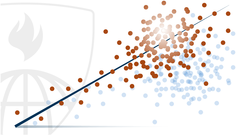
A practical and example filled tour of simple and multiple regression techniques (linear, logistic, and Cox PH) for estimation, adjustment and prediction.

We will learn the basics of statistical inference in order to understand and compute p-values and confidence intervals, all while analyzing data with R. We provide R programming examples in a way that will help make the connection between concepts and implementation. Problem sets requiring R programming will be used to test understanding and ability to implement basic data analyses. We will use visualization techniques to explore new data sets and determine the most appropriate approach. We will describe robust statistical techniques as alternatives when data do not fit assumptions required by the standard approaches. By using R scripts to analyze data, you will learn the basics of conducting reproducible research.
Given the diversity in educational background of our students we have divided the series into seven parts. You can take the entire series or individual courses that interest you. If you are a statistician you should consider skipping the first two or three courses, similarly, if you are biologists you should consider skipping some of the introductory biology lectures. Note that the statistics and programming aspects of the class ramp up in difficulty relatively quickly across the first three courses. By the third course will be teaching advanced statistical concepts such as hierarchical models and by the fourth advanced software engineering skills, such as parallel computing and reproducible research concepts.
These courses make up 2 XSeries and are self-paced:
PH525.1x: Statistics and R for the Life Sciences
PH525.2x: Introduction to Linear Models and Matrix Algebra
PH525.3x: Statistical Inference and Modeling for High-throughput Experiments
PH525.4x: High-Dimensional Data Analysis
PH525.5x: Introduction to Bioconductor: annotation and analysis of genomes and genomic assays
PH525.6x: High-performance computing for reproducible genomics
PH525.7x: Case studies in functional genomics
This class was supported in part by NIH grant R25GM114818.
HarvardX requires individuals who enroll in its courses on edX to abide by the terms of the edX honor code. HarvardX will take appropriate corrective action in response to violations of the edX honor code, which may include dismissal from the HarvardX course; revocation of any certificates received for the HarvardX course; or other remedies as circumstances warrant. No refunds will be issued in the case of corrective action for such violations. Enrollees who are taking HarvardX courses as part of another program will also be governed by the academic policies of those programs.
HarvardX pursues the science of learning. By registering as an online learner in an HX course, you will also participate in research about learning. Read our research statement to learn more.
Harvard University and HarvardX are committed to maintaining a safe and healthy educational and work environment in which no member of the community is excluded from participation in, denied the benefits of, or subjected to discrimination or harassment in our program. All members of the HarvardX community are expected to abide by Harvard policies on nondiscrimination, including sexual harassment, and the edX Terms of Service. If you have any questions or concerns, please contact harvardx@harvard.edu and/or report your experience through the edX contact form.

An introduction to the statistics behind the most popular genomic data science projects. This is the sixth course in the Genomic Big Data Science Specialization from Johns Hopkins University.

Super-Earths And Life is a course about alien life, how we search for it, and what this teaches us about our place in the universe.
In the past decade astronomers have made incredible advances in the discovery of planets outside our solar system. Thirty years ago, we knew only of the planets in our own solar system. Now we know of thousands circling nearby stars.
Meanwhile, biologists have gained a strong understanding of how life evolved on our own planet, all the way back to the earliest cells. We can describe how simple molecules can assemble themselves into the building blocks of life, and how those building blocks might have become the cells that make up our bodies today.
Super-Earths And Life is all about how these two fields together - astronomy and biology - can answer one of our most powerful and primal questions: are we alone in the universe?
HarvardX requires individuals who enroll in its courses on edX to abide by the terms of the edX honor code: https://www.edx.org/edx-terms-service. HarvardX will take appropriate corrective action in response to violations of the edX honor code, which may include dismissal from the HarvardX course; revocation of any certificates received for the HarvardX course; or other remedies as circumstances warrant. No refunds will be issued in the case of corrective action for such violations. Enrollees who are taking HarvardX courses as part of another program will also be governed by the academic policies of those programs.
HarvardX pursues the science of learning. By registering as an online learner in an HX course, you will also participate in research about learning. Read our research statement: http://harvardx.harvard.edu/research-statement to learn more.
Harvard University and HarvardX are committed to maintaining a safe and healthy educational and work environment in which no member of the community is excluded from participation in, denied the benefits of, or subjected to discrimination or harassment in our program. All members of the HarvardX community are expected to abide by Harvard policies on nondiscrimination, including sexual harassment, and the edX Terms of Service. If you have any questions or concerns, please contact harvardx@harvard.edu and/or report your experience through the edX contact form: https://www.edx.org/contact-us.

Learn about the impact of infectious disease on sustainable animal-based food production by understanding the science of growth, immunity, and infection and by learning the problem-solving skills needed to advance animal health and food production through optimal management practices.

Crop production: learn about agriculture and food production for the future
How much food will be available for humankind in the future? Feeding nine billion people in 2050 without exhausting the planetary reserves is perhaps the greatest challenge humanity has ever faced.
In this course of the XSeries in environmental studies, you will examine the principles of crop production. You will learn about the ‘availability pillar’ of global food security that lies at the heart of food production, applicable to both crops and animal production. This course will discuss why yields in some parts of the world are lagging behind and identify the agro-ecological drivers that shape the broad diversity of production systems. Also, key issues relating to the closing of yield gaps and the difference in visions of sustainability will be explored.
Systems-based approach at Wageningen University
The University of Wageningen offers an excellent combination of conducting research worldwide and educating in the area of ‘healthy food and living environment’. Through its unique systems-based approach to food systems, the institute adds the phase of primary production to the broad context of global food security.
This is why you should sign up
If you want to enrich your views and action perspectives related to global food security and food systems, you can sign up as a:
- international student
- professional with a varied educational background
After successful completion of both practice and graded questions related to this course, you will:
- Understand the basic concept of plant production
- Be able to value central issues related to global food production and consumption
- Understand the influences of water scarcity and water availability on crop production, as well as measures suppressing pests, diseases, and weeds
- Be able to identify processes that cause significant environmental problems and evaluate measures to solve and prevent those problems be able to judge innovations in food crop production on their merits for the rural population in the different geographical regions
A verified edX certificate provides proof for an employer, school, or other institution that you have successfully completed this online course.
Add to calendar

Trusted paper writing service WriteMyPaper.Today will write the papers of any difficulty.