

Courses tagged with "Customer Service Certification Program" (283)

In this course, we will see how evolutionary trees resolve quandaries from finding the origin of a deadly virus to locating the birthplace of modern humans. We will then use methods from computational proteomics to test whether we can reconstruct Tyrannosaurus rex proteins and prove that birds evolved from dinosaurs.

This course covers vector and multi-variable calculus. It is the second semester in the freshman calculus sequence. Topics include vectors and matrices, partial derivatives, double and triple integrals, and vector calculus in 2 and 3-space.
MIT OpenCourseWare offers another version of 18.02, from the Spring 2006 term. Both versions cover the same material, although they are taught by different faculty and rely on different textbooks. Multivariable Calculus (18.02) is taught during the Fall and Spring terms at MIT, and is a required subject for all MIT undergraduates.

This course covers differential, integral and vector calculus for functions of more than one variable. These mathematical tools and methods are used extensively in the physical sciences, engineering, economics and computer graphics.
Course Formats
 The materials have been organized to support independent study. The website includes all of the materials you will need to understand the concepts covered in this subject. The materials in this course include:
- Lecture Videos recorded on the MIT campus
- Recitation Videos with problem-solving tips
- Examples of solutions to sample problems
- Problem for you to solve, with solutions
- Exams with solutions
- Interactive Java Applets ("Mathlets") to reinforce key concepts
Content Development
Denis Auroux
Arthur Mattuck
Jeremy Orloff
John Lewis


An advanced introduction to nonlinear dynamics, with emphasis on methods used to analyze chaotic dynamical systems encountered in science and engineering.

This graduate level course focuses on nonlinear dynamics with applications. It takes an intuitive approach with emphasis on geometric thinking, computational and analytical methods and makes extensive use of demonstration software.

This course provides an introduction to nonlinear dynamics and chaos in dissipative systems. The content is structured to be of general interest to undergraduates in engineering and science.

This course introduces the basic ideas for understanding the dynamics of continuum systems, by studying specific examples from a range of different fields. Our goal will be to explain the general principles, and also to illustrate them via important physical effects. A parallel goal of this course is to give you an introduction to mathematical modeling.

This is the first semester of a one year graduate course in number theory covering standard topics in algebraic and analytic number theory. At various points in the course, we will make reference to material from other branches of mathematics, including topology, complex analysis, representation theory, and algebraic geometry.

This graduate-level course is an advanced introduction to applications and theory of numerical methods for solution of differential equations. In particular, the course focuses on physically-arising partial differential equations, with emphasis on the fundamental ideas underlying various methods.

This is an advanced interdisciplinary introduction to applied parallel computing on modern supercomputers. It has a hands-on emphasis on understanding the realities and myths of what is possible on the world's fastest machines. We will make prominent use of the Julia Language, a free, open-source, high-performance dynamic programming language for technical computing.

Personal and Family Financial Planning will address many critical personal financial management topics in order to help you learn prudent habits both while in school and throughout your lifetime.
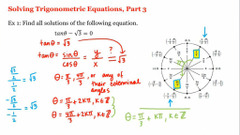
This course covers mathematical topics in algebra and trigonometry and is designed to prepare students to enroll for a first semester course in single variable calculus.

Curso diseñado para facilitar la entrada del estudiante en los cursos de cálculo de primer semestre de prácticamente cualquier grado universitario, con especial énfasis en Ciencias e Ingeniería.
Non-trigonometry pre-calculus topics. Solid understanding of all of the topics in the "Algebra" playlist should make this playlist pretty digestible. Introduction to Limits (HD). Introduction to Limits. Limit Examples (part 1). Limit Examples (part 2). Limit Examples (part3). Limit Examples w/ brain malfunction on first prob (part 4). Squeeze Theorem. Proof: lim (sin x)/x. More Limits. Sequences and Series (part 1). Sequences and series (part 2). Permutations. Combinations. Binomial Theorem (part 1). Binomial Theorem (part 2). Binomial Theorem (part 3). Introduction to interest. Interest (part 2). Introduction to compound interest and e. Compound Interest and e (part 2). Compound Interest and e (part 3). Compound Interest and e (part 4). Exponential Growth. Polar Coordinates 1. Polar Coordinates 2. Polar Coordinates 3. Parametric Equations 1. Parametric Equations 2. Parametric Equations 3. Parametric Equations 4. Introduction to Function Inverses. Function Inverse Example 1. Function Inverses Example 2. Function Inverses Example 3. Basic Complex Analysis. Exponential form to find complex roots. Complex Conjugates. Series Sum Example. Complex Determinant Example. 2003 AIME II Problem 8. Logarithmic Scale. Vi and Sal Explore How We Think About Scale. Vi and Sal Talk About the Mysteries of Benford's Law. Benford's Law Explanation (Sequel to Mysteries of Benford's Law).

Students often encounter grave difficulty in calculus if their algebraic knowledge is insufficient. This course is designed to provide students with algebraic knowledge needed for success in a typical calculus course. We explore a suite of functions used in calculus, including polynomials (with special emphasis on linear and quadratic functions), rational functions, exponential functions, and logarithmic functions. Along the way, basic strategies for solving equations and inequalities are reinforced, as are strategies for interpreting and manipulating a variety of algebraic expressions. Students enrolling in the course are expected to have good number sense and to have taken an intermediate algebra course.
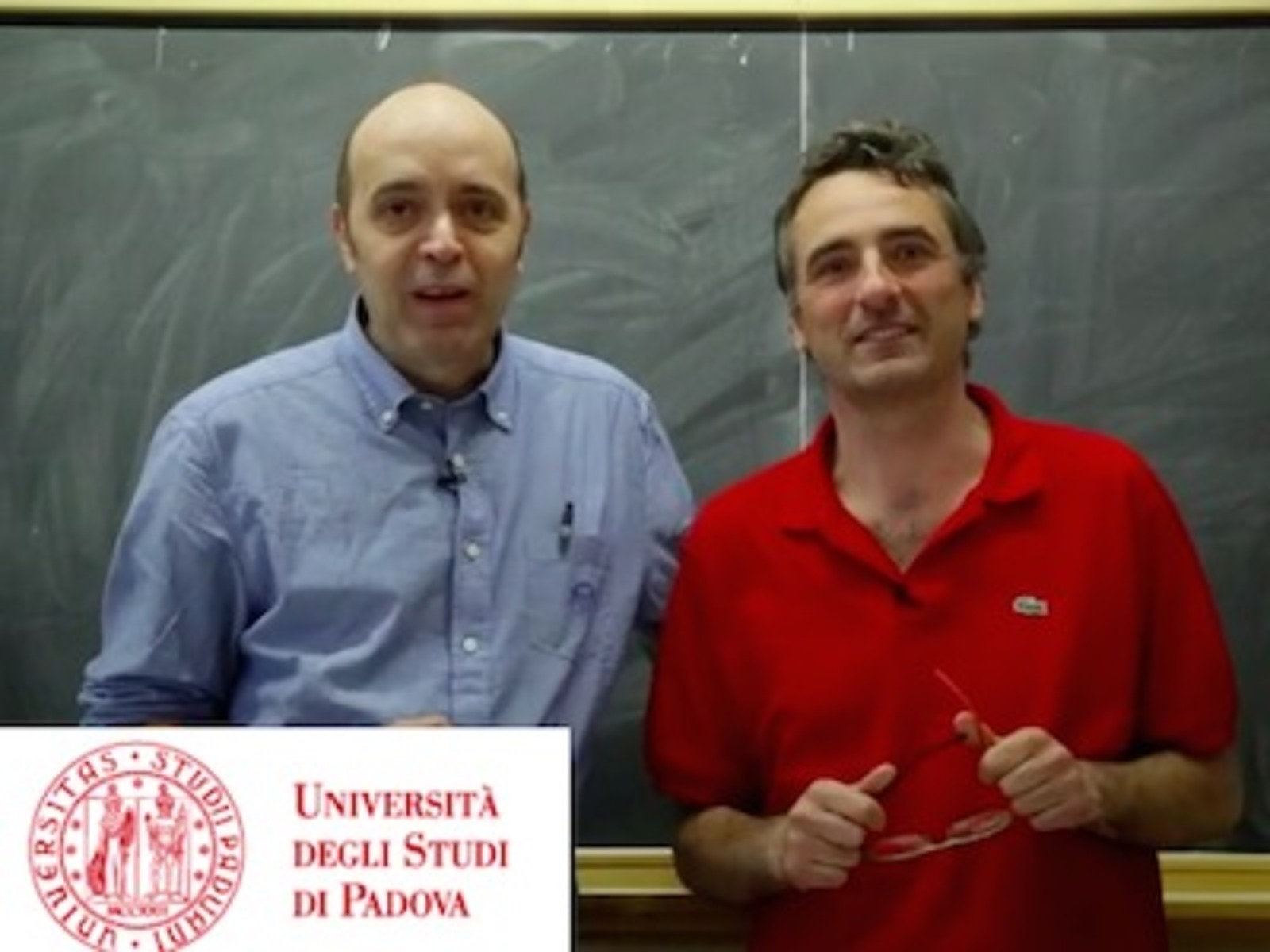
E' possibile studiare l'intero corso in pochi giorni: il test iniziale di ogni capitolo vi permette di capire su quali argomenti concentrarvi. L'intero corso sarà attivato nello stesso momento, e tutti i materiali saranno disponibili da subito. In questo modo gli iscritti potranno studiare seguendo il loro ritmo e focalizzare l'impegno per rafforzare i propri punti deboli.
Inoltre, per chi si registra al corso durante il periodo di apertura, tutti i materiali resteranno disponibili per ulteriori 6 mesi dopo la chiusura del corso stesso.
Riassunto del corso
Il corso consiste in un ripasso delle nozioni di Matematica di base viste nelle Scuole Superiori: insiemi, funzioni, grafici, numeri reali, equazioni e disequazioni, elementi di geometria piana, polinomi, funzioni esponenziali e logaritmi, trigonometria.
Obiettivi formativi
Fornire la preparazione per seguire con tranquillità i corsi di matematica al primo anno di Università.
Conoscenze richieste
L’algebra e la geometria di base delle scuole superiori.
Struttura del corso
L'intero corso sarà attivato nello stesso momento, e tutti i materiali saranno disponibili da subito. In questo modo gli iscritti potranno studiare seguendo il loro ritmo e focalizzare l'impegno per rafforzare i propri punti deboli.
All'inizio di ogni capitolo, ci sarà in quiz per la valutazione del proprio livello. In questo modo è possibile vedere da subito quali sono le proprie lacune e decidere se seguire tutte (o in parte) le video lezioni seguenti.
Capitoli:
Nozioni di base. Insiemi, prodotto cartesiano. Funzioni.
Geometria analitica del piano. Coordinate cartesiane. Grafici di funzioni e simmetrie. La retta. Il cerchio.
Polinomi. Monomi, polinomi, divisione tra polinomi, frazioni di polinomi.
Numeri reali. Numeri reali, valore assoluto, radici di numeri positivi.
Equazioni. Equazioni di primo e secondo grado, equazioni di ordine superiore a 2.
Sistemi di equazioni. Sistemi lineari. Sistemi di primo e secondo grado. Interpretazione grafica.
Disequazioni. Disequazioni di I grado. La regola del prodotto dei segni. Disequazioni di secondo grado. Disequazioni varie (fratte, con modulo/radici).
Esponenziali e logaritmi. Esponenziali. Logaritmi. Applicazione: equazioni e disequazioni con logaritmi/esponenziali.
Trigonometria 1. Le funzioni trigonometriche. Formule di addizione e sottrazione. Formule di prostaferesi.
Trigonometria 2. Funzioni trigonometriche inverse. Equazioni e disequazioni trigonometriche.
Università degli Studi di Padova
Fondata nel 1222, l'Università degli Studi di Padova è una delle più antiche e più prestigiose istituzioni accademiche europee. È un'università multidisciplinare che cerca di fornire ai suoi studenti sia un efficace training professionale, sia un solido background culturale. Un titolo di studio acquisito all'Università di Padova è un obiettivo ambizioso, riconosciuto e ricercato sia da studenti sia dal mondo delle imprese.
Se volete sapere di più sull'Univeristà di Padova, visitate il sito web all'indirizzo: http://www.unipd.it
Dipartimento di Matematica
Il Dipartimento di Matematica (DM) è il principale riferimento dell'Ateneo per la matematica sia sul piano della ricerca che su quello della didattica, e ospita al suo interno un gruppo di informatica numericamente limitato, ma di grande valore scientifico. La ricerca spazia in tutti gli ambiti della matematica, della matematica applicata e dell’informatica, proseguendo un'illustre tradizione testimoniata dalla considerazione della comunità scientifica internazionale e recentemente confermata dall’esito della prima Valutazione della Qualità della Ricerca (VQR).
Grazie all’impegno di 63 professori di area matematica, 11 di area informatica e 32 ricercatori, è il dipartimento di riferimento per i Corsi di Laurea di primo e secondo livello in Matematica ed in Informatica; inoltre coordina e parzialmente impartisce gli insegnamenti di matematica in più di 30 Corsi di Studio dell’Ateneo, nei quali la matematica costituisce uno strumento di base nonché una parte fondamentale della formazione scientifica.
Un compito importante del DM è anche la formazione alla ricerca dei giovani. Il DM persegue questo obiettivo ospitando il Corso di Dottorato in Scienze Matematiche e collaborando al Curriculum in Computer Science for societal challenges and innovation del Corso di Dottorato in Brain, Mind and Computer Science.
Maggiori informazioni su sito web http://www.math.unipd.it

This six week course will help students prepare for the AP* Calculus AB Exam. * AP Calculus is a registered trademark of the College Board, which was not involved in the production of, and does not endorse, this product.
This is a 6 week course covering the first part of AP* Calculus which includes limits, derivatives and applications. * AP Calculus is a registered trademark of the College Board, which was not involved in the production of, and does not endorse, this product.
This is a 6 week course covering the second part of AP* Calculus curriculum which includes integration rules, techniques and applications. * AP Calculus is a registered trademark of the College Board, which was not involved in the production of, and does not endorse, this product.
Add to calendar

Trusted paper writing service WriteMyPaper.Today will write the papers of any difficulty.