

Courses tagged with "Customer Service Certification Program" (283)

Este curso provee al estudiante con conceptos y herramientas matemáticas para modelar problemas en física, que al aplicar podrá enfrentar con éxito los cursos de física universitarios.

Lectures by P.B.Sunil Kumar, Department of Physics, IIT Madras

Let’s make history together - again! 让我们再一次创造历史!

In this course, you will look at the properties behind the basic concepts of probability and statistics and focus on applications of statistical knowledge. You will learn about how statistics and probability work together. The subject of statistics involves the study of methods for collecting, summarizing, and interpreting data. Statistics formalizes the process of making decisions, and this course is designed to help you use statistical literacy to make better decisions. Note that this course has applications for the natural sciences, economics, computer science, finance, psychology, sociology, criminology, and many other fields. We read data in articles and reports every day. After finishing this course, you should be comfortable evaluating an author's use of data. You will be able to extract information from articles and display that information effectively. You will also be able to understand the basics of how to draw statistical conclusions. This course will begin with descriptive statistic…

This is the first semester of a two-semester sequence on Differential Analysis. Topics include fundamental solutions for elliptic; hyperbolic and parabolic differential operators; method of characteristics; review of Lebesgue integration; distributions; fourier transform; homogeneous distributions; asymptotic methods.

In this course, we study elliptic Partial Differential Equations (PDEs) with variable coefficients building up to the minimal surface equation. Then we study Fourier and harmonic analysis, emphasizing applications of Fourier analysis. We will see some applications in combinatorics / number theory, like the Gauss circle problem, but mostly focus on applications in PDE, like the Calderon-Zygmund inequality for the Laplacian, and the Strichartz inequality for the Schrodinger equation. In the last part of the course, we study solutions to the linear and the non-linear Schrodinger equation. All through the course, we work on the craft of proving estimates.

The laws of nature are expressed as differential equations. Scientists and engineers must know how to model the world in terms of differential equations, and how to solve those equations and interpret the solutions. This course focuses on the equations and techniques most useful in science and engineering.
Course Format
 This course has been designed for independent study. It provides everything you will need to understand the concepts covered in the course. The materials include:
- Lecture Videos by Professor Arthur Mattuck.
- Course Notes on every topic.
- Practice Problems with Solutions.
- Problem Solving Videos taught by experienced MIT Recitation Instructors.
- Problem Sets to do on your own with Solutions to check your answers against when you're done.
- A selection of Interactive Java® Demonstrations called Mathlets to illustrate key concepts.
- A full set of Exams with Solutions, including practice exams to help you prepare.
Content Development
Haynes Miller
Jeremy Orloff
Dr. John Lewis
Arthur Mattuck
Other Versions
Other OCW Versions
OCW has published multiple versions of this subject. 
Related Content
Course Collections
See related courses in the following collections:
Find Courses by Topic
MIT Crosslinks
Explore the topics covered in this course with MIT Crosslinks, a website that highlights connections among select MIT undergraduate STEM  courses and recommends specific study materials from OCW and others. Learn more.

Differential Equations are the language in which the laws of nature are expressed. Understanding properties of solutions of differential equations is fundamental to much of contemporary science and engineering. Ordinary differential equations (ODE's) deal with functions of one variable, which can often be thought of as time.

Topics covered in a first year course in differential equations.
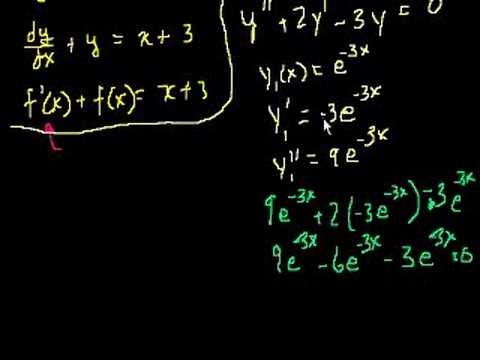
Topics covered in a first year course in differential equations. Need to understand basic differentiation and integration from Calculus playlist before starting here. What is a differential equation. Separable Differential Equations. Separable differential equations 2. Exact Equations Intuition 1 (proofy). Exact Equations Intuition 2 (proofy). Exact Equations Example 1. Exact Equations Example 2. Exact Equations Example 3. Integrating factors 1. Integrating factors 2. First order homegenous equations. First order homogeneous equations 2. 2nd Order Linear Homogeneous Differential Equations 1. 2nd Order Linear Homogeneous Differential Equations 2. 2nd Order Linear Homogeneous Differential Equations 3. 2nd Order Linear Homogeneous Differential Equations 4. Complex roots of the characteristic equations 1. Complex roots of the characteristic equations 2. Complex roots of the characteristic equations 3. Repeated roots of the characteristic equation. Repeated roots of the characteristic equations part 2. Undetermined Coefficients 1. Undetermined Coefficients 2. Undetermined Coefficients 3. Undetermined Coefficients 4. Laplace Transform 1. Laplace Transform 2. Laplace Transform 3 (L{sin(at)}). Laplace Transform 4. Laplace Transform 5. Laplace Transform 6. Laplace Transform to solve an equation. Laplace Transform solves an equation 2. More Laplace Transform tools. Using the Laplace Transform to solve a nonhomogeneous eq. Laplace Transform of : L{t}. Laplace Transform of t^n: L{t^n}. Laplace Transform of the Unit Step Function. Inverse Laplace Examples. Laplace/Step Function Differential Equation. Dirac Delta Function. Laplace Transform of the Dirac Delta Function. Introduction to the Convolution. The Convolution and the Laplace Transform. Using the Convolution Theorem to Solve an Initial Value Prob.

This course is an introduction to differential geometry. The course itself is mathematically rigorous, but still emphasizes concrete aspects of geometry, centered on the notion of curvature.

Learn the fundamentals of digital signal processing theory and discover the myriad ways DSP makes everyday life more productive and fun.

Double affine Hecke algebras (DAHA), also called Cherednik algebras, and their representations appear in many contexts: integrable systems (Calogero-Moser and Ruijsenaars models), algebraic geometry (Hilbert schemes), orthogonal polynomials, Lie theory, quantum groups, etc. In this course we will review the basic theory of DAHA and their representations, emphasizing their connections with other subjects and open problems.

An introduction to dynamical modeling techniques used in contemporary Systems Biology research.

Lecture Series by Prof. S.C Dutta Roy, Department of Electrical Engineering, IIT Delhi

Lecture Series on Electronics For Analog Signal Processing by Prof.K.Radhakrishna Rao, Department of Electrical Engineer

This graduate-level course is a computationally focused introduction to elliptic curves, with applications to number theory and cryptography.

Learn how to make effective decisions about your future career and how to take control of your professional development by honing your critical thinking and employability skills. Suitable for anyone undertaking some form of study, regardless of academic discipline, interests or employment background.

This course introduces students to iterative decoding algorithms and the codes to which they are applied, including Turbo Codes, Low-Density Parity-Check Codes, and Serially-Concatenated Codes. The course will begin with an introduction to the fundamental problems of Coding Theory and their mathematical formulations. This will be followed by a study of Belief Propagation--the probabilistic heuristic which underlies iterative decoding algorithms. Belief Propagation will then be applied to the decoding of Turbo, LDPC, and Serially-Concatenated codes. The technical portion of the course will conclude with a study of tools for explaining and predicting the behavior of iterative decoding algorithms, including EXIT charts and Density Evolution.
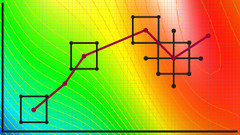
We are constantly using experiments to tweak and find improvements in our personal lives, our communities, and in our work. But are you doing it efficiently? Or are you changing one thing at a time and hoping for the best? In this course, you'll learn how to plan efficient experiments using statistical methods - enabling you to test for many variables that lead to better results.
Add to calendar

Trusted paper writing service WriteMyPaper.Today will write the papers of any difficulty.