

Courses tagged with "Diencephalon" (158)

This course provides an introduction to the chemistry of biological, inorganic, and organic molecules. The emphasis is on basic principles of atomic and molecular electronic structure, thermodynamics, acid-base and redox equilibria, chemical kinetics, and catalysis.
In an effort to illuminate connections between chemistry and biology, a list of the biology-, medicine-, and MIT research-related examples used in 5.111 is provided in Biology-Related Examples.
Acknowledgements
Development and implementation of the biology-related materials in this course were funded through an HHMI Professors grant to Prof. Catherine L. Drennan.

This course provides an introduction to the chemistry of biological, inorganic, and organic molecules. The emphasis is on basic principles of atomic and molecular electronic structure, thermodynamics, acid-base and redox equilibria, chemical kinetics, and catalysis. One year of high school chemistry is the expected background for this freshman-level course.
The aims include developing a unified and intuitive view of how electronic structure controls the three-dimensional shape of molecules, the physical and chemical properties of molecules in gases, liquids and solids, and ultimately the assembly of macromolecules as in polymers and DNA. Relationships between chemistry and other fundamental sciences such as biology and physics are emphasized, as are the relationships between the science of chemistry to its applications in environmental science, atmospheric chemistry and electronic devices.

Acknowledgements
Professor Drennan would like to acknowledge the contributions of MIT Lecturer Dr. Elizabeth Vogel Taylor, Professor Sylvia Ceyer, and Professor Robert Silbey to the development of this course and its materials.

This course provides a systematic presentation of the chemical applications of group theory with emphasis on the formal development of the subject and its applications to the physical methods of inorganic chemical compounds. Against the backdrop of electronic structure, the electronic, vibrational, and magnetic properties of transition metal complexes are presented and their investigation by the appropriate spectroscopy described.

This course covers the principles of main group (s and p block) element chemistry with an emphasis on synthesis, structure, bonding, and reaction mechanisms.

The level of popularity you experienced in childhood and adolescence is still affecting you today in ways that you may not even realize. Learn about how psychologists study popularity and how these same concepts can be used in adulthood to be more successful at work, become better parents, and have a happier life.

Knowing the geometrical structure of the molecules around us is one of the most important and fundamental issues in the field of chemistry. This course introduces the two primary methods used to determine the geometrical structure of molecules: molecular spectroscopy and gas electron diffraction.
In molecular spectroscopy, molecules are irradiated with light or electric waves to reveal rich information, including:
- Motions of electrons within a molecule (Week 1),
- Vibrational motions of the nuclei within a molecule (Week 2), and
- Rotational motions of a molecule (Week 3).
In the gas electron diffraction method, molecules are irradiated with an accelerated electron beam. As the beam is scattered by the nuclei within the molecule, the scattered waves interfere with each other to generate a diffraction pattern. In week 4, we study the fundamental mechanism of electron scattering and how the resulting diffraction images reveal the geometrical structure of molecules.
By the end of the course, you will be able to understand molecular vibration plays an important role in determining the geometrical structure of molecules and gain a fuller understanding of molecular structure from the information obtained by the two methodologies.
FAQ
Do I need to buy a textbook?
No, you can learn the contents without any textbooks. However, if you hope to learn more on the subjects treated in this course, you are recommended to read the textbook introduced below:
Kaoru Yamanouchi, “Quantum Mechanics of Molecular Structures,” Springer-Verlag, 2012.

This is an Exploratorium Teacher Institute professional development course open to any middle or high school science teacher. This course is designed to help science teachers infuse their curriculum with hands-on STEM activities that support the NGSS engineering practices.

Con este curso aprenderás los conceptos básicos relacionados con las reacciones químicas y profundizarás en su estudio desde el punto de vista cuantitativo, es decir su estequiometría. Entenderás el comportamiento de los gases y las disoluciones y aplicarás las leyes que regulan su comportamiento en los procesos químicos en los que participan.
La ecuación química representa lo que sucede cuando tiene lugar un proceso en el que unas sustancias se convierten en otras mediante una “reacción química”.
En las reacciones se cumple la ley de la conservación de la masa y es posible calcular las cantidades de reactivos que reaccionan y de productos que se obtienen.
El estudio de las reacciones químicas y de los aspectos cuantitativos de las mismas, es decir su “estequiometría”, es competencia de la Química, una materia básica que se estudia en muchas titulaciones Universitarias.
Este curso va dirigido a los alumnos que acceden a la Universidad, especialmente aquellos que no han cursado Química y que requieren de los conocimientos básicos en estos aspectos.
Las unidades que trataremos:
- Conceptos básicos: masa, mol y fórmula química
- Gases. Ecuación de los gases ideales
- Disoluciones y formas de expresar la concentración
- Ecuaciones y reacciones químicas
- Estequiometría y cálculos en reacciones completas
- Reacciones reversibles y cálculos estequiométricos en el equilibrio

During each week of this course, chefs reveal the secrets behind some of their most famous culinary creations — often right in their own restaurants. Inspired by such cooking mastery, the Harvard team will then explain the science behind the recipe.
Topics will include:
- How molecules influence flavor
- The role of heat in cooking
- Diffusion, revealed by the phenomenon of spherification, the culinary technique pioneered by Ferran Adrià.
You will also have the opportunity to become an experimental scientist in your very own laboratory — your kitchen. By following along with the engaging recipe of the week, taking precise measurements, and making skillful observations, you will learn to think like both a cook and a scientist. The lab is certainly one of the most unique components of this course — after all, in what other science course can you eat your experiments?
HarvardX requires individuals who enroll in its courses on edX to abide by the terms of the edX honor code : https://www.edx.org/edx-terms-service. HarvardX will take appropriate corrective action in response to violations of the edX honor code, which may include dismissal from the HarvardX course; revocation of any certificates received for the HarvardX course; or other remedies as circumstances warrant. No refunds will be issued in the case of corrective action for such violations. Enrollees who are taking HarvardX courses as part of another program will also be governed by the academic policies of those programs.
HarvardX pursues the science of learning. By registering as an online learner in an HX course, you will also participate in research about learning. Read our research statement: http://harvardx.harvard.edu/research-statement to learn more.
Harvard University and HarvardX are committed to maintaining a safe and healthy educational and work environment in which no member of the community is excluded from participation in, denied the benefits of, or subjected to discrimination or harassment in our program. All members of the HarvardX community are expected to abide by Harvard policies on nondiscrimination, including sexual harassment, and the edX Terms of Service. If you have any questions or concerns, please contact harvardx@harvard.edu and/or report your experience through the edX contact form: https://www.edx.org/contact-us.

In Part 2 of Science and Cooking (Part 1 is available here), we will be visited by more world-famous chefs who use a number of different styles and techniques in their cooking. Each chef will demonstrate how he or she prepares delicious and interesting creations, and we will explore how fundamental scientific principles make them possible.
Topics will include:
- How cooking changes food texture
- Making emulsions and foams
- Phase changes in cooking
You will also have the opportunity to become an experimental scientist in your very own laboratory — your kitchen! By following along with the recipes of the week, taking precise measurements, and making skillful observations, you will learn to think like both a chef and a scientist. This practice will prepare you for the final project, when you will design and perform an experiment to analyze a recipe of your choice from a scientific perspective.
The lab is certainly one of the most unique components of this course — after all, in what other science course can you eat your experiments?
This course focuses on the physical changes that occur during cooking. If you are interested in signing up for “Part 1,” which focuses more on the chemistry of cooking, you can do so here.

How do artists create visual effects? In order to create an artistic impression, artists select materials that allow image formation, and that lend color, emphasis, shape, and size to the object created.
A scientist might follow up by asking, why those materials? What characteristics do they have that allow them to embody the artist’s intent? How durable are they? Will they maintain the same qualities, both physical and aesthetic, they had when the work left the studio?
Conservation science further notes that all materials deteriorate over time, and then asks a follow-up question: What physical interventions are possible to maintain, preserve and protect the work as the artist intended? Whatever is done to the art object, the result must be to make the work recognizable as the artist’s work or the result is a failure.
That is a key goal of this course: to understand, from a chemical point of view, how conservation protocols and the material aspects of an art work allow a better appreciation of an artwork and its creation, as well as confidence that it is the artist’s work.
These are not new problems. According to Leonardo da Vinci, the study of art should include the following topics:
- A knowledge of materials
- The chemistry of colors
- The mathematics of composition
- The laws of perspective
- The illusions of chiaroscuro
As the briefest study of Leonardo's life shows, he was clearly ahead of his time in wanting to understand the reasons for a vast array of natural and artificial phenomena. Even so, a thorough understanding of those subjects listed above still escapes us today – but, progress has been made and that progress is at once the subject matter and the goal of this course.
Course banner painting: Unknown (previously attributed to Vincent van Gogh), Poppies, c.1886-c.1887, oil on canvas, Wadsworth Atheneum Museum of Art, Bequest of Anne Parrish Titzell, 1957.617

The goal of this course is to illustrate the spectroscopy of small molecules in the gas phase: quantum mechanical effective Hamiltonian models for rotational, vibrational, and electronic structure; transition selection rules and relative intensities; diagnostic patterns and experimental methods for the assignment of non-textbook spectra; breakdown of the Born-Oppenheimer approximation (spectroscopic perturbations); the stationary phase approximation; nondegenerate and quasidegenerate perturbation theory (van Vleck transformation); qualitative molecular orbital theory (Walsh diagrams); the notation of atomic and molecular spectroscopy.

This course discusses the principles and methods of statistical mechanics. Topics covered include classical and quantum statistics, grand ensembles, fluctuations, molecular distribution functions, other concepts in equilibrium statistical mechanics, and topics in thermodynamics and statistical mechanics of irreversible processes.

In this course you will learn a whole lot of modern physics (classical and quantum) from basic computer programs that you will download, generalize, or write from scratch, discuss, and then hand in. Join in if you are curious (but not necessarily knowledgeable) about algorithms, and about the deep insights into science that you can obtain by the algorithmic approach.

This introductory physical chemistry course examines the connections between molecular properties and the behavior of macroscopic chemical systems.
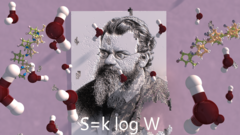
Thermodynamics explains phenomena we observe in the natural world and is the cornerstone of all of engineering. You're going to learn about thermodynamics from a molecular picture where we'll combine theory with a wide range of practical applications and examples. The principles you'll learn in this class will help you understand energy systems such as batteries, semiconductors, catalysts from a molecular perspective. But be warned: this is a fast-paced, challenging course. Everyone is welcome, but hold on to your hat!

The motion of falling leaves or small particles diffusing in a fluid is highly stochastic in nature. Therefore, such motions must be modeled as stochastic processes, for which exact predictions are no longer possible. This is in stark contrast to the deterministic motion of planets and stars, which can be perfectly predicted using celestial mechanics.
This course is an introduction to stochastic processes through numerical simulations, with a focus on the proper data analysis needed to interpret the results. We will use the Jupyter (iPython) notebook as our programming environment. It is freely available for Windows, Mac, and Linux through the Anaconda Python Distribution.
The students will first learn the basic theories of stochastic processes. Then, they will use these theories to develop their own python codes to perform numerical simulations of small particles diffusing in a fluid. Finally, they will analyze the simulation data according to the theories presented at the beginning of course.
At the end of the course, we will analyze the dynamical data of more complicated systems, such as financial markets or meteorological data, using the basic theory of stochastic processes.

In 3.072x: Symmetry, Structure, and Tensor Properties of Materials, you will study the underlying structures of materials and deepen your understanding of the relationship between the properties of materials and their structures. Topics include lattices, point groups, and space groups in both two and three dimensions; the use of symmetry in the tensor representation of crystal properties; and the relationship between crystalline structure and properties, including transport properties, piezoelectricity, and elasticity. Two course projects will allow students to explore their particular interests in greater depth.
FAQ
Who can register for this course?
Unfortunately, learners from Iran, Sudan and the Crimea region of Ukraine will not be able to register for this course at the present time. While edX has received a license from the U.S. Office of Foreign Assets Control (OFAC) to offer courses to learners from Iran and Sudan our license does not cover this course. Separately, EdX has applied for a license to offer courses to learners in the Crimea region of Ukraine, but we are awaiting a determination from OFAC on that application. We are deeply sorry the U.S. government has determined that we have to block these learners, and we are working diligently to rectify this situation as soon as possible.

This course focuses on general methods and strategies for the synthesis of complex organic molecules. Emphasis is on strategies for stereoselective synthesis, including stereocontrolled synthesis of complex acyclic compounds.

This participatory seminar focuses on the knowledge and skills necessary for teaching science and engineering in higher education. This course is designed for graduate students interested in an academic career, and anyone else interested in teaching. Topics include theories of adult learning; course development; promoting active learning, problem-solving, and critical thinking in students; communicating with a diverse student body; using educational technology to further learning; lecturing; creating effective tests and assignments; and assessment and evaluation. Students research and present a relevant topic of particular interest. The subject is appropriate for both novices and those with teaching experience.
Add to calendar

Trusted paper writing service WriteMyPaper.Today will write the papers of any difficulty.