

Courses tagged with "Diencephalon" (158)

CHEM 216 builds on the experimental approach started in CHEM 211. Students participate in planning exactly what they are going to do in the laboratory by being given general goals and directions that have to be adapted to fit the specific project they will be working on. They use microscale equipment, which requires them to develop manual dexterity and care in working in the laboratory. They also evaluate the results of their experiments by checking for identity and purity using various chromatographic and spectroscopic methods. Course Level: Undergraduate This Work, Chemistry 216 - The Synthesis and Characterization of Carbonyl Compounds, by Ginger Shultz is licensed under a Creative Commons Attribution-ShareAlike license.
Organic Chemistry of Macromolecules covers the preparation, reactions, and properties of high molecular weight polymeric materials of both natural and synthetic origin. As a part of this course, U-M students collaboratively created and edited Wikipedia articles. Course Level: Graduate This Work, Chemistry 538 - Organic Chemistry of Macromolecules, by Anne McNeil is licensed under a Creative Commons Attribution-ShareAlike license.

This course is an intensive introduction to the techniques of experimental chemistry and gives first year students an opportunity to learn and master the basic chemistry lab techniques for carrying out experiments. Students who successfully complete the course and obtain a "Competent Chemist" (CC) or "Expert Experimentalist" (EE) rating are likely to secure opportunities for research work in a chemistry lab at MIT.
Acknowledgements
The laboratory manual and materials for this course were prepared by Dr. Katherine J. Franz and Dr. Kevin M. Shea with the assistance of Professors Rick L. Danheiser and Timothy M. Swager. Materials have been revised by Dr. J. Haseltine, Dr. Kevin M. Shea, Dr. Sarah A. Tabacco, Dr. Kimberly L. Berkowski, Anne M. (Gorham) Rachupka, and Dr. John J. Dolhun.
WARNING NOTICE
The experiments described in these materials are potentially hazardous and require a high level of safety training, special facilities and equipment, and supervision by appropriate individuals. You bear the sole responsibility, liability, and risk for the implementation of such safety procedures and measures. MIT shall have no responsibility, liability, or risk for the content or implementation of any of the material presented.
Legal Notice

5.451 is a half-semester introduction to natural product biosynthetic pathways. The course covers the assembly of complex polyketide, peptide, terpene and alkaloid structures. Discussion topics include chemical and biochemical strategies used to elucidate natural product pathways.
Acid Base Introduction. pH, pOH of Strong Acids and Bases. pH of a Weak Acid. pH of a Weak Base. Conjugate Acids and Bases. pKa and pKb Relationship. Buffers and Hendersen-Hasselbalch. Strong Acid Titration. Weak Acid Titration. Half Equivalence Point. Titration Roundup. Acid Base Titration. Acid Base Introduction. pH, pOH of Strong Acids and Bases. pH of a Weak Acid. pH of a Weak Base. Conjugate Acids and Bases. pKa and pKb Relationship. Buffers and Hendersen-Hasselbalch. Strong Acid Titration. Weak Acid Titration. Half Equivalence Point. Titration Roundup. Acid Base Titration.
Molecular and Empirical Formulas. The Mole and Avogadro's Number. Formula from Mass Composition. Another mass composition problem. Balancing Chemical Equations. Stoichiometry. Stoichiometry Example Problem 1. Stoichiometry Example Problem 2. Stoichiometry: Limiting Reagent. Limiting Reactant Example Problem 1. Spectrophotometry Introduction. Spectrophotometry Example. Molecular and Empirical Formulas. The Mole and Avogadro's Number. Formula from Mass Composition. Another mass composition problem. Balancing Chemical Equations. Stoichiometry. Stoichiometry Example Problem 1. Stoichiometry Example Problem 2. Stoichiometry: Limiting Reagent. Limiting Reactant Example Problem 1. Spectrophotometry Introduction. Spectrophotometry Example.

This introduction to fundamental chemical concepts of atomic and molecular structure will emphasize the development of these concepts from experimental observations and scientific reasoning.

This course is the second semester of the two semester sequence, Chemistry Concept Development and Application. This course will cover the topics of a typical second semester General Chemistry course at most colleges and universities. We will use the Chemistry Concept Development Study approach, developed and used in our courses at Rice and used in Part I of this course.

Ideal Gas Equation: PV=nRT. Ideal Gas Equation Example 1. Ideal Gas Equation Example 2. Ideal Gas Equation Example 3. Ideal Gas Equation Example 4. Partial Pressure. Vapor Pressure Example. Ideal Gas Equation: PV=nRT. Ideal Gas Equation Example 1. Ideal Gas Equation Example 2. Ideal Gas Equation Example 3. Ideal Gas Equation Example 4. Partial Pressure. Vapor Pressure Example.
Elements and Atoms. Introduction to the atom. Elements and Atoms. Introduction to the atom.
Orbitals. More on orbitals and electron configuration. Electron configurations. Electron configurations 2. Valence Electrons. Orbitals. More on orbitals and electron configuration. Electron configurations. Electron configurations 2. Valence Electrons.
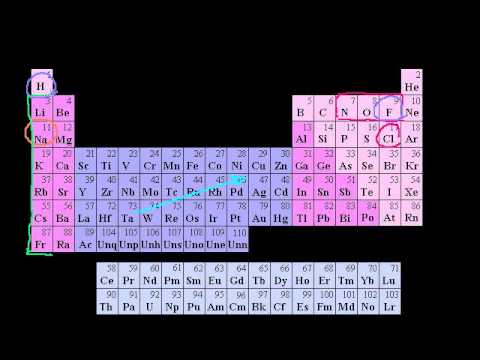
Introduction to Oxidation States. More on Oxidation States. Hydrogen Peroxide Correction. Redox Reactions. Galvanic Cells. Introduction to Oxidation States. More on Oxidation States. Hydrogen Peroxide Correction. Redox Reactions. Galvanic Cells.
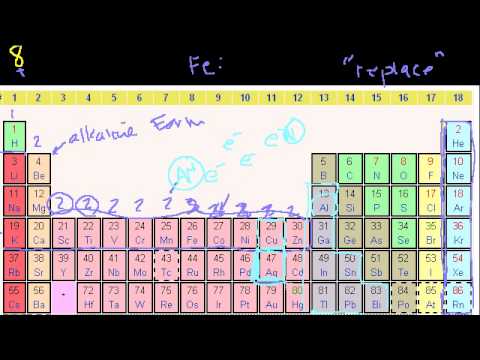
Groups of the Periodic Table. Valence Electrons. Periodic Table Trends: Ionization Energy. Other Periodic Table Trends. Ionic, Covalent, and Metallic Bonds. Groups of the Periodic Table. Valence Electrons. Periodic Table Trends: Ionization Energy. Other Periodic Table Trends. Ionic, Covalent, and Metallic Bonds.

Types of Decay. Half-Life. Exponential Decay Formula Proof (can skip, involves Calculus). Introduction to Exponential Decay. More Exponential Decay Examples. Types of Decay. Half-Life. Exponential Decay Formula Proof (can skip, involves Calculus). Introduction to Exponential Decay. More Exponential Decay Examples.
Introduction to Kinetics. Reactions in Equilibrium. Mini-Video on Ion Size. Keq Intuition (mathy and not necessary to progress). Keq derivation intuition (can skip; bit mathy). Heterogeneous Equilibrium. Le Chatelier's Principle. Introduction to pH, pOH, and pKw. Introduction to Kinetics. Reactions in Equilibrium. Mini-Video on Ion Size. Keq Intuition (mathy and not necessary to progress). Keq derivation intuition (can skip; bit mathy). Heterogeneous Equilibrium. Le Chatelier's Principle. Introduction to pH, pOH, and pKw.
States of Matter. States of Matter Follow-Up. Specific Heat, Heat of Fusion and Vaporization. Chilling Water Problem. Phase Diagrams. Van Der Waals Forces. Covalent Networks, Metallic, and Ionic Crystals. Vapor Pressure. Suspensions, Colloids and Solutions. Solubility. Boiling Point Elevation and Freezing Point Suppression. Change of State Example. States of Matter. States of Matter Follow-Up. Specific Heat, Heat of Fusion and Vaporization. Chilling Water Problem. Phase Diagrams. Van Der Waals Forces. Covalent Networks, Metallic, and Ionic Crystals. Vapor Pressure. Suspensions, Colloids and Solutions. Solubility. Boiling Point Elevation and Freezing Point Suppression. Change of State Example.

Let’s make history together - again! 让我们再一次创造历史!

This course covers the following topics: X-ray diffraction: symmetry, space groups, geometry of diffraction, structure factors, phase problem, direct methods, Patterson methods, electron density maps, structure refinement, how to grow good crystals, powder methods, limits of X-ray diffraction methods, and structure data bases.

This course in crystal structure refinement examines the practical aspects of crystal structure determination from data collection strategies to data reduction and basic and advanced refinement problems of organic and inorganic molecules.

This overview course is designed to show new students how to take a course on edx.org. You will learn how to navigate the edX platform and complete your first course! From there, we will help you get started choosing the course that best fits your interests, needs, and dreams.
Add to calendar

Trusted paper writing service WriteMyPaper.Today will write the papers of any difficulty.