

Courses tagged with "Evaluation" (733)
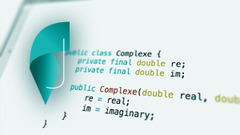
Ce cours introduit la programmation orientée objet en l'illustrant en langage Java. Il présuppose connues les bases de la programmation (variables, types, boucles, fonctions, ...). Il est conçu comme la suite du cours «Initiation à la programmation (en Java)».

Everywhere you look today, enterprises are embracing big data-driven customer relationships and building innovative solutions based on insights gained from data. According to IBM, every day we create 2.5 quintillion bytes of data — so much that 90% of the data in the world today has been created in the last two years. This data comes from everywhere: sensors used to gather climate information, posts to social media sites, digital pictures and videos, purchase transaction records, and cell phone GPS signals, just to name a few. This data is big data.
The demand for storing this unprecedented amount of information is enough of a challenge, but when you add the need for analytics, the technology requirements truly start pushing the envelope on state-of-the-art IT infrastructures. Fortunately, the Open Source community has stepped up to this challenge and developed a storage and processing layer called Apache Hadoop. Add the dozens of other projects integrating with Apache Hadoop and you have the whole Hadoop ecosystem.
The Hadoop ecosystem, along with the data management architectures it enables, is growing at an unprecedented rate, with 73% of Hadoop cluster deployments now in production — a number which continues to rise.
The demand for individuals who have experience managing this platform is also accelerating. According to the IT Skills and Certifications Pay Index research from Foote Partners, “the need for big data skills also continues to lead to pay increases — about 8% over the last year.” Now is exactly the right time to build an exciting and rewarding career managing big data with Apache Hadoop.
This introductory course is taught by Hadoop experts from The Linux Foundation’s ODPi collaborative project. As host to some of the world's leading open source projects, The Linux Foundation provides training and networking opportunities to help you advance your career.
This course is perfect for IT professionals seeking a high-level overview of Hadoop, and who want to find out if a Hadoop-driven big data strategy is the right solution to meet their data retention and analytics needs. This course will also help anyone who wants to set up a small-scale Hadoop test environment to gain experience working with this exciting open source technology.

Spark is rapidly becoming the compute engine of choice for big data. Spark programs are more concise and often run 10-100 times faster than Hadoop MapReduce jobs. As companies realize this, Spark developers are becoming increasingly valued.
This statistics and data analysis course will teach you the basics of working with Spark and will provide you with the necessary foundation for diving deeper into Spark. You’ll learn about Spark’s architecture and programming model, including commonly used APIs. After completing this course, you’ll be able to write and debug basic Spark applications. This course will also explain how to use Spark’s web user interface (UI), how to recognize common coding errors, and how to proactively prevent errors. The focus of this course will be Spark Core and Spark SQL.
This course covers advanced undergraduate-level material. It requires a programming background and experience with Python (or the ability to learn it quickly). All exercises will use PySpark (the Python API for Spark), but previous experience with Spark or distributed computing is NOT required. Students should take this Python mini-quiz before the course and take this Python mini-course if they need to learn Python or refresh their Python knowledge.

Organizations use their data for decision support and to build data-intensive products and services, such as recommendation, prediction, and diagnostic systems. The collection of skills required by organizations to support these functions has been grouped under the term Data Science. This course will attempt to articulate the expected output of Data Scientists and then teach students how to use PySpark (part of Apache Spark) to deliver against these expectations. The course assignments include Log Mining, Textual Entity Recognition, Collaborative Filtering exercises that teach students how to manipulate data sets using parallel processing with PySpark.
This course covers advanced undergraduate-level material. It requires a programming background and experience with Python (or the ability to learn it quickly). All exercises will use PySpark (part of Apache Spark), but previous experience with Spark or distributed computing is NOT required. Students should take this Python mini-quiz before the course and take this Python mini-course if they need to learn Python or refresh their Python knowledge.

This course is part of the Microsoft Professional Program Certificate in Front-End Web Development.
Bootstrap is an open source project originally created by Twitter to enable creation of responsive, mobile first web pages. Bootstrap has a standard set of classes that allow developers to quickly create applications that scale to devices of all sizes, and incorporate common components such as dialog boxes and validation. Bootstrap has become a de facto standard for web design.
This course is designed to be a primer on Bootstrap. By the end of the three modules you will have gained the knowledge to create pages common to all web applications, and implement the most frequently used components and classes provided by Bootstrap. You will also see how to use the tooling provided by Visual Studio to assist you in creating pages as quickly as possible.

There are many programming languages in use today. Choosing which language to program in can be based on many factors such as learning curve, job specific requirements, platform specifics, or a plethora of other criteria. In this course, you will be introduced to the C# language and the world of .NET programming.
The C# programming language was created from the ground up to be an object-oriented programming language that offers ease of use, familiarity to C/C++ and Java developers, along with enhanced memory and resource management. C# is prevalent on the Microsoft platform but is also being used to develop software that runs on Linux, Android, and iOS devices as well.
Learning C# can position you for future programming opportunities, provide a solid foundation in object-oriented programming knowledge, and pave the way for learning other programming languages. This course aims to teach you about the core aspects of the C# language.
This course is the first part of a three-part series designed to teach core C# language fundamentals. In the second course of the series, you will learn object-oriented programming concepts and the third course offers instruction on data structures and algorithms with C#. Once you complete the series, you will have a very good foundation of C# knowledge to expand on and learn more as you progress in your programming career or hobby.

C++ is a general purpose programming language that supports various computer programming models such as object-oriented programming and generic programming. It was created by Bjarne Stroustrup and, “Its main purpose was to make writing good programs easier and more pleasant for the individual programmer.”*
By learning C++, you can create applications that will run on a wide variety of hardware platforms such as personal computers running Windows, Linux, UNIX, and Mac OS X, as well as small form factor hardware such as IoT devices like the Raspberry PI and Arduino–based boards.
(Bjarne Stroustrup, The C++ Programming Language, Third Edition. Reading, MA: Addison-Wesley, 1997).

Cloud computing, or “the cloud”, has gone from a leading trend in IT to mainstream consciousness and wide adoption.
This self-paced course introduces cloud computing concepts where you’ll explore the basics of cloud services and cloud deployment models.
You’ll become acquainted with commonly used industry terms, typical business scenarios and applications for the cloud, and benefits and limitations inherent in the new paradigm that is the cloud.
This course will help prepare you for more advanced courses in Windows Server-based cloud and datacenter administration.

Does your team use Cloud Foundry to deploy applications? Or would you like to use Cloud Foundry, but haven't had time to learn the lingo? Then this course is just what you need! Cloud Foundry makes it simple for developers to deliver business value more quickly, without wasting time getting their app to the cloud -- it's already there.
This course is an introduction to Cloud Foundry, including distributions available to end users, an overview of the platform's components, and what it means to be Cloud Foundry certified. The course also includes technical instructions on how to use the command line interface, how applications are deployed, what services are within the context of the system and basic debugging practices.
Finally, the workshop will take you on a tour through what it means to build cloud-native applications architecturally and ideologically. In doing so, we'll review the 12-factor method of composing modern distributed web systems.

New to the cloud and not sure where to begin? This introductory course, taught by cloud experts from The Linux Foundation, will help you grasp the basics of cloud computing and comprehend the terminology, tools and technologies associated with today’s top cloud platforms.
Understanding cloud technologies tops the list of most important skills for any developer, system administrator or network computing professional seeking a lucrative career in technology. However, getting started and researching all things cloud can be complicated and time consuming. This course maps out the entire cloud landscape and explains how various tools and platforms fit together.
Experts from The Linux Foundation can help guide you step-by-step as you begin to navigate the cloud. They host some of the world's leading open source cloud projects and provide training and networking opportunities to educate a talent pool to support those projects, and is a respected, neutral, non-profit education source to provide training for anyone learning how to build and manage cloud infrastructure.
This course gives you a primer on cloud computing and the use of open source software to maximize development and operations. Topics covered include:
- Next-generation cloud technologies: Learn about cloud and container technologies like Docker, CoreOS, Cloud Foundry, Kubernetes and OpenStack, as well as the tooling around them.
- Scalable and performant compute, storage and network solutions: Get an overview of software defined storage and software defined networking solutions.
- Solutions employed by companies to meet their business demands: Study up on DevOps and continuous integration practices, as well as the deployment tools available to architects to meet and exceed their business goals.
No previous cloud experience is required for this course. "Introduction to Cloud Infrastructure Technologies" gives you the knowledge and tools to make smart decisions about which cloud services and applications to use depending on your needs.

This multidisciplinary production class serves as an introduction to, and exploration of electronic media in the arts. Lectures will cover concepts and presentations of artists working in various capacities with computers, as well as tutorials on specific software packages.

In this 5-week course we’ll introduce the fundamentals of programming in Processing, an accessible introduction to combining arts and computing. The course will provide the essentials of programming in a visual context, allowing you to visualize, design, and create generative art with Processing.

6.00.2x will teach you how to use computation to accomplish a variety of goals and provides you with a brief introduction to a variety of topics in computational problem solving . This course is aimed at students with some prior programming experience in Python and a rudimentary knowledge of computational complexity. You will spend a considerable amount of time writing programs to implement the concepts covered in the course. For example, you will write a program that will simulate a robot vacuum cleaning a room or will model the population dynamics of viruses replicating and drug treatments in a patient's body.
Topics covered include:
- Advanced programming in Python 3
- Knapsack problem, Graphs and graph optimization
- Dynamic programming
- Plotting with the pylab package
- Random walks
- Probability, Distributions
- Monte Carlo simulations
- Curve fitting
- Statistical fallacies

This course is designed as an introduction to computer programming using Java. Students will learn how to a) analyze a problem, and identify and define the computing requirements appropriate to its solution b) design, implement, and evaluate a computer-based system, process, component, or program to meet desired needs, and c) apply design and development principles in the construction of software systems of varying complexity. Topics include Computers, programs, Java, input and output, identifiers, variables, assignment statements, constants, memory diagrams, primitive data types, conditional statements, repetition, methods, parameters, arguments, return values, one dimensional arrays, objects, classes, and classes from the Java Application Programmers Interface (API).
This course is designed as an introduction to computer programming using Java. Students will learn how to a) analyze a problem, and identify and define the computing requirements appropriate to its solution b) design, implement, and evaluate a computer-based system, process, component, or program to meet desired needs, and c) apply design and development principles in the construction of software systems of varying complexity. Topics include Computers, programs, Java, input and output, identifiers, variables, assignment statements, constants, memory diagrams, primitive data types, conditional statements, repetition, methods, parameters, arguments, return values, one dimensional arrays, objects, classes, and classes from the Java Application Programmers Interface (API).

This is CS50x, Harvard University's introduction to the intellectual enterprises of computer science and the art of programming for majors and non-majors alike, with or without prior programming experience. An entry-level course taught by David J. Malan, CS50x teaches students how to think algorithmically and solve problems efficiently. Topics include abstraction, algorithms, data structures, encapsulation, resource management, security, software engineering, and web development. Languages include C, Python, SQL, and JavaScript plus CSS and HTML. Problem sets inspired by real-world domains of biology, cryptography, finance, forensics, and gaming. As of Fall 2016, the on-campus version of CS50x, CS50, was Harvard's largest course.
Students who earn a satisfactory score on 9 problem sets (i.e., programming assignments) and a final project are eligible for a certificate. This is a self-paced course–you may take CS50x on your own schedule.
HarvardX requires individuals who enroll in its courses on edX to abide by the terms of the edX honor code. HarvardX will take appropriate corrective action in response to violations of the edX honor code, which may include dismissal from the HarvardX course; revocation of any certificates received for the HarvardX course; or other remedies as circumstances warrant. No refunds will be issued in the case of corrective action for such violations. Enrollees who are taking HarvardX courses as part of another program will also be governed by the academic policies of those programs.
HarvardX pursues the science of learning. By registering as an online learner in an HX course, you will also participate in research about learning. Read our research statement to learn more.
Harvard University and HarvardX are committed to maintaining a safe and healthy educational and work environment in which no member of the community is excluded from participation in, denied the benefits of, or subjected to discrimination or harassment in our program. All members of the HarvardX community are expected to abide by Harvard policies on nondiscrimination, including sexual harassment, and the edX Terms of Service. If you have any questions or concerns, please contact harvardx@harvard.edu and/or report your experience through the edX contact form.

This course is the first of a two-course sequence: Introduction to Computer Science and Programming Using Python, and Introduction to Computational Thinking and Data Science. Together, they are designed to help people with no prior exposure to computer science or programming learn to think computationally and write programs to tackle useful problems. Some of the people taking the two courses will use them as a stepping stone to more advanced computer science courses, but for many it will be their first and last computer science courses. This run features updated lecture videos, lecture exercises, and problem sets to use the new version of Python 3.5. Even if you took the course with Python 2.7, you will be able to easily transition to Python 3.5 in future courses, or enroll now to refresh your learning.
Since these courses may be the only formal computer science courses many of the students take, we have chosen to focus on breadth rather than depth. The goal is to provide students with a brief introduction to many topics so they will have an idea of what is possible when they need to think about how to use computation to accomplish some goal later in their career. That said, they are not "computation appreciation" courses. They are challenging and rigorous courses in which the students spend a lot of time and effort learning to bend the computer to their will.

In this computer science course, you will learn about foundational computing principles, such as how to write and read computer code and how to run and debug code.
You will learn about programming concepts in Python and how they demonstrate computing principles and domain applications that use programming concepts and computing principles in real applications.
The course will also cover:
- procedural programming
- control structures
- data structures
- advanced topics in algorithms and object-oriented programming
This course builds on a custom textbook written for the class and online course delivery and provides ample interaction and formative evaluation. The course teaches both the theory and implementation of core computing concepts in a highly interactive, multi-modal manner.

计算概论A是针对“信息科学技术学科一年级本科生”开设的一门专业基础主干课程。本课程的教学目标有二:其一,帮助学习者建立起“学习计算机科学技术知识所需的基本知识背景”;其二,帮助学习者“掌握计算机程序设计的基础知识”,培养学习者“独立设计计算机程序解决问题”的基本技能。

Have you wondered about the design strategies behind temperature controllers, quad-copters, or self-balancing scooters? Are you interested in robotics, and have heard of, or tried, “line-following" or “PID control” and want to understand more?
Feedback control is a remarkably pervasive engineering principle. Feedback control uses sensor data (e.g. brightness, temperature, or velocity) to adjust or correct actuation (e.g. steering angle, motor acceleration, or heater output), and you use it all the time, like when you steer a bicycle, catch a ball, or stand upright. But even though applications of feedback are very common, the subject is an uncommonly compelling example of mathematical theory guiding practical design. In this engineering course we will introduce you to the theory and practice of feedback control and provide a glimpse into this rich and beautiful subject.
Each week we will begin with a mathematical description of a fundamental feedback concept, combined with on-line exercises to test your understanding, and will finish with you designing, implementing, measuring, and analyzing a hardware system, that you build, for controlling a propeller-levitated-arm feedback system.
You will not need a background in calculus or software engineering to succeed in this class but you should be familiar with algebra and mechanical forces, have some exposure to complex numbers, and be comfortable with modifying mathematical formulas in short computer programs.
This is a lab course, and in order to complete the weekly assignments, you will need to purchase/acquire a list of parts. To make sure you receive your parts before the class begins, you should register promptly, so that you can access the lists of parts and international vendors.
Add to calendar

Trusted paper writing service WriteMyPaper.Today will write the papers of any difficulty.