

Courses tagged with "Evaluation" (733)

In this course, you will learn about software defined networking and how it is changing the way communications networks are managed, maintained, and secured.

In this course, you will learn about software defined networking and how it is changing the way communications networks are managed, maintained, and secured.

In this project course, the final course in the Software Development MicroMasters program, you will learn how to input, manipulate, and return data with a modern web development stack. Using TypeScript and Node, you will manipulate large amounts of information using a domain-specific querying language. Backend, REST, and front-end technologies will be required to successfully complete the project.
In teams, students will work through the project in several sprints. In each sprint, students will produce a deliverable that is evaluated using an automated test suite. The feedback you will receive from this suite will be limited. To succeed at the project you will need to create your own private test suite to further validate each deliverable.
By working through such a large-scale development project, you will learn technical development skills, and gain experience with how teams develop software in the industry.
This is the largest project in the Software Development MicroMasters program. Verified learners will have access to greatly increased staff coaching to help complete the project.

Software developers are in high demand in the current job market, and computer programming is a prerequisite skill for success in this field.
Start your journey toward becoming a professional software developer by learning Java, one of the industry’s most commonly used programming languages.
This course, part of the CS Essentials for Software Development Professional Certificate program, will quickly cover Java syntax and keywords and then explore features of object-oriented programming including encapsulation, inheritance, and polymorphism. You will learn how to apply these concepts to programmatic problem solving by investigating class modeling techniques and relationships such as aggregation, realization, and generalization.
In addition to programming, you will learn about software testing techniques that help us find problems in our code, and you will use modern development environments and tools for tasks like debugging and unit testing. We will introduce Eclipse, the eclipse debugger and Junit (a unit testing framework).
After completing this course, you will be able to design, develop, and test large applications in Java and understand and apply core principles of professional software development.

The world of software engineering requires high flexibility, an influx of new ideas, and the courage to challenge traditional approaches. As a software engineer, you need to know the methods, workflows and tools to handle continuously growing complexity and shortened development cycles. You must be able to work in teams to build high-quality software.
In this course, we will introduce the basic concepts of object-oriented software engineering. You will learn and apply UML modeling, patterns and project management techniques that are used when developing complex software systems.
This course is interactive. You will watch videos in which we explain critical theory. You will participate in online exercises to practice your knowledge including quizzes, UML modeling with peer reviews, and programming exercises with immediate feedback

This course, part of the Software Development MicroMasters Program, introduces how teams design, build, and test multi-version software systems.
You will learn software engineering principles that are applicable to the breadth of large-scale software systems. The course explores topics such as agile development, REST and Async programming, software specification, design, refactoring, information security, and more.
By the end of this course, learners will work in teams, applying an agile software development process to specify, design, and test multiple versions of complex software systems.
Learners who enroll in the Verified track will receive staff grading and increased interaction with the instructor and staff.

This course we will explore the foundations of software security. We will consider important software vulnerabilities and attacks that exploit them -- such as buffer overflows, SQL injection, and session hijacking -- and we will consider defenses that prevent or mitigate these attacks, including advanced testing and program analysis techniques. Importantly, we take a "build security in" mentality, considering techniques at each phase of the development cycle that can be used to strengthen the security of software systems.

Want to gain software testing skills to start a career or are you a software developer looking to improve your unit testing skills? This course, part of the Software Testing and Verification MicroMasters program, will provide the essential skills you need for success.
Software needs to be tested for bugs and to insure the product meets the requirements and produces the desired results. Software testing is essential to providing a quality product.
Learn the techniques Software Testers and Quality Assurance Engineers use every day, which can be applied to any programming language and testing software.
No previous programming knowledge needed. This course will use Java and JUnit, however, for examples and assignments.

There is much more to software testing than just finding defects. Successful software and quality assurance engineers need to also manage the testing of software.
In this course, part of the Software Testing and Verification MicroMasters program, you will learn about the management aspects of software testing. You will learn how to successfully plan, schedule, estimate and document a software testing plan.
You will learn how to analyze metrics to improve software quality and software tests.
We will also discuss software quality initiatives developed by industry experts.
No previous programming knowledge needed.

Lernen Sie die wichtigsten sprachtechnologischen Methoden kennen, um Texte mit digitalen Werkzeugen zu erschliessen!

If you need intuitive, interactive and high-performance access to your data—and especially if you have large volumes of data—then this course is for you.
Whether you're new to Analysis Services or are experienced with earlier versions, this course will teach you all the information you need to develop a tabular data model. You will learn how to import tables of data from different sources and relate them to form the foundation of your model. You will then learn how to enhance your model with usability features, such as hierarchies.
Next, you will learn how to enhance your model with business logic. You will learn how to create calculated columns, tables and measures using DAX, the language of tabular models.
Additional topics include how to manage a tabular database -- including table storage, processing, permissions and deployment -- and how to deploy your tabular model to the cloud with Azure Analysis Services.
Finally, this course will teach you how to compare the two types of Analysis Services models: tabular and multidimensional. This will help you to determine the appropriate data model for your project.
By the end of the course, you will have designed, developed and deployed a tabular model, and you will be ready to deliver high-performance business user experiences.
The course includes comprehensive hands-on exercises that enable you to directly apply the lessons with sample data.
Note: To complete the hands-on elements in this course, you will require an Azure subscription. You can sign up for a free Azure trial subscription (a valid credit card is required for verification, but you will not be charged for Azure services). Note that the free trial is not available in all regions. It is possible to complete the course and earn a certificate without completing the hands-on practices.

Learn the engineering skills needed to build a technology startup from the ground up.

This course discusses the lessons learned by Michael Stonebraker and Andy Palmer during their start-up endeavors over a 30-year period. The lessons are distilled into six steps that any entrepreneur can follow to get a company going.
Topics include the generation and assessment of ideas, the challenges of building a prototype, the recruitment of a talented team, the closing of the first financing round, and pursuing growth with the right business leadership.
This is a self-paced course ending on August 31, 2016. Participants can move through the lectures and materials at their own pace and once completed, a certificate of completion will be generated automatically. Please note that we will be moderating the discussion board about 3 times a week on average. This discussion board is meant to serve as a platform between participants to discuss the content of the course, to offer additional ideas and useful perspectives, and to get answers to questions from the moderators or other participants. We hope you find the discussion board useful.

Improvements in modern biology have led to a rapid increase in sensitivity and measurability in experiments and have reached the point where it is often impossible for a scientist alone to sort through the large volume of data that is collected from just one experiment.
For example, individual data points collected from one gene expression study can easily number in the hundreds of thousands. These types of data sets are often referred to as ‘biological big data’ and require bioinformaticians to use statistical tools to gain meaningful information from them.
In this course, part of the Bioinformatics MicroMasters program, you will learn about the R language and environment and how to use it to perform statistical analyses on biological big datasets.

In this course you will learn a whole lot of modern physics (classical and quantum) from basic computer programs that you will download, generalize, or write from scratch, discuss, and then hand in. Join in if you are curious (but not necessarily knowledgeable) about algorithms, and about the deep insights into science that you can obtain by the algorithmic approach.

Regression Analysis is the most common statistical modeling approach used in data analysis and it is the basis for more advanced statistical and machine learning modeling.
In this course, you will be given fundamental grounding in the use of widely used tools in regression analysis. You will learn the basics of regression analysis such as linear regression, logistic regression, Poisson regression, generalized linear regression and model selection.
Throughout this course, you will be exposed to not only fundamental concepts of regression analysis but also many data examples using the R statistical software. Thus by the end of this course, you will also be familiar with the implementation of regression models using the R statistical software along with interpretation for the results derived from such implementations.
This course is more about the opportunity for individual discovery than it is about mastering a fixed set of techniques.
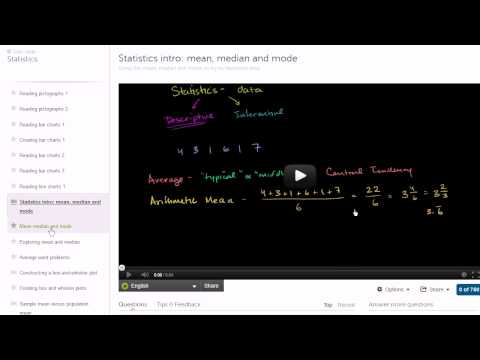
Introduction to statistics. We start with the basics of reading and interpretting data and then build into descriptive and inferential statistics that are typically covered in an introductory course on the subject. Overview of Khan Academy statistics. Statistics intro: mean, median and mode. Constructing a box-and-whisker plot. Sample mean versus population mean.. Variance of a population. Sample variance. Review and intuition why we divide by n-1 for the unbiased sample variance. Simulation showing bias in sample variance. Simulation providing evidence that (n-1) gives us unbiased estimate. Statistics: Standard Deviation. Statistics: Alternate Variance Formulas. Introduction to Random Variables. Probability Density Functions. Binomial Distribution 1. Binomial Distribution 2. Binomial Distribution 3. Binomial Distribution 4. Expected Value: E(X). Expected Value of Binomial Distribution. Poisson Process 1. Poisson Process 2. Introduction to the Normal Distribution. Normal Distribution Excel Exercise. Law of Large Numbers. ck12.org Normal Distribution Problems: Qualitative sense of normal distributions. ck12.org Normal Distribution Problems: Empirical Rule. ck12.org Normal Distribution Problems: z-score. ck12.org Exercise: Standard Normal Distribution and the Empirical Rule. ck12.org: More Empirical Rule and Z-score practice. Central Limit Theorem. Sampling Distribution of the Sample Mean. Sampling Distribution of the Sample Mean 2. Standard Error of the Mean. Sampling Distribution Example Problem. Confidence Interval 1. Confidence Interval Example. Mean and Variance of Bernoulli Distribution Example. Bernoulli Distribution Mean and Variance Formulas. Margin of Error 1. Margin of Error 2. Small Sample Size Confidence Intervals. Hypothesis Testing and P-values. One-Tailed and Two-Tailed Tests. Z-statistics vs. T-statistics. Type 1 Errors. Small Sample Hypothesis Test. T-Statistic Confidence Interval. Large Sample Proportion Hypothesis Testing. Variance of Differences of Random Variables. Difference of Sample Means Distribution. Confidence Interval of Difference of Means. Clarification of Confidence Interval of Difference of Means. Hypothesis Test for Difference of Means. Comparing Population Proportions 1. Comparing Population Proportions 2. Hypothesis Test Comparing Population Proportions. Squared Error of Regression Line. Proof (Part 1) Minimizing Squared Error to Regression Line. Proof Part 2 Minimizing Squared Error to Line. Proof (Part 3) Minimizing Squared Error to Regression Line. Proof (Part 4) Minimizing Squared Error to Regression Line. Regression Line Example. Second Regression Example. R-Squared or Coefficient of Determination. Calculating R-Squared. Covariance and the Regression Line. Correlation and Causality. Chi-Square Distribution Introduction. Pearson's Chi Square Test (Goodness of Fit). Contingency Table Chi-Square Test. ANOVA 1 - Calculating SST (Total Sum of Squares). ANOVA 2 - Calculating SSW and SSB (Total Sum of Squares Within and Between).avi. ANOVA 3 -Hypothesis Test with F-Statistic. Another simulation giving evidence that (n-1) gives us an unbiased estimate of variance. Mean Median and Mode. Range and Mid-range. Reading Pictographs. Reading Bar Graphs. Reading Line Graphs. Reading Pie Graphs (Circle Graphs). Misleading Line Graphs. Stem-and-leaf Plots. Box-and-Whisker Plots. Reading Box-and-Whisker Plots. Statistics: The Average. Statistics: Variance of a Population. Statistics: Sample Variance. Deductive Reasoning 1. Deductive Reasoning 2. Deductive Reasoning 3. Inductive Reasoning 1. Inductive Reasoning 2. Inductive Reasoning 3. Inductive Patterns.

Introduction to statistics. Will eventually cover all of the major topics in a first-year statistics course.

We live in a time of unprecedented access to information. You'll learn how to use statistics to interpret that information and make decisions. San Jose State University

This course has a focus on learning the most commonly used project management methodologies in the IT field, and why they are effective. This course introduces you to project management standards and frameworks that increase efficiency and deliver tangible business benefits to IT projects.
Topics include:
- Relationships among projects, programs and portfolios
- Organizational culture and project management roles
- Project management methods and lifecycles and their applications
Add to calendar

Trusted paper writing service WriteMyPaper.Today will write the papers of any difficulty.