

Courses tagged with "Navigation+SAP" (294)

This is an introduction to quantum computation, a cutting edge field that tries to exploit the exponential power of computers based on quantum mechanics. The course does not assume any prior background in quantum mechanics, and can be viewed as a very simple and conceptual introduction to that field.

This introduction to fundamental chemical concepts of atomic and molecular structure will emphasize the development of these concepts from experimental observations and scientific reasoning.
Calculus One is a first introduction to differential and integral calculus, emphasizing engaging examples from everyday life.

Thermodynamics (part 1). Thermodynamics (part 2). Thermodynamics (part 3). Thermodynamics (part 4). Thermodynamics (part 5). Macrostates and Microstates. Quasistatic and Reversible Processes. First Law of Thermodynamics/ Internal Energy. More on Internal Energy. Work from Expansion. PV-diagrams and Expansion Work. Proof: U=(3/2)PV or U=(3/2)nRT. Work Done by Isothermic Process. Carnot Cycle and Carnot Engine. Proof: Volume Ratios in a Carnot Cycle. Proof: S (or Entropy) is a valid state variable. Thermodynamic Entropy Definition Clarification. Reconciling Thermodynamic and State Definitions of Entropy. Entropy Intuition. Maxwell's Demon. More on Entropy. Efficiency of a Carnot Engine. Carnot Efficiency 2: Reversing the Cycle. Carnot Efficiency 3: Proving that it is the most efficient. Enthalpy. Heat of Formation. Hess's Law and Reaction Enthalpy Change. Gibbs Free Energy and Spontaneity. Gibbs Free Energy Example. More rigorous Gibbs Free Energy/ Spontaneity Relationship. A look at a seductive but wrong Gibbs/Spontaneity Proof. Stoichiometry Example Problem 1. Stoichiometry Example Problem 2. Limiting Reactant Example Problem 1. Empirical and Molecular Formulas from Stoichiometry. Example of Finding Reactant Empirical Formula. Stoichiometry of a Reaction in Solution. Another Stoichiometry Example in a Solution. Molecular and Empirical Forumlas from Percent Composition. Hess's Law Example. Thermodynamics (part 1). Thermodynamics (part 2). Thermodynamics (part 3). Thermodynamics (part 4). Thermodynamics (part 5). Macrostates and Microstates. Quasistatic and Reversible Processes. First Law of Thermodynamics/ Internal Energy. More on Internal Energy. Work from Expansion. PV-diagrams and Expansion Work. Proof: U=(3/2)PV or U=(3/2)nRT. Work Done by Isothermic Process. Carnot Cycle and Carnot Engine. Proof: Volume Ratios in a Carnot Cycle. Proof: S (or Entropy) is a valid state variable. Thermodynamic Entropy Definition Clarification. Reconciling Thermodynamic and State Definitions of Entropy. Entropy Intuition. Maxwell's Demon. More on Entropy. Efficiency of a Carnot Engine. Carnot Efficiency 2: Reversing the Cycle. Carnot Efficiency 3: Proving that it is the most efficient. Enthalpy. Heat of Formation. Hess's Law and Reaction Enthalpy Change. Gibbs Free Energy and Spontaneity. Gibbs Free Energy Example. More rigorous Gibbs Free Energy/ Spontaneity Relationship. A look at a seductive but wrong Gibbs/Spontaneity Proof. Stoichiometry Example Problem 1. Stoichiometry Example Problem 2. Limiting Reactant Example Problem 1. Empirical and Molecular Formulas from Stoichiometry. Example of Finding Reactant Empirical Formula. Stoichiometry of a Reaction in Solution. Another Stoichiometry Example in a Solution. Molecular and Empirical Forumlas from Percent Composition. Hess's Law Example.

Introduction to Waves. Amplitude, Period, Frequency and Wavelength of Periodic Waves. Introduction to the Doppler Effect. Doppler effect formula when source is moving away. When the source and the wave move at the same velocity. Mach Numbers. Specular and Diffuse Reflection. Specular and Diffuse Reflection 2. Refraction and Snell's Law. Refraction in Water. Snell's Law Example 1. Snell's Law Example 2. Total Internal Reflection. Virtual Image. Parabolic Mirrors and Real Images. Parabolic Mirrors 2. Convex Parabolic Mirrors. Convex Lenses. Convex Lens Examples. Doppler effect formula for observed frequency. Concave Lenses. Object Image and Focal Distance Relationship (Proof of Formula). Object Image Height and Distance Relationship. Introduction to Waves. Amplitude, Period, Frequency and Wavelength of Periodic Waves. Introduction to the Doppler Effect. Doppler effect formula when source is moving away. When the source and the wave move at the same velocity. Mach Numbers. Specular and Diffuse Reflection. Specular and Diffuse Reflection 2. Refraction and Snell's Law. Refraction in Water. Snell's Law Example 1. Snell's Law Example 2. Total Internal Reflection. Virtual Image. Parabolic Mirrors and Real Images. Parabolic Mirrors 2. Convex Parabolic Mirrors. Convex Lenses. Convex Lens Examples. Doppler effect formula for observed frequency. Concave Lenses. Object Image and Focal Distance Relationship (Proof of Formula). Object Image Height and Distance Relationship.

Computer fonts, Angry Birds, March Madness, and Google - sound like fun? Indeed, math influences the world around us.

Learn how to think more methodically and how to solve problems more effectively

Learn Organic Chemistry from UC Irvine Professor James Nowick
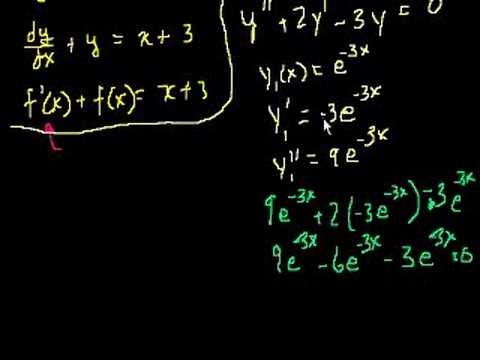
Topics covered in a first year course in differential equations. Need to understand basic differentiation and integration from Calculus playlist before starting here. What is a differential equation. Separable Differential Equations. Separable differential equations 2. Exact Equations Intuition 1 (proofy). Exact Equations Intuition 2 (proofy). Exact Equations Example 1. Exact Equations Example 2. Exact Equations Example 3. Integrating factors 1. Integrating factors 2. First order homegenous equations. First order homogeneous equations 2. 2nd Order Linear Homogeneous Differential Equations 1. 2nd Order Linear Homogeneous Differential Equations 2. 2nd Order Linear Homogeneous Differential Equations 3. 2nd Order Linear Homogeneous Differential Equations 4. Complex roots of the characteristic equations 1. Complex roots of the characteristic equations 2. Complex roots of the characteristic equations 3. Repeated roots of the characteristic equation. Repeated roots of the characteristic equations part 2. Undetermined Coefficients 1. Undetermined Coefficients 2. Undetermined Coefficients 3. Undetermined Coefficients 4. Laplace Transform 1. Laplace Transform 2. Laplace Transform 3 (L{sin(at)}). Laplace Transform 4. Laplace Transform 5. Laplace Transform 6. Laplace Transform to solve an equation. Laplace Transform solves an equation 2. More Laplace Transform tools. Using the Laplace Transform to solve a nonhomogeneous eq. Laplace Transform of : L{t}. Laplace Transform of t^n: L{t^n}. Laplace Transform of the Unit Step Function. Inverse Laplace Examples. Laplace/Step Function Differential Equation. Dirac Delta Function. Laplace Transform of the Dirac Delta Function. Introduction to the Convolution. The Convolution and the Laplace Transform. Using the Convolution Theorem to Solve an Initial Value Prob.
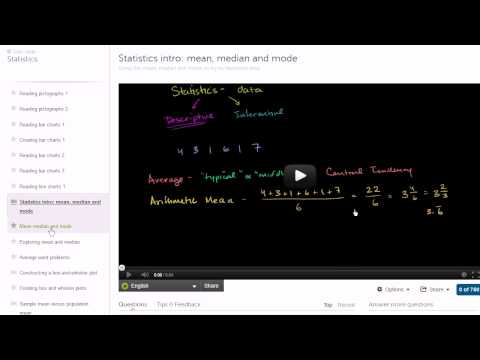
Introduction to statistics. We start with the basics of reading and interpretting data and then build into descriptive and inferential statistics that are typically covered in an introductory course on the subject. Overview of Khan Academy statistics. Statistics intro: mean, median and mode. Constructing a box-and-whisker plot. Sample mean versus population mean.. Variance of a population. Sample variance. Review and intuition why we divide by n-1 for the unbiased sample variance. Simulation showing bias in sample variance. Simulation providing evidence that (n-1) gives us unbiased estimate. Statistics: Standard Deviation. Statistics: Alternate Variance Formulas. Introduction to Random Variables. Probability Density Functions. Binomial Distribution 1. Binomial Distribution 2. Binomial Distribution 3. Binomial Distribution 4. Expected Value: E(X). Expected Value of Binomial Distribution. Poisson Process 1. Poisson Process 2. Introduction to the Normal Distribution. Normal Distribution Excel Exercise. Law of Large Numbers. ck12.org Normal Distribution Problems: Qualitative sense of normal distributions. ck12.org Normal Distribution Problems: Empirical Rule. ck12.org Normal Distribution Problems: z-score. ck12.org Exercise: Standard Normal Distribution and the Empirical Rule. ck12.org: More Empirical Rule and Z-score practice. Central Limit Theorem. Sampling Distribution of the Sample Mean. Sampling Distribution of the Sample Mean 2. Standard Error of the Mean. Sampling Distribution Example Problem. Confidence Interval 1. Confidence Interval Example. Mean and Variance of Bernoulli Distribution Example. Bernoulli Distribution Mean and Variance Formulas. Margin of Error 1. Margin of Error 2. Small Sample Size Confidence Intervals. Hypothesis Testing and P-values. One-Tailed and Two-Tailed Tests. Z-statistics vs. T-statistics. Type 1 Errors. Small Sample Hypothesis Test. T-Statistic Confidence Interval. Large Sample Proportion Hypothesis Testing. Variance of Differences of Random Variables. Difference of Sample Means Distribution. Confidence Interval of Difference of Means. Clarification of Confidence Interval of Difference of Means. Hypothesis Test for Difference of Means. Comparing Population Proportions 1. Comparing Population Proportions 2. Hypothesis Test Comparing Population Proportions. Squared Error of Regression Line. Proof (Part 1) Minimizing Squared Error to Regression Line. Proof Part 2 Minimizing Squared Error to Line. Proof (Part 3) Minimizing Squared Error to Regression Line. Proof (Part 4) Minimizing Squared Error to Regression Line. Regression Line Example. Second Regression Example. R-Squared or Coefficient of Determination. Calculating R-Squared. Covariance and the Regression Line. Correlation and Causality. Chi-Square Distribution Introduction. Pearson's Chi Square Test (Goodness of Fit). Contingency Table Chi-Square Test. ANOVA 1 - Calculating SST (Total Sum of Squares). ANOVA 2 - Calculating SSW and SSB (Total Sum of Squares Within and Between).avi. ANOVA 3 -Hypothesis Test with F-Statistic. Another simulation giving evidence that (n-1) gives us an unbiased estimate of variance. Mean Median and Mode. Range and Mid-range. Reading Pictographs. Reading Bar Graphs. Reading Line Graphs. Reading Pie Graphs (Circle Graphs). Misleading Line Graphs. Stem-and-leaf Plots. Box-and-Whisker Plots. Reading Box-and-Whisker Plots. Statistics: The Average. Statistics: Variance of a Population. Statistics: Sample Variance. Deductive Reasoning 1. Deductive Reasoning 2. Deductive Reasoning 3. Inductive Reasoning 1. Inductive Reasoning 2. Inductive Reasoning 3. Inductive Patterns.

Why "is" biology log-normal? Why do some circuits oscillate? See biology from a physical sciences perspective.

A bunch of video tutorials to make GCSE Maths a whole lot easier. This course is pitched at the D/C borderline.

A virtual team is a small temporary groups of geographically, organizationally and/ or time dispersed knowledge workers

A fascinating overview of the field of public health: how it keeps us safe and healthy and why it matters.

Learn game theory from Yale professor Ben Polak. Topics covered include: dominance, signaling, commitment, and more.

Lecture - 24 GraphsrnLecture Series on Data Structures and Algorithms by Dr. Naveen Garg, Department of Computer Science

Lecture Series on Quantum Physics by Prof.V.Balakrishnan, Department of Physics, IIT Madras.


Lecture Series on Basic Electronics by Dr.Chitralekha Mahanta, Department of Electronics and Communication Engineering ,

This Stanford Continuing Studies course is the second of a six-quarter sequence of classes exploring the essential theor
Add to calendar

Trusted paper writing service WriteMyPaper.Today will write the papers of any difficulty.