

Courses tagged with "Nutrition" (6413)

This course is designed for students who will be starting or restarting college within the next year, and for current students who have not completed their general education math requirement. It will provide math refresher materials covering a wide range of mathematical concepts together with information about success in college. Incoming college students are typically placed in college math courses based on placement exam scores. Students often take these placement exams with minimal preparation or after a long break since their last math class. The study materials in the course will help students prepare for placement exams, and higher scores mean fewer required math courses in college. Students who have already taken a placement exam (such as the ACT) can also use these materials to study and then retest, hopefully scoring higher. College students who have started, but not finished their math courses, can also retake a placement exam and possibly skip a math class. The course will also be valuable for anyone who just wants to refresh their math skills. The provided study materials are individualized based on a student’s current knowledge. Each student will be provided a customized learning path that maximizes efficiency so that study time is spent where it’s needed most. Beyond math content, the course will also provide college success material such as test-taking strategies, new student orientation, and study techniques. All of this material can be accessed separately from the math content so even if a student is already placed highly in math, or has tested out of it completely, the course will provide valuable information to help the student orient to college and to get the most out of the college experience.

This class presents the fundamental probability and statistical concepts used in elementary data analysis. It will be taught at an introductory level for students with junior or senior college-level mathematical training including a working knowledge of calculus. A small amount of linear algebra and programming are useful for the class, but not required.
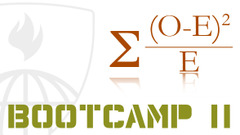
Learn fundamental concepts in data analysis and statistical inference, focusing on one and two independent samples.

This course provides techniques of effective presentation of mathematical material. Each section of this course is associated with a regular mathematics subject, and uses the material of that subject as a basis for written and oral presentations. The section presented here is on chaotic dynamical systems.

This graduate-level course is a continuation of Mathematical Methods for Engineers I (18.085). Topics include numerical methods; initial-value problems; network flows; and optimization.

Mathematical Methods for Quantitative Finance covers topics from calculus and linear algebra that are fundamental for the study of mathematical finance. Students successfully completing this course will be mathematically well prepared to study quantitative finance at the graduate level.

Find out what solid-state physics has brought to Electromagnetism in the last 20 years. This course surveys the physics and mathematics of nanophotonics—electromagnetic waves in media structured on the scale of the wavelength.
Topics include computational methods combined with high-level algebraic techniques borrowed from solid-state quantum mechanics: linear algebra and eigensystems, group theory, Bloch's theorem and conservation laws, perturbation methods, and coupled-mode theories, to understand surprising optical phenomena from band gaps to slow light to nonlinear filters.
Note: An earlier version of this course was published on OCW as 18.325 Topics in Applied Mathematics: Mathematical Methods in Nanophotonics, Fall 2005.

How do populations grow? How do viruses spread? What is the trajectory of a glider?
Many real-life problems can be described and solved by mathematical models. In this course, you will form a team with another student and work in a project to solve a real-life problem.
You will learn to analyze your chosen problem, formulate it as a mathematical model (containing ordinary differential equations), solve the equations in the model, and validate your results. You will learn how to implement Euler’s method in a Python program.
If needed, you can refine or improve your model, based on your first results. Finally, you will learn how to report your findings in a scientific way.
This course is mainly aimed at Bachelor students from Mathematics, Engineering and Science disciplines. However it will suit anyone who would like to learn how mathematical modeling can solve real-world problems.

As modern life science research becomes ever more quantitative, the need for mathematical modeling becomes ever more important. A deeper and mechanistic understanding of complicated biological processes can only come from the understanding of complex interactions at many different scales, for instance, the molecular, the cellular, individual organisms and population levels.
In this course, through case studies, we will examine some simplified and idealized mathematical models and their underlying mathematical framework so that we learn how to construct simplified representations of complex biological processes and phenomena. We will learn how to analyze these models both qualitatively and quantitatively and interpret the results in a biological fashion by providing predictions and hypotheses that experimentalists may verify.
当现代生命科学研究变得更加量化,建立数学模型的需求变得越来越重要。对复杂生物现象的深入理解最终是建立在了解发生于多时空间尺度的复杂生物学相互作用上,例如,分子尺度,细胞尺度,个体和群体尺度上。通过研究一些案例,我们将建立一些简化的数学模型以及其背后的基本数学框架。同时,我们将学习如何建立基本生物学过程的简单表征,以及如何定量和定性和定量地的分析这些模型,并将它们的结果以生物学的方式进行解释,以期提供实验学家进行检验的假说和预测。

This graduate level mathematics course covers decision theory, estimation, confidence intervals, and hypothesis testing. The course also introduces students to large sample theory. Other topics covered include asymptotic efficiency of estimates, exponential families, and sequential analysis.

This course provides students with decision theory, estimation, confidence intervals, and hypothesis testing. It introduces large sample theory, asymptotic efficiency of estimates, exponential families, and sequential analysis.

This course covers elementary discrete mathematics for computer science and engineering. It emphasizes mathematical definitions and proofs as well as applicable methods. Topics include formal logic notation, proof methods; induction, well-ordering; sets, relations; elementary graph theory; integer congruences; asymptotic notation and growth of functions; permutations and combinations, counting principles; discrete probability. Further selected topics may also be covered, such as recursive definition and structural induction; state machines and invariants; recurrences; generating functions.

This subject offers an interactive introduction to discrete mathematics oriented toward computer science and engineering. The subject coverage divides roughly into thirds:
- Fundamental concepts of mathematics: Definitions, proofs, sets, functions, relations.
- Discrete structures: graphs, state machines, modular arithmetic, counting.
- Discrete probability theory.
On completion of 6.042J, students will be able to explain and apply the basic methods of discrete (noncontinuous) mathematics in computer science. They will be able to use these methods in subsequent courses in the design and analysis of algorithms, computability theory, software engineering, and computer systems.
Interactive site components can be found on the Unit pages in the left-hand navigational bar, starting with Unit 1: Proofs.

This course covers the mathematical techniques necessary for understanding of materials science and engineering topics such as energetics, materials structure and symmetry, materials response to applied fields, mechanics and physics of solids and soft materials. The class uses examples from the materials science and engineering core courses (3.012 and 3.014) to introduce mathematical concepts and materials-related problem solving skills. Topics include linear algebra and orthonormal basis, eigenvalues and eigenvectors, quadratic forms, tensor operations, symmetry operations, calculus of several variables, introduction to complex analysis, ordinary and partial differential equations, theory of distributions, and fourier analysis.
Users may find additional or updated materials at Professor Carter's 3.016 course Web site.

Broadly speaking, Machine Learning refers to the automated identification of patterns in data. As such it has been a fertile ground for new statistical and algorithmic developments. The purpose of this course is to provide a mathematically rigorous introduction to these developments with emphasis on methods and their analysis.
You can read more about Prof. Rigollet's work and courses on his website.

Planning to study for an MBA but unsure of your basic maths skills? All MBA programs require some maths, particularly on quantitative subjects such as Accounting, Economics and Finance.
In this mathematics course, you will learn the fundamental business math skills needed to succeed in your MBA study. These math skills will also give you an edge in the workplace enabling you to apply greater analytical skill to your decision making.
You will learn how to evaluate and manipulate the types of formulae that appear in an accounting syllabus, how to perform the calculus required to solve optimization problems in economics and how to apply the concept of geometric series to solving finance-related problems such as calculating compound interest payments.
This course assumes no prior knowledge of business maths, concepts are explained clearly and regular activities give you the opportunity to practice your skills and improve your confidence.

Take an exciting crash course in MATLAB and Octave programming. Both languages allow users to experiment with advanced mathematical functions and produce exciting matrix visualizations.
In this hands-on, self-paced introductory course, students will learn step by step how to use these mathematical tools to write functions, calculate vectors and matrices and plot graphical representations of results. Explore ways to organize your work using scripts and functions to improve productivity.

Commencer à utiliser un logiciel est toujours délicat, on ne sait jamais par où commencer.
Dans ce cours nous allons nous concentrer sur la maîtrise d’Octave et MATLAB, de façon à pouvoir par la suite continuer à apprendre de manière indépendante.
Le but est donc d’apprendre, pas à pas, comment ces logiciels sont organisés, comment faire des calculs compliqués, en utilisant des matrices et des vecteurs, ainsi que traiter des données et dessiner des graphiques qui mettent en valeur vos résultats. Vous allez aussi apprendre à bien organiser le travail en utilisant des scripts et des fonctions, ce qui va améliorer votre efficacité par la suite.
Enfin vous allez connaitre de bases simples pour la programmation.

This International Study Tour went to New Zealand during the first half of the 2016 Spring semester and travel during the Sloan Innovation Period. International Study Tours provide students with a course credit opportunity to identify and address issues about which they feel particularly passionate. After classroom sessions featuring faculty, industry, and cultural experts, students embark on site visits to their destination of choice, meeting with industry and government leaders, as well as local alumni. Through these visits, students are able to build on the preparatory course work with an in-depth exploration of industries, companies, and countries they have visited.
This course fulfills the Sloan Innovation Period (SIP) elective requirement. SIP occurs at the midpoint of each semester providing students with an intensive week of experiential leadership learning, as well as exposure to groundbreaking faculty work. It allows students to engage in intellectual exploration outside the classroom. SIP degree requirements include core courses in ethics and leadership as well as electives.

Discover what makes your brain tick in this first module of a three-part introductory series in neuroscience.
Add to calendar

Trusted paper writing service WriteMyPaper.Today will write the papers of any difficulty.