

Courses tagged with "Website Development" (161)

Helping you build human-centered design skills, so that you have the principles and methods to create excellent interfaces with any technology.

Ce cours initie à la programmation en utilisant le langage C++. Il ne présuppose pas de connaissance préalable. Les aspects plus avancés (programmation orientée objet) sont donnés dans un cours suivant, «Introduction à la programmation orientée objet (en C++)».
Ce cours initie à la programmation en utilisant le langage C++. Il ne présuppose pas de connaissance préalable. Les aspects plus avancés (programmation orientée objet) sont donnés dans un cours suivant, «Introduction à la programmation orientée objet (en C++)».

Ce cours initie à la programmation en utilisant le langage Java. Il ne présuppose pas de connaissance préalable. Les aspects plus avancés (programmation orientée objet) sont donnés dans un cours suivant, «Introduction à la programmation orientée objet (en Java)».
Ce cours initie à la programmation en utilisant le langage Java. Il ne présuppose pas de connaissance préalable. Les aspects plus avancés (programmation orientée objet) sont donnés dans un cours suivant, «Introduction à la programmation orientée objet (en Java)».

This class will teach you about the basic principles of 3D computer graphics: meshes, transforms, cameras, materials, lighting, and animation.

This course introduces various interactive tools for visual problem solving. Students will learn how to design and implement such tools for your own problems.

Applications of computer graphics are ubiquitous, ranging from animations in movies to computer aided design of mechanical parts. In this course, we will learn how to create three-dimensional interactive applications using WebGL that run within the latest web browsers. We will disucss all aspects of computer graphics from hardware to software to applications.

Ever played the Kevin Bacon game? This class will show you how it works by giving you an introduction to the design and analysis of algorithms, enabling you to discover how individuals are connected.

Artificial Intelligence (AI) is a field that has a long history but is still constantly and actively growing and changing. In this course, you’ll learn the basics of modern AI as well as some of the representative applications of AI. Along the way, we also hope to excite you about the numerous applications and huge possibilities in the field of AI, which continues to expand human capability beyond our imagination. ***Note: Parts of this course are featured in the Machine Learning Engineer Nanodegree and the Data Analyst Nanodegree programs. If you are interested in AI, be sure to check out those programs as well!***

In this introduction to computer programming course, you’ll learn and practice key computer science concepts by building your own versions of popular web applications. You’ll learn Python, a powerful, easy-to-learn, and widely used programming language, and you’ll explore computer science basics, as you build your own search engine and social network.

The Apache™ Hadoop® project develops open-source software for reliable, scalable, distributed computing. Learn the fundamental principles behind it, and how you can use its power to make sense of your Big Data.

In this introductory course, you'll learn and practice essential computer science concepts using the Java programming language. You'll learn about Object Oriented Programming, a technique that allows you to use code written by other programmers in your own programs. You'll put your new Java programming skills to the test by solving real-world problems faced by software engineers.

Learn the fundamentals of parallel computing with the GPU and the CUDA programming environment! In this class, you'll learn about parallel programming by coding a series of image processing algorithms, such as you might find in Photoshop or Instagram. You'll be able to program and run your assignments on high-end GPUs, even if you don't own one yourself. **Why It’s Important to Think Parallel** [Third Pillar of Science][1] Learn how scientific discovery can be accelerated by combining theory and experimentation with computing to fight cancer, prevent heart attacks, and spur new advances in robotic surgery. [1]: http://www.youtube.com/watch?v=3DbAB2ChDBw
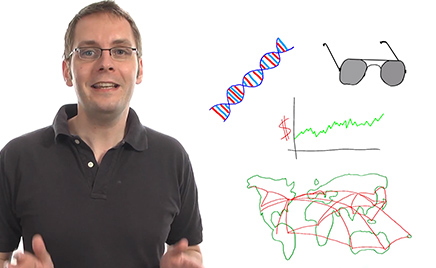
This class teaches you about basic concepts in theoretical computer science -- such as NP-completeness -- and what they imply for solving tough algorithmic problems.

Ce cours introduit la programmation orientée objet en l'illustrant en langage C++. Il présuppose connues les bases de la programmation (variables, types, boucles, fonctions, ...). Il est conçu comme la suite du cours «Initiation à la programmation (en C++)».

Ce cours introduit la programmation orientée objet en l'illustrant en langage C++. Il présuppose connues les bases de la programmation (variables, types, boucles, fonctions, ...). Il est conçu comme la suite du cours «Initiation à la programmation (en C++)».

Ce cours introduit la programmation orientée objet en l'illustrant en langage Java. Il présuppose connues les bases de la programmation (variables, types, boucles, fonctions, ...). Il est conçu comme la suite du cours «Initiation à la programmation (en Java)».
Ce cours introduit la programmation orientée objet en l'illustrant en langage Java. Il présuppose connues les bases de la programmation (variables, types, boucles, fonctions, ...). Il est conçu comme la suite du cours «Initiation à la programmation (en Java)».

计算概论A是针对“信息科学技术学科一年级本科生”开设的一门专业基础主干课程。本课程的教学目标有二:其一,帮助学习者建立起“学习计算机科学技术知识所需的基本知识背景”;其二,帮助学习者“掌握计算机程序设计的基础知识”,培养学习者“独立设计计算机程序解决问题”的基本技能。
Add to calendar

Trusted paper writing service WriteMyPaper.Today will write the papers of any difficulty.