

Online courses directory (10358)

This course focuses on the land use-transportation "interaction space" in metropolitan settings. The course aims to develop an understanding of relevant theories and analytical techniques, through the exploration of various cases drawn from different parts of the world. The course begins with an overview of the role of transportation in patterns of urban development and metropolitan growth. It introduces the concept of accessibility and related issues of individual and firm travel demand. Later in the semester, students will explore the influence of the metropolitan built environment on travel behavior and the role of transportation on metropolitan land development. The course will conclude with an examination of the implications of the land use-transportation interaction space for metropolitan futures, and our abilities to forecast them.

This graduate seminar has two main goals: to explore the main theoretical and methodological approaches to the study of contemporary Chinese politics; and to relate those approches to broader trends in the field of comparative politics. What has the study of China contributed to the field of comparative politics, and vice versa? What are the most effective ways to integrate area studies, broader comparative approaches, and theory? Seminar presumes a basic understanding of the history and politics of contemporary China.

This course focuses on the complexities associated with security and sustainability of states in international relations. Covering aspects of theory, methods and empirical analysis, the course is in three parts, and each consists of seminar sessions focusing on specific topics.
This course focuses on the complexities associated with security and sustainability of states in international relations. Covering aspects of theory, methods and empirical analysis, the course is in three parts, and each consists of seminar sessions focusing on specific topics.

After sequencing genomes, we would like to compare them. We will see that dynamic programming is a powerful algorithmic tool when we compare two genes (i.e., short sequences of DNA) or two proteins. When we "zoom out" to compare entire genomes, we will employ combinatorial algorithms.

What are the competencies for deliberate cocreation? And what does prosperity/ poverty consciousness have to do with it?

Competition in Telecommunications provides an introduction to the economics, business strategies, and technology of telecommunications markets. This includes markets for wireless communications, local and long-distance services, and customer equipment. The convergence of computers, cable TV and telecommunications and the competitive emergence of the Internet are covered in depth. A number of speakers from leading companies in the industry will give course lectures.
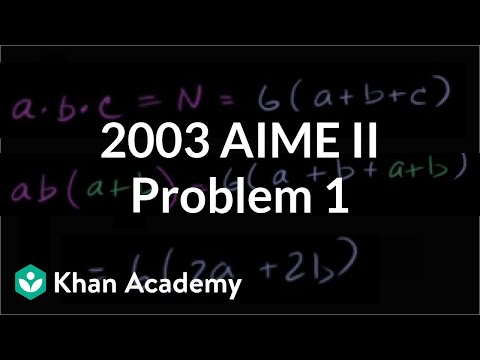
Example problems from random math competitions. 2003 AIME II Problem 1. 2003 AIME II Problem 3. 2003 AIME II Problem 4 (part 1). Sum of factors of 27000. Sum of factors 2. 2003 AIME II Problem 5. 2003 AIME II Problem 5 Minor Correction. Area Circumradius Formula Proof. 2003 AIME II Problem 8. Sum of Polynomial Roots (Proof). Sum of Squares of Polynomial Roots. 2003 AIME II Problem 9. 2003 AIME II Problem 12. 2003 AIME II Problem 13. 2003 AIME II Problem 10. 2003 AIME II Problem 11. 2003 AIME II Problem 14. 2003 AIME II Problem 15 (part 1). 2003 AIME II Problem 15 (part 2). 2003 AIME II Problem 15 (part 3). 2003 AIME II Problem 1. 2003 AIME II Problem 3. 2003 AIME II Problem 4 (part 1). Sum of factors of 27000. Sum of factors 2. 2003 AIME II Problem 5. 2003 AIME II Problem 5 Minor Correction. Area Circumradius Formula Proof. 2003 AIME II Problem 8. Sum of Polynomial Roots (Proof). Sum of Squares of Polynomial Roots. 2003 AIME II Problem 9. 2003 AIME II Problem 12. 2003 AIME II Problem 13. 2003 AIME II Problem 10. 2003 AIME II Problem 11. 2003 AIME II Problem 14. 2003 AIME II Problem 15 (part 1). 2003 AIME II Problem 15 (part 2). 2003 AIME II Problem 15 (part 3).

This course aims to develop negotiation skills by active participation in a variety of negotiation settings, and a series of integrative bargaining cases between two and more than two parties over multiple issues. Ethical dilemmas in negotiation are discussed at various times throughout the course.

In this six-modules course you will learn how firms behave in situations in which strategic decisions are interdependent, i.e. where my actions affect my competitors' profits and vice versa. Using the basic tools of game theory, we will analyze how firms choose strategies to attain competitive advantage.

This course will discuss the major ideas used today in the implementation of programming language compilers. You will learn how a program written in a high-level language designed for humans is systematically translated into a program written in low-level assembly more suited to machines!


The objective of this course is to learn the theory and practice behind building automatic translators (compilers) for higher level programming languages and to engineer and build key phases of a compiler in Java or C++ for a small language.

This is a continuation of our series of accounting courses that will greatly increase your knowledge and understanding of the theory of accounting and accounting practices. This free online accounting course explains the processes used to close your accounts at the end of an accounting period, from creating a worksheet that facilitates the generation of the Income Statement and Retained Earnings statement to the generation of the Balance sheet. You will also be shown how a Classified Balance sheet is broken down into current and long-term assets and liabilities. The important Current Ratio figure is calculated and explained in context. You will also learn a little about the history of accounting systems and the impact of computerization on the process. This free online accounting course will be of great interest to entrepreneurs and business professionals who would like to get a thorough introduction to accounting principles, and to any learner who is interested in accounting as a future career.<br />

In this advanced math course, you will learn how to build solutions to important differential equations in physics and their asymptotic expansions. Armed with the tools mastered in this course, you will have a solid command of the methods of tackling differential equations and integrals encountered in theoretical and applied physics and material science.
The course is for engineering and physics majors. The course instructors are active researchers in theoretical solid-state physics.

This course is offered to graduates and is a project-oriented course to teach new methodologies for designing multi-million-gate CMOS VLSI chips using high-level synthesis tools in conjunction with standard commercial EDA tools. The emphasis is on modular and robust designs, reusable modules, correctness by construction, architectural exploration, and meeting the area, timing, and power constraints within standard cell and FPGA frameworks.

This course explored topics such as complex algebra and functions, analyticity, contour integration, Cauchy's theorem, singularities, Taylor and Laurent series, residues, evaluation of integrals, multivalued functions, potential theory in two dimensions, Fourier analysis and Laplace transforms.

Análisis de un caso real en el que se pueden obtener importantes conclusiones sobre los controles a aplicar

As organizational data stored in email and documents continues to grow, Office 365 makes it easy to find relevant information as you need it.
In this course, you will learn how to plan, implement and manage eDiscovery in your organization. This course covers all necessary steps to effectively plan and manage discovery requests and conduct an Advanced eDiscovery analysis.
This is the first in a series of courses concerning Compliance in Office 365.

In Compliance in Office 365®: Data Governance, you will learn how to plan, implement, and manage the archiving and data retention features of Office 365 in your organization. As organizational data stored in email and documents continues to grow, Office 365 makes it easy to control the information that you want to keep and control the flow of information out of your organization. This course covers all the information you need to effectively plan and manage data retention and data leakage.
This is the second in a series of courses concerning Compliance in Office 365. By completing this course, you will gain an understanding of the archiving and data retention capabilities of Office 365 and data leakage prevention.
Add to calendar

Trusted paper writing service WriteMyPaper.Today will write the papers of any difficulty.