

Online courses directory (10358)

Workplace safety and health policies are key elements of any modern business or organization. They can help ensure employee well-being as well as foster a productive work environment.<br /><br />ALISON's free online health and safety certification course guides you through the important aspects involved in workplace safety and health and is ideal for anyone wishing to attain certification or gain a greater understanding of the topic.<br /><br />Topics covered in this free online course include behavior-based safety for supervisors and managers, workstation ergonomics, back safety, and the keys to maintaining a drug-free workplace.<br /><br />You will gain a thorough understanding of key aspects such as risk analysis, hazard identification and control, safety education and training, and best practice policies for the implementation of effective safety programs. Also included is a case study that focuses on the management of safety and health in schools.<br />

Welcome to Diploma Plugin Investment Prep I put together this investment information because I saw people with college d

This course introduces principles and technologies for converting heat into electricity via solid-state devices. The first part of the course discusses thermoelectric energy conversion and thermoelectric materials, thermionic energy conversion, and photovoltaics. The second part of the course discusses solar thermal technologies. Various solar heat collection systems will be reviewed, followed by an introduction to the principles of solar thermophotovoltaics and solar thermoelectrics. Spectral control techniques, which are critical for solar thermal systems, will be discussed.

<span style="font-weight: bold;"></span>Developed by award-winning teaching fellow Russell Stannard, this free online course teaches you how to create professional animated multimedia videos for your business or place of employment, or simply to entertain your friends and family. Start the course and begin making professional animated videos today!<br />

If you wish to effectively approach disability from a human rights perspective, this course is for you. Drawing from expertise and examples at the global and national level, it provides essential knowledge of worldwide standards, practices and challenges.

The goal of this course is to promote equal opportunity and the full participation of students with disabilities in higher education by helping participants advance their awareness of the meaning of accessibility in education. Participants will gain competence and confidence in working with students by focusing on legislation, universal design, and assistive technologies.

During this course, students will gain an understanding of the Disaster Cycle, concentrating on the Mitigation Phase. They will examine disaster planning on a personal level developing a disaster plan and examine Awareness and Attitude during disasters and daily life.

You have to ask yourself how ready are you really? The key to survival and minimizing effects of a disaster is preparedn

Are you ready for the next inevitable disaster or public health emergency? Whether you're an EMS responder, physician, nurse, social worker, health care student, or other health care provider, you will acquire foundational knowledge in preparedness, management, and response for disasters and large-scale public health emergencies in this 6-week course.
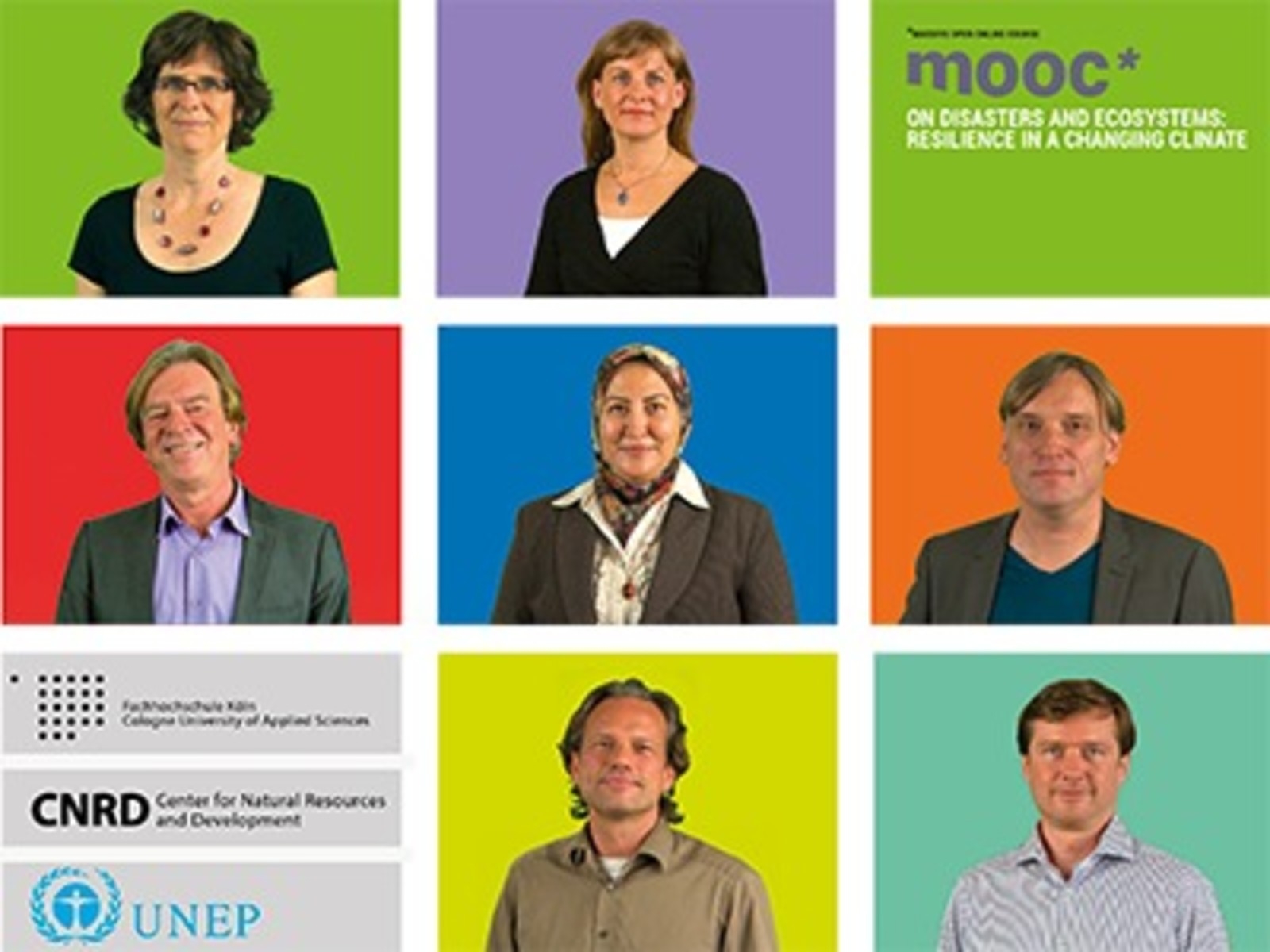
offered by the United Nations Environment Programme

and the Cologne University of Applied Science

Course Summary
This MOOC enhances knowledge and skills for tackling complex issues such as resilience and transformation, sustainable development, ecosystem management, disaster risk reduction, climate change adaptation and how they can be operationalized. It will benefit disaster managers and practitioners, climate change adaptation professionals, development planners, project implementers and policy makers. The course will be delivered through a series of lectures and case studies, quizzes, peer-reviewed exercises, along with additional study materials provided to the students. Lectures will be available through videos as well as online documents and will be geared for students who may not have access to high speed internet so they can follow the course. Students will be provided the opportunity to enhance their critical thinking through real life and fictitious problem solving exercises. Each week will feature an international expert who will be available to respond to questions and interact with students.
What will I learn?
After completion of the course, the participant will be able to:
- Define basic concepts of disasters, disaster risk reduction, climate change adaptation and resilience.
- Recognize key linkages between ecosystems, disaster risk reduction and climate change adaptation.
- Recognize the linkages and overlaps between ecosystem based disaster risk reduction and ecosystem based adaptation.
- Identify various ecosystem based tools in reducing disaster risk and climate change adaptation.
- Identify key international agreements, organizations and initiatives related to disaster risk reduction, and climate change adaptation.
- Apply concepts and tools of ecosystem-based disaster risk reduction (Eco-DRR) and ecosystem based adaptation (EbA).
- Evaluate costs and benefits of different type of measures for reducing disaster risks.
- Design your own ecosystem-based project for increasing resilience and reducing climate risks.
What do I need to know?
There are no prerequisites, just some willingness to learn about this innovative topic! It is however true that it will help if you have heard about disasters and climate change before starting.
Course Structure
The course is structured in two parts:
The leadership track, which is tailored for busy professionals or students curious about the topic. The leadership track will run three weeks.
The expert track is for professionals and students who seek more in-depth learning and skill development in applying ecosystem-based tools for disaster risk reduction and adaptation. The expert track will run 12 weeks with 3 weeks for the final assignment, peer review process and course wrap-up. Each unit has several quizzes, a concise background document for further reading, a discussion forum, supplementary videos with interviews with international experts and short documentary videos from around the world. In addition, world leaders were interviewed for our MOOC.
Course Outline and Schedule
Chapter 1. Leadership track – introduction (Week 1. Jan 12-18)
Unit 1. Disasters and Ecosystems: Resilience in a Changing Climate - why take this course?
Unit 2. Introduction to disasters, risk reduction and climate change
Chapter 2. Leadership track – linking disasters, climate change and ecosystems, Part 1 (Week 2. Jan 19-25)
Unit 3. Links between disasters, disaster risk reduction, adaptation and key international actors
Unit 4. Principles and challenges of ecosystem-based disaster risk reduction (Eco-DRR) and adaptation (EbA)
Chapter 3. Leadership track – disaster management, resilience and ecosystems (Week 3. Jan 26- Feb 1)
Unit 5. Ecosystem management contributions pre- and post-disasters
Unit 6. Managing resilience and transformation
Chapter 4. Expert track – linking disasters, climate change and ecosystems, Part 2 (Weeks 4&5. Feb 2-15)
Unit 7. Linking ecosystems and humans to disasters
Unit 8. Principles of systems thinking and using natural systems for disaster risk reduction
Unit 9. Putting Ecosystem-based disaster risk reduction (Eco-DRR) into practice
Chapter 5. Putting theory into practice (Weeks 5 & 6. Feb 16-22)
Unit 10. Linkages between Eco-DRR and EbA
Unit 11. Putting Ecosystem-based adaptation into practice & peer review assignment
Chapter 6. Ecosystem-based tools for disaster risk reduction – introduction (Week 7. Feb 23-Mar 1)
Unit 12. Incorporating ecosystems in risk assessments
Unit 13. Ecosystems and spatial tools for risk reduction
Chapter 7. Most common Eco-DRR tools (Week 8. Mar 2-8)
Unit 14. Principles of spatial planning and community-based tools for Eco-DRR
Chapter 8. Most common Eco-DRR tools (Week 9. Mar 9-15)
Unit 15. Sustainable land and water management tools for Eco-DRR
Unit 16. Ecological engineering for disaster risk reduction and climate change adaptation
Chapter 9. Economics, valuation and policy issues (Week 10. Mar 16-22)
Unit 17. Economic tools for Eco-DRR
Unit 18. Principles of mainstreaming ecosystem based disaster risk reduction into national policies, strategies, plans and projects
Chapter 10. Resilience and transformation & final assignment (Weeks 11 -13. Mar 23-April 12)
Unit 19. Approaches for operationalizing resilience
Unit 20. Problem solving assignment – peer review of assignments
Unit 21. Course wrap-up and forum discussions
Who is teaching this course?
Instructors include international faculty members from Germany, Egypt, Austria and Switzerland, supported by a line-up of expert guest lecturers and exclusive interviews with world leaders in the field of climate change, disaster risk reduction and environment:
• Dr. Achim Steiner (Executive Director of UNEP)
• Ms. Margareta Wahlström (Special Representative of the Secretary-General of the United Nations for Disaster Risk Reduction)
• Dr. Rajendra Pachauri (Chancellor of TERI University)
• Ms. Julia Marton-Lefèvre (Director General of the International Union for the Conservation of Nature 2007-2015
Some FAQs
How much time do I need to put in taking the MOOC?
In total, we estimate that a total of 40-50 hours is needed to complete the MOOC (taking both the Leadership and Expert Tracks), which will also depend on your background and English fluency. The MOOC is roughly equivalent to a 1 –week in-class training course. This estimate is based on completing the video lectures, guest video lectures, reading materials and exercises.
Do I have to be online at specific times?
No. While new modules will be released sequentially on specific dates, you need not come online simultaneously. The lectures are not webcast real-time and you can choose the time you wish to watch them. However, there will be some deadlines for assignments and peer-to-peer reviews.
Will there be exams involved?
The Leadership track has quizzes so you can self-check your knowledge level as you go. This is, however, not a precondition for progressing to the next module. And you may, however, choose to revisit a module if you feel you did do not perform satisfactorily in a module. The Expert track has two short peer-reviewed assignments and one final peer-reviewed exercise where you will be designing your own project! The peer reviewed exercises will provide an environment for interaction between course participants. You are welcome to use any other communication tool to facilitate group assignments.
What are the interactive features in this MOOC?
Iversity has a community discussion forum that will be followed by course instructors and a roster of international “Experts of the week”. The Iversity platform offers all participants the chance to give feedback on the MOOC itself but also to start discussions on any topic related to the MOOC. During the enrolment stage of the MOOC, you will be asked to fill out some basic information about yourself and be invited to actively participate in the community discussion forum. You can also post notices on the MOOC “meeting point” or to join discussions that others have started. There will thus be ample opportunity to connect with other participants for information exchanges
In cooperation with the Global Universities Partnership on Environment and Sustainability
and the Center for Natural Resources and Development
Contributions by eye on earth
Supported by the Federal Ministry for Economic Cooperation and Development

exceed - Excellence Centers for Exchange and Development

and the DAAD - German Academic Exchange Service

An entertaining and illuminating course for everyone to explore the impact dentistry has on our lives.

This self-paced course provides participants with the opportunity to explore, assess, and document learning mastered through a variety of life experiences.

This self-paced course provides participants with the opportunity to explore, assess, and document learning mastered through a variety of life experiences.

Over the past decade, young people around the globe has faced very different but great challenges: unemployment, skills gap, vocational trainings, outdated educational formats, school-to-work transition etc. Consequently, "empowerment" has become the buzzword in business, evaluation and youth development. Because of its wide use, the word "empowerment" has many different meanings to people. “Discover Yourself: Build a Career and Make an Impact” is an interactive MOOC that will empower youth through a holistic approach on four different skills sets and dimensions:
Chapter 1: Personal Development: What do you love doing?
Chapter 2: Professional Development: What do you do well?
Chapter 3: Community Development: What is the community around you?
Chapter 4: Sustainable Development: What the world needs?
Empowerment is defined as a way to provide tips and opportunities for youth to develop the competencies they need to become successful contributing members of their communities.
The MOOC is part of a youth-strategic partnership project titled “Cease Cowering: Youth Empower Action Here!” (CC: YEAH) supported by the programme Erasmus +. The project is based on partnership between the Association for Education Mladiinfo International from Macedonia, Mladiinfo Slovensko (Slovakia), The Global Experience (Germany) and Iversity (Germany). As a part of the project, the course content was developed, the video shooting was organized in Bratislava, Slovakia and a special brochure containing the materials from the course was produced. The expected project results can be summed up as following:
- Development of an innovative approach in the process of self-learning based on Open Education Resources;
- Enlarged awareness on required skills and competences needed for youth career development;
- Increased soft, entrepreneurial and digital skills of youth through non-formal online education opportunities;
- Created a strategic approach and mutual action on youth development among involved partner organizations.
Who is this course for?
Discover Yourself: Build a Career and Make an Impact will be an inclusive, free and open course for all vision-driven, knowledge-hungry and goal-oriented young individuals. We aim to attract young people aged 18 to 30, from all around the globe who are eager to work on themselves and to grow both personally and professionally. The idea is to provide those interested youth with concrete skills and tools to boost their potentials as well as to bring relevant information to them that will encourage them to undertake concrete activities in the communities where they live. In the same time, we are also targeting youngsters who have fewer opportunities and face economic, social, educational or geographical difficulties and through the MOOC we want to bring them closer to the world of opportunities.
What will I learn?
The whole course content will be organized around 4 chapters devoted on: personal, professional, community and sustainable development.
At the end of the course, you will be able to:
Personal development chapter:
- Discover what your interests, values and personal characteristics are;
- Identify exactly what you want and what you do not want to do.
Professional development chapter:
- Understand the drivers behind your career preferences and choices;
- Learn how to recognize your talents and interests and how to match them with your concrete professional career;
- Identify the skills which you can offer as well as learn about your current skills gaps.
Community development chapter:
- Demonstrate knowledge and ability to create a plan to help you improve your soft skills;
- Recognize opportunities for your career enhancement both within and beyond your current status;
- Summarize your achievements and skills in appropriate formats for future employers or academic institutions.
Sustainable development chapter:
- Extend and make most effective use of your professional network both on- and off-line
- Learn what the world career trends are;
- Discover how your career choice can influence the world challenges.
What do I need to know?
This is an introductory course. Previous knowledge is not required. The course is designed for people interested in building up a career and make an impact.
Course Structure
Chapter 1: Personal Development
Our journey to self-discovery will start from the personal development. In the first chapter, we will give you the overview of your personality and how it could influence your career choice. In the three chapter units, you will identify what the personal values you appreciate the most are and how these values are influencing your choices. Also, you will be guided to discover your personality type and will have a chance to test yourself and find out which personality type you belong to and how you can connect it to your potential career.
Chapter 2: Professional Development
Once you have discovered who actually you really are and what you love doing, it is time to see what kind of career will fit your personality and interests. Your professional self is under huge pressure lately, right? So many trends, reports and statistics show new, undiscovered ways of working and imagining your job of the future. But nothing will ever make sense unless you get to know your professional self and make choices based on your skills, needs and capacities. In this chapter you will be able to walk the thin line between self-discovery and self-creation, while articulating your experience and skills into a successful career plan.
Chapter 3: Community Development
In the Community Development chapter, we will help you discover what and how the empowered YOU can do for your community, for your peers, for your neightbours. In this chapter, we will show you the ways how you can make an impact: as an individual, as part of non formal group, and as a member of an organization. At the end of the chapter, you will be able to identify a project idea, draft a basic proposal and find a suitable programme where you can apply for a project grant for your idea. But first and foremost, you will be inspired to take the community in your hands and move the things forward!
Chapter 4: Sustainable Development
In the last chapter we will take a step back. What is the big picture? What are the challenges in the world today? We will speak about Sustainable Development Goals and discover ways how you can expand your circle of influence. We will finish the course with three elements of sustainable development - the economic, social and environmental. We want to motivate you to take personal social responsibility for your surrounding and for the whole world.
At the end of the course, the students will be able to draft a personal development plan that will present their pathway to their personal, professional, community and sustainable development.

Zinc Copper cell (reduction-oxidation). How to Measure?. Battery Meter (Galvanometer). How Many Turns?. Electrolyte Test (pure water vs. vinegar). Reverse Electrodes (polarity). Electrolyte (strong acid test). Electrolyte (salt test). Electrode (distance test). Electrolyte (temperature test). Electrode (surface area test). Standard Cell. How much electrolyte does a single cell need?. What's Next?.
Discovery of Electromagnetism. Experiment: Electromangetism. Electromagnetic Field (above vs. below). Electromagnetic Field (forward vs. reverse). Electromagnetic Field (loop). Right-Hand Rule. Battery Meter (Galvanometer).
Magnet near Compass. Tracing a Magnetic Field. Tracing a magnetic field. Discovery of Magnetic Fields. Magnet and iron filings. Magnetic field. 3D magnet with field. Magnetic Permeability. Increase Strength of Magnet. What's Next?.
Discovery of Magnetism. Compass: which way is north?. Floating Magnet. Compass Build (stroke direction). Compass Build (magnet orientation). Neutralize a Compass. Compass Interactions. Magnetising materials. What's Next?.
Series Load. Pencil Resistor. Variable Resistor (Pencil). Listen to Variable Resistance. What's Next?.
Spinning Compass. Build your own motor. What's Next.
Add to calendar

Trusted paper writing service WriteMyPaper.Today will write the papers of any difficulty.