

Online courses directory (19947)

Kursbeschreibung
In der Veranstaltung "Einführung in das Rechnungswesen" erlernst du die kaufmännische Sprache des Unternehmens. Damit kannst du Finanzberichte lesen, verstehen und interpretieren. Du kannst Entscheidungen kostenrechnerisch vorbereiten, Produkte bewerten und Kostenabweichungen analysieren. Damit kannst du unternehmerisch sowohl in die Vergangenheit als auch in die Zukunft schauen. Der Inhalt der Vorlesung umfasst den kompletten Stoff einer umfassenden Einführung in das Rechnungswesen (internes und externes Rechnungswesen), wie er an vielen Universitäten und Hochschulen in Deutschland gelehrt wird.
Planspiel
Als besonderes Feature gibt es zu der Veranstaltung das Rechnungswesen-MOOC Planspiel der Firma Simucate. Das Planspiel bietet eine interaktive Möglichkeit, die Studieninhalte gleich praktisch anzuwenden und so besser zu verstehen. Das Planspiel ist in allen Klausurpaketen enthalten. Alternativ kann es im Audit Track während des Kurses für 19 Euro hinzu gebucht werden.
Was lerne ich in diesem Kurs
Nach erfolgreichem Kursabschluss beherrschst du die Grundlagen des betriebswirtschaftlichen Rechnungswesens als kaufmännische Sprache von Unternehmen. Du kennst dich in Grundfragen der Buchführung ebenso aus wie auf dem Gebiet des internen Rechnungswesens. Du kannst Finanzberichte aufstellen, die doppelte Buchführung durchführen und Kosten mithilfe des internen Rechnungswesens dokumentierten, planen und überwachen. Damit bist du in der Lage, Entscheidungen wirtschaftlich fundiert zu analysieren.
Welche Vorkenntnisse benötige ich?
Die Teilnahme ist ohne spezielle Vorkenntnisse möglich.
Kursstruktur
Der Kurs besteht aus 7 Module von jeweils 2 Wochen:
Modul 1: Einführung und Abbildung von Eigenkapitalveränderungen
Modul 2: Doppelte Buchführung und Verbuchung von Geschäftsvorfällen
Modul 3: Buchungen am Ende des Abrechnungszeitraums und Abschlussarbeiten
Modul 4: Einführung in das interne Rechnungswesen
Modul 5: Kostenträgerrechnung
Modul 6: Kostenstellen- und Kostenartenrechnung
Modul 7: Unternehmenssteuerung, Planungsrechnungen und Kostenabweichungen
Kombi-Paket
Besuche diesen Kurs in Verbindung mit dem RWTH-MOOC "Einführung in die Betriebswirtschaftslehre" von Prof. Frank Piller. Gemeinsam bieten beide Kurse eine ausgezeichnete Einführung in die BWL und übermitteln dir das notwendige Handlungswissen und Vokabular, um im Studium oder Beruf mitreden zu können. Als besonderes Highlight bieten wir hierfür Kombinationspakete im Schüler-Track und ECTS-Track an, mit denen du Zertifikate für beide Kurse zu einem vergünstigten Preis inkl. des Planspiels erhältst.

Course Summary
Modelling and simulation make a particular part of the world easier to define, visualize and understand. Both require the identification of relevant aspects of a situation in the real world and then the use of different types of models for different objectives and the definition of the most suitable model parameters.
This course provides to you a number of methods suitable for modelling technical systems and processes in a wide range of applications. These applications cover a range from image processing via machine learning to face recognition.
After introducing the techniques in general, you train their application to real problems employing the widely used modelling and simulation tool MATLAB®.
What will I learn?
- You will be acquainted with the concepts of modelling and simulation
- You will be able to implement and simulate models using MATLAB®.
- You will acquire further knowledge of Image Processing, Optical Character Recognition, Machine Learning and Face Recognition.
- If you are an enthusiastic student with only rudimentary programming knowledge you can acquire an understanding of basic MATLAB® programming.
What do I have to know?
The course will be taught on an academic level for undergraduate students. Therefore, mathematics and physics knowledge of at least secondary education level as well as programming knowledge is a prerequisite. MATLAB® is commercial software. As a result of support from MathWorks, students will be granted a downloadable license to MATLAB® for the duration of the course.
Course Schedule
Chapter 1: Introduction to MATLAB Concepts
Chapter 2: Modelling and Simulation
Chapter 3: The Basic Problem Solving Toolbox
Chapter 4: Advanced Problem Solving Methods
Chapter 5: Statistics and Image Processing
Chapter 6: Machine Learning in a Nutshell
Chapter 7: Optical Character Recognition
Cahpter 8: Face Recognition

Kursbeschreibung
Wir möchten mit Ihnen das wissenschaftliche Denken, Arbeiten und Schreiben entwickeln.
Der Kurs beginnt philosophisch. Wir werden erörtern, was Wahrheit ist, was Wissenschaft tut und wie sie sich vom Alltagswissen unterscheidet. Danach wird es aber schnell praktisch und wir zeigen Ihnen, wie man vom leeren Blatt zu einer Hausarbeit gelangt. Alle Grundtechniken wissenschaftlichen Arbeitens von Zitation bis Datenerhebung werden hierbei vermittelt oder zumindest einmal eingeführt. Wir sprechen dabei auch über Lerntypen und Arbeitsorganisation.
Ist dieser Kurs etwas für mich?
Der Kurs richtet sich an Schüler, die schon mal ein Gefühl für wissenschaftliche Methoden entwickeln wollen, sowie an Studienanfänger, die ihn ergänzend zu den Angeboten ihres Studiengangs belegen können. Aber auch Master-Studierende, deren Einführungskurse in das Wissenschaftliche Arbeiten schon eine Weile zurückliegen, können ihre Kenntnisse in diesem Kurs auffrischen. Kurz: Er eignet sich für alle, die – aus welchen Gründen auch immer – eine schriftliche Arbeit nach wissenschaftlichen Standards erstellen möchten oder müssen.
Wir richten uns mit dem Kurs aber vor allem an nicht-naturwissenschaftliche Studiengänge.
Was werde ich lernen?
- Warum und wie man Wissenschaft betreiben kann.
- Wie man eine Hausarbeit schreibt (Thema, Recherche, Auswertung, Schreiben)
- Wie man mit der eigenen Arbeitsweise zum Erfolg kommt.
- Wie man richtig zitiert und Quellenangaben macht.
- Wie und warum man Daten sammelt und auswertet, um bestimmte Fragen zu beantworten.
Welches Vorwissen brauche ich?
Sie sollten lesen und schreiben können. Ansonsten ist dies ein Einstiegskurs.
Kursstruktur
0: Organisatorisches
1: Was ist Wissenschaft? Sie werden überrascht sein, wie wenige Menschen dies wissen.
2: Die Sache mit der Wahrheit: Wir versuchen logisch zu beweisen, dass Ihre Realität nicht wirklich existiert und wir nicht mal wissen warum.
3: Arbeitsorganisation und Lerntypen: Falls Arbeit doch real ist: Wie gehen wir damit um?
4: Die Hausarbeit I: Auf zur Jagd: Eine Hausarbeit ist nicht so schwer, wenn man...
5: Die Hausarbeit II: Exzerpieren und filetieren: Texte verstehen ist ganz leicht, wenn man....
6: Die Hausarbeit III: Das Rezept - Schreiben, zitieren und belegen: Schreiben ist ganz leicht, wenn...
7: Der Wahrheit näher kommen I: Methoden der quantitativen empirischen Forschung: Können Sie zählen? Dann können Sie auch forschen. Wir finden heraus, wie die Welt ist.
8: Der Wahrheit näher kommen II: Methoden qualitativer Forschung: Können Sie Fragen stellen? Dann können Sie auch forschen. Wir finden raus, wie die Welt ist.
Die Gliederung des Kurses in anatomische Regionen erfolgt anhand klinischer Fallberichte.
Die relevanten makroskopischen Strukturen dieser Regionen werden anhand qualitativ hochwertiger anatomischer Abbildungen und Präparationen sowie anhand klinischer Untersuchungen an gesunden Probanden erörtert.
Was lerne ich in diesem Kurs?
Du wirst Dir das Verständnis für die Anatomie des Kopfes und des Halses angeignen, das Dich befähigt:
- Weiterführende anatomische Kurse wie den Präparierkurs zu absolvieren
- Dich in Richtung klinischer Fachdisziplinen wie der Allgemeinen Chirurgie, HNO, MKG, Neurochirurgie, Ophthalmologie oder Radiologie zu orientieren
- Dich auf medizinnahe Fachberufe vorzubereiten
Welches Vorwissen brauche ich?
Anatomische Grundkenntnisse werden vorausgesetzt.
Kursstruktur
Kapitel 1: Übersicht, Kompartimente und Blutversorgung des Halses
Kapitel 2: Nerven, Lymphabfluß und Topographie des Halses
Kapitel 3: Schilddrüse und Pharynx
Kapitel 4: Larynx, Phonation und Spatium parapharyngeum
Kapitel 5: Der knöcherne Schädel
Kapitel 6: Kiefer, Mundhöhle und Kaumuskulatur
Kapitel 7: Zunge und Mundboden
Kapitel 8: Die Ohrspeicheldrüse und die mimische Muskulatur
Kapitel 9: Nase und Nasennebenhöhlen
Kapitel 10: Keilbein und Orbita
Kapitel 11: Schläfenbein und Ohr
Kapitel 12: Tiefe Gesichtsregion

Have you ever dreamed about starting your own business? Are you dedicated to sustainability but don't know how to put this passion into practice? Do you see challenges in your community which you want to change? If the answer to one or all of these questions is yes, then this is the course for you!
In this course, you will systematically explore and build your own New Business Model around your own idea. In a systematic manner, we will present you with five building blocks that will help you develop a viable and valuable model. By using the knowhow and experience of your peers in this course, you gain insight into what others are doing and get feedback on your own results. Step by step, you will build and test the model, leading to a mature result than can be put to practice instantly after the course. Enrol and invest in new adventures that will help you to create a lasting impact for yourself and the community around you.
Who is this course for?
This course is open to anyone interested in the subject. Particular groups include:
- Students of management programmes
- People/groups working on the development of a new business model
- Companies wanting to transform their existing business model
What do I need to know?
No prior knowledge is required.
What will I learn?
By the end of the course, you will know:
- the role of business models in a changing economy, against the background of trends and developments.
- understand how the economy and society is changing and how to use this as input for your value proposition.
- how to make making an initial design for your NBM.
- who and what you will need for your NBM and how to design your own NBM.
- how to improve your value proposition, based on three principles of value creation.
- how to develop a community of people who actively participate in your NBM.
- how to distinguish and assess the values your NBM is creating.
If you successfully complete the course, you will have your own NBM.
Course Structure
Chapter 1: Introduction
1.0 Introduction: Part of the first video, welcome to the week, learning objectives and assignments.
1.1 What is sustainability: Understand the notion of sustainability from a organisational and business wise perspective.
1.2 The great transition: Identify the transition from a linear to a circular economy and what this implies.
1.3 Business Models & why do we need new business models?: What is a business model and why a changing economy needs a new generation of business models.
1.4 Living in a changing economy: Identify seven trends and developments of a changing economy
1.5 Let’s talk about your NBM: What are you going to do? At the end of this course you will have your own new business model. Note to self: Isn’t this the right time to start your own community for your NBM?
Chapter 2: WEconomy
2.1 WEconomy: Understand how the economy and society is changing and how to use this as input for your value proposition.
2.2 Bio-based, functional and circular economy: Describe how we can shift from a commodity-based economy to one based on natural materials.Understand how the economy is changing from a linear to a circular model and what this implies when it comes to design. Explain the notion of selling functions instead of products and how this impacts ownership / legal structures.
2.3 Sharing and Collaborative economy: Understand what “asset management” is and how it offers tremendous possibilities for the sustainable economy. Understand how a changing economy requires new concepts of collaboration.
2.4 Self-production (3D) economy: Envision the rise of self-production through 3D print technology.
2.5 Internet of Things + Let’s talk about your NBM: Understand how people and things and things are exponentially connected and what this implies for transition. Write down your value proposition for the first time, upload and ask for feedback.
Chapter 3: New Business Model Design
3.1 Pitching your NBM team: Identify and describe the people with whom you want to develop the initial value proposition.
3.2 Organising your NBM?: Describe what kind of organisational concept you have in mind.
3.3 Resources needed for your NBM? Make an inventory of the things you need to structure your value proposition.
3.4 Case-study: Study several real world examples and analyse how they have shaped their value proposition.
3.5 Let’s talk about your NBM: This week we concentrated on the who, how and what. Write this down for your NBM, upload it and ask for feedback.
Chapter 4: Principles & Value proposition
4.1 What is value creation? Understand the nature of value creation from a co-creation perspective.
4.2 Comparing conventional and new business models: Recognise the difference in value creation between conventional and new business models.
4.3 Principles: Understand how business models are based on principles and what the principles are at play in new business models.
4.4 Reassessing the value proposition: Analyse your initial value proposition in the light of principles of value creation.
4.5 Let’s talk about your NBM: Write down your new value proposition, upload it and ask for feedback.
Chapter 5: Community building
5.1 What is a community?: Identify the key elements that make up a community.
5.2 Communities come in different shapes and sizes: Describe the different character of communities.
5.3 Building a community means building a value network: Create a value network based on diversity, scope and the nature of membership.
5.4 How to build your own community? Structure a community based on role division, principles and membership.
5.5 Let’s talk about your NBM: Start looking for a limited number of people who will help you elaborate the model, either on the internet or in your psychical environment. Ask them for feedback on your value proposition and upload the feedback.
Chapter 6 Assessing value creation
6.1 What is the value created? Understand the nature of values and which role they play in business models.
6.2 How do we assess values: Understanding the difference monetisation and valuation.
6.3 Assessing the value created by your NBM: Understand how valuation and monetisation are embedded in your NBM
6.4 Missed chances: Assess your business model from a non-monetary perspective.
6.5 Let’s talk about your NBM: At the end of this week you will have a complete clover canvas and you will hand this in as a text (100 words).
6.6 Make a video of your NBM: Make a video of your NBM and upload it.
We present a course developed by the team of Tomsk State University of Control Systems and Radioelectronics.
This course offers basic knowledge in mathematical logic.
The goals of mathematical logic are:
- To provide a formal language for mathematical statements that is easily translatable into the natural language and that allows compact and convenient notation.
- To offer clear and unambiguous interpretation of such statements that is at the same time simple and close to the natural mathematical concepts.
We made sure to make this course informative and interesting for everyone!
What will I learn?
Upon completion of the course, students will have acquired fundamental knowledge that is valuable in itself and will serve as the foundation for other studies. For example, software engineers strongly rely on logic-mathematical theories in their work.
• Natural languages possess a number of flaws - inaccuracy, polysemy, complexity.
• Knowledge of the simple yet powerful methods of mathematical statement transformations made possible by the language of logic is just as vital as is the knowledge of elementary algebra. No need to reinvent the wheel.
• Invented almost a century ago to address the needs of mathematics, mathematical logic has found application in theoretical and practical programming.
• When dealing with applied problems, a researcher has to switch between the descriptive language, mathematical language, the language of numerical methods and algorithms, and specific programming languages. The language of mathematical logic offers a great opportunity to practice this translation between languages and is used as a powerful formalised tool for transmission of information between distant languages.
What do I need to know?
Most of the course content will be understandable for students with only a high school level of education. Some minor sections of the course will require knowledge of imperative programming and elements of mathematical analysis.
Course Structure
The course consists of 7 chapters:
Chapter 1 - Mission of mathematical logic:
Goals, objectives, methods.
Relation between mathematics and mathematical logic.
Examples of logical errors, sophisms and paradoxes.
Brief history of mathematical logic, discussing how problems mathematical logic faced and solved in its development, and how mathematical logic integrates further and further into programming.
Chapter 2 - Foundations of the set theory:
Set theory is the basis for development of languages.
Chapter 3 - Propositional logic:
Propositional logic studies the simplest yet the most important formal language.
Chapter 4 - First-order languages:
The language of propositional logic has limited tools, so we talk about more complex languages based on predicate logic. The language of predicate logic offers tools for full and exact description of any formal notions and statements.
Chapter 5 - Axiomatic method:
The axiomatic method makes it possible to solve many logical problems, errors and paradoxes. It is widely used in today's mathematics and the knowledge of it is vital for anyone using functional and logical programming languages.
Chapter 6 - Mathematical proof:
Discussion of the types of mathematical proof and how proof can be aided with a computer.
Chapter 7 - Algorithm theory:
To learn about the possibilities of the algorithmic approach and the limitations of calculations, one must know the rigorous definition of algorithms and computability. The module offers these definitions and defines algorithmically unsolvable problems. The module introduces the concept of algorithm complexity, which is an important factor when selecting algorithms to solve problems. The module also compares problems by complexity - this knowledge makes it possible to use any search algorithm to solve problem instead of search for the good algorithm.
Course Summary
Due to a fast-changing environment in our increasingly globalised world, higher insecurity and higher competition increases the pressure placed on companies. Furthermore, the quality of the information necessary for managers and executives to perform is increasingly both important and complex.
Based on this backdrop, this course outlines and structures the basic challenges and assumptions for companies in the field of Controlling. We will also outline and analyse the current status of Controlling. After laying this foundation, together we will deduce the "Objectification-orientated Controlling approach".
What will I learn?
The students will learn the basic building blocks and the elements of a Controlling system as well as dive deep into the "Objectification-orientated Controlling approach" .
With this knowledge, the participants will understand the need for objectified information, as well as the appropriate quality and quantity, in order to inform proper decision making as a baseline for successful company management.
Prior Knowledge
No prior knowledge necessary.
Course Syllabus
Chapter 1: Basic Assumptions
Chapter 2: Value Orientation
Chapter 3: Objectification
Chapter 4: Controlling Status Analysis
Chapter 5: Controlling Approach: Part 1
Chapter 6: Controlling Approach: Part 2

Course Summary
The climate change and the shortage of the fossil resources are energy-related topics that lead to discussions about the energy supply of the future: On a local and on a global level, in professional and in private contexts.
Following the catastrophe in Fukushima the awareness for the necessity of discussing increased. In Germany, the reaction resulted in the so-called “Energiewende” – the energy transition.
While English – as lingua franca – cannot solve the problems of energy supply, it can at least aid finding the right words when talking about finding a solution.
Within the wide field of energy, this MOOC focuses on the topics closely related to energy transition. However, it will not give a deep insight into the technical terminology e.g. of a power plant.
Who can participate?
This course is aimed at professionals and students with previous English knowledge, interested in refreshing their language skills and learning the most important vocabulary from the energy world, particularly the topics connected to the energy transition. The course is especially suitable for those who would like to push their international career in the energy sector and hose who would like to brush up their language skills before joining the Energy English further education course at the Center for Technology Enhanced Learning (ZML).
What do I need to know?
Some prerequisite knowledge is required: English level at A2/B1 or above according to the Common European Framework of Reference for Languages (CEFR).
Previous knowledge of the energy business would be helpful, but is not strictly necessary.
What will I learn?
The overall course objective is to acquire a sound basis in the necessary vocabulary for communicating about topics concerning the energy transition. The aim is for students to both understand and be able to use this vocabulary in context. The quantifiable goal is the acquisition of between 20-30 vocabulary words per week.
You will be trained in the passive skills of listening and reading comprehension as well as the active skill of writing when discussing in the forum or completing exercises. After completion of this MOOC the participants shall be supplied with the solid basic vocabulary to follow and participate in discussions on the above mentioned topics in private as well as in professional contexts, to understand texts or videos on energy transition. These discussions could be in a business context e.g. negotiation with an international partner, or with a political background.
Course Structure
The course consists of 6 chapters, which will be issued on a weekly basis. If you are enrolled in the Certificate Track, the first exam session will take place in the 8th course week.
Chapter 1: Introduction
An overview of our current situation (fossil fuel and nuclear powered thermal energy plants), a look at turbines and energy conversion; the concept of moving away from fossil fuels and toward renewable and sustainable energy sources. What is the Energy Transition, and why do we need it? Some big-picture ideas: public policy, implementation targets, energy security.
Chapter 2: Renewable Energy
Introduction to the mature renewable technologies that are currently on the market: wind, solar, hydro, biomass, geothermal.
Chapter 3: Transmission and Distribution
How does power get from where it is generated, to where it is consumed? An examination of our current infrastructure (the power grid) and the importance and challenges of keeping the grid balanced. Introduction to the next generation of infrastructure: smart grid technology - what it is, and the fundamentals of how it works.
Chapter 4: Storage
How can we integrate renewables into the existing energy infrastructure? The current system is demand-oriented; renewables are inherently supply-driven. One key way to bridge this gap is by using energy storage. This is an overview of the most promising technologies currently available (pumped-storage hydro, batteries, compressed air, thermal energy storage, power-to-gas methane synthesis).
Chapter 5: Efficiency and Usage
The two pillars of the Energy Transition are sustainable energy and energy efficiency. Without efficiency, energy demand continues to grow unchecked and the Transition will fail. This unit focuses particularly on energy use/consumption in buildings, and the enormous role human behaviour plays in efficiency and the reduction of energy demand.
Chapter 6: Future of Energy
Research in sustainable energy and energy efficiency continues to advance - what are some potential untapped sources of energy? What are the effects the technologies of today will have on the future? How can renewable energy improve energy access and energy equality in a world of ever-growing energy demand?

Design 1o1 “Redux”
“Design 1o1 Redux” is an introduction to design through 101 exercises. A six-month journey divided into 3 courses “online” here on iversity (Part 1, Part 2 and Part 3), one final exhibition / graduation party and an “offline” workshop in which we will go one step beyond.
In short:
Part 1: “Myself” (Nov 2 to Dec 27)
Part 2: “My House” (Jan 4 to Feb 28)
Part 3: “My World” (Feb 29 to Apr 24)
Exhibition / Graduation: In Croatia (Apr 23-24)
Winter camp: In Croatia (Apr 25 to May 1)
:-)
Here we proceed with “Part 2: My House”.
Design 1o1 Redux Part 2: My House
Spaces, furniture, objects, memories... Our houses are composed of fascinating elements. In this part of the Design 1o1 Redux, we will rethink these components in order to design our own “homes”, the places where we live (or, “where the heart is” as Pliny the Elder would say).
Can we trap time into space? How to frame the ordinary? These are some of the many things we will explore!
To do so, we will work with all kinds of cool apps for phones and tablets (do you have a smartphone or tablet?). We will also share our works with the others on Instagram, using special hashtags.
Course Structure
Our various activities will be divided into 8 weeks:
Week 1: My Room
Week 2: My Kitchen
Week 3: My Garden
Week 4: My Guests
Week 5: My Basement
Week 6: My Show
Week 7: My Exam
Week 8: My Break
What will I learn?
You will learn to develop some basic design attitudes for better understanding the mechanics of today’s world.
One step at a time, you will learn that “design” is foremost a language.
A language shared, talked and discussed by designers from all over the world.
How does the world look through the special lenses of "design"?
Along the way, you will learn about a considerably high number of things. Starting from your very own self.
Prior Knowledge
In terms of prior knowledge, there is nothing required.
If you have a lot of prior knowledge, it might make the learning process more difficult, but don’t worry, no one is perfect. If we talk about contemporary “#design”, we are all absolute beginners!
However, in terms of technical equipment, this course is easier to follow via a smartphone or tablet. Of course, you can follow us via a desktop computer... but this is not how we intended the whole thing to be.
:-)
Workload
Between 4 and 7 hours a week.
Everyday, from Monday to Friday, for a total of 6 weeks, you will receive a package via email. Each package will contain a 15-second video to watch (to get you in the proper mood), and a pdf-letter introducing the daily brief (or “homework”) and a series of objects, characters and happenings intertwined with the narrative of the course (to go deeper in the subject at hand).
You will work on your assignment…
Then, once completed, you will upload it to your Instagram account (for the rest of us to see).
Easy as a kiss.
Questions or Comments?
You can write to Ms. Lola (our so-called secretary, but actually the real boss of this whole venture) at: design101.info@gmail.com.
Now, please understand that Ms. Lola is very busy. You might get higher chances of getting a quick and complete answer via Instagram, Facebook, Twitter. Come and let us show you around!
:-)
The Design 1o1 Community
This course is run by the Design 1o1 community.
You can learn more about who we are and what we do here.
All course contents are used for educational purposes.
The written content is by IdLab, and the visual content is assembled by IdLab.
The Design 1o1 Redux is a project by IdLab for Abadir Academy of Fine Arts.
Kursbeschreibung
Mathematik: das ist Freude am Denken! Und mathematisch denken kann jeder! Wer an diesem Kurs teilnimmt, erhält seine regelmäßige Dosis an meditativen Denkaufgaben, spannenden Knobeleien und mathematischen Einsichten. In den Inhaltsgebieten Arithmetik und Geometrie werden mathematische Denk- und Arbeitsweisen vermittelt, beispielsweise Problemlösen, Begriffe definieren und Sätze finden und beweisen.
Was lerne ich in diesem Kurs?
Im ersten Kursblock werden wir uns mit folgenden Fragen befassen: Wie definiert man mathematische Begriffe? Wie findet man eigentlich mathematische Gesetzmäßigkeiten? Und wie beweist man diese? Welche Rolle spielen Annahmen in der Mathematik? Wie baut sich das Gebäude der Mathematik aus Definitionen, Annahmen und Gesetzmäßgikeiten auf? Fragen über Fragen, denen wir uns mit zahlreichen Experimenten widmen.
Im zweiten Kursblock werden wir die Denk- und Arbeitsweisen aus dem ersten Block in verschiedenen Gebieten anwenden und dadurch festigen. In der Geometrie werden wir uns mit der Tätigkeit des Messens und dem Abstandsbegriff, mit Strecken, Halbgeraden und Geraden, mit Ebenen und Halbenenen und mit Winkeln befassen. In der Arithmetik schauen wir uns den Begriff der Teilbarkeit näher an, veranschaulichen Begriffe wie "größter gemeinsamer Teiler" und "kleinstes gemeinsames Vielfaches", untersuchen Primzahlen und Primfaktorzerlegungen und experimentieren mit Stellenwertsystemen.
Im dritten Kursblock befassen wir uns mit grundlegenden mathematischen Konzepten: Was sind Mengen, Relationen und Funktionen? Auch hier werden wir uns den Begriffen und ihren Zusammenhängen mit grundlegenden mathematischen Denk- und Arbeitsweisen nähern. Experimentieren, erforschen, untersuchen, ergründen, Vermutungen anstellen, Vermutungen verwerfen, Vermutungen beweisen.
Im vierten und letzten Kursblock machen wir uns noch einmal an zentrale Gesetzmäßigkeiten der Mathematik. Wie findet man solche Gesetzmäßgikeiten, und wie beweist man sie? In der Geometrie schauen wir uns schicke Sätze am Kreis an, in der Arithmetik nicht weniger schicke Sätze der Zahlentheorie. Mathematik pur, Mathematik anschaulich, Mathematik handgemacht.
Welche Vorkenntnisse benötige ich?
Jede/r kann mitmachen, der mathematische Vorkenntnisse aus dem Gymnasium mitbringt. Und wenn Du nicht auf dem Gymnasium warst, aber gerne mitmachen möchtest: Dann trau dich! Man sollte natürlich schon mal mit Geometrie und Algebra zu tun gehabt haben. Vieles wird dann wieder aufgefrischt, denn wir machen dann nicht auf dem Niveau der 12. oder 13. Klasse weiter, sondern bauen die Teilgebiete, in denen wir arbeiten, noch einmal grundlegend auf. Oberstufenwissen zu Analysis und Linearer Algebra ist nicht notwendig!
Wie hoch ist der Arbeitsaufwand
Du kannst dich entscheiden, wie aktiv Du dich in den Kurs einbringen möchtest - je nach Interesse und Ehrgeiz!
1) Kiebitze wollen "nur mal gucken" oder mit dem mathematischen Denken erst einmal warm werden. Kiebitze schnuppern jede Woche in den Kurs, schauen sich eins, zwei Videos an und stöbern vielleicht einmal in den weiterführenden Bereichen. Hierdurch bekommen sie einen Einblick, was mathematisches Denken bedeutet, und sie erhalten Impulse, wo man Mathematik auch im Alltag findet und gebrauchen kann. Vielleicht bekommen sie dabei sogar Lust auf mehr! Aufwand: ca. 1-2 Stunden pro Woche
2) Anpacker legen Hand an und erforschen aktiv Mathematik, haben aber keine rechte Lust auf zu viele Formeln. Für Anpacker heißt es: Ärmel hochkrempeln! Im MOOC lernen sie, wie man mathematische Situationen systematisch erforscht, wie man anschauliche Begründungen für mathematische Gesetzmäßgikeiten finden kann, und sie erhalten einen Einblick darin, wie man Abstraktes konkretisiert (und umgekehrt). Sie entwickeln ihre Vorstellungskraft zur Lösung mathematischer Probleme weiter und lernen, Vermutungen anhand konkreter Modelle zu untersuchen. Aufwand: ca. 3-4 Stunden pro Woche
3) Formalisierer geben sich mit der Anschauung nicht zufrieden - sie wollen Formeln sehen! Formalisierer sind Anpacker, die zusätzlich auch noch das Spiel mit abstrakter Symbolsprache lieben. Sie lernen, formale Definitionen zu fassen und formale Beweise zu führen. Natürlich immer basierend auf tragfähigen Vorstellungen, die sie mit den Anpackern teilen! Aufwand: ca. 7-8 Stunden pro Woche
Du möchtest ein Kiebitz in der Arithmetik sein, aber ein Anpacker in der Geometrie? Oder ein Formalisierer in der Arithmetik, aber ein Kiebitz in der Geometrie? Kein Problem - alles ist möglich! So kannst Du deinen individuellen Aufwand selbst wählen und dir diejenigen Inhalte zusammenstellen, die dich interessieren.
Erhalte ich ein Zertifikat?
Du erhältst eine Teilnahmebestätigung, wenn du aktiv mitmachst. Wie das genau geht, wird in der ersten Woche erklärt.

Il corso, a cui hanno contribuito alcuni tra i più qualificati specialisti degli studi danteschi, ha carattere propedeutico ed è indirizzato a un vasto pubblico; non rinuncia, tuttavia, a fornire le principali coordinate che permettono di situare il poema dantesco nel contesto culturale e storico del Medioevo, nonché di valutare il percorso di formazione che ha portato Dante dalle prime opere al compimento del suo capolavoro.
Concetti e argomenti principali: Dante Alighieri, Divina Commedia, Poesia, Letteratura italiana, Letteratura medievale, Cultura medievale, Storia medievale, poetica dantesca, teoria politica dantesca, teologia dantesca.
Obiettivi formativi
Alla fine del corso i partecipanti avranno acquisito conoscenza e familiarità con:
• il significato complessivo del viaggio-visione narrato nella Commedia;
• la struttura del poema, i suoi personaggi principali, le sue risorse espressive, stilistiche e metriche;
• il percorso intellettuale e letterario di Dante, dalle opere giovanili al poema;
• le principali concezioni filosofiche e religiose presupposte dalla Commedia: la teoria delle virtù e la concezione politica, il profetismo, il rapporto tra poesia e teologia.
Il corso è rivolto in particolare a:
• Studenti universitari, soprattutto nel campo della letteratura italiana e degli studi italiani;
• Studenti dei licei;
• Insegnanti e professori di lingua e/o letteratura italiana;
• Tutti coloro che sono interessati ad un primo approccio alla Commedia o ad approfondirne la conoscenza.
Conoscenze richieste
Trattandosi di un corso introduttivo alla "Commedia" di Dante, non ci sono prerequisiti per la partecipazione al corso.
Struttura del corso
Il corso è diviso in 8 capitoli. Ciascun capitolo presenta una o più lezioni video, il testo e la parafrasi dei canti presentati, e materiali di approfondimento (percorsi iconografici e musicali relativi ai canti presentati, letture aggiuntive).
Capitolo 1. Introduzione: Titolo e struttura del poema, sistema dei personaggi e fisionomia delle tre cantiche
Istruttori: Stefano Prandi, Carlo Ossola
• Benvenuti al MOOC "All'eterno dal tempo": la Commedia di Dante.
• Titolo e struttura del poema.
• Sistema dei personaggi e fisionomia delle tre cantiche.
Capitolo 2. Introduzione: Poesia, teoria politica e teologia nella Commedia
Istruttori: Stefano Prandi, Mira Mocan
• La Commedia come culmine dell'esperienza poetica dantesca.
• Profetismo e teoria politica. Poesia e teologia nella Commedia.
Capitolo 3. Inferno I-II: Il prologo infernale
Istruttore: Carlo Ossola
• Inferno I-II: l'inizio del viaggio ultraterreno di Dante.
Capitolo 4. Inferno XXXIII - XXXIV: Disperato dolore
Istruttore: Piero Boitani
• Inferno XXXIII - XXXIV: la fine della prima cantica.
Capitolo 5. Purgatorio I. La riconquista dell'innocenza
Istruttore: Corrado Bologna
• Purgatorio I: il Purgatorio come invenzione di Dante
Capitolo 6. Purgatorio XXXIII: "Puro e disposto a salire le stelle"
Istruttore: Lino Pertile
• Purgatorio XXXIII: la fine della seconda cantica e la profezia politica di Dante.
Capitolo 7. Paradiso I-II: Un nuovo inizio
Istruttore: Corrado Bologna
• Paradiso I-II: l'inizio della terza cantica e il concetto dantesco di Paradiso.
Capitolo 8. Paradiso XXXI-XXXIII: Da Beatrice all'infinito
Istruttore: Lino Pertile
• Paradiso XXXI-XXXIII: la fine della terza cantica e la fine del viaggio dantesco, il personaggio di Dante raggiunge lo stato di essere oltre la parola e oltre la memoria.
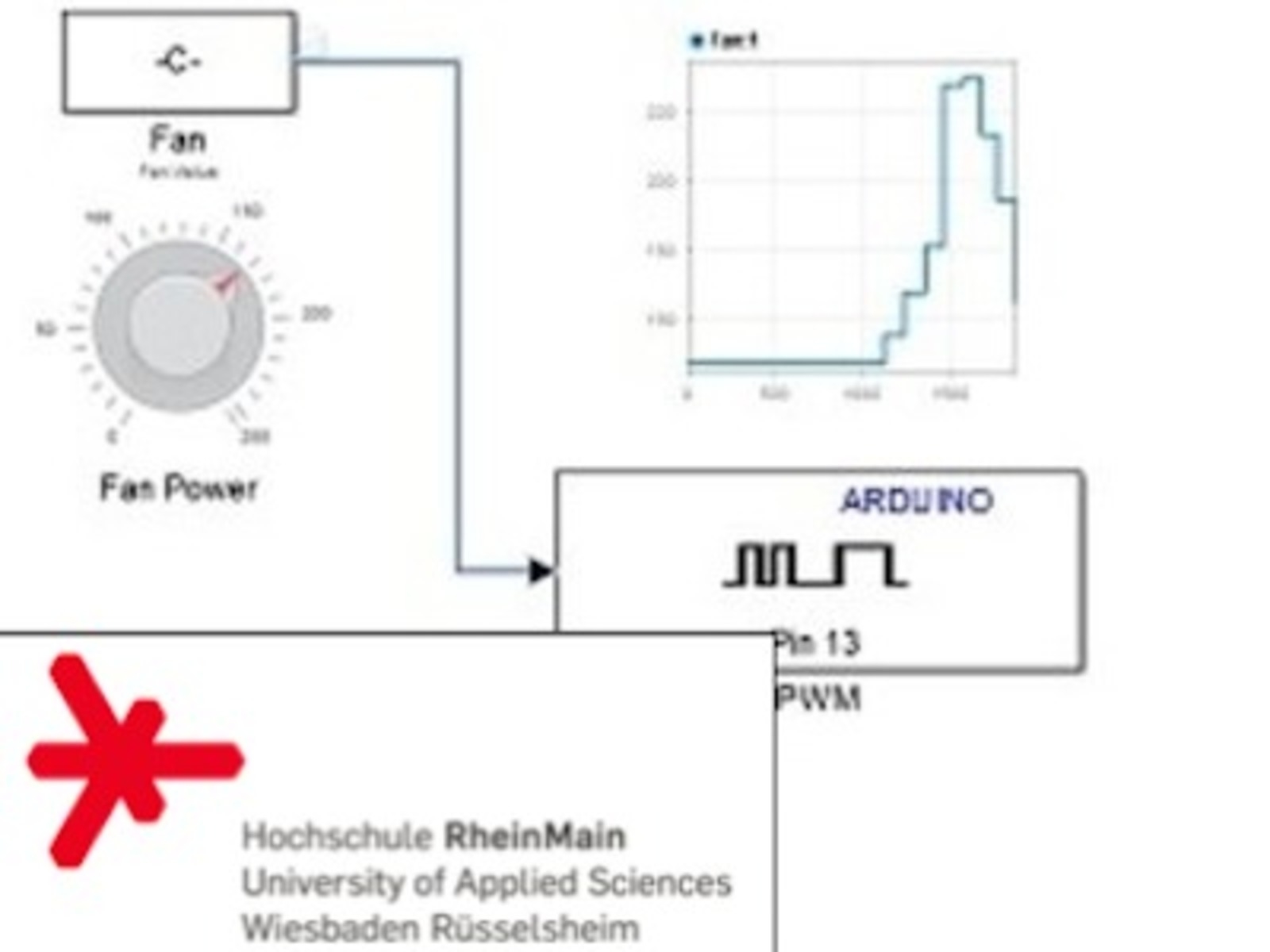
The main objective of this MOOC is to teach the use of Simulink® as a simulation tool for a broad variety of application domains. We will specifically focus on topics of interaction of the simulation models with the real world using Arduino Microcontrollers and Simulink®'s corresponding Arduino Hardware Support Package.
First, we will explain modelling and simulation concepts in general and introduce Simulink®. As a first application, we show how a simplified model of a Water Treatment Plant is implemented using Simulink®. We will then use an Arduino microcontroller to access hardware in the real world. We will go on to introduce control engineering techniques using Simulink® and apply these techniques to drive an example system of a ball floating in an airstream.
What will I learn?
By the end of this course, you will be able to implement simulation models using the tool Simulink®. These models can cover applications in the engineering domain and you know methods and technologies to create simulation models of realistic complexity.
In the engineering domain, microcontrollers are frequently used to control some physical system. Therefore, in this course you will also learn how to use an Arduino microcontroller for this purpose and how programmes for such a microcontroller are implemented in Simulink®. You will specifically learn techniques of control engineering by applying them to a technically simple physical system that is yet difficult to control.
What do I need to know?
This course will be taught on an academic level for undergraduate students. Therefore, knowledge in mathematics and physics of at least secondary education level as well as programming knowledge is a prerequisite.
Having already passed our MOOC "Modelling and Simulation using MATLAB" is helpful but not mandatory.
Course Structure
Chapter 1: My first Simulink® model
Chapter 2: Advanced Simulink® modelling
Chapter 3: Modelling a Water Treatment Plant
Chapter 4: The Arduino microcontroller and the corresponding Simulink® support package
Chapter 5: Control Engineering using Simulink®
Chapter 6: Control Engineering using the Arduino

Design 1o1 “Redux”
Are you ready?
The Design 1o1 saga is finally back with its special “redux” edition!
A special edition in which we go one step beyond! In fact, in this journey, Stefano Mirti and Anne-Sophie Gauvin are handing over more responsibilities to their students. Our former teachers will keep on producing the course contents (and correct the exams together with the course instructors), while the rest (the scary part) will be run by the Design 1o1 community.
“Design 1o1 Redux” is an introduction to design through 101 exercises. A six-month journey divided into 3 courses “online” here on iversity (Part 1, Part 2 and Part 3), one final exhibition / graduation party and an “offline” workshop for which we will go one step beyond.
In short:
Part 1: “Myself” (Nov 2 to Dec 27)
Part 2: “My House” (Jan 04 to Feb 28)
Part 3: “My World” (Feb 29 to Apr 24)
Exhibition / Graduation: In Croatia (Apr 23-24)
Winter camp: In Croatia (Apr 25 to May 1)
Ready for take off?
Here go with the first part of the course: “Myself”.
Design 1o1 Redux Part 1: Myself
Starting from our very own selves, we will collectively observe, translate and communicate many things, in a series of different ways and projects.
As Protagoras once said, “Man is the measure of all things”. It is the main reason we focus on “ourselves” in this first part of Design 1o1 Redux.
To do so, we will work with all kinds of cool apps for phones and tablets (do you have a smartphone or tablet?). We will also share our works with the others on Instagram, using special hashtags.
Indeed, we will explore a new way to learn a new design.
:-)
Course Structure
Our various activities will be divided into 8 weeks:
Week 1: My Body
Week 2: My Mind
Week 3: My Time
Week 4: My Diary
Week 5: My Food
Week 6: My Clothes
Week 7: My Exam
Week 8: My Break
What will I learn?
You will learn to develop some basic design attitudes for better understanding the mechanics of today’s world.
One step at a time, you will learn that “design” is foremost a language.
A language shared, talked and discussed by designers from all over the world.
How does the world look through the special lenses of "design"?
Along the way, you will learn about a considerably high number of things. Starting from your very own selves.
Prior Knowledge
In terms of prior knowledge, there is nothing required.
If you have a lot of prior knowledge, it might make the learning process more difficult, but don’t worry, no one is perfect. If we talk about contemporary “#design”, we are all absolute beginners!
However, in terms of technical equipment, this course is easier to follow via a smartphone or tablet. Of course, you can follow us via a desktop computer... but this is not how we intended the whole thing to be.
:-)
Workload
Between 4 and 7 hours a week.
Everyday, from Monday to Friday, for a total of 6 weeks, you will receive a package via email. Each package will contain a 15-second video to watch (to get you in the proper mood), and a pdf-letter introducing the daily brief (or “homework”) and a series of objects, characters and happenings intertwined with the narrative of the course (to go deeper in the subject at hand).
You will work on your assignment…
Then, once completed, you will upload it to your Instagram account (for the rest of us to see).
Easy as a kiss.
Questions or Comments?
You can write to Ms. Lola (our so-called secretary, but actually the real boss of this whole venture) at: design101.info@gmail.com.
Now, please understand that Ms. Lola is very busy. You might get higher chances of getting a quick and complete answer via Instagram, Facebook, Twitter. Come and let us show you around!
:-)
The Design 1o1 Community
This course is run by the Design 1o1 community.
You can learn more about who we are and what we do here.
All course contents are used for educational purposes.
The written content is by IdLab, and the visual content is assembled by IdLab.
The Design 1o1 Redux is a project by IdLab for Abadir Academy of Fine Arts.
The course embraces the following aspects:
- understanding the key geological concepts, including crystal, mineral and rock;
- applying basic methods to determine the properties of minerals and structure and texture of rocks;
- identifying the composition, formation conditions, characteristic features of naturally-occurring and urban environment stone material and to determine its practical significance;
- identifying rocks and minerals so as to understand their specific application in such areas as building construction, civil engineering, as well as distinguishing ornamental stones or gemstones in the collections;
- obtaining theoretical background to further one's ability to observe and determine the practical value of rocks.
In general, this course provides an overview of some aspects of our world from a geological point of view.
Who should participate in this course?
Everyone is welcome to join us and discover the rock and mineral environment the surrounds us. Particular groups that would be interested in the course topic include:
- Students interested in the world environment - minerals and rocks
- Future applicants in geological specialty
- Undergraduates studying the Earth's crust, including geology, mineralogy and petrology
- Technical specialists and engineers in the field of geological engineering survey
- Naturalists interested in the surrounding world and its rock components
What do I need to know?
No specific skills or prior knowledge, only self-interest, motivation and desire for self-development.
What will I learn?
The aim of the course is to understand and appreciate the surrounding inanimate nature (the Earth surface), consisting of minerals and rocks. This course will also teach you how to identify the practical importance and value of the rocks surrounding you.
By the end of the course, students will be able to:
- distinguish crystals, minerals and rocks;
- identify the most common minerals and rocks;
- know their practical value and their influence on the environment.
Course Structure
Chapter 1: Crystallography and symmetry around us. Morphology of natural geological formations.
Instructor: Associate Prof. Lyudmila Ananieva
- Historical development of geoscience
- Mineralization and mineral chemical composition
- Crystal structure and habit
- Crystal morphology
- Aggregate morphology
Apply basic and specialised knowledge related to the structure and evolution of matter in nature; dependency of shape to internal structure and composition of natural objects (minerals, crystals, rocks)
Chapter 2: Physical properties of minerals
Instructor: Associate Prof. Lyudmila Ananieva
- Optical properties of minerals: color and streak
- Optical properties of minerals: transparency and lustre
- Mechanical properties of minerals: cleavage, jointing, fracture, hardness
- Specific properties of minerals
- Useful physical properties for identifying a mineral
Apply simple methods in identifying the properties of minerals
Chapter 3: Mineral Classification
Instructor: Director of the TPU Mineralogical Museum Tatyana Martynova
- Rock-forming minerals - salic (light in color) - very broad category
- Rock-forming minerals - femic (dark in color) - very broad category
- Mineral salts
- Rare minerals
Know and identify the most common minerals
Chapter 4: Ores. Gems and ornamental stones
Instructor: Director of the TPU Mineralogical Museum Tatyana Martynova
- Noble metals
- Ferrous metals
- Non-Ferrous metals
- Other metals
- Gemstones
- Ornamental stones
Know and identify ore minerals and distinguish ornamental stones and gems
Chapter 5: Igneous rocks
Instructor: Associate Prof. Lyubov Krasnoshchekova
- Formation conditions of igneous rocks ( magma and lava-definitions, igneous crystallisation)
- Morphology and settings of igneous rocks
- Composition, structure and texture of igneous rocks
- Common volcanic (extrusive) rocks
- Common plutonic (intrusive) rocks
Identify and determine the most common igneous (extrusive and intrusive) rocks among other rocks
Chapter 6: Sedimentary rocks
Instructor: Associate Prof. Lyubov Krasnoshchekova
- Composition, structure and texture of sedimentary rocks
- Formation conditions of sedimentary rocks
- Clastic rocks (pebbles, gravel, sand)
- Chemical and biochemical rocks (chalk, coquina, gypsum, salt)
Identify and recognise the most common sedimentary rocks among other rocks.
Chapter 7: Metamorphic rocks
Instructor: Associate Prof. Lyubov Krasnoshchekova
- Formation conditions (genesis) of metamorphic rocks: Types of metamorphism
- Composition, structure and texture of metamorphic rocks
- Common metamorphic rocks (slate, gneiss, marble) and their application
- Cyclic processes of naturally occurring substances
Identify and recognise metamorphic rocks; determine their transformation conditions

Kursbeschreibung
Be the change you want to see!
Im Changemaker MOOC lernst du, wie du aus einer Idee ein Projekt zur Lösung eines gesellschaftlichen Problems entwickelst. Wir zeigen dir, wie du unternehmerische Ansätze nutzen kannst, um gesellschaftliche Herausforderungen zu lösen, egal ob du ein Projekt in den Bereichen Gesellschaft, Umwelt, Bildung oder Kultur realisieren willst.
Schritt für Schritt zum eigenen Projekt
Der Kurs führt dich Schritt für Schritt zur Erstellung eines eigenen Projektkonzepts. Du lernst, aus der Schnittmenge deiner Stärken und eines konkreten gesellschaftlichen Bedarfs eine umsetzbare Projektidee zu entwickeln. Wir machen dich mit Konzepten, Strategien und Akteuren in den Bereichen Social Entrepreneurship und Social Business vertraut. Wir zeigen dir, wie du den genauen Bedarf deiner Zielgruppe ermittelst, wie du die Maßnahmen deines Projektes planst, die Kosten kalkulierst und eine realistische Zeitplanung erstellst. Du entwickelst Strategien, um dein Projekt zu finanzieren und wirkungsvoll zu kommunizieren.
Praxis statt Theorie
Zentrale Lerninhalte werden in Form kurzer Videos vermittelt. Sie erklären alles, was du brauchst, um aus deiner Idee ein umsetzbares Projektkonzept zu machen. Du lernst erfahrene Changemaker ebenso wie junge Changeprojekte kennen. Dabei verbindet jede Lektion die Vermittlung konzeptioneller Inhalte mit der Erstellung von Bausteinen deines Projektkonzepts. Am Ende des Kurses hast du ein klar strukturiertes Konzept für dein eigenes Changeprojekt.
Was lerne ich in diesem Kurs?
Am Ende des Kurses sind die TeilnehmerInnen in der Lage, ein eigenes Changeprojekt zu planen. Sie haben die Grundkonzepte von Social Entrepreneurship kennen gelernt. Sie wissen, wo sie im Internet weitere Lernressourcen für ihr Vorhaben finden.
Welche Vorkenntnisse benötige ich?
Für die Teilnahme an diesem Kurs ist kein Vorwissen erforderlich. Er richtet sich an alle Menschen, die lernen wollen, ein eigenes Changeprojekt zur Lösung einer gesellschaftlichen Herausforderung zu entwickeln. Jede/r kann teilnehmen!
Kursstruktur
| Kapitel | Thema |
|---|---|
| Kapitel 1 | Die Welt verändern |
| Kapitel 2 | Vom Interesse zur Projektidee |
| Kapitel 3 | Was ist Social Entrepreneurship? |
| Kapitel 4 | Die Projektziele festlegen |
| Kapitel 5 | Die Strategie optimieren |
| Kapitel 6 | Die Projektstruktur planen |
| Kapitel 7 | Die Umsetzung des Projekts planen |
| Kapitel 8 | Das Projekt finanzieren |
| Kapitel 9 | Das Projekt bekannt machen |
| Kapitel 10 | Das Projekt präsentieren |

Teaching is one of the most underfunded professional fields in the United States. Teachers often spend their own money to provide basic supplies for their classrooms. In order to bring in new technology or try new approaches in the classroom teachers often have to write grants to obtain external funding to achieve their teaching goals. In this course, we will focus on learning about the different kinds of grants available, the grant writing process and common mistakes that may hamper your success. We will work as a learning community to support each other to prepare a crowdsourcing and a traditional grant application that can be submitted to a funding agency. The overall goal of this course is to help you feel informed and empowered to seek funding for your classroom today!
Course Summary
This MOOC aims to provide students with a critical knowledge concerning the phenomenon of youth bullying. The course focuses on both traditional bullying that usually takes place on school premises and cyberbullying, which occurs via information and communication technologies. With a social-ecological perspective, the first part of the MOOC explores the boundaries of these phenomena, and analyzes the characteristics of youth involved and the social-psychological processes that underlie the different roles youth play in bully-victim-bystander dynamics. The second part of this MOOC covers the prevention and intervention strategies available at the international level.
What will I learn?
Our MOOC will help you answer the following questions:
1. What is bullying? How can I recognize it?
2. How do new information and communication technologies modify traditional bullying behavior? Is ‘virtual’ bullying less ‘real’ than face-to-face bullying?
3. What are the risk factors for (cyber)bullying? And its consequences for youth?
4. What role do the family, school and peers play?
5. How can bullying and cyberbullying be prevented? What can schools, parents, and the society do about them? What really works?
Who is this course for?
The MOOC can be of high interest for people from all over the world and with different backgrounds (e.g. psychology, sociology, educational studies, public health, pediatrics) who wish to expand their knowledge and understanding of bullying among children and youth in a social-ecological perspective.
Given the twofold focus on both research and intervention, the course is also particularly suggested to people actively engaged in children’s and adolescents’ education and well-being (such as, teachers, school counsellors, school nurses, policy makers, etc.).
What do I need to know?
No prior knowledge of psychological concepts is needed, but can be helpful.
Interest in children’s and adolescents’ development, education and well-being is welcome and encouraged.
Course Schedule
Chapter 1: Introducing peer bullying In this chapter, you will learn what bullying is and how it differs from other types of aggression. Moreover, you will get an overview of the different forms that bullying can take in face-to-face and online interactions.
Chapter 2: A global health perspective Bullying is recognized as a serious problem worldwide. Gain an overview of what International organizations say about it. You will also learn about how it changes during children’s development and about its consequences on youth’s life.
Chapter 3: Individual risk and protective factors Complexity of bullying behavior requires a multidimensional explanation of why it occurs. Gain an overview of the cognitive, emotional, motivational, and moral factors that contribute to explain why some kids bully other kids.
Chapter 4: Bullying as a group phenomenon Bullying dynamics are not limited to the bully-victim dyad. Learn to change your perspective to recognize the role of the whole peer group. You will gain some insight into the different roles peers can play in bullying situations and how the peer group can influence individual behavior.
Chapter 5: How other contexts influence bullying Go even further and learn how bullying is influenced by other social environmental characteristics that lie in different contexts, including classrooms, schools, family, and culture.
Chapters 6 and 7: Preventing and tackling bullying In these two final chapters you will learn what can be done to prevent and tackle bullying. You will learn what an evidence-based intervention is and you will gain an overview of the intervention strategies that can be implemented at different levels, from the broad community to the single individual student. Moreover, some experts from around the world will offer you concrete examples of programs to address bullying and cyberbullying.
Our assistants
During the course you will meet our assistants: Sheila, Claudia and Valentina who will help you go through the materials and the assignments.
University of Padova
Founded in 1222, the University of Padova is one of Europe’s oldest and most prestigious seats of learning: it is a multidisciplinary university, which aims to provide its students with both professional training and a solid cultural background. A qualification from the University of Padova is a symbol of having achieved an ambitious objective, one that is recognised and coveted by both students and employers alike.
If you want to know more about the University of Padova, visit its website.
Department of Developmental Psychology and Socialisation - Within the University of Padova, the Department of Developmental Psychology and Socialisation (DPSS) was founded in 1984, replacing the Institute of Developmental Psychology founded in 1965 on the initiative of professors Fabio Metelli and Guido Petter.
Research projects conducted within the Department include basic, applied and clinical research, in the following key areas: neo-natal development, psychology of language and literacy, psychology and neuropsychology of cognitive processes, cognition and social relations, psychology of emotions, dynamic psychology and psychopathology, parenting, health and community psychology, instructional psychology and learning disabilities. For more than 15 years, the Department has been an active partner in several bullying projects funded by different agencies, including the European Union and the Italian Ministry of Research and Education.
SOBRE EL CURSO
Cada vez se abre más la brecha entre los Modelos Educativos exitosos del primer mundo y los impulsados por los países emergentes o del tercer mundo. Sin embargo, y pese a que la materia prima fundamental es el razonamiento, se ha exagerado en la proliferación de propuestas en múltiples sentidos, aunado a visiones restringidas de las potencialidades del cerebro humano. Somos firmes en creer que la inteligencia se desarrolla al igual que el conocimiento universal, y que es necesaria una reconstrucción de los enfoques educativos y cognitivos que los sustentan, a fin de promover su crecimiento y fortalecimiento sostenido.
Lamentablemente, su repercusión en la práctica profesional cotidiana demuestra que cada día dependemos más de nuevas propuestas para la solución de problemas, las cuales resultan costosas para ser implantadas en las empresas que los enfrentan. Tal es el caso del Razonamiento o Pensamiento Disruptivo, o el CPS Creative Problem Solving.
Es por ello que consideramos urgente que los Modelos Educativos consideren la necesidad de formar a los alumnos en esta línea, y en el caso de las empresas o instituciones, reflexionen acerca de esta problemática.
Las ventajas competitivas del MIRM, son:
1. Englobar, bajo un único enfoque, las diferentes corrientes de pensamiento, como son: Convergente, Divergente o Paralelo, Crítico, Intuitivo, Disruptivo, etc.
2. Ampliar el enfoque del DHP (Desarrollo de Habilidades del Pensamiento), como herramienta de apoyo fundamental.
3. Aplicar el MIRM como alternativa de solución creativa de los problemas, toda vez que es un Modelo que genera Modelos Estratégicos.
4. Ofrecer, para los que obtengan la certificación de este curso, materiales online editables y reusables en sus áreas profesionales de trabajo, libres de derechos.
EL CURSO ESTÁ ORIENTADO, A
• Empresas, Despachos o Instituciones que requieran herramientas formativas y de aplicación práctica en la Solución Creativa de Problemas.
• Instituciones promotoras de nuevos e innovadores horizontes educativos.
• Investigadores Educativos que buscan esquemas propositivos más eficientes.
• Universidades que consideren factible el reorientar el rumbo de sus esquemas de investigación educativa, impulsando el propio desarrollo de Objetos de Conocimiento (construidos con herramientas de lenguajes de programación)
• Desarrolladores de software interesados en participar en propuestas vía online, aportando recursos abiertos disponibles para uso gratuito universal.
• Maestros y alumnos preocupados por la dispersión agravada de los modelos actuales que siguen privilegiando la memorización y no el razonamiento.
CONOCIMIENTO PREVIO
Es deseable, no indispensable:
• Contar con referencias previas, o haber escuchado, de Modelos y Paradigmas Educativos.
• Saber de la existencia o haber aplicado técnicas diversas de Desarrollo de Habilidades del Pensamiento.
• Ser sensible o afecto al Enfoque Sistémico (Teoría General de Sistemas), Re-Ingeniería, Psicología Cognitiva, y áreas afines.
• Tener deseos de irrumpir con esquemas no convencionales para la solución de problemas.
LOS OBJETIVOS DE APRENDIZAJE
- Desarrollar una visión propia y sustentada de un Moldeo altamente factible, soportado con técnicas aplicables en el ámbito profesional y sujeto a un Ciclo de Mejora Continua.
- Estructurar y encausar una herramienta de trabajo, con enfoques: Epistemológico, Heurístico y Holístico, y orientada a la Solución de Problemas.
- Fortalecer el conocimiento del Paradigma por Competencias Laborales, como visión actual del mundo contemporáneo.
LA ESTRUCTURA DEL CURSO
Capítulos:
1. Bienvenida.
2. Introducción general.
3. Inteligencia adquirida.
4. El DHP como estrategia, no como fin.
5. Estructura atómica del Razonamiento Inferencial.
6. Modelo Integral para El Razonamiento Múltiple.
7. Principios estratégicos y funcionales del MIRM.
8. El MIRM, como estrategia basada en Applets (Objetos de Conocimiento)
9. Instrumentos de evaluación bajo la óptica MIRM.

How can we think of culture as a tool for understanding foreign societies?
Why do emerging countries consider cultural values as instrumental in their quest for modernisation?
How can art contribute to a country’s public image?
These are central questions in an increasingly globalised world. Through a case study on global culture, this online course on the first ever award for contemporary art in China aims to address these questions and to find some possible answers.
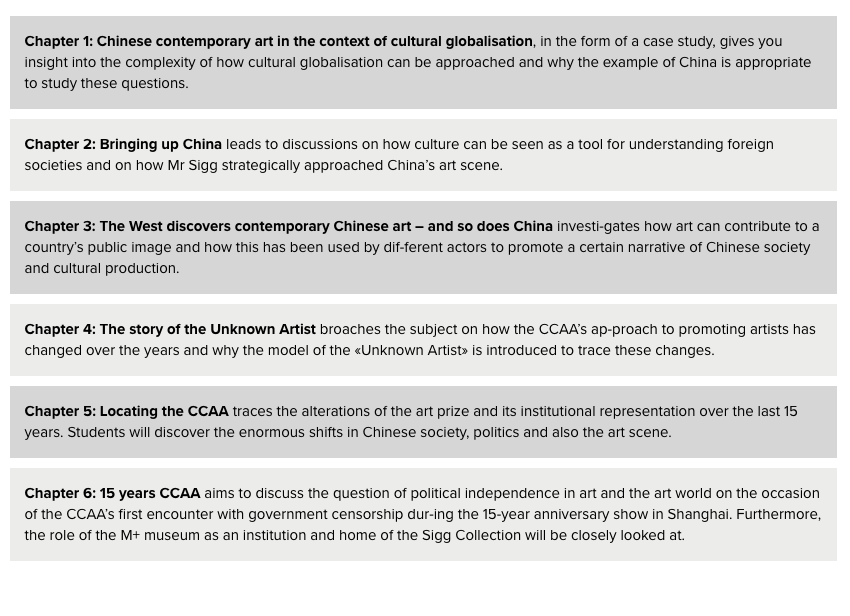
While working through six chapters, you will receive exclusive reading material, supplementary videos and background information about the developments in the Chinese art scene over the past 40 years, the Chinese Contemporary Art Award established by Mr Uli Sigg as well as the Sigg Collection as part of the newly created M+ museum in Hong Kong.
Moreover, you will gain insights into Chinese contemporary art, first-hand information about the art scene in China, and a wide range of contacts with relevant local and international institutions and actors.
The course is produced by the Centre of Further Education at the Zurich University of the Arts (ZHdK), based on research by IFCAR and presented by Michael Schindhelm on the e-learning platform iversity.org.
–
–
Zurich University of the Arts
Centre of Further Education
Prof. Elisabeth Danuser
–
Target Group
The CCAA online course is tailored to the needs and interests of curators, collectors, art managers, artists, journalists, cultural producers, gallery owners and researchers but equally attractive for curious individuals.
Prerequisites
If you opt for the Certification of Accomplishment track, you must have experience in a cultural or artistic field in order to help shape your personal perspective. Such prior knowledge will help you while completing the assignment and applying models and methods.
With its audit track, the CCAA online course also welcomes curious individuals.
Learning Objectives
In this online course you will learn:

By working through the entire online course, you will acquire the skills and knowledge needed to analyse and navigate the Chinese contemporary art scene.
Course Structure
This online course will be accessible for one year, beginning on April 13, 2016. For the first six weeks, it will be released as a time-based MOOC with a new chapter launched every Wednesday. Later on, it will be available as a self-paced course.
The course includes six chapters:
Suggested reading list
- Belting, Hans 2011: Global Studies. Mapping Contemporary Art and Culture. Ostfildern: Hatje Cantz.
- Chiu, Melissa 2008: Chinese Contemporary Art. 7 Things You Should Know. New York: AW Asia.
- Fibicher, Bernhard (ed.) 2005: Mahjong. Contemporary Chinese Art from the Sigg Collection, Ostfildern-Ruit: Hatje Cantz. (exhibition catalogue)
- Goodrow, Gérard A. 2014: Crossing China. Land of the Rising Art Scene. Köln: Daab.
- Schindhelm, Michael et al. 2014: Why Hong Kong. Connecting Spaces Documents # 1, Zurich.
http://issuu.com/connecting_spaces_hk_zh/docs/why_hong_kong_k
- Wu, Hung 2014: Contemporary Chinese Art. A History: 1970s-2000s. London: Thames&Hudson.

This course is an introductory course on the significance of water in our world. The title of the course makes reference to (1) water as a global and local natural resource (Water), (2) water as a chemical compound with important properties and characteristics (H20), and (3) the science and technology of bringing clean water to peoples in need (WaTER, an acronym for "Water Technologies for Emerging Regions"). The course is designed to generate awareness of water’s beneficial uses as well as the challenges associated with water quality, degradation, scarcity, over-abundance (flooding), and inequities in access to clean water. It will also introduce the students to the need to consider both technological options and cultural context in determining sustainable solutions to water problems.
Add to calendar

Trusted paper writing service WriteMyPaper.Today will write the papers of any difficulty.