Online courses directory (19947)

The main objective of this cross-disciplinary course is to understand the historical development and the current status of ideas and models, to present and question the constraints from the different research fields, and to investigate if and how the different views on mantle flow can be reconciled with the currently available data.
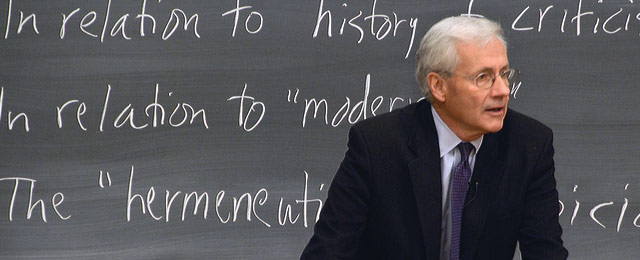
This is a survey of the main trends in twentieth-century literary theory. Lectures will provide background for the readings and explicate them where appropriate, while attempting to develop a coherent overall context that incorporates philosophical and social perspectives on the recurrent questions: what is literature, how is it produced, how can it be understood, and what is its purpose?

This course will focus on issues that arise in contemporary public debate concerning matters of social justice. Topics will likely include: euthanasia, gay marriage, racism and racial profiling, free speech, hunger and global inequality. Students will be exposed to multiple points of view on the topics and will be given guidance in analyzing the moral frameworks informing opposing positions. The goal will be to provide the basis for respectful and informed discussion of matters of common moral concern.

"The Art of the Probable" addresses the history of scientific ideas, in particular the emergence and development of mathematical probability. But it is neither meant to be a history of the exact sciences per se nor an annex to, say, the Course 6 curriculum in probability and statistics. Rather, our objective is to focus on the formal, thematic, and rhetorical features that imaginative literature shares with texts in the history of probability. These shared issues include (but are not limited to): the attempt to quantify or otherwise explain the presence of chance, risk, and contingency in everyday life; the deduction of causes for phenomena that are knowable only in their effects; and, above all, the question of what it means to think and act rationally in an uncertain world.
Our course therefore aims to broaden students' appreciation for and understanding of how literature interacts with – both reflecting upon and contributing to – the scientific understanding of the world. We are just as centrally committed to encouraging students to regard imaginative literature as a unique contribution to knowledge in its own right, and to see literary works of art as objects that demand and richly repay close critical analysis. It is our hope that the course will serve students well if they elect to pursue further work in Literature or other discipline in SHASS, and also enrich or complement their understanding of probability and statistics in other scientific and engineering subjects they elect to take.

Choice of material has implications throughout the life-cycle of a product, influencing many aspects of economic and environmental performance. This course will provide a survey of methods for evaluating those implications. Lectures will cover topics in material choice concepts, fundamentals of engineering economics, manufacturing economics modeling methods, and life-cycle environmental evaluation.

Recent years have seen an astonishing spread of democracy to many African, Asian, and Latin American countries. What caused these dramatic political transitions? What challenges do democratizing countries in the Third World face? Will these new democracies endure? We will take up these questions using film, fiction, and popular journalism, as well as scholarly research. We will also focus on a small number of countries (Brazil, India, Mexico, Nigeria, Senegal, Singapore, and Sri Lanka) in order to explore in greater depth some of the most important political challenges faced by developing countries. Although the class focuses on the developing world, many of the lessons should "travel" to democratizing countries in other regions.

This subject is designed for graduate students interested in international politics, national security and comparative political economy in East Asia. It examines the political, military, and economic challenges facing Japan, its neighbors, and the international system under conditions of great uncertainty. Topics range from the history of once "new" world orders to theories that inform our understanding of international affairs and foreign policy decision-making, as each is related to Japan. We focus on Japanese bilateral, regional, and global security policies from a range of theoretical perspectives. The semester will culminate in a weekend-long Asia-Pacific Crisis Simulation game in which invited U.S. and foreign experts will participate with the graduate students.

STS.467 examines the intellectual foundations of archaeology in the deep sea. The course explores the current convergence of oceanography, archaeology, and engineering which allows scientists to discover, survey, and excavate shipwrecks in deep water with robots and submarines. The course seeks to address the following questions: How are new devices best employed for archaeological work? How do new capabilities (e.g. higher frequencies, higher resolution, all digital data output) change operations plans and research designs? What new technologies will be required? Area studies focus on the Aegean in Minoan times and western Sicily during Phoenician, Greek, and Roman hegemony.

Data that has relevance for managerial decisions is accumulating at an incredible rate due to a host of technological advances. Electronic data capture has become inexpensive and ubiquitous as a by-product of innovations such as the internet, e-commerce, electronic banking, point-of-sale devices, bar-code readers, and intelligent machines. Such data is often stored in data warehouses and data marts specifically intended for management decision support. Data mining is a rapidly growing field that is concerned with developing techniques to assist managers to make intelligent use of these repositories. A number of successful applications have been reported in areas such as credit rating, fraud detection, database marketing, customer relationship management, and stock market investments. The field of data mining has evolved from the disciplines of statistics and artificial intelligence.
This course will examine methods that have emerged from both fields and proven to be of value in recognizing patterns and making predictions from an applications perspective. We will survey applications and provide an opportunity for hands-on experimentation with algorithms for data mining using easy-to- use software and cases.

Firms must develop major innovations to prosper, but they don't know how to. However, recent research into the innovation process has made it possible to develop breakthroughs systematically. 15.356 How to Develop Breakthrough Products and Services explores several practical idea generation development methods. To convey the art required to implement each of these methodologies, experts are invited to present real cases to the class.

15.389A Global Entrepreneurship Lab: Asia-Pacific enables teams of students to work with the top management of global start-ups and gain experience in running, and consulting to, a new enterprise outside the United States. The focus is on start-ups operating in emerging markets throughout the world, with a special focus on the Asia-Pacific region. The course combines an internship in a growing firm with in-class discussions of the issues and policies that affect the climate for innovation and start-up success around the world.
Special Features
15.389A is part of a two-section course and includes materials that cover entrepreneurship in the Asia-Pacific region. 15.389B Global Entrepreneurship Lab: Latin America, the Middle East, and Africa is also available on OpenCourseWare and covers topics pertinent to these additional regions.

This course examines management accounting and related analytical methodologies for decision making and control in profit-directed organizations. It also defines product costing, budgetary control systems, and performance evaluation systems for planning, coordinating, and monitoring the performance of a business. This course defines principles of measurement and develops framework for assessing behavioral dimensions of control systems; impact of different managerial styles on motivation and performance in an organization.

Information Technology I helps students understand technical concepts underlying current and future developments in information technology. There will be a special emphasis on networks and distributed computing. Students will also gain some hands-on exposure to powerful, high-level tools for making computers do amazing things, without the need for conventional programming languages. Since 15.564 is an introductory course, no knowledge of how computers work or are programmed is assumed.

Our objective in this course is to introduce you to concepts and techniques related to the design, planning, control, and improvement of manufacturing and service operations. The course begins with a holistic view of operations, where we stress the coordination of product development, process management, and supply chain management. As the course progresses, we will investigate various aspects of each of these three tiers of operations in detail. We will cover topics in the areas of process analysis, materials management, production scheduling, quality improvement, and product design.
To pursue the course objective most effectively, you will have to:
- Study the assigned reading materials.
- Prepare and discuss cases, readings, and exercises in class.
- Prepare written analyses of cases.
Other Versions
Other OCW Versions
OCW has published multiple versions of this subject.