

Online courses directory (19947)

This course provides a comprehensive introduction to crystalline structure, crystal chemistry, and bonding in rock-forming minerals. It introduces the theory relating crystal structure and crystal symmetry to physical properties such as refractive index, elastic modulus, and seismic velocity. It surveys the distribution of silicate, oxide, and metallic minerals in the interiors and on the surfaces of planets, and discusses the processes that led to their formation. It also addresses why diamonds are hard and why micas split into thin sheets.

Game Theory, also known as Multiperson Decision Theory, is the analysis of situations in which the payoff of a decision maker depends not only on his own actions but also on those of others. Game Theory has applications in several fields, such as economics, politics, law, biology, and computer science. In this course, I will introduce the basic tools of game theoretic analysis. In the process, I will outline some of the many applications of Game Theory, primarily in economics.
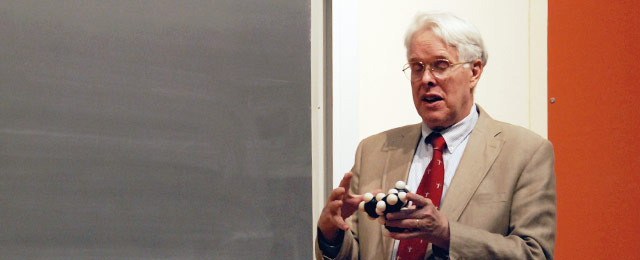
This is a continuation of Freshman Organic Chemistry I (CHEM 125a), the introductory course on current theories of structure and mechanism in organic chemistry for students with excellent preparation in chemistry and physics. This semester treats simple and complex reaction mechanisms, spectroscopy, organic synthesis, and some molecules of nature.

This subject examines the historical development and contemporary politics of social policy in the United States. We will discuss the kinds of risks individuals face over a lifetime and why some are ameliorated by social policy while others are not (and how the U.S. is similar or different from other countries in this regard). We will examine the policymaking process in the U.S., why some alternatives are implemented and others abandoned, why some interests are privileged over others, and how the designs of policies can feed back and shape politics in a given policy area. Along the way we will examine interactions among political institutions, policy elites, the media, and the mass public.

This class focuses on how the housing and human service systems interact: how networks and social capital can build between elements of the two systems. It explores ways in which the differing world views, professional perspectives, and institutional needs of the two systems play out operationally. Part I establishes the nature of the action frames of these two systems. Part II applies these insights to particular vulnerable groups: "at risk" households in transitional housing, the chronically mentally ill, and the frail elderly.

This course is the first subject in the Environmental Policy and Planning sequence. It reviews philosophical debates including growth vs. deep ecology, "command-and-control" vs. market-oriented approaches to regulation, and the importance of expertise vs. indigenous knowledge. Its emphasis is placed on environmental planning techniques and strategies. Related topics include the management of sustainability, the politics of ecosystem management, environmental governance and the changing role of civil society, ecological economics, integrated assessment (combining environmental impact assessment (EIA) and risk assessment), joint fact finding in science-intensive policy disputes, environmental justice in poor communities of color, and environmental dispute resolution.

This course is an examination of the theory, the practice, and the implications of rhetoric & rhetorical criticism. This semester, you will have the opportunity to deepen many of your skills: Analysis, persuasion, oral presentation, and critical thinking. In this course you will act as both a rhetor (a person who uses rhetoric to persuade) and as a rhetorical critic (one who analyzes the rhetoric of others). Both the rhetor and the rhetorical critic write to persuade; both ask and answer important questions. Always one of their goals is to create new knowledge for all of us, so no endeavor in this class is a "mere exercise."

Matter exists in four states - solid, liquid, gas and plasma and it will change state depending on the temperature and pressure applied to the matter. In this free online chemistry course about states of matter you will learn about the characteristics of each of the four states and the amount of energy that can be added to or taken from a substance before it starts to change state. As all substances change state at different temperatures and pressures you will learn how to use phase change diagrams to plot the energy and pressure levels, the triple point, critical temperature, boiling and melting points associated with different substances. You will also learn in a step by step manner how to calculate the change in energy needed to move a substance along the state of matter spectrum. This free online chemistry course will be of great interest to all students who wish to pursue a career in any of the sciences such as chemistry, physics, biology or geology, or the individual learner who simply wants to learn and understand what is happening when matter changes from solid to liquid to gas.<br />

Welcome to PRDV103: Interviewing Skills. This course is the third in a series of four courses included in the Job Search Skills Program that also includes Job Search Skills, Resume Writing, and Professional Etiquette. The Interviewing Skills course is intended to help you showcase your personality, strengths, interests, and abilities to potential employers. At this stage of your career exploration, you will have researched and targeted appropriate jobs and have marketed yourself to these employers with an attention-getting resume. If you have not already done so and feel you would benefit from more information about how to conduct a successful job search, or how to formulate a resume that gets you that interview, please explore the other exciting courses in this track.
Though accounting may seem like a dense and complex subject, this course is designed to present the accounting cycle in an accessible and logical manner. This course will provide you with a solid understanding of basic accounting principles and will introduce you to financial statement analysis. Please note that this course is the first of two courses on the principles of accounting and that each of these two courses is divided into 10 units. Each unit should take approximately three hours to complete and should be completed sequentially for the most logical progression of information. As you work through these units, you will encounter a range of examples and problem sets geared towards providing you with practical applications of the lessons you learn. By the end of this course, you will able to create accurate and appropriate financial statements to convey a company’s financial health. This course begins with an introduction to financial accounting and the various ways in which financial stat…

Jargon free photography for perfect pictures with your compact camera

Fire That CustoMonster and Your Life Will Be Richer For It. Learn how to in this customer service training.

How to Separate Personal Credit from Business Credit and Build your business profile.

What wisdom does Sheryl Sandberg, Facebook COO, pass to the next generation of entrepreneurs and business leaders? The i

The Secret for Generating a Long Term Passive Income is Here...by self-publishing on Kindle

The basic objective of Unified Engineering is to give a solid understanding of the fundamental disciplines of aerospace

FINALLY! The Quick & Easy Path To Producing And Publishing Podcasts

This fun Adobe Creative Suite/Cloud Training will help to boost your skills in InDesign, Illustrator, & Photoshop.

A Course from Electrician Basics

This graduate level course presents a basic study in seismology and the utilization of seismic waves for the study of Earth's interior. It introduces techniques necessary for understanding of elastic wave propagation in layered media.
Add to calendar

Trusted paper writing service WriteMyPaper.Today will write the papers of any difficulty.