

Courses tagged with "Line+integrals+and+Green's+theorem" (23)
Course Summary
This MOOC aims to provide students with a critical knowledge concerning the phenomenon of youth bullying. The course focuses on both traditional bullying that usually takes place on school premises and cyberbullying, which occurs via information and communication technologies. With a social-ecological perspective, the first part of the MOOC explores the boundaries of these phenomena, and analyzes the characteristics of youth involved and the social-psychological processes that underlie the different roles youth play in bully-victim-bystander dynamics. The second part of this MOOC covers the prevention and intervention strategies available at the international level.
What will I learn?
Our MOOC will help you answer the following questions:
1. What is bullying? How can I recognize it?
2. How do new information and communication technologies modify traditional bullying behavior? Is ‘virtual’ bullying less ‘real’ than face-to-face bullying?
3. What are the risk factors for (cyber)bullying? And its consequences for youth?
4. What role do the family, school and peers play?
5. How can bullying and cyberbullying be prevented? What can schools, parents, and the society do about them? What really works?
Who is this course for?
The MOOC can be of high interest for people from all over the world and with different backgrounds (e.g. psychology, sociology, educational studies, public health, pediatrics) who wish to expand their knowledge and understanding of bullying among children and youth in a social-ecological perspective.
Given the twofold focus on both research and intervention, the course is also particularly suggested to people actively engaged in children’s and adolescents’ education and well-being (such as, teachers, school counsellors, school nurses, policy makers, etc.).
What do I need to know?
No prior knowledge of psychological concepts is needed, but can be helpful.
Interest in children’s and adolescents’ development, education and well-being is welcome and encouraged.
Course Schedule
Chapter 1: Introducing peer bullying In this chapter, you will learn what bullying is and how it differs from other types of aggression. Moreover, you will get an overview of the different forms that bullying can take in face-to-face and online interactions.
Chapter 2: A global health perspective Bullying is recognized as a serious problem worldwide. Gain an overview of what International organizations say about it. You will also learn about how it changes during children’s development and about its consequences on youth’s life.
Chapter 3: Individual risk and protective factors Complexity of bullying behavior requires a multidimensional explanation of why it occurs. Gain an overview of the cognitive, emotional, motivational, and moral factors that contribute to explain why some kids bully other kids.
Chapter 4: Bullying as a group phenomenon Bullying dynamics are not limited to the bully-victim dyad. Learn to change your perspective to recognize the role of the whole peer group. You will gain some insight into the different roles peers can play in bullying situations and how the peer group can influence individual behavior.
Chapter 5: How other contexts influence bullying Go even further and learn how bullying is influenced by other social environmental characteristics that lie in different contexts, including classrooms, schools, family, and culture.
Chapters 6 and 7: Preventing and tackling bullying In these two final chapters you will learn what can be done to prevent and tackle bullying. You will learn what an evidence-based intervention is and you will gain an overview of the intervention strategies that can be implemented at different levels, from the broad community to the single individual student. Moreover, some experts from around the world will offer you concrete examples of programs to address bullying and cyberbullying.
Our assistants
During the course you will meet our assistants: Sheila, Claudia and Valentina who will help you go through the materials and the assignments.
University of Padova
Founded in 1222, the University of Padova is one of Europe’s oldest and most prestigious seats of learning: it is a multidisciplinary university, which aims to provide its students with both professional training and a solid cultural background. A qualification from the University of Padova is a symbol of having achieved an ambitious objective, one that is recognised and coveted by both students and employers alike.
If you want to know more about the University of Padova, visit its website.
Department of Developmental Psychology and Socialisation - Within the University of Padova, the Department of Developmental Psychology and Socialisation (DPSS) was founded in 1984, replacing the Institute of Developmental Psychology founded in 1965 on the initiative of professors Fabio Metelli and Guido Petter.
Research projects conducted within the Department include basic, applied and clinical research, in the following key areas: neo-natal development, psychology of language and literacy, psychology and neuropsychology of cognitive processes, cognition and social relations, psychology of emotions, dynamic psychology and psychopathology, parenting, health and community psychology, instructional psychology and learning disabilities. For more than 15 years, the Department has been an active partner in several bullying projects funded by different agencies, including the European Union and the Italian Ministry of Research and Education.

Kursbeschreibung
Be the change you want to see!
Im Changemaker MOOC lernst du, wie du aus einer Idee ein Projekt zur Lösung eines gesellschaftlichen Problems entwickelst. Wir zeigen dir, wie du unternehmerische Ansätze nutzen kannst, um gesellschaftliche Herausforderungen zu lösen, egal ob du ein Projekt in den Bereichen Gesellschaft, Umwelt, Bildung oder Kultur realisieren willst.
Schritt für Schritt zum eigenen Projekt
Der Kurs führt dich Schritt für Schritt zur Erstellung eines eigenen Projektkonzepts. Du lernst, aus der Schnittmenge deiner Stärken und eines konkreten gesellschaftlichen Bedarfs eine umsetzbare Projektidee zu entwickeln. Wir machen dich mit Konzepten, Strategien und Akteuren in den Bereichen Social Entrepreneurship und Social Business vertraut. Wir zeigen dir, wie du den genauen Bedarf deiner Zielgruppe ermittelst, wie du die Maßnahmen deines Projektes planst, die Kosten kalkulierst und eine realistische Zeitplanung erstellst. Du entwickelst Strategien, um dein Projekt zu finanzieren und wirkungsvoll zu kommunizieren.
Praxis statt Theorie
Zentrale Lerninhalte werden in Form kurzer Videos vermittelt. Sie erklären alles, was du brauchst, um aus deiner Idee ein umsetzbares Projektkonzept zu machen. Du lernst erfahrene Changemaker ebenso wie junge Changeprojekte kennen. Dabei verbindet jede Lektion die Vermittlung konzeptioneller Inhalte mit der Erstellung von Bausteinen deines Projektkonzepts. Am Ende des Kurses hast du ein klar strukturiertes Konzept für dein eigenes Changeprojekt.
Was lerne ich in diesem Kurs?
Am Ende des Kurses sind die TeilnehmerInnen in der Lage, ein eigenes Changeprojekt zu planen. Sie haben die Grundkonzepte von Social Entrepreneurship kennen gelernt. Sie wissen, wo sie im Internet weitere Lernressourcen für ihr Vorhaben finden.
Welche Vorkenntnisse benötige ich?
Für die Teilnahme an diesem Kurs ist kein Vorwissen erforderlich. Er richtet sich an alle Menschen, die lernen wollen, ein eigenes Changeprojekt zur Lösung einer gesellschaftlichen Herausforderung zu entwickeln. Jede/r kann teilnehmen!
Kursstruktur
| Kapitel | Thema |
|---|---|
| Kapitel 1 | Die Welt verändern |
| Kapitel 2 | Vom Interesse zur Projektidee |
| Kapitel 3 | Was ist Social Entrepreneurship? |
| Kapitel 4 | Die Projektziele festlegen |
| Kapitel 5 | Die Strategie optimieren |
| Kapitel 6 | Die Projektstruktur planen |
| Kapitel 7 | Die Umsetzung des Projekts planen |
| Kapitel 8 | Das Projekt finanzieren |
| Kapitel 9 | Das Projekt bekannt machen |
| Kapitel 10 | Das Projekt präsentieren |
The course will provide clinicians with an in-depth understanding of the scope and manifestations of HIV-related diseases, their prevention, management, and care. Special emphasis will be placed on co-infections and co-morbidities as well as the latest research findings and guidelines related to HIV treatment. The course will be comprised of 6 modules, with various sub-topics under each module.
The course language is English. We will provide subtitles in English and Russian.
What will I learn?
By the end of this course, students will be able to:
- differentiate the clinical manifestations of HIV-related diseases
- propose relevant diagnosis, monitoring, and treatment strategies for HIV infection and related diseases according to EACS and WHO guidelines
- recognise benefits and adverse effects of various HIV drug therapies
- assess strategies for prevention and treatment of opioid drug use
- assess strategies for prevention of the transmission of HIV and related infections
- understand public health approaches in delivering HIV/AIDS treatment and strategic use of ARVs for treating and preventing HIV infection
What do I need to know?
Participants should have a basic background in medicine.
Course Structure
The course consists of 6 chapters:


Design 1o1 “Redux”
Are you ready?
The Design 1o1 saga is finally back with its special “redux” edition!
A special edition in which we go one step beyond! In fact, in this journey, Stefano Mirti and Anne-Sophie Gauvin are handing over more responsibilities to their students. Our former teachers will keep on producing the course contents (and correct the exams together with the course instructors), while the rest (the scary part) will be run by the Design 1o1 community.
“Design 1o1 Redux” is an introduction to design through 101 exercises. A six-month journey divided into 3 courses “online” here on iversity (Part 1, Part 2 and Part 3), one final exhibition / graduation party and an “offline” workshop for which we will go one step beyond.
In short:
Part 1: “Myself” (Nov 2 to Dec 27)
Part 2: “My House” (Jan 04 to Feb 28)
Part 3: “My World” (Feb 29 to Apr 24)
Exhibition / Graduation: In Croatia (Apr 23-24)
Winter camp: In Croatia (Apr 25 to May 1)
Ready for take off?
Here go with the first part of the course: “Myself”.
Design 1o1 Redux Part 1: Myself
Starting from our very own selves, we will collectively observe, translate and communicate many things, in a series of different ways and projects.
As Protagoras once said, “Man is the measure of all things”. It is the main reason we focus on “ourselves” in this first part of Design 1o1 Redux.
To do so, we will work with all kinds of cool apps for phones and tablets (do you have a smartphone or tablet?). We will also share our works with the others on Instagram, using special hashtags.
Indeed, we will explore a new way to learn a new design.
:-)
Course Structure
Our various activities will be divided into 8 weeks:
Week 1: My Body
Week 2: My Mind
Week 3: My Time
Week 4: My Diary
Week 5: My Food
Week 6: My Clothes
Week 7: My Exam
Week 8: My Break
What will I learn?
You will learn to develop some basic design attitudes for better understanding the mechanics of today’s world.
One step at a time, you will learn that “design” is foremost a language.
A language shared, talked and discussed by designers from all over the world.
How does the world look through the special lenses of "design"?
Along the way, you will learn about a considerably high number of things. Starting from your very own selves.
Prior Knowledge
In terms of prior knowledge, there is nothing required.
If you have a lot of prior knowledge, it might make the learning process more difficult, but don’t worry, no one is perfect. If we talk about contemporary “#design”, we are all absolute beginners!
However, in terms of technical equipment, this course is easier to follow via a smartphone or tablet. Of course, you can follow us via a desktop computer... but this is not how we intended the whole thing to be.
:-)
Workload
Between 4 and 7 hours a week.
Everyday, from Monday to Friday, for a total of 6 weeks, you will receive a package via email. Each package will contain a 15-second video to watch (to get you in the proper mood), and a pdf-letter introducing the daily brief (or “homework”) and a series of objects, characters and happenings intertwined with the narrative of the course (to go deeper in the subject at hand).
You will work on your assignment…
Then, once completed, you will upload it to your Instagram account (for the rest of us to see).
Easy as a kiss.
Questions or Comments?
You can write to Ms. Lola (our so-called secretary, but actually the real boss of this whole venture) at: design101.info@gmail.com.
Now, please understand that Ms. Lola is very busy. You might get higher chances of getting a quick and complete answer via Instagram, Facebook, Twitter. Come and let us show you around!
:-)
The Design 1o1 Community
This course is run by the Design 1o1 community.
You can learn more about who we are and what we do here.
All course contents are used for educational purposes.
The written content is by IdLab, and the visual content is assembled by IdLab.
The Design 1o1 Redux is a project by IdLab for Abadir Academy of Fine Arts.
Design 1o1 “Redux”
“Design 1o1 Redux” is an introduction to design through 101 exercises. A six-month journey divided into 3 courses “online” here on iversity (Part 1, Part 2 and Part 3), one final exhibition / graduation party and an “offline” workshop in which we will go one step beyond.
In short:
Part 1: “Myself” (Nov 2 to Dec 27)
Part 2: “My House” (Jan 4 to Feb 28)
Part 3: “My World” (Feb 29 to Apr 24)
Exhibition / Graduation: In Croatia (Apr 23-24)
Winter camp: In Croatia (Apr 25 to May 1)
:-)
Here we proceed with “Part 2: My House”.
Design 1o1 Redux Part 2: My House
Spaces, furniture, objects, memories... Our houses are composed of fascinating elements. In this part of the Design 1o1 Redux, we will rethink these components in order to design our own “homes”, the places where we live (or, “where the heart is” as Pliny the Elder would say).
Can we trap time into space? How to frame the ordinary? These are some of the many things we will explore!
To do so, we will work with all kinds of cool apps for phones and tablets (do you have a smartphone or tablet?). We will also share our works with the others on Instagram, using special hashtags.
Course Structure
Our various activities will be divided into 8 weeks:
Week 1: My Room
Week 2: My Kitchen
Week 3: My Garden
Week 4: My Guests
Week 5: My Basement
Week 6: My Show
Week 7: My Exam
Week 8: My Break
What will I learn?
You will learn to develop some basic design attitudes for better understanding the mechanics of today’s world.
One step at a time, you will learn that “design” is foremost a language.
A language shared, talked and discussed by designers from all over the world.
How does the world look through the special lenses of "design"?
Along the way, you will learn about a considerably high number of things. Starting from your very own self.
Prior Knowledge
In terms of prior knowledge, there is nothing required.
If you have a lot of prior knowledge, it might make the learning process more difficult, but don’t worry, no one is perfect. If we talk about contemporary “#design”, we are all absolute beginners!
However, in terms of technical equipment, this course is easier to follow via a smartphone or tablet. Of course, you can follow us via a desktop computer... but this is not how we intended the whole thing to be.
:-)
Workload
Between 4 and 7 hours a week.
Everyday, from Monday to Friday, for a total of 6 weeks, you will receive a package via email. Each package will contain a 15-second video to watch (to get you in the proper mood), and a pdf-letter introducing the daily brief (or “homework”) and a series of objects, characters and happenings intertwined with the narrative of the course (to go deeper in the subject at hand).
You will work on your assignment…
Then, once completed, you will upload it to your Instagram account (for the rest of us to see).
Easy as a kiss.
Questions or Comments?
You can write to Ms. Lola (our so-called secretary, but actually the real boss of this whole venture) at: design101.info@gmail.com.
Now, please understand that Ms. Lola is very busy. You might get higher chances of getting a quick and complete answer via Instagram, Facebook, Twitter. Come and let us show you around!
:-)
The Design 1o1 Community
This course is run by the Design 1o1 community.
You can learn more about who we are and what we do here.
All course contents are used for educational purposes.
The written content is by IdLab, and the visual content is assembled by IdLab.
The Design 1o1 Redux is a project by IdLab for Abadir Academy of Fine Arts.

Design 1o1 “Redux”
“Design 1o1 Redux” is an introduction to design through 101 exercises. A six-month journey divided into 3 courses “online” here on iversity (Part 1, Part 2 and Part 3), one final exhibition / graduation party and an “offline” workshop in which we will go one step beyond.
In short:
Part 1: “Myself” (Nov 2 to Dec 27)
Part 2: “My House” (Jan 4 to Feb 28)
Part 3: “My World” (Feb 29 to Apr 24)
Exhibition / Graduation: In Croatia (Apr 23-24)
Winter camp: In Croatia (Apr 25 to May 1)
:-)
And now, Part 3: My World...
Design 1o1 Redux Part 3: My World
Johan Cruyff, a very famous footballer (and fantastic designer), once said:
“I never practice tricks. I play very simply.
That's what it's all about. Playing simple football is the hardest thing.”
If we think about it, design is everything.
It can be football, but it can also be an object, a building, a game… our lives, our worlds!
In this part of the Design 1o1 Redux, we will go out and “get busy” designing our very own worlds. Something for which we will need to master a high level of simplicity.
We will work with all kinds of cool apps for phones and tablets (do you have a smartphone or tablet?). We will also share our works with the others on Instagram, using special hashtags.
:-)
Course Structure
Our various activities will be divided into 8 weeks:
Week 1: My Neighborhood
Week 2: My Town
Week 3: My Trips
Week 4: My Nature
Week 5: My Shelter
Week 6: My Thing
Week 7: My Exam
Week 8: My Break
What will I learn?
You will learn to develop some basic design attitudes for better understanding the mechanics of today’s world.
One step at a time, you will learn that “design” is foremost a language.
A language shared, talked and discussed by designers from all over the world.
How does the world look through the special lenses of "design"?
Along the way, you will learn about a considerably high number of things. Starting from your very own self.
Prior Knowledge
In terms of prior knowledge, there is nothing required.
If you have a lot of prior knowledge, it might make the learning process more difficult, but don’t worry, no one is perfect. If we talk about contemporary “#design”, we are all absolute beginners!
However, in terms of technical equipment, this course is easier to follow via a smartphone or tablet. Of course, you can follow us via a desktop computer... but this is not how we intended the whole thing to be.
:-)
Workload
Between 4 and 7 hours a week.
Everyday, from Monday to Friday, for a total of 6 weeks, you will receive a package via email. Each package contains a 15-second video to watch (to get you in the proper mood), and a pdf-letter introducing the daily brief (or “homework”) and a series of objects, characters and happenings intertwined with the narrative of the course (to go deeper in the subject at hand).
You will work on your assignment…
Then, once completed, you will upload it to your Instagram account (for the rest of us to see).
Easy as a kiss.
Questions or Comments?
You can write to Ms. Lola (our so-called secretary, but actually the real boss of this whole venture) at: design101.info@gmail.com.
Now, please understand that Ms. Lola is very busy. You might get higher chances of getting a quick and complete answer via Instagram, Facebook, Twitter. Come and let us show you around!
:-)
The Design 1o1 Community
This course is run by the Design 1o1 Community.
You can learn more about who we are and what we do here.
All course contents are used for educational purposes.
The written content is by IdLab, and the visual content is assembled by IdLab.
The Design 1o1 Redux is a project by IdLab for Abadir Academy of Fine Arts.

Whether you are a student, a designer or an entrepreneur, join this course and develop your creativity methods and innovation attitude while exploring the human-centred design-approach.
offered by the United Nations Environment Programme

and the Cologne University of Applied Science

Course Summary
This MOOC enhances knowledge and skills for tackling complex issues such as resilience and transformation, sustainable development, ecosystem management, disaster risk reduction, climate change adaptation and how they can be operationalized. It will benefit disaster managers and practitioners, climate change adaptation professionals, development planners, project implementers and policy makers. The course will be delivered through a series of lectures and case studies, quizzes, peer-reviewed exercises, along with additional study materials provided to the students. Lectures will be available through videos as well as online documents and will be geared for students who may not have access to high speed internet so they can follow the course. Students will be provided the opportunity to enhance their critical thinking through real life and fictitious problem solving exercises. Each week will feature an international expert who will be available to respond to questions and interact with students.
What will I learn?
After completion of the course, the participant will be able to:
- Define basic concepts of disasters, disaster risk reduction, climate change adaptation and resilience.
- Recognize key linkages between ecosystems, disaster risk reduction and climate change adaptation.
- Recognize the linkages and overlaps between ecosystem based disaster risk reduction and ecosystem based adaptation.
- Identify various ecosystem based tools in reducing disaster risk and climate change adaptation.
- Identify key international agreements, organizations and initiatives related to disaster risk reduction, and climate change adaptation.
- Apply concepts and tools of ecosystem-based disaster risk reduction (Eco-DRR) and ecosystem based adaptation (EbA).
- Evaluate costs and benefits of different type of measures for reducing disaster risks.
- Design your own ecosystem-based project for increasing resilience and reducing climate risks.
What do I need to know?
There are no prerequisites, just some willingness to learn about this innovative topic! It is however true that it will help if you have heard about disasters and climate change before starting.
Course Structure
The course is structured in two parts:
The leadership track, which is tailored for busy professionals or students curious about the topic. The leadership track will run three weeks.
The expert track is for professionals and students who seek more in-depth learning and skill development in applying ecosystem-based tools for disaster risk reduction and adaptation. The expert track will run 12 weeks with 3 weeks for the final assignment, peer review process and course wrap-up. Each unit has several quizzes, a concise background document for further reading, a discussion forum, supplementary videos with interviews with international experts and short documentary videos from around the world. In addition, world leaders were interviewed for our MOOC.
Course Outline and Schedule
Chapter 1. Leadership track – introduction (Week 1. Jan 12-18)
Unit 1. Disasters and Ecosystems: Resilience in a Changing Climate - why take this course?
Unit 2. Introduction to disasters, risk reduction and climate change
Chapter 2. Leadership track – linking disasters, climate change and ecosystems, Part 1 (Week 2. Jan 19-25)
Unit 3. Links between disasters, disaster risk reduction, adaptation and key international actors
Unit 4. Principles and challenges of ecosystem-based disaster risk reduction (Eco-DRR) and adaptation (EbA)
Chapter 3. Leadership track – disaster management, resilience and ecosystems (Week 3. Jan 26- Feb 1)
Unit 5. Ecosystem management contributions pre- and post-disasters
Unit 6. Managing resilience and transformation
Chapter 4. Expert track – linking disasters, climate change and ecosystems, Part 2 (Weeks 4&5. Feb 2-15)
Unit 7. Linking ecosystems and humans to disasters
Unit 8. Principles of systems thinking and using natural systems for disaster risk reduction
Unit 9. Putting Ecosystem-based disaster risk reduction (Eco-DRR) into practice
Chapter 5. Putting theory into practice (Weeks 5 & 6. Feb 16-22)
Unit 10. Linkages between Eco-DRR and EbA
Unit 11. Putting Ecosystem-based adaptation into practice & peer review assignment
Chapter 6. Ecosystem-based tools for disaster risk reduction – introduction (Week 7. Feb 23-Mar 1)
Unit 12. Incorporating ecosystems in risk assessments
Unit 13. Ecosystems and spatial tools for risk reduction
Chapter 7. Most common Eco-DRR tools (Week 8. Mar 2-8)
Unit 14. Principles of spatial planning and community-based tools for Eco-DRR
Chapter 8. Most common Eco-DRR tools (Week 9. Mar 9-15)
Unit 15. Sustainable land and water management tools for Eco-DRR
Unit 16. Ecological engineering for disaster risk reduction and climate change adaptation
Chapter 9. Economics, valuation and policy issues (Week 10. Mar 16-22)
Unit 17. Economic tools for Eco-DRR
Unit 18. Principles of mainstreaming ecosystem based disaster risk reduction into national policies, strategies, plans and projects
Chapter 10. Resilience and transformation & final assignment (Weeks 11 -13. Mar 23-April 12)
Unit 19. Approaches for operationalizing resilience
Unit 20. Problem solving assignment – peer review of assignments
Unit 21. Course wrap-up and forum discussions
Who is teaching this course?
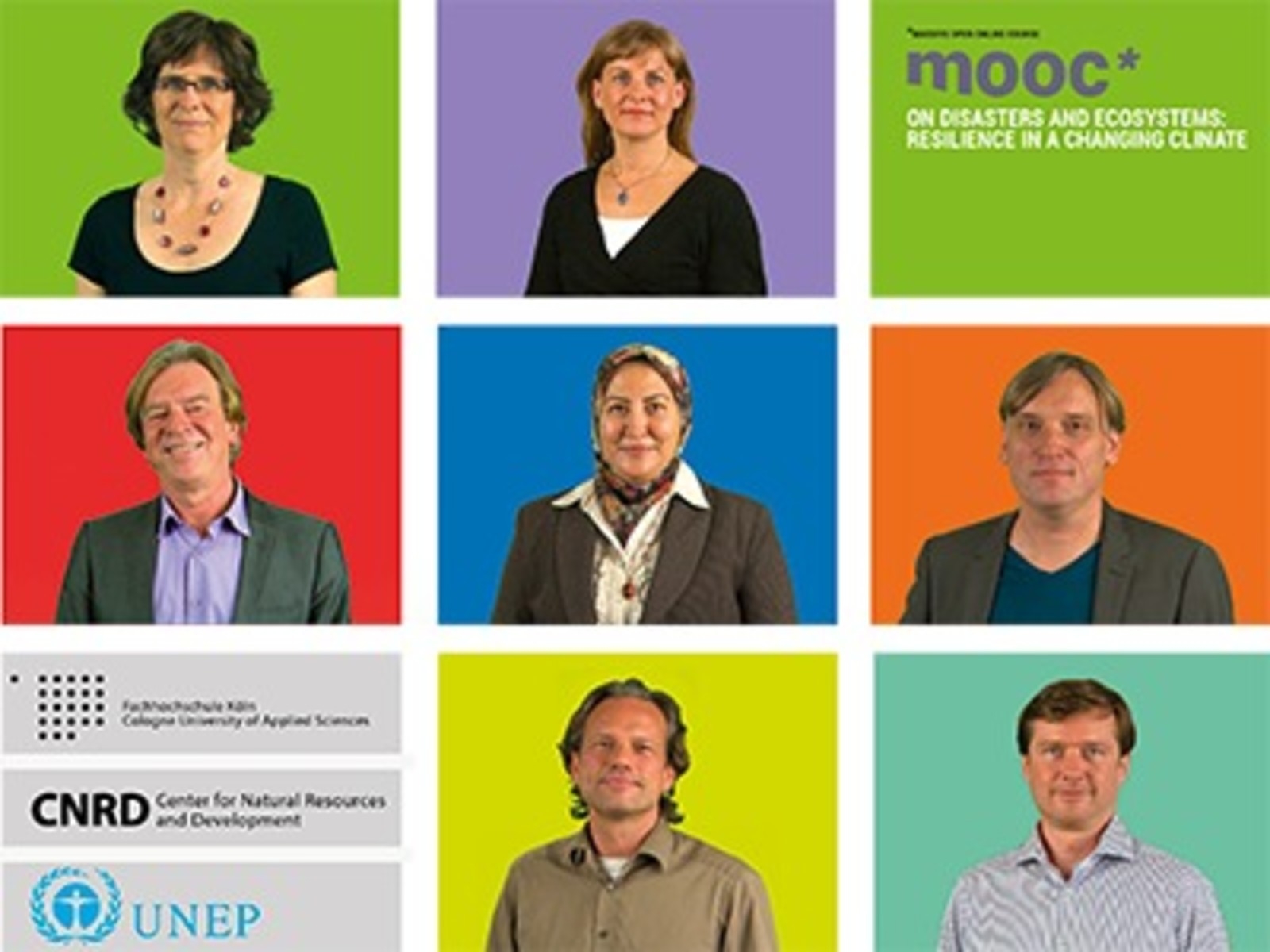
Instructors include international faculty members from Germany, Egypt, Austria and Switzerland, supported by a line-up of expert guest lecturers and exclusive interviews with world leaders in the field of climate change, disaster risk reduction and environment:
• Dr. Achim Steiner (Executive Director of UNEP)
• Ms. Margareta Wahlström (Special Representative of the Secretary-General of the United Nations for Disaster Risk Reduction)
• Dr. Rajendra Pachauri (Chancellor of TERI University)
• Ms. Julia Marton-Lefèvre (Director General of the International Union for the Conservation of Nature 2007-2015
Some FAQs
How much time do I need to put in taking the MOOC?
In total, we estimate that a total of 40-50 hours is needed to complete the MOOC (taking both the Leadership and Expert Tracks), which will also depend on your background and English fluency. The MOOC is roughly equivalent to a 1 –week in-class training course. This estimate is based on completing the video lectures, guest video lectures, reading materials and exercises.
Do I have to be online at specific times?
No. While new modules will be released sequentially on specific dates, you need not come online simultaneously. The lectures are not webcast real-time and you can choose the time you wish to watch them. However, there will be some deadlines for assignments and peer-to-peer reviews.
Will there be exams involved?
The Leadership track has quizzes so you can self-check your knowledge level as you go. This is, however, not a precondition for progressing to the next module. And you may, however, choose to revisit a module if you feel you did do not perform satisfactorily in a module. The Expert track has two short peer-reviewed assignments and one final peer-reviewed exercise where you will be designing your own project! The peer reviewed exercises will provide an environment for interaction between course participants. You are welcome to use any other communication tool to facilitate group assignments.
What are the interactive features in this MOOC?
Iversity has a community discussion forum that will be followed by course instructors and a roster of international “Experts of the week”. The Iversity platform offers all participants the chance to give feedback on the MOOC itself but also to start discussions on any topic related to the MOOC. During the enrolment stage of the MOOC, you will be asked to fill out some basic information about yourself and be invited to actively participate in the community discussion forum. You can also post notices on the MOOC “meeting point” or to join discussions that others have started. There will thus be ample opportunity to connect with other participants for information exchanges
In cooperation with the Global Universities Partnership on Environment and Sustainability
and the Center for Natural Resources and Development
Contributions by eye on earth

Supported by the Federal Ministry for Economic Cooperation and Development

exceed - Excellence Centers for Exchange and Development

and the DAAD - German Academic Exchange Service

Over the past decade, young people around the globe has faced very different but great challenges: unemployment, skills gap, vocational trainings, outdated educational formats, school-to-work transition etc. Consequently, "empowerment" has become the buzzword in business, evaluation and youth development. Because of its wide use, the word "empowerment" has many different meanings to people. “Discover Yourself: Build a Career and Make an Impact” is an interactive MOOC that will empower youth through a holistic approach on four different skills sets and dimensions:
Chapter 1: Personal Development: What do you love doing?
Chapter 2: Professional Development: What do you do well?
Chapter 3: Community Development: What is the community around you?
Chapter 4: Sustainable Development: What the world needs?
Empowerment is defined as a way to provide tips and opportunities for youth to develop the competencies they need to become successful contributing members of their communities.
The MOOC is part of a youth-strategic partnership project titled “Cease Cowering: Youth Empower Action Here!” (CC: YEAH) supported by the programme Erasmus +. The project is based on partnership between the Association for Education Mladiinfo International from Macedonia, Mladiinfo Slovensko (Slovakia), The Global Experience (Germany) and Iversity (Germany). As a part of the project, the course content was developed, the video shooting was organized in Bratislava, Slovakia and a special brochure containing the materials from the course was produced. The expected project results can be summed up as following:
- Development of an innovative approach in the process of self-learning based on Open Education Resources;
- Enlarged awareness on required skills and competences needed for youth career development;
- Increased soft, entrepreneurial and digital skills of youth through non-formal online education opportunities;
- Created a strategic approach and mutual action on youth development among involved partner organizations.
Who is this course for?
Discover Yourself: Build a Career and Make an Impact will be an inclusive, free and open course for all vision-driven, knowledge-hungry and goal-oriented young individuals. We aim to attract young people aged 18 to 30, from all around the globe who are eager to work on themselves and to grow both personally and professionally. The idea is to provide those interested youth with concrete skills and tools to boost their potentials as well as to bring relevant information to them that will encourage them to undertake concrete activities in the communities where they live. In the same time, we are also targeting youngsters who have fewer opportunities and face economic, social, educational or geographical difficulties and through the MOOC we want to bring them closer to the world of opportunities.
What will I learn?
The whole course content will be organized around 4 chapters devoted on: personal, professional, community and sustainable development.
At the end of the course, you will be able to:
Personal development chapter:
- Discover what your interests, values and personal characteristics are;
- Identify exactly what you want and what you do not want to do.
Professional development chapter:
- Understand the drivers behind your career preferences and choices;
- Learn how to recognize your talents and interests and how to match them with your concrete professional career;
- Identify the skills which you can offer as well as learn about your current skills gaps.
Community development chapter:
- Demonstrate knowledge and ability to create a plan to help you improve your soft skills;
- Recognize opportunities for your career enhancement both within and beyond your current status;
- Summarize your achievements and skills in appropriate formats for future employers or academic institutions.
Sustainable development chapter:
- Extend and make most effective use of your professional network both on- and off-line
- Learn what the world career trends are;
- Discover how your career choice can influence the world challenges.
What do I need to know?
This is an introductory course. Previous knowledge is not required. The course is designed for people interested in building up a career and make an impact.
Course Structure
Chapter 1: Personal Development
Our journey to self-discovery will start from the personal development. In the first chapter, we will give you the overview of your personality and how it could influence your career choice. In the three chapter units, you will identify what the personal values you appreciate the most are and how these values are influencing your choices. Also, you will be guided to discover your personality type and will have a chance to test yourself and find out which personality type you belong to and how you can connect it to your potential career.
Chapter 2: Professional Development
Once you have discovered who actually you really are and what you love doing, it is time to see what kind of career will fit your personality and interests. Your professional self is under huge pressure lately, right? So many trends, reports and statistics show new, undiscovered ways of working and imagining your job of the future. But nothing will ever make sense unless you get to know your professional self and make choices based on your skills, needs and capacities. In this chapter you will be able to walk the thin line between self-discovery and self-creation, while articulating your experience and skills into a successful career plan.
Chapter 3: Community Development
In the Community Development chapter, we will help you discover what and how the empowered YOU can do for your community, for your peers, for your neightbours. In this chapter, we will show you the ways how you can make an impact: as an individual, as part of non formal group, and as a member of an organization. At the end of the chapter, you will be able to identify a project idea, draft a basic proposal and find a suitable programme where you can apply for a project grant for your idea. But first and foremost, you will be inspired to take the community in your hands and move the things forward!
Chapter 4: Sustainable Development
In the last chapter we will take a step back. What is the big picture? What are the challenges in the world today? We will speak about Sustainable Development Goals and discover ways how you can expand your circle of influence. We will finish the course with three elements of sustainable development - the economic, social and environmental. We want to motivate you to take personal social responsibility for your surrounding and for the whole world.
At the end of the course, the students will be able to draft a personal development plan that will present their pathway to their personal, professional, community and sustainable development.
Kurszusammenfassung
Der Kurs führt ein in die Fragestellungen der modernen Arbeitspsychologie. Er vermittelt das Grundwissen und die wichtigsten Konzepte und Interventionsmethoden der Arbeitspsychologie. Am Anfang steht die Klärung der wichtigsten Begriffe: Was ist Psychologie bzw. Arbeitspsychologie? Was unterscheidet bedingungs- von personenbezogenen Ansätzen? Welche Menschenbilder, Bilder der Arbeit, Organisationsmetaphern und Technikverständnisse liegen der Arbeitspsychologie zu Grunde? Es folgt die Erläuterung vier grundlegender Paradigmen der Arbeitsgestaltung und des Betriebsmanagements. In den folgenden Kapiteln werden Einzelthemen wie Zielvereinbarung und Mitarbeitergespräche, Arbeit und Gesundheit - speziell Ermüdung, Stress und Bewältigung, Burnout, Arbeitszufriedenheit und Arbeitsmotivation, Arbeitsgruppen und Gruppenarbeit erklärt. Der Kurs schliesst ab mit einem Kapitel zur Methodik der Analyse, Bewertung und Gestaltung von Arbeit.
Lernziele
Die Teilnehmenden entwickeln ein Grundverständnis für Fragestellungen und Herangehensweisen der Psychologie, speziell im Bereich der Arbeits- und Berufstätigkeit in Organisationen.
Die Teilnehmenden lernen grundlegende Konzepte und Theorieansätze der Psychologie kennen und sie lernen, diese für konkrete praktische Frage- und Problemstellungen zu nutzen.
Die Teilnehmenden lernen die Forschungsmethoden und Ergebnisse wichtiger empirischer Studien sowie die psychologischen Schlussfolgerungen daraus kennen.
Die Studierenden lernen grundlegende Ansätze und Methoden/Verfahren der Arbeitsanalyse und der Arbeitsgestaltung kennen und für Anwendungen in ihrem eigenen Arbeitsbereich nutzbar zu machen.
Die Studierenden lernen die wichtigsten Wirkungszusammenhänge zwischen Arbeit und Gesundheit/ Wohlbefinden sowie damit verbundene Präventionsansätze kennen.
Die Studierenden lernen, anhand ihres erworbenen Wissens ihre eigene Arbeits- und Lebenssituation zu reflektieren und wissensbasiert zu optimieren.
Kursübersicht
Einführung in die Arbeitspsychologie
1. Einleitung, Grundlegende Konzepte der Arbeitspsychologie, Was ist Arbeitspsychologie?
2. Vier Paradigmen der Arbeitsgestaltung und des Betriebsmanagements 1: Taylorismus, Human Relations (Hawthorne)
3. Vier Paradigmen der Arbeitsgestaltung und des Betriebsmanagements 2: Job Enlargement und Job Enrichment (Herzberg), der soziotechnische Systemansatz
4. Arbeitstätigkeit und Arbeitshandeln
5. Die Wirkung von Arbeit auf den Menschen 1: Belastung, Beanspruchung und Beanspruchungsfolgen
6. Die Wirkung von Arbeit auf den Menschen 2: Stress, Burnout
7. Arbeitszufriedenheit und Arbeitsmotivation
8. Arbeitsgruppen und Gruppenarbeit
9. Management und Führung aus arbeitspsychologischer Sicht
10. Psychologische Konzepte und Verfahren der Arbeitsanalyse und Arbeitsgestaltung
Was muss ich wissen?
Voraussetzung für die Teilnahme sind ein Grundverständnis von und Interesse an psychologischen Fragestellungen. Der Kurs richtet sich an Studienanfänger aber auch Führungskräfte sowie Mitarbeitende in Personalabteilungen, die in der Praxis mit arbeitspsychologischen Fragestellungen konfrontiert sind.

Do you want to know what Gamification really is about? Do you want to learn how to design fun and engaging experiences? Are you ready to change your world with game design? Then join us in this MOOC!
Course Summary
Human rights are a complex issue. Their protection and promotion involve a number of actors: from international organisations to local communities, from governments to civil society. Human rights affect all aspects of our life, as individuals (as women, men, children, refugees, workers…) and as members of a community. This MOOC provides students with critical knowledge concerning the norms, institutions and procedures tasked to promote and protect human rights. Students will acquire the knowledge needed to actively join the global debate on fundamental rights and to avail themselves of the existing legal and institutional tools set up for their implementation. The MOOC introduces to the human rights legal framework in a multi-disciplinary and multi-level perspective, helping students to approach real-life scenarios with competence and cultural and ethical awareness.
What do I learn?
Students are expected to acquire a sound knowledge of the international system of human rights protection, and of the opportunities for human rights promotion and protection that are practically available at the national and local levels. The skills acquired can be preparatory for further specialisation on this subject. Finally, students will be able to apply the acquired knowledge and skills to real scenarios, including in relation to their everyday life.
What do I need to know?
The MOOC is mainly addressed to people from all over the world who have a background in political science, international relations and/or international law. The course, however, includes a general introductory chapter explaining the main issues, concepts and scenarios at stake. For this reason the MOOC is also open to people actively engaged on the ground that do not have a specific academic or educational background.
Course Structure
Chapter 1 - The basics
The Chapter aims to introduce the course and starts addressing (and providing some preliminary answers) some basic questions: What are human rights? Who is involved in their protection? Why are human rights a global priority? How can effectively be protected?
Chapter 2 - The UN and human rights
The focus is on the evolution of the UN commitment in human rights protection based on three pillars: positivisation, monitoring and mainstreaming.
Chapter 3 - The UN human rights machinery
The analysis deals with the UN mechanisms for the protection of human rights at the global level. Special attention will be given to the role of the Human Rights Council and the Universal Periodic Review.
Chapter 4 - The European system for the promotion and protection of human rights
The Chapter starts looking into the promotion and protection of human rights at regional (continental or sub-continental) levels. In particular, the European system will be presented highlighting the respective roles of the European Union, the Council of Europe, and the OSCE and their capacity to interplay and possibly complement each other.
Chapter 5 - Regional systems for the promotion and protection of human rights in Africa, Asia and the Americas
The other regional systems investigated in this chapter are those operating in the framework of regional organisations in the Americas (the Organisation of American States), in Africa (the African Union), in the Arab world (the League of Arab States), as well as in South-East Asia (the ASEAN).
Chapter 6 - Human rights in conflict and post-conflict contexts
The focus shifts to the national level, in particular to situations of armed conflict and to post-conflict scenarios. Issues related to the standards and procedures of International Humanitarian Law and International Criminal Law are also tackled.
Chapter 7 - Human rights promotion and protection at the National and sub-national level
This Chapter addresses a number of issues related to the role of National Human Rights Institutions and other actors involved in human rights policies nationwide and at the local/community levels, such as local governments and municipalities.
Chapter 8 - The driving forces of human rights promotion: the role of civil society
The Chapter focuses on civil society organisations and networks. The analysis looks into the multifaceted strategies carried out by non-state actors, especially in relation to the international instances of human rights protection.
Chapter 9 - Conclusions: perspectives on global human rights
A summary and discussion of the multi-level dimensions of human rights protection dealt with in the previous chapters. This final segment provides some closing critical reflections on the questions set forth in Chapter 1.
Mid –term homework
At the end of chapter 4, the instructions for homework will be released: homework must be submitted by the end of chapter 6 (2 weeks). Homework consists of writing a communication or a petition addressed to one of the monitoring bodies studied in the first four chapters. The aim is to familiarise students with the tools of human rights protection mechanisms. The texts will be evaluated using a peer review methodology.
Final homework
At the end of chapter 8, the instructions for homework will be released: homework must be submitted in 2 weeks. Students will be asked to write, using a simplified form, a project addressing a human rights related issue that is challenging their town, territory, home country and likely to be taken up by governmental or non-governmental agencies.
Within each chapter, the MOOC offers tailored case-studies, interviews with field experts, officers and academics.
Workload
Approximately 4 hours per week for watching video lectures, taking quizzes, completing homework and reading the material provided.
UNIPD
Founded in 1222, the University of Padova is one of Europe’s oldest and most prestigious seats of learning: it is a multidisciplinary university, which aims to provide its students with both professional training and a solid cultural background. A qualification from the University of Padova is a symbol of having achieved an ambitious objective, one that is recognised and coveted by both students and employers alike.
If you want to know more about the University of Padova, visit its website.
HRC
The Human Rights Centre of the University of Padova is the first established (in 1982) specialised structure dedicated to human rights in the framework of an Italian University, and one of the oldest in Europe. The Centre hosts the UNESCO Chair in Human rights, democracy and peace - its chair-holder being prof. Antonio Papisca - and the European Jean Monnet Centre of Excellence Intercultural dialogue, human rights and multi-level governance. It edits the Italian Yearbook of Human Rights and manages the Archive Peace Human Rights, a web portal on human rights funded by the Region of Veneto.
The Centre supports the master’s degree in Human Rights and Multi-Level Governance at the University of Padova, and the postgraduate courses of the EU-backed EIUC (the European Inter-University Centre for Human Rights and Democratisation in Venice).
Learn more about the Human Rights Centre of the University of Padova.

Workers’ Rights are Human Rights. International Labour Standards are designed to provide minimum levels of protection every worker should enjoy. They serve as safeguards against exploitative and dangerous working conditions. Reaffirmed by the UN Sustainable Development Goals, fundamental rights and dignity at the workplace are a precondition for building inclusive and sustainable societies. However, making respect for workers’ rights a reality remains a daily struggle for far too many.
This short online course offers a mix of video lectures, readings, discussion questions and self-learning options to provide you with knowledge and practical skills for using International Labour Standards to promote and defend worker’s rights worldwide.
What will I learn
At the end of the course you will understand the concept behind International Labour Standards, as well as their standard setting process at the International Labour Organisation (ILO).
You will have a sound overview on the functioning of the ILO supervisory mechanisms and how you can use them to promote and defend workers’ rights in your country or at the international level. You will also have a good understanding of the fundamentals on Freedom of Association and Collective Bargaining, as well as the right to strike as a key element for realising workers’ rights.
What do I need to know?
No prior knowledge is required.
Course Structure
Chapter 1: Introduction to International Labour Standards (ILS)
What is the concept behind International Labour Standards? Which types of International Labour Standards exist and how are they set? Which actors are involved and how are they interlinked? This chapter provides an overview on International Labour Standards and lays the foundation for understanding the standard setting mechanisms at the ILO. In particular, we have a close look at the role of trade unions in setting International Labour Standards.
Chapter 2: Supervision of International Labour Standards (ILS)
This chapter aims at enabling you to understand and use the ILO supervisory mechanisms for the protection of workers’ rights. The elaborate process is illustrated in a concise and hands-on way, and we take you through it step by step. Again, we pay particular attention to what trade unions can do to make effective use of the ILO supervisory mechanisms.
Chapter 3: Freedom of Association, Collective Bargaining and the right to strike
Freedom of Association and Collective Bargaining are ‘enabling rights’ at the heart of decent work. But what is the legal concept of Freedom of Association under Convention 87 and what makes it fundamental to the implementation of International Labour Standards? This chapter also provides you with an overview on the current debate on the right to strike as a key element of Freedom of Association.
Line-up of contributors
Beatriz Vacotto
- Legal specialist and Coordinator of the Wages, Working Time, Maritime and Specific Workers Team, International Labour Standards Department, ILO
- Main areas of interest: Support to trade unions on issues related to International Labour Standards and the ILO supervisory mechanisms.
Jeffrey Vogt
- Legal Director, International Trade Union Confederation (ITUC)
- Main areas of interest: trade and labour standards, freedom of association, precarious work, comparative labour law
Prof. Dr. Stefanie Lorenzen
- Professor of Employment and Labour Law at the Berlin School of Economics and Law, Department of Business and Economics, Germany
- Author of the video lectures on Freedom of Association and Collective Bargaining of this course
- Main areas of interest: employment law, co-determination, right to collective bargaining, international and European labour law
Prof. Paul Whitehead
- Professor of Practice in Labor Studies and Employment Relations at Penn State University, USA
- Main areas of interest: Trade unions, collective bargaining, labor and employment law, international labor law, international human resources, trade law, and programs for pensions, health care, and social security
Maité Llanos
- International project coordinator, Global Labour University
- Global Labour University Online tutor
Tandiwe Gross
- Associate Expert at the Bureau for Workers’ Activities, ILO
- International coordinator of the Global Labour University’s Online Education Programs
Kursbeschreibung
Dieser MOOC bereitet die wissenschaftlichen Grundlagen des Klimawandels und dessen Folgen für Natur und Gesellschaft auf. Die Grundlage bildet der 5. Sachstandbericht des IPCC. Alle Interessierten können sich hier eingehend mit dem Thema verständlich aufbereiteter Wissenschaft beschäftigen. Lehrkräfte und Studierende können das Thema auch im Sinne einer Bildung für nachhaltige Entwicklung in den Unterricht aufnehmen und Energiemanager und -berater in Kommunen und Städten erhalten mit diesem Kurs eine einfache Möglichkeit, sich klimafit zu machen und bestehendes Wissen zu vertiefen.
Gefördert wird das Projekt von der Robert Bosch Stiftung.
Was lerne ich in diesem Kurs?
- Ein fundiertes Grundverständnis des Klimasystems und des Klimawandels erwerben und die Bedeutung komplexer Zusammenhänge im Klimasystem verstehen.
- Natürliche und anthropogene Einflüsse auf das Klimasystem sowie die natürliche interne Klimavariabilität unterscheiden können.
- Ursachen des anthropogenen Klimawandels verstehen.
- Verschiedene Szenarien für den Klimawandel im 21. Jahrhundert verstehen.
- Folgen des anthropogenen Klimawandels für Natur und Gesellschaft verstehen und einordnen sowie einen Überblick über Handlungsoptionen erwerben.
- Die wissenschaftliche Arbeitsweise in der Klimaforschung und ihre wichtigsten Methoden kennenlernen. Interessengeleitete Informationen von wissenschaftlich belastbarem Wissen unterscheiden können und inhärente Unsicherheiten richtig einordnen können.
- Verlässliche Quellen für wissenschaftliche Informationen und aufbereitete Darstellungen kennenlernen.
- Wissenschaftliche Institutionen in der Klimaforschung und Forscherpersönlichkeiten exemplarisch kennenlernen.
Welches Vorwissen brauche ich?
Du brauchst kein Vorwissen, um erfolgreich am Kurs teilzunehmen.
Kursstruktur
Hauptsprecher
• Prof. Dr. Mojib Latif, GEOMAR Helmholtz-Zentrum für Ozeanforschung Kiel
• Prof. Dr. Jochem Marotzke, Max-Planck-Institut für Meteorologie Hamburg
• Prof. Dr. Michael Schulz, MARUM – Zentrum für Marine Umweltwissenschaften an der Universität Bremen
• Prof. Dr. Hermann Lotze-Campen, Potsdam-Institut für Klimafolgenforschung
• Prof. Dr. Anita Engels, Exzellenzcluster „Integrated Climate System Analysis and Prediction“ (CliSAP) an der Universität Hamburg
Programmauswahl:
Einführung und Moderation: Dirk Steffens (Wissenschaftsjournalist und Filmemacher)
Kapitel 1: Klimasystem und Klimawandel
Dr. Paul Becker (Deutscher Wetter Dienst): Klima, Wetter, Witterung, Extremereignisse
Prof. Dr. Mojib Latif (GEOMAR): Das Klimasystem und seine Komponenten
Prof. Dr. Mojib Latif (GEOMAR): Wie funktioniert der (natürliche) Treibhauseffekt?
Prof. Dr. Mojib Latif (GEOMAR): Menschliche Emissionen verstärken den natürlichen Treibhauseffekt
Prof. Dr. Mojib Latif (GEOMAR): Weitere Antriebe und interne Variabilität
Dr. Sonja Peterson (Institut für Weltwirtschaft): Quellen+ Ursachen menschl.Treibhausgasemissionen
Dr. Sonja Peterson (Institut für Weltwirtschaft): Regionale Verteilung der Treibhausgasemissionen
Kapitel 2: Modelle und Szenarien
Prof. Dr. Jochem Marotzke (MPI met.): Die Modellierung des Klimasystems
Prof. Dr. Jochem Marotzke (MPI met.): Was ist ein Klimamodell?
Dr. Marco Giorgetta (MPI met.): Die wichtigsten Klimaszenarien
Dr. Tatiana Ilyina (MPI met.): Wie sieht das Klima in einer wärmeren Welt aus?
Prof. Dr. Jochem Marotzke (MPI met.): Warum 2 Grad?
Prof. Dr. Jochem Marotzke (MPI met.): Zusammenhang von Temperatur- und Emissionszielen
Dr. Christiane Textor (Deutsche IPCC-Koordinierungsstelle): Die Rolle des Weltklimarats IPCC
Kapitel 3: Klima der Vergangenheit
Prof. Dr. Michael Schulz (MARUM): Welche Informationen finden wir in einem Bohrkern?
Prof. Dr. Michael Schulz (MARUM): Vom Bohrkern zur Temperaturkurve der Vergangenheit
Dr. Ute Merkel (MARUM): Zusammenhang von CO2-Konzentration und Erdtemperatur
Prof. Dr. Gerald Haug (MPI Chemie): Klimawandel und die Maya
Dr. Ute Merkel (MARUM): Klimawandel der jüngeren Vergangenheit und der menschliche Einfluss
Prof. Dr. Michael Schulz (MARUM): Resümee: Botschaften aus der Klimageschichte
Kapitel 4: Folgen des Klimawandels
Prof. Dr. Hermann Lotze-Campen (PIK): Das Mosaik der Folgen des Klimawandels
Prof. Dr. Ulf Riebesell (GEOMAR): Ein Ökosystem unter Stress: Beispiel Ozeanversauerung
Prof. Dr. Hermann Lotze-Campen (PIK): Klimarisiken. Eine Definition
Prof. Dr. Hermann Lotze-Campen (PIK): Globale Folgen des Klimawandels in einzelnen Sektoren
Prof. Dr. Manfred Stock (PIK): Folgen des Klimawandels in Deutschland
Dr. Susanne Grossman-Clarke (PIK): Folgen des Klimawandels in Städten
Kapitel 5: Klimawandel und Gesellschaft
Prof. Dr. Anita Engels (CliSAP): Was bedeutet Klimawandel für die Gesellschaft und wie reagiert sie?
Prof. Dr. Beate Ratter (CliSAP): Anpassung an den Klimawandel
Prof. Dr. Michael Brzoska (CliSAP): Grenzen der Anpassung: Ressourcenkonflikte
Prof. Dr. Jürgen Scheffran (CliSAP): Grenzen der Anpassung: Migration
Prof. Dr. Hermann Held (CliSAP): Die 2 Grad-Grenze der Internationalen Klimapolitik
Prof. Dr. Anita Engels (CliSAP): Erfolge und Herausforderungen der Internationalen Klimapolitik
Prof. Dr. Hermann Held (CliSAP): Optionen und Instrumente im globalen Klimaschutz
Prof. Dr. Anita Engels (CliSAP): Europäische und deutsche Klimapolitik
Abschlussprüfung
Teilnehmer, die sich mit dem Zertifikats-Track angemeldet haben, können die Prüfung zwischen dem 05-19. Juli ablegen.


Kursbeschreibung
Die Deadline für einen wichtigen Auftrag rückt immer näher oder es gilt eine schwierige Pflichtklausur im Studium zu meistern. Eigentlich sollten Sie bereits lernen oder arbeiten, doch jeden Tag schaffen Sie es, sich mit anderen „wichtigen“ Aufgaben wie Putzen oder Internetsurfen zu beschäftigen. Doch die Zeit wird knapper und der Druck immer größer…
Prokrastination oder „Aufschieberitis“ ist ein Alltagsphänomen, das den meisten Menschen bekannt sein dürfte: Unangenehme Tätigkeiten werden lieber erst einmal aufgeschoben, anstatt sie sofort zu erledigen. In acht Wochen vermitteln wir in diesem MOOC die wissenschaftlichen Hintergründe und bieten Unterstützung, das eigene Verhalten zu reflektieren und zu ändern!
Für wen ist dieser Kurs gedacht?
Dieser MOOC richtet sich an Personen, die daran interessiert sind ihre Selbstregulationsfähigkeiten zu verbessern, um sich in Zukunft ein effizienteres Vorgehen in Studium und Beruf zu erarbeiten. Der Kurs zielt nicht nur auf Wissensvermittlung ab, sondern möchte Ihnen auch dabei helfen, Ihr Verhalten zu verändern! Am Ende des Kurses sollten Sie in der Lage sein, diejenigen Strategien in Ihrem Alltag anzuwenden, welche sich für Sie als besonders erfolgsversprechend zeigen.
Was lerne ich in diesem Kurs?
Am Ende des Kurse
- kennen Sie die wichtigsten wissenschaftlichen Hintergründe zum Thema Prokrastination (Modelle & Theorien)
- kennen Sie die Konzepte der Selbstkontrolle und Selbstregulation und können diese voneinander abgrenzen
- sind Sie mit verschiedenen Strategien aus den Bereichen Selbstkontrolle (Planungsfähigkeit, Zielkontrolle, Arbeitsplatzgestaltung, Startkontrolle, Impulskontrolle) und Selbstregulation (Emotionsregulation, Selbstmotivierung, Umgang mit Ablenkungen, Selbstberuhigung und -aktivierung) vertraut und können diese einsetzen
Welche Vorkenntnisse benötige ich?
Keine – Sie sollten aber natürlich schon Probleme mit dem Aufschieben haben und daran etwas ändern wollen! Wenn Sie Fallschirmspringen wollen, besuchen Sie ja auch keinen Kochkurs, oder? ;-) Allerdings sollten Sie eine gewisse Bereitschaft zur Reflexion des eigenen Verhaltens mitbringen, denn nur wenn Sie sich damit auseinandersetzen, werden Sie die Aufschieberitis in den Griff bekommen!
Kurs Struktur
Kapitel 1 Willkommen: Schön, dass Sie mit dabei sind! In der ersten Kurswoche möchten wir Sie mit dem Phänomen der Aufschieberitis vertraut machen. Wir erläutern Ihnen die unterschiedlichen Ausprägungen von Aufschiebeverhalten und geben einen ersten Überblick darüber, was Sie in den kommenden Wochen erwartet. Außerdem haben Sie die Möglichkeit Ihr individuelles Prokrastinationsprofil zu ermitteln.
Kapitel 2 Volition & Motivation: Nach einem ersten Überblick steigen wir nun tiefer in die Theorie zur Prokrastination ein. Welche Modelle, Theorien und Erklärungsansätze gibt es? Ist alles nur eine Frage der Motivation? Außerdem erfahren Sie alles zum Unterschied zwischen Selbstregulation und Selbstkontrolle, denn dieser Logik folgt auch der Aufbau des Trainings.
Kapitel 3 Grundlagen der Selbstkontrolle: Genug mit Theorie, nun geht es in die Praxis und wir beginnen mit den Grundlagen der Selbstkontrolle. Hierbei handelt es sich um grundsätzliche Schritte zur Vorbereitung auf die im nächsten Kapitel folgenden Strategien. Konkret geht es bei den Grundlagen zur Selbstkontrolle um Zeitmanagement und den Umgang mit komplexen Zielen und Aufgaben.
Kapitel 4 Strategien der Selbstkontrolle: Diese Woche steht ganz im Zeichen der Selbstkontrolltechniken. Wir behandeln die Themen Planungsfähigkeit (Gesamtplanung, Tagesplanung, Planung einer Arbeitseinheit), Zielkontrolle (wie behalten Sie das Ziel im Auge), Arbeitsplatzgestaltung, das pünktliche Beginnen sowie die Impulskontrolle.
Kapitel 5 Grundlagen der Selbstregulation: Ebenso wie zuvor bei der Selbstkontrolle wenden wir uns nun zuerst wieder den Grundlagen zu, diesmal jenen der Selbstregulation. Das Stichwort lautet hier "Selbstwahrnehmung", denn bevor wir uns aktiv regulieren, müssen wir zunächst einmal feststellen wie unser aktueller Zustand ist. In diesem Kapitel geht es primär um die Wahrnehmung von Emotionen, Zielen, Motiven und Bedürfnissen.
Kapitel 6 Strategien der Selbstregulation I: Da die Strategien zur Selbstregulation recht umfangreich und etwas komplexer sind, erwarten Sie gleich zwei Kapitel zu diesem Thema. Im ersten Teil erläutern wir Ihnen verschiedene Techniken zur Aufmerksamkeitslenkung bzw. dem Umgang mit Ablenkungen. Außerdem stellen wir Ihnen 7 Strategien zur Selbstmotivierung vor.
Kapitel 7 Strategien der Selbstregulation II: Wie angekündigt nun Teil II mit Strategien zur Emotionsregulation sowie Techniken zu Selbstberuhigung und -aktivierung. Sie erfahren wie Sie mit negativen Emotionen umgehen und was Sie aktiv dagegen tun können wenn Sie entweder zu müde oder zu angespannt für Ihre anstehenden Aufgaben sind. Außerdem möchten wir Ihnen ein paar Tipps zum Umgang mit Erfolg und Misserfolg mit auf den Weg geben.
Kapitel 8 Abschluss: Herzlichen Glückwunsch, Sie haben es geschafft! Schade dass wir uns schon von Ihnen verabschieden müssen. Abschließend haben Sie nun die Möglichkeit, erneut Ihr Prokrastinationsprofil zu erstellen. Nun können Sie anhand Ihrer Werte zu Beginn ermitteln, in welchen Punkten Sie sich verbessert haben oder wo evtl. noch Trainingsbedarf besteht.
Wer 80% der Lehrvideos sowie 80% der Quizzes absolviert, erhält eine kostenfreie Teilnahmebestätigung.
The course embraces the following aspects:
- understanding the key geological concepts, including crystal, mineral and rock;
- applying basic methods to determine the properties of minerals and structure and texture of rocks;
- identifying the composition, formation conditions, characteristic features of naturally-occurring and urban environment stone material and to determine its practical significance;
- identifying rocks and minerals so as to understand their specific application in such areas as building construction, civil engineering, as well as distinguishing ornamental stones or gemstones in the collections;
- obtaining theoretical background to further one's ability to observe and determine the practical value of rocks.
In general, this course provides an overview of some aspects of our world from a geological point of view.
Who should participate in this course?
Everyone is welcome to join us and discover the rock and mineral environment the surrounds us. Particular groups that would be interested in the course topic include:
- Students interested in the world environment - minerals and rocks
- Future applicants in geological specialty
- Undergraduates studying the Earth's crust, including geology, mineralogy and petrology
- Technical specialists and engineers in the field of geological engineering survey
- Naturalists interested in the surrounding world and its rock components
What do I need to know?
No specific skills or prior knowledge, only self-interest, motivation and desire for self-development.
What will I learn?
The aim of the course is to understand and appreciate the surrounding inanimate nature (the Earth surface), consisting of minerals and rocks. This course will also teach you how to identify the practical importance and value of the rocks surrounding you.
By the end of the course, students will be able to:
- distinguish crystals, minerals and rocks;
- identify the most common minerals and rocks;
- know their practical value and their influence on the environment.
Course Structure
Chapter 1: Crystallography and symmetry around us. Morphology of natural geological formations.
Instructor: Associate Prof. Lyudmila Ananieva
- Historical development of geoscience
- Mineralization and mineral chemical composition
- Crystal structure and habit
- Crystal morphology
- Aggregate morphology
Apply basic and specialised knowledge related to the structure and evolution of matter in nature; dependency of shape to internal structure and composition of natural objects (minerals, crystals, rocks)
Chapter 2: Physical properties of minerals
Instructor: Associate Prof. Lyudmila Ananieva
- Optical properties of minerals: color and streak
- Optical properties of minerals: transparency and lustre
- Mechanical properties of minerals: cleavage, jointing, fracture, hardness
- Specific properties of minerals
- Useful physical properties for identifying a mineral
Apply simple methods in identifying the properties of minerals
Chapter 3: Mineral Classification
Instructor: Director of the TPU Mineralogical Museum Tatyana Martynova
- Rock-forming minerals - salic (light in color) - very broad category
- Rock-forming minerals - femic (dark in color) - very broad category
- Mineral salts
- Rare minerals
Know and identify the most common minerals
Chapter 4: Ores. Gems and ornamental stones
Instructor: Director of the TPU Mineralogical Museum Tatyana Martynova
- Noble metals
- Ferrous metals
- Non-Ferrous metals
- Other metals
- Gemstones
- Ornamental stones
Know and identify ore minerals and distinguish ornamental stones and gems
Chapter 5: Igneous rocks
Instructor: Associate Prof. Lyubov Krasnoshchekova
- Formation conditions of igneous rocks ( magma and lava-definitions, igneous crystallisation)
- Morphology and settings of igneous rocks
- Composition, structure and texture of igneous rocks
- Common volcanic (extrusive) rocks
- Common plutonic (intrusive) rocks
Identify and determine the most common igneous (extrusive and intrusive) rocks among other rocks
Chapter 6: Sedimentary rocks
Instructor: Associate Prof. Lyubov Krasnoshchekova
- Composition, structure and texture of sedimentary rocks
- Formation conditions of sedimentary rocks
- Clastic rocks (pebbles, gravel, sand)
- Chemical and biochemical rocks (chalk, coquina, gypsum, salt)
Identify and recognise the most common sedimentary rocks among other rocks.
Chapter 7: Metamorphic rocks
Instructor: Associate Prof. Lyubov Krasnoshchekova
- Formation conditions (genesis) of metamorphic rocks: Types of metamorphism
- Composition, structure and texture of metamorphic rocks
- Common metamorphic rocks (slate, gneiss, marble) and their application
- Cyclic processes of naturally occurring substances
Identify and recognise metamorphic rocks; determine their transformation conditions

Los derechos de los trabajadores y trabajadoras son derechos humanos. Las Normas Internacionales del Trabajo están diseñadas para ofrecer niveles mínimos de protección de los cuales debería gozar todo trabajador/a. Sirven como salvaguarda frente a la explotación y las condiciones de trabajo peligrosas. Los derechos fundamentales y la dignidad en el trabajo, reafirmados por los Objetivos de Desarrollo Sostenible de Naciones Unidas, son una precondición para la creación de sociedades inclusivas y sostenibles. Sin embargo, hacer realidad el respeto de los derechos de los trabajadores, sigue siendo la lucha diaria de muchas personas.
Este breve curso online está compuesto por una combinación de clases en vídeo, textos, preguntas para el debate y opciones de autoaprendizaje con el objetivo de brindarte contenidos y competencias prácticas para el uso de las Normas Internacionales del Trabajo en la promoción y defensa de los derechos de los trabajadores y trabajadoras en todo el mundo.
Qué aprenderé
Al finalizar el curso comprenderás el concepto subyacente a las Normas Internacionales del Trabajo, así como el proceso de elaboración de normas de la Organización Internacional del Trabajo (OIT).
Contarás con una visión general sólida sobre el funcionamiento de los mecanismos de control de la OIT y sobre cómo pueden utilizarse para promover y defender los derechos de los trabajadores/as en tu país y a escala internacional. Asimismo tendrás una buena comprensión de los fundamentos de la libertad sindical, la negociación colectiva y el derecho de huelga como elemento clave para hacer cumplir los derechos de los trabajadores.
Estructura del curso
Capítulo 1: Introducción a las Normas Internacionales del Trabajo (NIT)
¿Qué concepto subyace a las Normas internacionales del trabajo? ¿Qué tipo de Normas Internacionales del Trabajo existen y cómo se elaboran? ¿Qué actores participan y cómo se vinculan? Este capítulo ofrece una visión general de las Normas Internacionales del Trabajo y sienta las bases para entender el mecanismo de elaboración de normas de la OIT. A su vez, el capítulo explora el papel de los sindicatos en la elaboración de las Normas Internacionales del Trabajo.
Capítulo 2: Mecanismos de control de las Normas Internacionales del Trabajo (NIT)
Este capítulo pretende ayudarte a entender y emplear los mecanismos de control de la OIT para la protección de los derechos de los y las trabajadores/as. Este proceso complejo se ilustra de forma concisa y práctica, paso a paso. Nuevamente, se presta especial atención al papel que pueden desempeñar los sindicatos a la hora de emplear los mecanismos de control de la OIT de forma efectiva.
Capítulo 3: Libertad sindical, negociación colectiva y derecho a huelga
La libertad sindical y la negociación colectiva son derechos necesarios fundamentales para el trabajo decente. Pero, ¿cuál es el concepto legal de la libertad sindical según el Convenio núm. 87 y por qué es fundamental para la aplicación de las Normas Internacionales del Trabajo? Este capítulo también ofrece una visión general del debate actual sobre el derecho de huelga como elemento fundamental de la libertad sindical.
Listado de colaboradores y presentadores
Jesús García Jiménez
- Especialista en Formación para los Trabajadores en la Oficina de Actividades para los Trabajadores, Centro Internacional de Formación de la OIT (CIF-OIT)
- Presentador de los videos en español de este curso
Víctor Hugo Ricco
- Abogado y Especialista Principal, Oficina de las Actividades para los Trabajadores, OIT
- Presentador de los videos en español de este curso
Jeffrey Vogt
- Director Jurídico, Confederación Sindical Internacional (CSI)
- Principales ámbitos de interés: sindicalismo y normas laborales, libertad sindical, trabajo precario, derecho laboral comparado
- Autor del video sobre el Derecho a Huelga
Beatriz Vacotto
- Especialista jurídica y Coordinadora del equipo de Salarios, Horario de Trabajo, Trabajadores Marítimos y Específicos, Departamento de Normas Internacionales del Trabajo (OIT)
- Principales ámbitos de interés: Apoyo a los sindicatos en cuestiones relacionadas con las Normas internacionales del trabajo y los mecanismos de control de la OIT
- Autora de las presentaciones en video del curso sobre mecanismos de control de la OIT
Prof. Dr. Stefanie Lorenzen
- Profesora de Derecho Laboral y del Empleo en la Escuela de Economía y Derecho de Berlín, Departamento de Empresa y Economía (Alemania)
- Principales ámbitos de interés: legislación laboral, co-determinación, derecho de negociación colectiva, derecho laboral internacional y europeo
- Autora de los videos de Libertad Sindical y Negociación Colectiva de este curso
Prof. Paul Whitehead
- Profesor de Práctica en Estudios Laborales y Relaciones Laborales en la Penn State University (EE.UU.)
- Principales ámbitos de interés: sindicatos, negociación colectiva, derecho laboral, derecho laboral internacional, recursos humanos internacionales, derecho mercantil y programas de pensiones, sanidad y seguridad social
- Autor de los videos sobre elaboración de NIT de este curso
Maité Llanos
- Coordinadora internacional de projectos, Global Labour University
- Tutora de los cursos online de la Global Labour University
Tandiwe Gross
- Especialista asociada y coordinadora internacional de los programas de formación online de Global Labour University, OIT

Les droits des travailleurs sont des droits de l'homme. Les normes internationales du travail visent à prévoir des niveaux minima de protection dont devrait bénéficier chaque travailleur.
Elles servent de garanties contre les conditions de travail dangereuses et relevant de l’exploitation. Réaffirmés par les objectifs des Nations Unies pour le développement durable, les droits fondamentaux et la dignité au travail sont une condition préalable à l'édification de sociétés inclusives et durables. Cependant, traduire le respect des droits des travailleurs dans les faits reste une lutte quotidienne pour beaucoup.
Cette courte formation en ligne combine des cours vidéo, du matériel de lecture, des questions de discussion et des options d'auto-apprentissage. Ces outils vous permettront d’acquérir des connaissances et des compétences pratiques sur l’utilisation des normes internationales du travail afin de promouvoir et de défendre les droits des travailleurs dans le monde entier.
Que vais-je apprendre?
À la fin du cours, vous comprendrez le concept qui sous-tend les normes internationales du travail, ainsi que le processus d’élaboration des normes à l'Organisation internationale du Travail (OIT).
Vous aurez un aperçu clair du fonctionnement des mécanismes de contrôle de l'OIT et de la façon dont vous pouvez vous en servir pour promouvoir et défendre les droits des travailleurs dans votre pays ou au niveau international. Vous parviendrez également à une bonne compréhension des principes fondamentaux de la liberté syndicale et de la négociation collective, ainsi que du droit de grève, élément clé de la réalisation des droits des travailleurs.
Structure du cours
Chapitre 1 : Introduction aux normes internationales du travail (NIT)
Quel est le concept qui sous-tend les normes internationales du travail ? Quels sont les différents types de normes internationales du travail, et comment sont-elles élaborées ? Quels acteurs entrent en jeu, et comment sont-ils liés entre? Ce chapitre offre un aperçu des normes internationales du travail et jette les bases pour comprendre les mécanismes d'établissement des normes à l'OIT. En particulier, nous examinerons de près le rôle des syndicats dans l'établissement des normes internationales du travail.
Chapitre 2 : Contrôle des normes internationales du travail (NIT)
Ce chapitre vise à vous permettre de comprendre et à utiliser les mécanismes de contrôle de l'OIT pour la protection des droits des travailleurs. Ce processus complexe est illustré de manière concise et pratique, et nous le parcourons avec vous, étape par étape. En outre, nous prêtons une attention particulière à ce que les syndicats peuvent faire pour utiliser efficacement les mécanismes de contrôle de l'OIT.
Chapitre 3 : La liberté syndicale, la négociation collective et le droit de grève
La liberté syndicale et la négociation collective sont au cœur du travail décent en tant que droits essentiels à la réalisation d’autres droits. Mais quel est le concept juridique de la liberté syndicale dans le cadre de la Convention n° 87, qu'est-ce qui le rend fondamental dans la mise en œuvre des normes internationales du travail ? Ce chapitre vous offre également un aperçu du débat actuel sur le droit de grève, élément clé de la liberté syndicale.
Contributeurs et orateurs
Beatriz Vacotto
- Spécialiste en droit et coordonnatrice de l'équipe en charge des salaires, de la durée de travail, des questions maritime et des catégories spécifiques de travailleurs, Département des normes internationales du travail, BIT
- Auteur des cours vidéos sur les systèmes de contrôle de l’OIT
- Principaux domaines d'intérêt: Soutien aux syndicats sur les questions relatives aux normes internationales du travail et les mécanismes de contrôle de l'OIT.
Prof. Paul Whitehead
- Professeur en études sociales et relations de travail à Penn State University, États-Unis
- Auteur des cours vidéos sur mécanismes d'établissement des normes à l'OIT
- Principaux domaines d'intérêt : Syndicats, négociation collective, droit du travail et de l'emploi, droit international du travail, ressources humaines internationales, droit commercial et programmes de pensions, de soins de santé et de sécurité sociale
Jeffrey Vogt
- Directeur juridique, Confédération syndicale internationale (CSI)
- Auteur du cours vidéo sur le droit de grève
- Principaux domaines d'intérêt: commerce et normes du travail, liberté syndicale, emploi précaire, droit du travail comparé
Prof. Dr. Stefanie Lorenzen
- Professeur en droit de l'emploi et du travail à l'École d'économie et de droit de Berlin, Département du commerce et de l'économie, Allemagne
- Auteur des cours vidéos sur la liberté syndicale et la négociation collective
- Principaux domaines d'intérêt : droit du travail, co-détermination, droit à la négociation collective, droit international et européen du travail
Mélanie Jeanroy
- Spécialiste pour la protection du travail, Bureau des activités pour les travailleurs, ILO
- Oratrice de la version française de cette formation en ligne
Janet Johnson
- Collaboratrice Externe, Centre international de formation (CIF-OIT)
- Oratrice de la version française de cette formation en ligne
Maité Llanos
- Coordinatrice international de projet, Global Labour University
- Tuteur en ligne de la Global Labour University
Tandiwe Gross
- Expert Associé et coordinatrice des programmes de formation en ligne de la Global Labour University, Bureau des activités pour les travailleurs, OIT
Droit d'auteur sur l'image (ci-dessus) : OIT/Crozet M.

Course Summary
The course addresses the design and development of Serious Games. Serious Games are games that do not have entertainment as the main purpose but rather an educational, awareness raising, training, advertisement or other “serious” purpose that benefits from the engaging context that games provide to motivate the users. Serious Games have been typically used in education, training, health, defense and other sectors.
MOOC students will go through all the steps of the development of a Serious Educational Game from selecting the idea and binding it with learning goals to the development and testing of the game prototype in an environment that does not require programming skills. The programme of study will allow students to understand the process of idealizing, designing, developing, testing and delivering a game. At the same time, students will benefit from a hands-on experience, working in intercultural and interdisciplinary teams, exploiting the expertise of an international team of participating teachers and industry experts.
What do I learn?
The course objective is to allow students understand the process of idealizing, designing, developing, testing and delivering a serious game.
In the end, students will be able to...
- Understand and comment the main concepts of game culture and digital game theory
- Analyze game taxonomies and identify the specific characteristics of each game type
- Carry out analyses and user tests to understand users’ demands and needs and convert them into serious game requisites (including learning objectives for game-based learning)
- Understand and apply serious game methodologies
- Understand the concepts related to game play, game flow, interactive narratives, storytelling and apply them in practice to develop an addictive game
- List the main tools (game editors) available to develop games and to identify the best one for a specific purpose
- Use a specific game editor to develop a serious game
- Idealize, design, develop, test and deliver a serious game
What do I need to know?
Basic computer and internet skills
Workload
Approximately 5 hours per week for watching video lectures, taking quizzes and completing homework assignments.

Social innovations, i.e. new social practices, are everywhere and largely influence our lives: they change the rules of the game in business, civil society and politics. With social innovations, we can design social practices that are more beneficial, sustainable or just.
But what are social innovations? And what effects can they have? This course is an introduction to the topic. You will gain an overview of what social innovations are, how they function and how they can be developed.
What will I learn?
You will learn what social innovations are and understand how they can help solve societal problems. You will get an overview of important literature and debates on social innovation.
You will also learn and apply methods to develop, implement and scale social innovations. Exercises will allow you to apply the methods, develop your own ideas and gather first-hand experiences.
What do I need to know?
This is an introductory course. Previous knowledge is not required. The course is designed for people interested in understanding and/or designing societal change.
Course Structure
This is a self-paced course. This means that once the course initially begins, you can make your way through the course chapters at your own pace, without time pressure or deadlines.
Chapter 1: A New Innovation Paradigm
In this chapter, you will learn what “social innovation” means. You will get an overview of how social innovations can be developed and implemented. Also, we explain the differences between all the “social” something-concepts like social business, social entrepreneurship, and corporate social responsibilities.
Chapter 2: The Spectrum of Social Innovation
There are different forms and formats of social innovation. Gain an overview of the variety of social innovations in this chapter. Specifically, you learn about social innovations that origin in civil society, business, and the social sector. Moreover, you will learn about cross-sector social innovations.
Chapter 3: Broaden your Horizon: Questioning the Existing and Recognising Challenges
Social innovators see opportunities where others see problems. Learn to change your perspective in order to recognise opportunities to solve societal problems with social innovations.
Chapter 4: Designing and Implementing Social Innovations: Tools
Design Thinking and Lean Start-up will help you to design social innovations together with your (future) beneficiaries. Furthermore, you learn how you can convince others by using effective storytelling.
Chapter 5: Designing and Implementing Social Innovations: Learning from Others
You will learn how others developed and implemented social innovations and how they learned to overcome resistance. Also, you learn about typical mechanisms of social value creation.
Chapter 6: Impact and Vision
In this chapter, you learn how to analyse the impact of social innovations and how you can increase the impact of social innovations using specific strategies of scaling and replication. Also, our experts will provide some suggestions and tips for future social innovators.
Add to calendar

Trusted paper writing service WriteMyPaper.Today will write the papers of any difficulty.