

Courses tagged with "How to Succeed" (381)

Machine Learning is a growing field that is used when searching the web, placing ads, credit scoring, stock trading and for many other applications.
This data science course is an introduction to machine learning and algorithms. You will develop a basic understanding of the principles of machine learning and derive practical solutions using predictive analytics. We will also examine why algorithms play an essential role in Big Data analysis.

In this engineering course, you will learn about magnetic materials and devices. Applications presented include magnetic data storage, motors, transformers, and spintronics.
This course is part of a three-part series, which explains the basis of electrical, optical, and magnetic properties of materials including semiconductors, metals, organics, and insulators. We will show how devices are built to take advantage of these properties. This is illustrated with a wide range of devices, placing a strong emphasis on new and emerging technologies.
Part 1 - 3.15.1x: Electronic Materials and Devices
Part 2 - 3.15.2x: Optical Materials and Devices

Humans have leveraged the power of cells for millennia to produce staples such as bread, cheese, beer and wine. Yet only recently have we begun to utilize cells as factories for the production of protein therapeutics.
These biologic drugs are able to treat otherwise untreatable diseases. In this course, you will learn how these life saving medicines are made.
We will connect the engineering fundamentals to real-world application by showing real pieces of biomanufacturing equipment in action and listening to experts describe real-world engineering challenges.

In this six-week course, you will learn the basics of photography and gain intriguing new perspectives on the visual world. The course will include video tutorials, accompanied by photography assignments. Learners will upload their images to small, online working groups for discussion and review. You will discover how subtle changes in lighting, composition, and background contribute to creating more compelling images that help communicate science visually. The course also includes interviews with noteable image makers and art directors.
While previous experience with a camera will be helpful, it is not essential. In order to complete the course assignments, you will need access to a single-lens reflex camera (a camera that can accept interchangeable lenses), a 105 macro lens, a flatbed scanner, and a smartphone or tablet with camera. Learners without access to this equipment can still benefit from the course concepts. However, full participation in the image making assignments will create more meaningful hands-on experience.

Do you have a passion for buildings and want to contribute to a sustainable environment? Then this is your chance to make a difference! The biggest sustainability challenge for cities worldwide is adapting existing obsolescent buildings and making them future-proof. In this course, you will learn about adapting buildings for sustainability.
This course first introduces you to the challenging management task of redeveloping buildings for future use. Then you will learn how different management tools can be used to convert old buildings for sustainable reuse.
Prior experience with studies or jobs related to the built environment is not essential for this course, but will be a great advantage.
This MOOC is especially relevant for students who are interested in Real Estate, Project Management, Urban Planning, Architecture, Construction, Engineering, and Sustainability.
The course is taught by a multi-disciplinary team of instructors and professors with relevant practical and theoretical experience. You can use the practical knowledge you obtain during this course to tackle many challenges related to the built environment.

This engineering course presents a broad multidisciplinary approach to understanding and manipulating the mechanical, electrical, optical and magnetic properties of materials.
Materials have always been the keystone of society, and they are playing an increasingly paramount role in our high-tech age. Correspondingly, materials scientists and engineers are highly valued and well-paid specialists.
The course content is closely related to chemical, mechanical, electrical, computing, and bio- and civil engineering. This course will provide key information about fundamental characteristics of a variety of materials including metals, ceramics, polymers, and electronic materials.
Taught by professor Alexander Mukasian, who has decades of experience in various materials science and engineering areas, this course will provide the essential basis for an engineering education.
This course considers:
- How the physical properties of metals, ceramics polymers and composites are correlated with their internal structures (on atomic, molecular, crystalline, micro- and macro- scales) and operational conditions (mechanical, thermal, chemical, electrical and magnetic)
- How materials processing, e.g. mechanical working and heat treatment, affects their properties and performance.
- The latest achievements in Materials Science and Engineering
Basic knowledge in chemistry and physics is required.

How do populations grow? How do viruses spread? What is the trajectory of a glider?
Many real-life problems can be described and solved by mathematical models. In this course, you will form a team with another student and work in a project to solve a real-life problem.
You will learn to analyze your chosen problem, formulate it as a mathematical model (containing ordinary differential equations), solve the equations in the model, and validate your results. You will learn how to implement Euler’s method in a Python program.
If needed, you can refine or improve your model, based on your first results. Finally, you will learn how to report your findings in a scientific way.
This course is mainly aimed at Bachelor students from Mathematics, Engineering and Science disciplines. However it will suit anyone who would like to learn how mathematical modeling can solve real-world problems.

Ce cours est une première introduction à la mécanique des fluides. Nous allons aborder tout d'abord les propriétés physiques des fluides : les états de la matière et la notion de viscosité. Un chapitre sera dédié à la tension de surface et à la capillarité. Nous introduirons ensuite le concept de similitude et l’utilisation des nombres adimensionnels. Nous allons alors considérer la statique des fluides à travers la loi de l'hydrostatique. La dynamique des fluides sera abordée en premier lieu par la cinématique. Ensuite, nous traiterons des équations de bilan avec notamment une application du théorème de conservation de l’énergie cinétique : le théorème de Bernoulli. Dans le dernier, nous montrerons que ce théorème relativement simple permet d’expliquer et de calculer des écoulements tels que ceux observés dans les rivières. Les vidéos du cours seront enrichies de vidéos d’expériences qui illustreront les concepts clés et par des quiz pour tester votre intuition et vos connaissances. Le dernier module vous permettra de piloter à distance une expérience d'hydraulique qui a lieu dans les laboratoires de l'EPFL.
This course is presented in French.

All around us, engineers are creating materials whose properties are exactly tailored to their purpose. This course is the first of three in a series of mechanics courses from the Department of Materials Science and Engineering at MIT. Taken together, these courses provide similar content to the MIT subject 3.032: Mechanical Behavior of Materials.
The 3.032x series provides an introduction to the mechanical behavior of materials, from both the continuum and atomistic points of view. At the continuum level, we learn how forces and displacements translate into stress and strain distributions within the material. At the atomistic level, we learn the mechanisms that control the mechanical properties of materials. Examples are drawn from metals, ceramics, glasses, polymers, biomaterials, composites and cellular materials.
Part 1 covers stress-strain behavior, topics in linear elasticity and the atomic basis for linear elasticity, and composite materials.
Part 2 ccovers stress transformations, beam bending, column buckling, and cellular materials.
Part 3 covers viscoelasticity (behavior intermediate to that of an elastic solid and that of a viscous fluid), plasticity (permanent deformation), creep in crystalline materials (time dependent behavior), brittle fracture (rapid crack propagation) and fatigue (failure due to repeated loading of a material).
All around us, engineers are creating materials whose properties are exactly tailored to their purpose. This course is the second of three in a series of mechanics courses from the Department of Materials Science and Engineering at MIT. Taken together, these courses provide similar content to the MIT subject 3.032: Mechanical Behavior of Materials.
The 3.032x series provides an introduction to the mechanical behavior of materials, from both the continuum and atomistic points of view. At the continuum level, we learn how forces and displacements translate into stress and strain distributions within the material. At the atomistic level, we learn the mechanisms that control the mechanical properties of materials. Examples are drawn from metals, ceramics, glasses, polymers, biomaterials, composites and cellular materials.
Part 1 covers stress-strain behavior, topics in linear elasticity and the atomic basis for linear elasticity, and composite materials.
Part 2 covers stress transformations, beam bending, column buckling, and cellular materials.
Part 3 covers viscoelasticity (behavior intermediate to that of an elastic solid and that of a viscous fluid), plasticity (permanent deformation), creep in crystalline materials (time dependent behavior), brittle fracture (rapid crack propagation) and fatigue (failure due to repeated loading of a material).
All around us, engineers are creating materials whose properties are exactly tailored to their purpose. This course is the third of three in a series of mechanics courses from the Department of Materials Science and Engineering at MIT. Taken together, these courses provide similar content to the MIT subject 3.032: Mechanical Behavior of Materials.
The 3.032x series provides an introduction to the mechanical behavior of materials, from both the continuum and atomistic points of view. At the continuum level, we learn how forces and displacements translate into stress and strain distributions within the material. At the atomistic level, we learn the mechanisms that control the mechanical properties of materials. Examples are drawn from metals, ceramics, glasses, polymers, biomaterials, composites and cellular materials.
Part 3 covers viscoelasticity (behavior intermediate to that of an elastic solid and that of a viscous fluid), plasticity (permanent deformation), creep in crystalline materials (time dependent behavior), brittle fracture (rapid crack propagation) and fatigue (failure due to repeated loading of a material).

Many natural and man-made structures can be modeled as assemblages of interconnected structural elements loaded along their axis (bars), in torsion (shafts) and in bending (beams). In this course you will learn to use equations for static equilibrium, geometric compatibility and constitutive material response to analyze these structural assemblages.
This course also provides an introduction to behavior in which the shape of the structure is permanently changed by loading the material beyond its elastic limit (plasticity), and behavior in which the structural response changes over time (viscoelasticity).
This is the second course in a 3-part series. In this series you will learn how mechanical engineers can use analytical methods and “back of the envelope” calculations to predict structural behavior. The three courses in the series are:
Part 1 – 2.01x: Elements of Structures. (Elastic response of Structural Elements: Bars, Shafts, Beams). Next session starts October 2017
Part 2 – 2.02.1x Mechanics of Deformable Structures: Part 1. (Assemblages of Elastic, Elastic-Plastic, and Viscoelastic Structural Elements).
Part 3 – 2.02.2x Mechanics of Deformable Structures: Part 2. (Multi-axial Loading and Deformation. Energy Methods). Next session starts October 2018
These courses are based on the first subject in solid mechanics for MIT Mechanical Engineering students. Join them and learn to rely on the notions of equilibrium, geometric compatibility, and constitutive material response to ensure that your structures will perform their specified mechanical function without failing.

Mechanics ReView is a second look at introductory Newtonian Mechanics. It will give you a unified overview of mechanics that will dramatically increase your problem-solving ability. It is open to all students who meet the prerequisites (see right), but is especially designed for teachers and students who want to improve their existing understanding of mechanics.
Newtonian mechanics is the study of how forces change the motion of objects. This course begins with force, and moves on to straight-line motion, momentum, mechanical energy, rotational motion, angular momentum, and harmonic oscillators. Optional units include planetary orbits and a unit whose problems require multiple concepts to be applied to obtain one solution.
NOTE: New Section “Problem-solving Pedagogy”
We have developed a special approach to organizing the physics content knowledge and for applying it when solving problems. This approach is called “Modeling Applied to Problem Solving” and has been researched carefully and has proven effectiveness for improving students’ performance in a later physics course on Electricity and Magnetism.
If you are a teacher looking to improve your knowledge of mechanics, or to learn new approaches to teach your students, we encourage you to sign up in the special teacher section featuring a discussion forum for teachers to discuss teaching ideas and techniques related to the topics discussed in this course. To join these discussions, verify yourself as a teacher, and we will sign you up in the teacher forum.
Note that this forum is exclusively reserved for teachers, so please do not register if you are not a teacher.
Teachers in the United States, and especially in Massachusetts, can receive extra benefit from this course. We offer Professional Development Points (PDPs) at no charge to teachers in Massachusetts who complete our course. If you are in a different state, we instead offer Continuing Education Units through the American Association of Physics Teachers. There is a fee for this certificate.
Note: Taking this Course Involves Using Some Experimental Materials
The RELATE group that authors and administers this course is an education research group, dedicated to understanding and improving education, especially online. We showed that 8.MReV generated slightly more conceptual learning than a conventionally taught on-campus course - but we were unable to find exactly what caused this learning. (So far this is the only published measurement of learning in a MOOC). This summer we will be comparing learning from different types of online activities that will be administerered to randomly assigned sub-groups of our students. At certain points in the course, new vs. previously used sequences of activities will be assigned to different groups. We will then use common questions to compare the amount learned. Which group receives the new activities will be switched so that neither group will have all new activities.
Our experimental protocol has been approved by the MIT Committee on Use of Human Subjects. As part of this approval we have the obligation to inform you about these experiments and to assure you that:
- We will not divulge any information about you that may be identified as yours personally (e.g. a discussion post showing your user name).
- The grade for obtaining a certificate will be adjusted downwards (from 60%) to compensate if one group has harder materials.
Note: By clicking on the registration button, you indicate that you understand that everyone who participates in this course is randomly assigned to one of the groups described above.
Welcome, and we hope you will both learn from and enjoy this course.
FAQs
Is there a required textbook?
You do not need to buy a textbook. All material is included in this edX course and is viewable online. If you would like to use a textbook with the course (for example, as a reference), most calculus-level books are suitable. Introductory physics books by Young and Freedman, Halliday and Resnick, or Knight are all appropriate (and older editions are fine).
What if I take a vacation?
The course schedule is designed with this in mind! Course contents are released four weeks ahead of the deadline, so even if you have a four-week vacation, you do not need to miss any deadlines and can still complete all of the material.
Will I get a certficiate?
Yes! This course awards certificates to all who satisfactorily complete the required portion of the course.
How are grades assigned?
There are three parts of the course that are worth points: Checkpoint problems that are folded in with the reading, Homework problems that come at the end of each unit, and Quizzes that are at the end of every 1-2 units. Each is worth a varying number of points, and you will not have to do every problem.
The course consists of 11 required units and three optional units. You do not need to complete the optional units in order to receive a certificate.
There is no final exam.

Microfabrication and nanofabrication are the basis of manufacturing for nearly all modern miniaturized systems that are ubiquitously used in our daily life. Examples include; computer chips and integrated sensors for monitoring our environment, cars, mobile phones, medical devices and more.
Micro- and nanofabrication can be taught to students and professionals by textbooks and ex-cathedra lectures, but the real learning comes from seeing the manufacturing steps as they happen.
In this engineering course, we will go a step beyond classroom teaching to not only explain the basics of each fabrication step but also show you how it’s done through video sequences and zooming into the equipment.

How do you design a mobile app that truly changes people's lives? How can you understand how a new service is being used, both quantitatively and qualitatively? How can you use all of the rich sensing and I/O capabilities of mobile devices to create experiences that go far beyond what's possible on a traditional computer?
Mobile devices are changing the ways that we interact with each other and information in the world. This course will take you from a domain of interest, through generative research, design, usability, implementation and field evaluation of a novel mobile experience. You'll finish the course with a working, field-tested application suitable for release in the app store as well as a deep understanding of human interaction with mobile devices and services.
Based on a popular MIT class that has been taught since 2006 by Frank Bentley of Yahoo Labs and Ed Barrett, a Senior Lecturer at MIT, this course will explore what makes mobile devices unique. A primary focus will be on studying existing behavior and using key findings for design. While writing the code for an app is a part of the class, the majority of the topics will cover designing and evaluating a unique mobile experience. Along the way, you will have opportunities to share your work with other students from around the world! Java experience (or Objective C for iOS users) and a smartphone are required.
All required readings are available within the courseware, courtesy of The MIT Press. A print version of the course textbook, Building Mobile Experiences, is also available for purchase. The MIT Press is offering enrolled students a special 30% discount on books ordered directly through the publisher’s website. To take advantage of this offer, please use promotion code BME30 at The MIT Press site.

Want to create the next big app, grounded in the needs of real users? This course will teach you Human Computer Interaction (HCI) methods to better understand current behavior in a domain, and then design, develop, and deploy your own application.
This module will take you from an application idea through the creation of a paper prototype and a usability evaluation to validate initial usability of your concept.
Completion of Mobile Application Experiences Part 1 is not required. You can begin this module with an idea you have had on your own.
This course is part of a five-part Mobile Application Experiences series:
- 21W.789.1x: Mobile Application Experiences Part 1: From a Domain to an App Idea
- 21W.789.2x: Mobile Application Experiences Part 2: Mobile App Design
- 21W.789.3x: Mobile Application Experiences Part 3: Building Mobile Apps
- 21W.789.4x: Mobile Application Experiences Part 4: Understanding Use
- 21W.789.5x: Mobile Application Experiences Part 5: Reporting Research Findings

Course Summary
Modelling and simulation make a particular part of the world easier to define, visualize and understand. Both require the identification of relevant aspects of a situation in the real world and then the use of different types of models for different objectives and the definition of the most suitable model parameters.
This course provides to you a number of methods suitable for modelling technical systems and processes in a wide range of applications. These applications cover a range from image processing via machine learning to face recognition.
After introducing the techniques in general, you train their application to real problems employing the widely used modelling and simulation tool MATLAB®.
What will I learn?
- You will be acquainted with the concepts of modelling and simulation
- You will be able to implement and simulate models using MATLAB®.
- You will acquire further knowledge of Image Processing, Optical Character Recognition, Machine Learning and Face Recognition.
- If you are an enthusiastic student with only rudimentary programming knowledge you can acquire an understanding of basic MATLAB® programming.
What do I have to know?
The course will be taught on an academic level for undergraduate students. Therefore, mathematics and physics knowledge of at least secondary education level as well as programming knowledge is a prerequisite. MATLAB® is commercial software. As a result of support from MathWorks, students will be granted a downloadable license to MATLAB® for the duration of the course.
Course Schedule
Chapter 1: Introduction to MATLAB Concepts
Chapter 2: Modelling and Simulation
Chapter 3: The Basic Problem Solving Toolbox
Chapter 4: Advanced Problem Solving Methods
Chapter 5: Statistics and Image Processing
Chapter 6: Machine Learning in a Nutshell
Chapter 7: Optical Character Recognition
Cahpter 8: Face Recognition
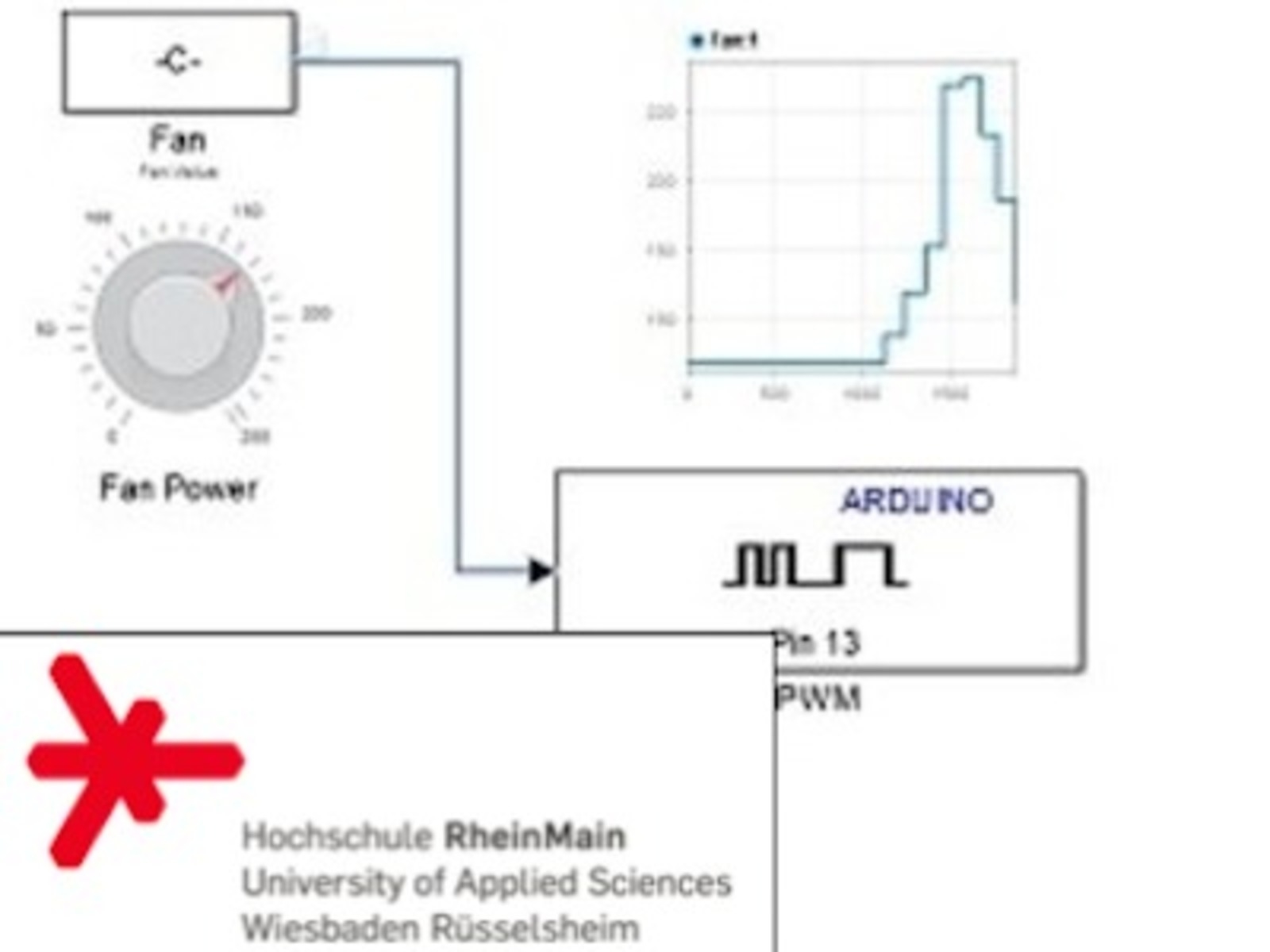
The main objective of this MOOC is to teach the use of Simulink® as a simulation tool for a broad variety of application domains. We will specifically focus on topics of interaction of the simulation models with the real world using Arduino Microcontrollers and Simulink®'s corresponding Arduino Hardware Support Package.
First, we will explain modelling and simulation concepts in general and introduce Simulink®. As a first application, we show how a simplified model of a Water Treatment Plant is implemented using Simulink®. We will then use an Arduino microcontroller to access hardware in the real world. We will go on to introduce control engineering techniques using Simulink® and apply these techniques to drive an example system of a ball floating in an airstream.
What will I learn?
By the end of this course, you will be able to implement simulation models using the tool Simulink®. These models can cover applications in the engineering domain and you know methods and technologies to create simulation models of realistic complexity.
In the engineering domain, microcontrollers are frequently used to control some physical system. Therefore, in this course you will also learn how to use an Arduino microcontroller for this purpose and how programmes for such a microcontroller are implemented in Simulink®. You will specifically learn techniques of control engineering by applying them to a technically simple physical system that is yet difficult to control.
What do I need to know?
This course will be taught on an academic level for undergraduate students. Therefore, knowledge in mathematics and physics of at least secondary education level as well as programming knowledge is a prerequisite.
Having already passed our MOOC "Modelling and Simulation using MATLAB" is helpful but not mandatory.
Course Structure
Chapter 1: My first Simulink® model
Chapter 2: Advanced Simulink® modelling
Chapter 3: Modelling a Water Treatment Plant
Chapter 4: The Arduino microcontroller and the corresponding Simulink® support package
Chapter 5: Control Engineering using Simulink®
Chapter 6: Control Engineering using the Arduino

Examine how architecture reflects Japan’s history, starting with its emergence as a new nation in the 19th century and the building of the Western-style capital city of Tokyo on the foundations of Edo. New building materials and construction methods reflected changing times, and the radical contrast between tradition and modernism in the nation was clearly visible in Japan’s architecture and politics.
While experiencing intense Westernization pressures, Japan developed rapidly to rival the world’s great powers, we will look at how Japanese architects developed their own version of Modernism. Initially, Japanese wanted to pursue the discoveries of the Franco-Swiss Le Corbusier and of Walter Gropius at the German Bauhaus. But soon, Japan also began to produce its own 20th-century architects and develop its own style. Following World War II, Kenzo Tange became the first Japanese architect in history to achieve international fame.
In the last section of the course, we will present an interview-based case study titled “Exploring Tokyo Tech’s Twenty-First Century O-okayama Campus.” Tokyo Institute of Technology (aka Tokyo Tech) possesses its own unique and unbroken succession of practicing architects/professors, who design campus buildings. We will learn about Professor Kazuo Shinohara, one of the most prominent Japanese designers of the second half of the 20th century, and several of his renowned disciples from Tokyo Tech.
This course aims to illustrate the present state of Japanese Modernist and postmodern building, as well as the distance covered over the past 150 years, including the 130-year history of Tokyo Tech itself. Join us on this journey through time as we examine and admire Japan’s architecture to better understand Japanese history and politics.

Learn how MOS transistors work, and how to model them. The understanding provided in this course is essential not only for device modelers, but also for designers of high-performance circuits.
Add to calendar

Trusted paper writing service WriteMyPaper.Today will write the papers of any difficulty.