

Courses tagged with "Nutrition" (6413)

This course relies on primary readings from the database community to introduce graduate students to the foundations of database systems, focusing on basics such as the relational algebra and data model, schema normalization, query optimization, and transactions. It is designed for students who have taken 6.033 (or equivalent); no prior database experience is assumed, though students who have taken an undergraduate course in databases are encouraged to attend.
This course relies on primary readings from the database community to introduce graduate students to the foundations of database systems, focusing on basics such as the relational algebra and data model, schema normalization, query optimization, and transactions. It is designed for students who have taken 6.033 (or equivalent); no prior database experience is assumed, though students who have taken an undergraduate course in databases are encouraged to attend.

This course presents an example of applying a database application development methodology to a major real-world project.

This course presents an example of how to apply a database application development methodology to a major real-world project.
All the database concepts, techniques and tools that are needed to develop a database application from scratch will be introduced along the way as you apply them to your own major class team project.
In addition to the development methodology, techniques and tools learned in this course will include the Extended Entity Relationship Model, the Relational Model, Relational algebra, calculus and SQL, database normalization, efficiency and indexing. Finally, techniques and tools for metadata management and archival will be presented.

This course addresses information technology fundamentals, including project management and software processes, data modeling, UML, relational databases and SQL. Topics covered include internet technologies, such as XML, web services, and service-oriented architectures. This course provides an introduction to security and presents the fundamentals of telecommunications and includes a project that involves requirements / design, data model, database implementation, website, security and data network. No prior programming experience required.

En esta era de la información, los datos están disponibles en todos lados y crecen a una tasa exponencial. ¿Cómo podemos darle sentido a todos los datos? ¿Cómo aprovechamos los datos en el momento de tomar decisiones? ¿Cómo utilizamos los datos para que nos ayuden a guiar la gestión y planificación de nuestras políticas? Tanto si eres ciudadano como planificador de políticas, deberías poder responder a estas preguntas.
En este curso podrás fortalecer tus capacidades de uso, comprensión e interpretación de datos, utilizando la plataforma desarrollada por el BID “Números para el Desarrollo”, que presenta datos e indicadores socioeconómicos de la región de América Latina y el Caribe. A través de estas herramientas, podrás comprender cómo mejorar el proceso de toma de decisiones en la gestión pública.
Al finalizar el curso, contarás con instrumentos para navegar entre los datos, realizar e interpretar visualizaciones y comprender los diferentes tipos de análisis de datos según la política a implementar.
Tranquilo, no se trata de un curso de estadística, sino de adquirir los conocimientos necesarios para interpretar gráficas, reportes estadísticos y comprender su lenguaje. Y, lo más importante: adquirirás las bases para fundamentar tus decisiones en datos comprobables, más allá de tu intuición.
El curso está basado en ejemplos para que puedas ir comprendiendo los diferentes conceptos y metodologías de una manera sencilla, práctica y amena. Encontrarás diferentes actividades prácticas, en las que podrás aplicar los conocimientos adquiridos y practicar con datos y gráficas. Además, te mostraremos casos reales del BID para promover el análisis y presentar las realidades a las que están expuestos los expertos de la región. También te enfrentarás a algunos retos creativos, con los que podrás medir tus capacidades en un nivel de dificultad más elevado.
Finalmente, el curso tiene lecturas y videos que permiten generar una mejor compresión de temas del curso y participar con fundamento en los foros de discusión; en los que se abren espacios para la discusión con tus compañeros alrededor de los temas y retos planteados durante el curso.
Este MOOC ha sido certificado por Quality Matters (QM), organización sin ánimo de lucro reconocida como líder en el aseguramiento de la calidad de la educación en línea. QM ha desarrollado un conjunto de estándares de calidad para el diseño de cursos cuyo cumplimiento ha sido certificado en este MOOC a través de un riguroso proceso de revisión de pares expertos para garantizar la efectividad del aprendizaje.

This course explores natural and electric lighting that integrates occupant comfort, energy efficiency and daylight availability in an architectural context. Students are asked to evaluate daylighting in real space and simulations, and also high dynamic range photography and physical model building.

La seguridad de los alimentos que ingerimos es uno de los principales objetivos de las políticas de la Unión Europea. Pero la realidad es que en las últimas décadas hemos sufrido crisis alimentarias muy importantes, tanto desde una perspectiva económica, con grandes pérdidas para productores y distribuidores, como sobre todo desde una perspectiva social, con un elevado número de fallecidos a lo largo de toda Europa. A través de este curso podrás conocer las respuestas adoptadas por la Unión Europea: la primacía del conocimiento científico sobre los criterios económicos; la colaboración de la industria alimentaria en la garantía de la seguridad; la adopción de procedimientos autorizatorios y de alerta ante situaciones de crisis; y la reparación de los daños generados por tales crisis.
Este curso se imparte en español, si bien alguno de los documentos de referencia pueden aparecer en ingles (aunque se incluirá una breve explicación en español). No se requiere conocimiento jurídico previo alguno.

La cocina mexicana es una de las mayores expresiones culturales de México. Es resultado del encuentro de dos mundos y de la suma de otras culturas. Su riqueza se da gracias a la enorme biodiversidad natural y cultural del país. En noviembre de 2010 fue declarada como Patrimonio Inmaterial de la Humanidad por la UNESCO.
Este curso, impartido por la Universidad del Claustro de Sor Juana, te proporcionará una visión amplia sobre los ingredientes básicos de la cocina mexicana. Conocerás sobre productos endémicos de México, la relevancia cultural e histórica de estos ingredientes y su importancia a nivel mundial; asimismo aprenderás algunas de las preparaciones más representativas de la cocina mexicana utilizando estos insumos. El curso consta con 6 módulos:
- Módulo 1. Introducción a la cocina mexicana
- Módulo 2. El maíz
- Módulo 3. El chile
- Módulo 4. El jitomate y el frijol
- Módulo 5. La vainilla y el amaranto
- Módulo 6. El cacao

If you want to know more about deafness in low and middle income countries this MOOC is for you. It is primarily aimed at those working as health or education professionals, government officials, support workers, NGOs and anyone with a family or personal interest in deafness. It aims to improve knowledge and understanding of this topic.

The Alaska Oil Pipeline is one example of a massive public private partnership. Learn how project finance principles and concepts are used in this deal and others, as well as how the legal and operating environment and customer segments impact these partnerships.
In addition to the Alaska Oil Pipeline, we’ll review other major PPPs including Eurotunnel, San Roque Hydroelectric Dam, Euro Disneyland, Albania Cell Phone, and Emirates Aluminum. You’ll also learn about the lender checklist and go over a case study in the United States before wrapping up this course.
This course is part of the New York Institute of Finance’s popular Project Finance and the Public Private Partnerships Professional Certificate program.

In this course, we will review multiple case studies and transactions to recognize how to select the best deal for an investment.
We’ll look at the different players in a deal and understand what the risks are.
This course is part of the New York Institute of Finance’s popular Project Finance and the Public Private Partnership Professional Certificate program.

This global health and life sciences course enables learners to investigate health problems affecting large populations – the whole world in fact! By understanding the big numbers in global mortality and their causes and distributions you will learn how to think numerically about global health. We will use real data from real people to ask the questions: What are the major causes of death in the world? Why do we need cause of death statistics? How does counting the dead help the living?
We begin with a historical perspective on global mortality and end with a hopeful look toward future trends. In between, you will learn about how death prior to old age can be avoided, worldwide mortality rates, and specific diseases such as HIV, malaria, childhood conditions, chronic diseases, and risk factors such as smoking. This course will help you use population statistics to understand how rapid gains in health are possible.

What causes a country’s debt to become unsustainable? How do we assess debt sustainability of public and external debt? How can countries manage their debt portfolio?
This online course aims to provide a comprehensive overview of debt sustainability analysis (DSA) and a medium-term debt management strategy framework adopted by the IMF and the World Bank.
Specifically, the course will: (i) introduce the main principles of debt sustainability; (ii) cover recently updated DSA frameworks — both for advanced and emerging markets and for low-income countries — with an emphasis on country data; (iii) present a medium-term debt management strategy (MTDS) framework; and (iv) illustrate debt sustainability analysis under uncertainty.
Whether you have a professional interest in debt sustainability or debt management or you are simply curious about these issues, we hope that you will join us in this in-depth study of one of the most critical and current issues in economic policy today!
Debt Sustainability Analysis is offered by the IMF with financial support from the Government of Belgium.

This history course delves into the medieval history of the city of Burgos, from its inception in 884 c.e. as the homeland of the Spanish Kingdom of Castile and Leon, until the completion of the Spanish Reconquista in 1492. We will study complicated legendary heroes like Rodrigo Diaz de Vivar, “The Cid”, both a champion of the Christian Reconquista and a friend of Islamic rulers, who lays buried in the Cathedral of Burgos. Like the Cid, medieval Burgos presented two competing views for Spain’s future – one centered on overt Castilian supremacy and another more nuanced one that incorporated religious minorities, especially Jews and Jewish converts to Christianity (conversos), into every element of political, economic, and even religious life.
This course will investigate the disastrous impact of the Plague and how it led to the death of King Alfonso XI and the ruinous civil war between the half-brothers, Pedro “The Cruel” and Enrique II of Trastamára. We will also appraise the collapse of the kingdom’s “Old Christian” nobility and the generation of new elite clans, some of whom hailed from Jewish ancestries. It was also the era of anti-Jewish pogroms, Christian fixations on “blood purity” and unsuccessful pleas for Christian harmony, and the last gasps of Jewish, Christian, and Muslim coexistence.
We will virtually-tour the Cathedral of Burgos, the Museum of Burgos, and what remains of the city’s medieval neighborhoods and structures. We will also study and transcribe intriguing vellum and paper manuscripts from the cathedral and municipal archives so that we discover new facets of this history.
No knowledge of Spanish is needed to participate in the course or in our transcription efforts.
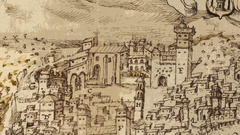
In this course students will explore the history of Jews, Christians, and Muslims in late medieval, fifteenth century Spain. Serving as citizen-scholars, students will learn about the positive and negative elements of inter-religious co-existence in Plasencia, Spain, and more importantly, contribute to an international scholarly effort by helping transcribe manuscripts.

This course evaluates the medieval history of Toledo from the reign of King Alfonso “The Wise” (1252-1284) until the creation of the blood purity statutes in the 1450s.
This local history will concentrate on the relations of Jews, Old Christians, and converts to Christianity (conversos). We will study King Alfonso X’s efforts to characterize himself as the “king of three religions” via his legal codices, the creation of the Cantigas de Santa María, and his intellectual endeavor known as the Toledo School of Translators.
We evaluate the robust Jewish and converso noble families of the city and appreciate their intellectual, religious, and economic contributions to Castilian life. We will bear witness to the rise of anti-Jewish blood purity statutes, the creation of the Inquisition, and the expulsion of the Jews. We will virtually-tour the Cathedral of Toledo, El Transito Synagogue, Santa Maria la Blanca Synagogue, and several of its neighborhoods.
We also will study and transcribe manuscripts from the municipal, cathedral, and national historic nobility archives to make new scholarly breakthroughs.
No knowledge of Spanish is needed to participate in the course or in our transcription efforts.

This course will teach you the first principles of complexity, uncertainty and how to make decisions in a complex world.

Good decision-making is an essential life skill most people acquire through trial and error. Few have had the benefit of formal training in decision making or are aware of decision science. This course demonstrates how a framework to help us make better decisions, decision quality, can help...

Good decision-making is an essential life skill most people acquire through trial and error. Few have had the benefit of formal training in decision making or are aware of decision science. This course demonstrates how a framework to help us make better decisions, decision quality, can help...
Add to calendar

Trusted paper writing service WriteMyPaper.Today will write the papers of any difficulty.