

Courses tagged with "Nutrition" (6413)
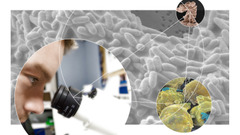
This course will give you an introduction to bacteria and chronic infections. Leading experts in the field will make you familiar with the fundamental concepts of microbiology and bacteriology such as single cell bacteria, biofilm formation, and acute and chronic infections.
Here is your chance to learn about digital badges and micro-credentialing, a great new way to engage students by recognizing their achievements at various stages in the learning process. This course will include a brief history of digital badges (or “badging”), an introduction to planning your badging system, and an introduction to creating and displaying badges. It will prepare you to make considerations for federal student information policies to develop internal procedures that support micro-credentialing programs. Participants may include educators and learning specialists who are already using badges; those who are aware of badges but have not been using them; anyone considering using badges; and anyone who knows nothing about digital badges and micro-credentialing but who wants to learn! Participants will have the opportunity to earn badges through class discussions and course assignments. “Learn-by-doing” is essential in this four-week course.

Es evidente que si no tomamos medidas para combatir el cambio climático el mundo será 4 grados centígrados más cálido a finales de siglo. Este incremento de temperatura amenaza nuestra sociedad tras décadas de desarrollo y nos encontramos actualmente en un punto de inflexión decisivo para el futuro de la humanidad. Este curso presenta las últimas evidencias científicas sobre el cambio climático y algunas de las alternativas e iniciativas que debemos empezar a implementar lo antes posible para poder revertir la situación.

Banking and financial markets encompass the ‘ecosystem’ that (a) channelizes money from those who have it (i.e. savers/investors) to those who need it (i.e. borrowers) and (b) facilitates cross-border flow of funds through exchange of currencies. The ecosystem of banks and financial markets (including Central Banks) has deepened in size, sophistication and complexity over the years. However, in recent times they have also been the subject of abuse, failures and economic distress in several countries resulting in a ‘contagion’ that has concurrently affected several countries around the world!
More recently, and perhaps more importantly, thanks to the liberalization of most economies, the world has witnessed an exponential increase in the free flow of capital across countries. Banking institutions and financial markets, being the predominant conduit for such free flow of capital across countries, have therefore become even more "globally interconnected." Such a globally interconnected financial system, combined with regulatory systems that are country-specific and hence varying considerably in rigor and implementation, has further compounded the risks and the consequent contagion, as witnessed in the global financial meltdown that was triggered in 2008.
This course on ‘Banking and Financial Markets’ comprises two parts:
In an earlier course, which was introductory in nature, we had looked at the theory and concepts underlying banking and financial markets, the products and instruments offered and the associated market mechanisms.
In this more advance course, we will look at Banking and Financial Markets from a Risk Management Perspective:
- The embedded risks in any financial system: credit risk, interest rate risk, foreign exchange risk, operational risk, off-balance sheet risk, etc.
- The contagion effect of these risks, as witnessed in the 2008 global financial meltdown
- How are these risks identified, measured and managed, using several risk mitigation techniques and sound regulatory oversight.

En este curso se recordará lo que es una ecuación con una única incógnita y cómo solucionarla. A partir de ahí se tratarán:
- Los sistemas de ecuaciones lineales. Cómo se definen, cómo se clasifican y cómo se resuelven utilizando el método de Gauss
- El concepto de matriz y las operaciones entre matrices
- El cálculo de matrices inversas mediante el método de Gauss y el de los adjuntos
- Una introducción a las ecuaciones matriciales
- El determinante de una matriz cuadrada y su cálculo
- El rango de una matriz
- La expresión matricial de un sistema de ecuaciones lineales y la regla de Cramer

Este curso se concibe como una revisión de los conceptos básicos del cálculo diferencial, necesarios para los primeros cursos de aquellos estudios universitarior en los que se imparte matemáticas. Nuestro objetivo es proporcionar un curso básico sobre funciones y derivadas, incluyendo sus aplicaciones.

Este curso se concibe como una revisión de los conceptos básicos del cálculo diferencial, necesarios para los primeros cursos de aquellos estudios universitarios en los que se imparte matemáticas. Nuestro objetivo es proporcionar un curso básico sobre funciones y derivadas, incluyendo sus aplicaciones.

Este curso está, concebido como una preparación mínima necesaria para los primeros cursos de ingeniería y otros estudios en los que se imparten matemáticas. En él trabajaremos:
- El concepto de conjunto y sus operaciones
- La notación matemática elemental
- Los diferentes tipos de números: naturales, enteros, racionales, irracionales y reales
- Finalmente aprenderás los conceptos básicos necesarios sobre números complejos

This course is a review of Basic Arithmetic skills that serve as a prerequisite for placement into and success in pre-college and college-level algebra courses. In this course, primary emphasis will be placed on fundamental operations with whole numbers, fractions, decimals, and integers. Other topics covered include proportions, percentages, representations of data, geometric figures, and measurement. Students who should take this course include: those that have an interest in brushing up on arithmetic skills prior to taking an upcoming placement test or those that have not had math in many years and want to review foundational skills and concepts. This course provides free digital access to all required materials including a student workbook, lesson videos, and online homework practice and assessment. A certificate of completion will be awarded by the instructor to students who complete required activities. The course instructor recommends purchase of a textbook or other course materials. Please see the details below. Required materials: Basic Arithmetic Student Workbook Purchase Info: Hard copy at Lulu.com or access via free digital download. Approximate cost for hard copy: $15

This course will survey fundamental principles of cognitive and behavioral neurology. The emphasis of the course will be on the neural mechanisms underlying aspects of cognition and on diseases that affect intellect and behavior. No prior background in neurology, medicine, or neuroscience is required.

Basic Life Support (BLS) will prepare you to respond to life-threatening emergencies in multiple populations with life-saving interventions.

Introductory Mandarin is the first in a series of six courses designed to teach you how to speak Mandarin Chinese. This course will introduce you to the basic language you will need to eat, live, and get around in Mandarin speaking countries.
Since this is a language course, we recommend taking this course with a friend or group of friends. Practicing with others by speaking the language will help you learn it more effectively. Additionally, Mandarin is a tonal language, which means that in order to truly master it, you will need to say the words out loud! Join the community of over 900 million native Mandarin speakers and start learning today!

In the second course of the Mandarin Chinese language series, you will learn extensive vocabulary for describing people and objects, making comparisons, and stating your own perspectives by using complex and varied sentence structures.
Learners will focus on tones and intonation with designed practices and learn to build dialogues for everyday communication. After this Mandarin Chinese language course, you will be able to communicate in Mandarin speaking countries without difficulties.
Supplementary tools or materials are recommended if you would like to learn written language and stroke orders of Chinese characters.

In the third course of the Mandarin Chinese language series, you will advance your Mandarin Chinese with extensive vocabulary and complex sentence structures based on dynamic scenarios.
You will get involved in situations such as buying a cell phone, setting up a date, or going to the movies. You will not only learn to respond correctly but also to deliver your point of view and convey a clear idea in Mandarin Chinese.
Previous knowledge of Mandarin Chinese is needed.

As an animation artist, why do you need to know physics? Chuck Jones once said, “We must all start with the believable. That is the essence of our craft.” This course will show you how to create believable motion and when to break the laws of physics.

This hands-on course introduces you to science-based skills through simple and exciting physics, chemistry and biology experiments

This course explains how you can use numbers to describe the natural world and make sense of everything from atoms to oceans.

This 7-week Spanish language course is aimed at students who would like to learn conversational Spanish starting with Spanish basics. The course introduces everyday language and includes activities to practice all four language skills: reading comprehension, writing, listening comprehension and speaking.
This course will introduce you to the A1 proficiency level as described in the Common European Framework of Reference for Languages (CEFRL, Council of Europe 2001). After completing this course, you will be prepared to introduce yourself, ask basic questions, and conduct a brief conversation in Spanish.
This course uses reference materials, cultural notes, grammar explanations, functions of language, etc. Students will be able to monitor their progress by taking a number of performance tests and a final achievement test.

¡Bienvenidos y bienvenidas! (Welcome!) In this Spanish course, you will learn basic vocabulary to talk about yourself and your everyday life, in the present and in the past, in simple and brief communication situations, as well as about plans for an immediate future. At the end of the course you will be able to communicate in everyday situations according to the A1 proficiency level as described in the Common European Framework of Reference for Languages (CEFRL, Council of Europe).
The course, which is designed for English speakers, offers a variety of exercises after going through the stages of content presentation, comprehension and production. You have videos, small texts and audios to improve your pronunciation, glossaries, activities for oral practice with other course students, quizzes, grammar cards and recommendations on external Internet resources to continue learning more and more Spanish.
The topics on which the activities revolve are work life, family life, city life and outdoor life. As you can see, a bit of everything to be able talk about yourself and to engage in everyday communication.
We hope you like our menu. ¡Buen provecho! (Bon appétit!)

- Have you ever wondered how magnetic resonance imaging (MRI) works?
- Do you know how one can determine three-dimensional structures of proteins without crystallization?
- How can chemists know for sure if they succeeded in synthesizing the desired molecules?
- How can you figure out the structure of a freshly discovered natural product extracted from plants or algae?
Add to calendar

Trusted paper writing service WriteMyPaper.Today will write the papers of any difficulty.