

Online courses directory (108)

Design 1o1 “Redux”
“Design 1o1 Redux” is an introduction to design through 101 exercises. A six-month journey divided into 3 courses “online” here on iversity (Part 1, Part 2 and Part 3), one final exhibition / graduation party and an “offline” workshop in which we will go one step beyond.
In short:
Part 1: “Myself” (Nov 2 to Dec 27)
Part 2: “My House” (Jan 4 to Feb 28)
Part 3: “My World” (Feb 29 to Apr 24)
Exhibition / Graduation: In Croatia (Apr 23-24)
Winter camp: In Croatia (Apr 25 to May 1)
:-)
And now, Part 3: My World...
Design 1o1 Redux Part 3: My World
Johan Cruyff, a very famous footballer (and fantastic designer), once said:
“I never practice tricks. I play very simply.
That's what it's all about. Playing simple football is the hardest thing.”
If we think about it, design is everything.
It can be football, but it can also be an object, a building, a game… our lives, our worlds!
In this part of the Design 1o1 Redux, we will go out and “get busy” designing our very own worlds. Something for which we will need to master a high level of simplicity.
We will work with all kinds of cool apps for phones and tablets (do you have a smartphone or tablet?). We will also share our works with the others on Instagram, using special hashtags.
:-)
Course Structure
Our various activities will be divided into 8 weeks:
Week 1: My Neighborhood
Week 2: My Town
Week 3: My Trips
Week 4: My Nature
Week 5: My Shelter
Week 6: My Thing
Week 7: My Exam
Week 8: My Break
What will I learn?
You will learn to develop some basic design attitudes for better understanding the mechanics of today’s world.
One step at a time, you will learn that “design” is foremost a language.
A language shared, talked and discussed by designers from all over the world.
How does the world look through the special lenses of "design"?
Along the way, you will learn about a considerably high number of things. Starting from your very own self.
Prior Knowledge
In terms of prior knowledge, there is nothing required.
If you have a lot of prior knowledge, it might make the learning process more difficult, but don’t worry, no one is perfect. If we talk about contemporary “#design”, we are all absolute beginners!
However, in terms of technical equipment, this course is easier to follow via a smartphone or tablet. Of course, you can follow us via a desktop computer... but this is not how we intended the whole thing to be.
:-)
Workload
Between 4 and 7 hours a week.
Everyday, from Monday to Friday, for a total of 6 weeks, you will receive a package via email. Each package contains a 15-second video to watch (to get you in the proper mood), and a pdf-letter introducing the daily brief (or “homework”) and a series of objects, characters and happenings intertwined with the narrative of the course (to go deeper in the subject at hand).
You will work on your assignment…
Then, once completed, you will upload it to your Instagram account (for the rest of us to see).
Easy as a kiss.
Questions or Comments?
You can write to Ms. Lola (our so-called secretary, but actually the real boss of this whole venture) at: design101.info@gmail.com.
Now, please understand that Ms. Lola is very busy. You might get higher chances of getting a quick and complete answer via Instagram, Facebook, Twitter. Come and let us show you around!
:-)
The Design 1o1 Community
This course is run by the Design 1o1 Community.
You can learn more about who we are and what we do here.
All course contents are used for educational purposes.
The written content is by IdLab, and the visual content is assembled by IdLab.
The Design 1o1 Redux is a project by IdLab for Abadir Academy of Fine Arts.
Course Summary
Human rights are a complex issue. Their protection and promotion involve a number of actors: from international organisations to local communities, from governments to civil society. Human rights affect all aspects of our life, as individuals (as women, men, children, refugees, workers…) and as members of a community. This MOOC provides students with critical knowledge concerning the norms, institutions and procedures tasked to promote and protect human rights. Students will acquire the knowledge needed to actively join the global debate on fundamental rights and to avail themselves of the existing legal and institutional tools set up for their implementation. The MOOC introduces to the human rights legal framework in a multi-disciplinary and multi-level perspective, helping students to approach real-life scenarios with competence and cultural and ethical awareness.
What do I learn?
Students are expected to acquire a sound knowledge of the international system of human rights protection, and of the opportunities for human rights promotion and protection that are practically available at the national and local levels. The skills acquired can be preparatory for further specialisation on this subject. Finally, students will be able to apply the acquired knowledge and skills to real scenarios, including in relation to their everyday life.
What do I need to know?
The MOOC is mainly addressed to people from all over the world who have a background in political science, international relations and/or international law. The course, however, includes a general introductory chapter explaining the main issues, concepts and scenarios at stake. For this reason the MOOC is also open to people actively engaged on the ground that do not have a specific academic or educational background.
Course Structure
Chapter 1 - The basics
The Chapter aims to introduce the course and starts addressing (and providing some preliminary answers) some basic questions: What are human rights? Who is involved in their protection? Why are human rights a global priority? How can effectively be protected?
Chapter 2 - The UN and human rights
The focus is on the evolution of the UN commitment in human rights protection based on three pillars: positivisation, monitoring and mainstreaming.
Chapter 3 - The UN human rights machinery
The analysis deals with the UN mechanisms for the protection of human rights at the global level. Special attention will be given to the role of the Human Rights Council and the Universal Periodic Review.
Chapter 4 - The European system for the promotion and protection of human rights
The Chapter starts looking into the promotion and protection of human rights at regional (continental or sub-continental) levels. In particular, the European system will be presented highlighting the respective roles of the European Union, the Council of Europe, and the OSCE and their capacity to interplay and possibly complement each other.
Chapter 5 - Regional systems for the promotion and protection of human rights in Africa, Asia and the Americas
The other regional systems investigated in this chapter are those operating in the framework of regional organisations in the Americas (the Organisation of American States), in Africa (the African Union), in the Arab world (the League of Arab States), as well as in South-East Asia (the ASEAN).
Chapter 6 - Human rights in conflict and post-conflict contexts
The focus shifts to the national level, in particular to situations of armed conflict and to post-conflict scenarios. Issues related to the standards and procedures of International Humanitarian Law and International Criminal Law are also tackled.
Chapter 7 - Human rights promotion and protection at the National and sub-national level
This Chapter addresses a number of issues related to the role of National Human Rights Institutions and other actors involved in human rights policies nationwide and at the local/community levels, such as local governments and municipalities.
Chapter 8 - The driving forces of human rights promotion: the role of civil society
The Chapter focuses on civil society organisations and networks. The analysis looks into the multifaceted strategies carried out by non-state actors, especially in relation to the international instances of human rights protection.
Chapter 9 - Conclusions: perspectives on global human rights
A summary and discussion of the multi-level dimensions of human rights protection dealt with in the previous chapters. This final segment provides some closing critical reflections on the questions set forth in Chapter 1.
Mid –term homework
At the end of chapter 4, the instructions for homework will be released: homework must be submitted by the end of chapter 6 (2 weeks). Homework consists of writing a communication or a petition addressed to one of the monitoring bodies studied in the first four chapters. The aim is to familiarise students with the tools of human rights protection mechanisms. The texts will be evaluated using a peer review methodology.
Final homework
At the end of chapter 8, the instructions for homework will be released: homework must be submitted in 2 weeks. Students will be asked to write, using a simplified form, a project addressing a human rights related issue that is challenging their town, territory, home country and likely to be taken up by governmental or non-governmental agencies.
Within each chapter, the MOOC offers tailored case-studies, interviews with field experts, officers and academics.
Workload
Approximately 4 hours per week for watching video lectures, taking quizzes, completing homework and reading the material provided.
UNIPD
Founded in 1222, the University of Padova is one of Europe’s oldest and most prestigious seats of learning: it is a multidisciplinary university, which aims to provide its students with both professional training and a solid cultural background. A qualification from the University of Padova is a symbol of having achieved an ambitious objective, one that is recognised and coveted by both students and employers alike.
If you want to know more about the University of Padova, visit its website.
HRC
The Human Rights Centre of the University of Padova is the first established (in 1982) specialised structure dedicated to human rights in the framework of an Italian University, and one of the oldest in Europe. The Centre hosts the UNESCO Chair in Human rights, democracy and peace - its chair-holder being prof. Antonio Papisca - and the European Jean Monnet Centre of Excellence Intercultural dialogue, human rights and multi-level governance. It edits the Italian Yearbook of Human Rights and manages the Archive Peace Human Rights, a web portal on human rights funded by the Region of Veneto.
The Centre supports the master’s degree in Human Rights and Multi-Level Governance at the University of Padova, and the postgraduate courses of the EU-backed EIUC (the European Inter-University Centre for Human Rights and Democratisation in Venice).
Learn more about the Human Rights Centre of the University of Padova.

Course Summary
When was Stonehenge built? Who built it? How was it built? Why was it built? Answers cannot be promised to all of these, but we can get better at asking the questions and work towards solutions. We can look at how people have responded to Stonehenge. Most of all we can begin to think about what Stonehenge means to us.
What do I learn?
- To understand present archaeological thinking about Stonehenge.
- To evaluate responses to Stonehenge in art, literature, music, architecture and culture.
- To consider your own response to Stonehenge, expressed through two peer-evaluated mini-essays.
What do I need too know?
No entry requirements. This MOOC is open to all.
Course Structure
Chapter 1: The Stonehenge Landscape
Stonehenge as a landscape of prehistoric sites. A historical context: the Mesolithic, the Neolithic and the building of the Stonehenge.
Chapter 2: Who built Stonehenge?
Theories: when, by whom, how and why.
Chapter 3: Stonehenge Problems
Context - the Stonehenge landscape: problems with transportation and erection. Part destruction - why and how?
Chapter 4: Responses to Stonehenge
An array of responses: Geoffrey of Monmouth (1138); the antiquarian tradition, the temple and astronomic alignments traditions; various amateur theories; the archaeological traditions.
Stonehenge, Woodhenge: monuments in a landscape
Chapter 5: Cultural Contexts
Stonehenge in fiction, poetry, music, art and popular culture.
Chapter 6: Stonehenge Today
Stonehenge as a cultural icon, emblem of Britain, World Heritage site and sacred space.
Blick Mead as the cradle of Stonehenge.
Chapter 7: Reassessing Stonehenge
Written activity as an assessment
Chapter 8: Responses to Stonehenge
Examination of students' responses through their essays. Integration of blog, Wiki, Twitter and eBook as a way of continuing the discussion after the course.
Workload
Approximately two hours per week for watching video lectures, completing quizzes and homework assignments.


Course Summary
The course addresses the design and development of Serious Games. Serious Games are games that do not have entertainment as the main purpose but rather an educational, awareness raising, training, advertisement or other “serious” purpose that benefits from the engaging context that games provide to motivate the users. Serious Games have been typically used in education, training, health, defense and other sectors.
MOOC students will go through all the steps of the development of a Serious Educational Game from selecting the idea and binding it with learning goals to the development and testing of the game prototype in an environment that does not require programming skills. The programme of study will allow students to understand the process of idealizing, designing, developing, testing and delivering a game. At the same time, students will benefit from a hands-on experience, working in intercultural and interdisciplinary teams, exploiting the expertise of an international team of participating teachers and industry experts.
What do I learn?
The course objective is to allow students understand the process of idealizing, designing, developing, testing and delivering a serious game.
In the end, students will be able to...
- Understand and comment the main concepts of game culture and digital game theory
- Analyze game taxonomies and identify the specific characteristics of each game type
- Carry out analyses and user tests to understand users’ demands and needs and convert them into serious game requisites (including learning objectives for game-based learning)
- Understand and apply serious game methodologies
- Understand the concepts related to game play, game flow, interactive narratives, storytelling and apply them in practice to develop an addictive game
- List the main tools (game editors) available to develop games and to identify the best one for a specific purpose
- Use a specific game editor to develop a serious game
- Idealize, design, develop, test and deliver a serious game
What do I need to know?
Basic computer and internet skills
Workload
Approximately 5 hours per week for watching video lectures, taking quizzes and completing homework assignments.
offered by the United Nations Environment Programme

and the Cologne University of Applied Science

Course Summary
This MOOC enhances knowledge and skills for tackling complex issues such as resilience and transformation, sustainable development, ecosystem management, disaster risk reduction, climate change adaptation and how they can be operationalized. It will benefit disaster managers and practitioners, climate change adaptation professionals, development planners, project implementers and policy makers. The course will be delivered through a series of lectures and case studies, quizzes, peer-reviewed exercises, along with additional study materials provided to the students. Lectures will be available through videos as well as online documents and will be geared for students who may not have access to high speed internet so they can follow the course. Students will be provided the opportunity to enhance their critical thinking through real life and fictitious problem solving exercises. Each week will feature an international expert who will be available to respond to questions and interact with students.
What will I learn?
After completion of the course, the participant will be able to:
- Define basic concepts of disasters, disaster risk reduction, climate change adaptation and resilience.
- Recognize key linkages between ecosystems, disaster risk reduction and climate change adaptation.
- Recognize the linkages and overlaps between ecosystem based disaster risk reduction and ecosystem based adaptation.
- Identify various ecosystem based tools in reducing disaster risk and climate change adaptation.
- Identify key international agreements, organizations and initiatives related to disaster risk reduction, and climate change adaptation.
- Apply concepts and tools of ecosystem-based disaster risk reduction (Eco-DRR) and ecosystem based adaptation (EbA).
- Evaluate costs and benefits of different type of measures for reducing disaster risks.
- Design your own ecosystem-based project for increasing resilience and reducing climate risks.
What do I need to know?
There are no prerequisites, just some willingness to learn about this innovative topic! It is however true that it will help if you have heard about disasters and climate change before starting.
Course Structure
The course is structured in two parts:
The leadership track, which is tailored for busy professionals or students curious about the topic. The leadership track will run three weeks.
The expert track is for professionals and students who seek more in-depth learning and skill development in applying ecosystem-based tools for disaster risk reduction and adaptation. The expert track will run 12 weeks with 3 weeks for the final assignment, peer review process and course wrap-up. Each unit has several quizzes, a concise background document for further reading, a discussion forum, supplementary videos with interviews with international experts and short documentary videos from around the world. In addition, world leaders were interviewed for our MOOC.
Course Outline and Schedule
Chapter 1. Leadership track – introduction (Week 1. Jan 12-18)
Unit 1. Disasters and Ecosystems: Resilience in a Changing Climate - why take this course?
Unit 2. Introduction to disasters, risk reduction and climate change
Chapter 2. Leadership track – linking disasters, climate change and ecosystems, Part 1 (Week 2. Jan 19-25)
Unit 3. Links between disasters, disaster risk reduction, adaptation and key international actors
Unit 4. Principles and challenges of ecosystem-based disaster risk reduction (Eco-DRR) and adaptation (EbA)
Chapter 3. Leadership track – disaster management, resilience and ecosystems (Week 3. Jan 26- Feb 1)
Unit 5. Ecosystem management contributions pre- and post-disasters
Unit 6. Managing resilience and transformation
Chapter 4. Expert track – linking disasters, climate change and ecosystems, Part 2 (Weeks 4&5. Feb 2-15)
Unit 7. Linking ecosystems and humans to disasters
Unit 8. Principles of systems thinking and using natural systems for disaster risk reduction
Unit 9. Putting Ecosystem-based disaster risk reduction (Eco-DRR) into practice
Chapter 5. Putting theory into practice (Weeks 5 & 6. Feb 16-22)
Unit 10. Linkages between Eco-DRR and EbA
Unit 11. Putting Ecosystem-based adaptation into practice & peer review assignment
Chapter 6. Ecosystem-based tools for disaster risk reduction – introduction (Week 7. Feb 23-Mar 1)
Unit 12. Incorporating ecosystems in risk assessments
Unit 13. Ecosystems and spatial tools for risk reduction
Chapter 7. Most common Eco-DRR tools (Week 8. Mar 2-8)
Unit 14. Principles of spatial planning and community-based tools for Eco-DRR
Chapter 8. Most common Eco-DRR tools (Week 9. Mar 9-15)
Unit 15. Sustainable land and water management tools for Eco-DRR
Unit 16. Ecological engineering for disaster risk reduction and climate change adaptation
Chapter 9. Economics, valuation and policy issues (Week 10. Mar 16-22)
Unit 17. Economic tools for Eco-DRR
Unit 18. Principles of mainstreaming ecosystem based disaster risk reduction into national policies, strategies, plans and projects
Chapter 10. Resilience and transformation & final assignment (Weeks 11 -13. Mar 23-April 12)
Unit 19. Approaches for operationalizing resilience
Unit 20. Problem solving assignment – peer review of assignments
Unit 21. Course wrap-up and forum discussions
Who is teaching this course?
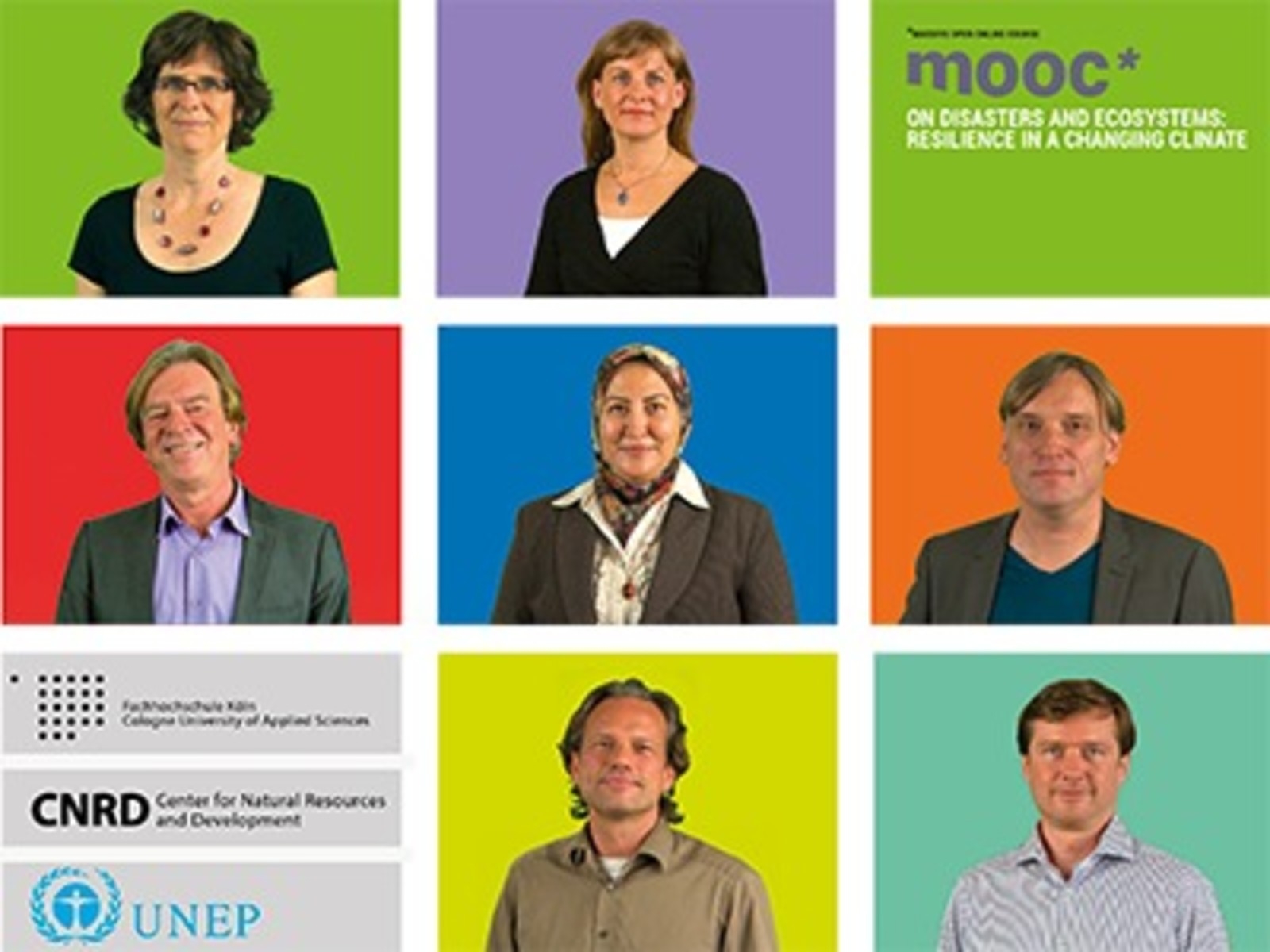
Instructors include international faculty members from Germany, Egypt, Austria and Switzerland, supported by a line-up of expert guest lecturers and exclusive interviews with world leaders in the field of climate change, disaster risk reduction and environment:
• Dr. Achim Steiner (Executive Director of UNEP)
• Ms. Margareta Wahlström (Special Representative of the Secretary-General of the United Nations for Disaster Risk Reduction)
• Dr. Rajendra Pachauri (Chancellor of TERI University)
• Ms. Julia Marton-Lefèvre (Director General of the International Union for the Conservation of Nature 2007-2015
Some FAQs
How much time do I need to put in taking the MOOC?
In total, we estimate that a total of 40-50 hours is needed to complete the MOOC (taking both the Leadership and Expert Tracks), which will also depend on your background and English fluency. The MOOC is roughly equivalent to a 1 –week in-class training course. This estimate is based on completing the video lectures, guest video lectures, reading materials and exercises.
Do I have to be online at specific times?
No. While new modules will be released sequentially on specific dates, you need not come online simultaneously. The lectures are not webcast real-time and you can choose the time you wish to watch them. However, there will be some deadlines for assignments and peer-to-peer reviews.
Will there be exams involved?
The Leadership track has quizzes so you can self-check your knowledge level as you go. This is, however, not a precondition for progressing to the next module. And you may, however, choose to revisit a module if you feel you did do not perform satisfactorily in a module. The Expert track has two short peer-reviewed assignments and one final peer-reviewed exercise where you will be designing your own project! The peer reviewed exercises will provide an environment for interaction between course participants. You are welcome to use any other communication tool to facilitate group assignments.
What are the interactive features in this MOOC?
Iversity has a community discussion forum that will be followed by course instructors and a roster of international “Experts of the week”. The Iversity platform offers all participants the chance to give feedback on the MOOC itself but also to start discussions on any topic related to the MOOC. During the enrolment stage of the MOOC, you will be asked to fill out some basic information about yourself and be invited to actively participate in the community discussion forum. You can also post notices on the MOOC “meeting point” or to join discussions that others have started. There will thus be ample opportunity to connect with other participants for information exchanges
In cooperation with the Global Universities Partnership on Environment and Sustainability

and the Center for Natural Resources and Development

Contributions by eye on earth

Supported by the Federal Ministry for Economic Cooperation and Development

exceed - Excellence Centers for Exchange and Development

and the DAAD - German Academic Exchange Service


Architecture 101:
Architecture to convert a place into a state of mind.
Apparently a simple task, actually a fairly tricky operation.
To (try to) understand, we split our journey into three parts.
This course is about part 1: from nothingness to place (part 2 is from place to space, part 3 is from space to architecture).
What is a place?
What is space?
How do we make space?
How do we prepare our mind to make space?
Without a concept, we can’t have a place.
Without a place, we can’t have space.
Without a space, we can’t have architecture...
If we want to create space, in the first instance, it has to happen in our mind. When a conceptual vision takes form in our minds, a place (with its own spatial features) is born.
Architecture 101 is an introduction to space and architecture through 101 exercises. A six-month journey divided into 3 courses “online” on iversity (part 1, part 2 and part 3), one final exhibition / graduation party. If you are still alive after all of this daunting process, there will be a one-week workshop “offline”, where we will go one step beyond.
In short:
Part 1: From Nothingness to Place (Jan 5 to Feb 28, we will work in 2d)
Part 2: From Place to Space (Mar 2 to Apr 25, we will work in 3d)
Part 3: From Space to Architecture (Apr 27 to Jun 20, we will work in scale 1 to 1)
Exhibition / Graduation at Abadir, in Sicily (Jun 19 to Jun 21, we set up our fancy exhibition)
Workshop: Architecture 101 Summer Camp at Abadir, in Sicily (Jun 22 to Jun 26, we build for real).
Architecture 101 (part 1: from nothingness to place)
To start our journey, we will deal with the absence of space and place.
Something that could be defined as “nothingness”.
As Ang Lee or Paul Valery would respectively say :
“The source of all the material comes from nothingness.”
“God made everything out of nothing, but the nothingness shows through.”
In a different way, Ludwig Wittgenstein taught us that when things have no name, they don’t exist. Hence in order to understand things, we have to start with worlds in which things have no name. Pieces of music without sound. Televisions without signal.
We will go through the process of shaping meaning. Articulate and complex meanings, defining relationships between mind and bodies, bodies and places. Little by little, we will encounter places and see the world taking shape.
All of this, using a “hands-on” system (you will by doing).
Course Structure
Week 1: taking pictures
Week 2: learning to sketch
Week 3: making collages
Week 4: observing the weather
Week 5: shaping diagrams
Week 6: drawing maps
Week 7: passing an exam
Week 8: taking a break
Learning Objectives
To see places like architects do.
To understand the principles upon which we convert a place into a state of mind.
We will explore nothingness, void and negative space.
We will learn to name things, we will learn how to invent place (as we wrote before, when things have no name, they cannot exist).
We will learn to stare, observe and see.
We will learn a significative amount of extremely interesting (and totally useless) things.
All of the above refers to the conceptual part of our course.
Then, since we love having our students making practical things, you will also learn lots of technical things using a number of interesting applications.
At the end, what do I make?
A booklet (with a given proportion, size, appearance) where you will collect all of your visual experiments. Each booklet devoted to a specific “place”. If one thousand people finish this part 1, we will have a fabulous collection of 1000 booklets.
Prior Knowledge
Important thing!
In terms of prior knowledge, nothing in particular is required.
However, in terms of technical equipment, this course will be easier to follow for those with access to a smartphone or tablet.
We shaped this course for a very specific kind of student.
Our imaginary student is a gent (or gentle lady) who accesses our content via his/her smartphone. Of course you can follow us via a desktop, make homework at home on your table. Yet, the way we intended the whole thing is for someone who takes the whole course (including doing homework) via a smartphone (or tablet).
Workload
Between 3 and 7 hours a week.
From Monday to Friday, for a total of 6 weeks, you will receive an email with a 15 second-video to watch (to get you in the mood), and a pdf with some instructions for completing an assignment and a series of references (to go deeper in the subject at hand).
Then, you will get to work on your assignment. Once you complete your assignment, you will upload it to the iversity platform and share it on your preferred social media account(s). Ideally Instagram.
Then, during the weekend, we will give you some time to catch up.
Are you ready?
:-)

Course Summary
In this third part of Vehicle Dynamics, we will illuminate the vertical dynamic aspects of vehicles. In short, we will describe the elements involved when a car drives on a bumpy or rough street.
We will start with a survey of suspensions and springs and dampers. After this, we will explain the description of rough streets and give an introduction to Fourier integrals. Next, we will take a closer look at vertical models. In the last fundamental part of the course, we will describe the conflict between driving safety and comfort. The course will be finished with two applications from automotive mechatronics.
What will I learn?
At the end of the course you will …
- know different kinds of suspensions, springs and dampers.
- know the description of rough and bumpy streets.
- understand the Fourier integral.
- understand the conflict between driving safety and comfort.
- be able to calculate simple properties of a car.
What do I have to know?
Some basic understanding of the following subjects will help you successfully participate in this course:
Algebra; Trigonometric Functions; Differential Calculus; Linear Algebra; Vectors; Coordinate Systems; Force, Torque, Equilibrium; Mass, Center of Gravity, Moment of Inertia; Method of Sections, Friction, Newton's Law, (Lagrange's Equation)
Course structure
This course has a total of 11 chapters, and the topics for each chapter are the following:
Chapter 1: Overview
Chapter 2: Damped Oscillator
Chapter 3: Fourier integral
Chapter 4: Conflict: Comfort vs. Safety I
Chapter 5: Conflict: Comfort vs. Safety II
Chapter 6: Ideal active system and skyhook damper principle
Chapter 7: Vibration absorber in powertrains
Chapter 8: Models and nonlinearities
Chapter 9: Homework solutions of chapter 1, 2 and 3
Chapter 10: Homework solutions of chapter 4, 5 and 6
Chapter 11: Homework solutions of chapter 7 and 8
Exam for the Certificate Track users: 17.07-31.07.2016 (exam period has been pushed forward)

You've learnt to develop Web sites and HTML5 apps. But what makes you a real Web professional? Complete your knowledge of quality assurance processes necessary to keep your Web apps running and maintainable.

How can architecture help people in times of urgent need caused by natural disasters? In this course, we will design resilient schools that could serve as community centers and shelters for the victims of the devastating typhoon Haiyan in the Philippines.

Learn how to design and develop a mobile Web app. What about realising a real-time multi-player game? We show you the way to get your idea to the app store.

Do you want to know what Gamification really is about? Do you want to learn how to design fun and engaging experiences? Are you ready to change your world with game design? Then join us in this MOOC!

This is a hands-on four chapter course to learn how to better understand and act when faced with complex situations. By the end of the course students will be able to take a story from the news, describe what makes the situation complex and identify opportunities for effective action or change. We will draw on systems theory and complexity theory for our teachings and learn to use proven data collection and modelling techniques from systems thinking and system dynamics.
Who is this course for?
The course is designed for practicing managers, social entrepreneurs, students of business and other social sciences. It is useful to anyone looking for a clear way to understand the complexities of today's world.
What do I need to know?
No prior knowledge is required.
What will I learn in this course?
By the end of the course, you will have acquired the ten skills of a systems thinker. You will know how to identify the variables in interaction in a complex situation, describe and model the systemic structure that explains complex behaviours, anticipate how a situation may change over time and find leverage points to influence outcomes.
Course structure
Chapter 1: Introducing complexity
We will define complexity and explore how complex situations require changes to the way we apprehend the world.
Chapter 2: Thinking in systems
We will describe and model how different factors, such as people, ideas or things interact over time and generate the complexity in a specific problem situation.
Chapter 3: Mapping the dynamics of complexity
We will learn the role of accumulations and nonlinearities in complex systems and observe how they contribute to both the changes over time and the unexpected and often frustrating behaviours we observe. We will learn to use free online software to simulate complex situations.
Chapter 4: Living with complexity
We will learn a number of tools and techniques that will accelerate our understanding of real world situations and help us to act with impact when faced with complexity. We will also consider the implications of complexity for management, social change and sustainability.

Kursbeschreibung
In der Veranstaltung "Einführung in das Rechnungswesen" erlernst du die kaufmännische Sprache des Unternehmens. Damit kannst du Finanzberichte lesen, verstehen und interpretieren. Du kannst Entscheidungen kostenrechnerisch vorbereiten, Produkte bewerten und Kostenabweichungen analysieren. Damit kannst du unternehmerisch sowohl in die Vergangenheit als auch in die Zukunft schauen. Der Inhalt der Vorlesung umfasst den kompletten Stoff einer umfassenden Einführung in das Rechnungswesen (internes und externes Rechnungswesen), wie er an vielen Universitäten und Hochschulen in Deutschland gelehrt wird.
Planspiel
Als besonderes Feature gibt es zu der Veranstaltung das Rechnungswesen-MOOC Planspiel der Firma Simucate. Das Planspiel bietet eine interaktive Möglichkeit, die Studieninhalte gleich praktisch anzuwenden und so besser zu verstehen. Das Planspiel ist in allen Klausurpaketen enthalten. Alternativ kann es im Audit Track während des Kurses für 19 Euro hinzu gebucht werden.
Was lerne ich in diesem Kurs
Nach erfolgreichem Kursabschluss beherrschst du die Grundlagen des betriebswirtschaftlichen Rechnungswesens als kaufmännische Sprache von Unternehmen. Du kennst dich in Grundfragen der Buchführung ebenso aus wie auf dem Gebiet des internen Rechnungswesens. Du kannst Finanzberichte aufstellen, die doppelte Buchführung durchführen und Kosten mithilfe des internen Rechnungswesens dokumentierten, planen und überwachen. Damit bist du in der Lage, Entscheidungen wirtschaftlich fundiert zu analysieren.
Welche Vorkenntnisse benötige ich?
Die Teilnahme ist ohne spezielle Vorkenntnisse möglich.
Kursstruktur
Der Kurs besteht aus 7 Module von jeweils 2 Wochen:
Modul 1: Einführung und Abbildung von Eigenkapitalveränderungen
Modul 2: Doppelte Buchführung und Verbuchung von Geschäftsvorfällen
Modul 3: Buchungen am Ende des Abrechnungszeitraums und Abschlussarbeiten
Modul 4: Einführung in das interne Rechnungswesen
Modul 5: Kostenträgerrechnung
Modul 6: Kostenstellen- und Kostenartenrechnung
Modul 7: Unternehmenssteuerung, Planungsrechnungen und Kostenabweichungen
Kombi-Paket
Besuche diesen Kurs in Verbindung mit dem RWTH-MOOC "Einführung in die Betriebswirtschaftslehre" von Prof. Frank Piller. Gemeinsam bieten beide Kurse eine ausgezeichnete Einführung in die BWL und übermitteln dir das notwendige Handlungswissen und Vokabular, um im Studium oder Beruf mitreden zu können. Als besonderes Highlight bieten wir hierfür Kombinationspakete im Schüler-Track und ECTS-Track an, mit denen du Zertifikate für beide Kurse zu einem vergünstigten Preis inkl. des Planspiels erhältst.

Whether you are a student, a designer or an entrepreneur, join this course and develop your creativity methods and innovation attitude while exploring the human-centred design-approach.

Успешное и эффективное ведение сельского хозяйства требует хорошего менеджмента. Для того, чтобы уметь экономически правильно принимать решения, инженеры-агрономы и фермеры должны обладать отличительными знаниями. На DE и RU языках.

Interaktiver MOOC mit spannenden anatomischen und medizinischen Videos der Universität Tübingen. Anatomen und Kliniker erklären die Anatomie der Kopf- und Hals-Region im klinischen und chirurgisch-operativen Kontext.

Methodisch ausgefeilter Doppel-MOOC mit Geometrie und Arithmetik. Du möchtest mathematisch denken lernen? Sei Kiebitz, Anpacker oder Formalisierer: Du hast die Wahl!

Dieser Kurs vermittelt die Grundzüge des Marketings und gibt einen Überblick von Konzepten, Strategien und Werkzeugen. Im Zentrum des Kurses stehen vier Themenbereiche: Produkt-, Kommunikations-, Preis- und Distributionspolitik.
Add to calendar

Trusted paper writing service WriteMyPaper.Today will write the papers of any difficulty.